


QuickBooks Online in Australia has no automatic late fee feature: the Late fees setting exists in the US product only. An Australian business adds a late fee by hand as a line item on the overdue invoice, or connects Paidnice, which applies late fees and interest to overdue QuickBooks invoices automatically and posts them to the ledger.
No. QuickBooks Online Australia has no late fee setting. Intuit's "Turn on automatic late fees" option, under Settings, Account and settings, Sales, is in the US edition of QuickBooks Online only. QuickBooks Online in Canada and the United Kingdom has no late fee setting either.
Even in the US the native fee is silent: it is added as a line and never emailed. An Australian business has two routes: add the fee by hand, or connect an app that raises it on the ledger for you.
| Option | How the fee is applied | Per customer group | Customer told |
|---|---|---|---|
| QuickBooks Online US (native) | Flat or percentage fee added as a line item after a grace period | No, one rule | No, the fee is silent |
| QuickBooks Online Australia (manual) | You add a late fee line to the overdue invoice or raise a separate invoice | By hand | Only when you send the invoice |
| Paidnice on QuickBooks Online Australia | Interest or a flat fee raised automatically on the ledger | Yes, different policies per group | Yes, by email and SMS with the invoice |
A late fee is added to a QuickBooks Online Australia invoice as a product or service line, because there is no fee setting to switch on. The fee sits on the invoice like any other charge and appears in the customer's balance.
The manual route holds for a handful of invoices a month and breaks when a customer part-pays or is late every month.
An Australian business can charge a late fee or interest on an overdue invoice only if the fee was in the agreed terms before the invoice was issued, and only if the amount is proportionate to the cost of the late payment. Australia has no statutory rate for business-to-business late payment interest.
The test is the penalty doctrine. In Paciocco v ANZ [2016] HCA 28 the High Court upheld ANZ's $20 and $35 late payment fees, holding a fee is a penalty only if it is out of all proportion to the legitimate interests of the party charging it, which include operating costs and the cost of carrying the debt. A fee that reflects your real cost of chasing and financing the late invoice holds up; a fee set to punish does not.
Standard practice is 1% to 1.5% a month, or a flat $30 to $50 administrative fee on smaller invoices. On a $5,000 invoice, 1.5% a month is $75 a month. If the customer still does not pay, a claim of up to $20,000 can be filed in the Small Claims Division of the NSW Local Court, and the other states run equivalent lists. The Australia late fee guide has a calculator and the wording for your terms.
Paidnice is accounts receivable automation for QuickBooks Online that raises late fees and interest on overdue invoices automatically, to the rules in your terms, and posts each fee to the QuickBooks ledger as a Draft or Approved invoice.
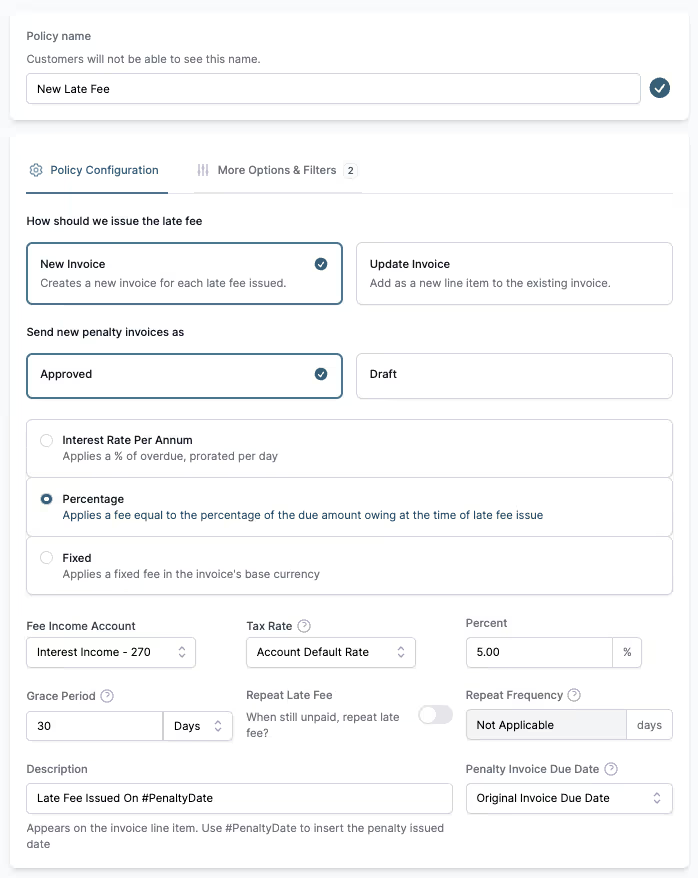
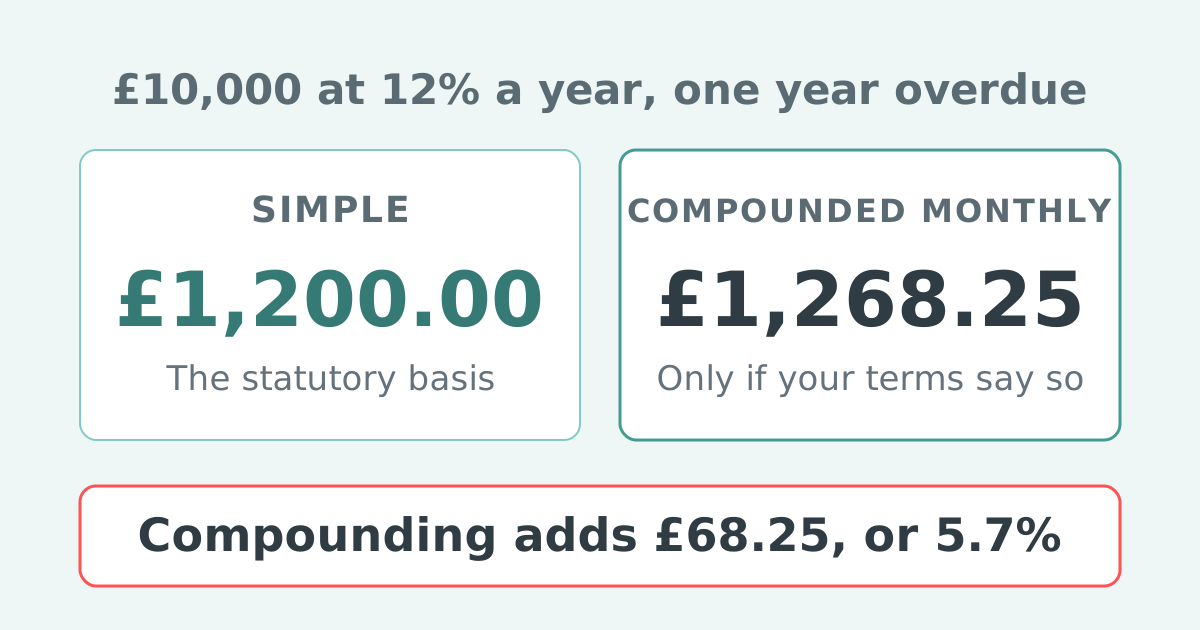
A policy runs as a flat fee per overdue invoice, a percentage, or an interest rate per annum prorated daily, with a grace period before it applies. Policies live under customer groups, so key accounts can have a 30-day grace period while everyone else has 7. Interest compounds by default, with a toggle for simple interest, and a fee can be waived or credited inside Paidnice.
Only a fee on the ledger is a receivable, has a GST treatment and enters the customer's aged payables and payment run. The fee is a lever: paired with email and SMS reminders, automatic statements and escalation workflows, a customer who reads "a late fee of $75 will be charged in 7 days" pays before it is raised.
Connecting Paidnice to QuickBooks Online Australia takes three steps, and Paidnice picks up invoices that were already open at connection, not only new ones.
1. Sign up and connect QuickBooks. Signing up is free, needs no credit card, and the first 20 actions are free with no time limit.
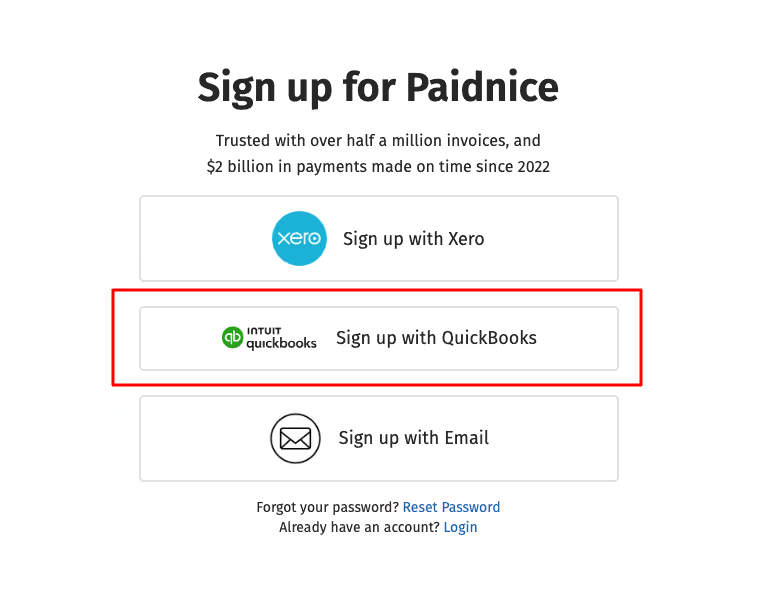
Connect QuickBooks Australia to Paidnice with a single click.

2. Set the late fee policy. Choose the fee type (percentage, flat fee, or both) and the grace period, for example 7 days after the due date.
3. Add reminders and escalation. Set payment reminders (for example 3 days before due, on the due date, 7 days after) that name the coming fee, monthly statements, and escalation steps for invoices that stay overdue.
Better Tuition Academy (BTA), an Australian tutoring business with about 700 students and 120 staff, moved late fees and reminders onto Paidnice after Victor, its Chief Marketing Officer and Accounts Manager, was spending two to three hours a week chasing payments by hand. Every late payer now gets a text, an email and a statement at the 10-day mark, the fee follows, and the chasing time is back in the business.
"It's so much easier now. Before, it was manual chase-ups. If you got 30 or 40 people that are late, each one of them gets a text message, each one of them gets an email, each one of them gets a statement. Now it automatically goes out at that 10-day mark. They're late, they know about it, and no one argues about it anymore. It's just easy."
Victor, BTA's Chief Marketing Officer and Accounts Manager.
Can I charge a late fee if my terms do not mention one? No. In Australia a late fee is only recoverable when the customer agreed to it before the invoice was issued. Add the fee, and the rate, to your terms of trade first.
Does QuickBooks Australia tell the customer about a late fee? No. QuickBooks Online Australia has no fee to send. Paidnice emails the fee invoice and can name the coming fee in a reminder before it is raised.
Start using Paidnice today to apply late fees in QuickBooks Australia, or book a demo.
Paidnice is accounts receivable automation that enforces your payment terms, trusted by thousands of businesses on Xero and QuickBooks. Credit control and debtor management, run for you.
Try it Now - It's FreeNo card required.
Optimize your cash flow with our suite of financial tools designed for AR professionals. Calculate DSO, aging analysis, late fees, and more.