Summary
To collect a business debt in Australia, send reminders and a statement, phone, then issue a letter of demand with a fixed deadline. If it stays unpaid, choose a licensed collection agency, a small claims court or tribunal (limits from $10,000 in WA to $100,000 in Victoria), or, for a company debtor, a statutory demand for $4,000 or more.
- The conduct rules: ASIC Regulatory Guide 96, issued 13 April 2021, applies to creditors collecting in-house and sets a limit of three contacts a week or ten a month, between 7.30am and 9pm on weekdays.
- The statutory demand: Regulation 5.4.01AAA of the Corporations Regulations sets the statutory minimum at $4,000 and gives the company 21 days to pay or apply to set the demand aside.
- The small claims door: NSW Local Court Small Claims hears debts up to $20,000, QCAT up to $25,000, and ACAT and NTCAT up to $25,000; every figure is on the court or tribunal site.
- The pre-legal work: Paidnice runs the reminders, statements, late fees and the escalation to a phone call, stop credit or template legal letter from your Xero or QuickBooks ledger.
What is the debt collection process for a business debt in Australia?
The debt collection process for a business debt in Australia runs in five steps: payment reminders, a statement and a phone call, a letter of demand, then a collection agency or a small claims court or tribunal, and for a company debtor a statutory demand. The Australian Small Business and Family Enterprise Ombudsman (ASBFEO) publishes the same order.
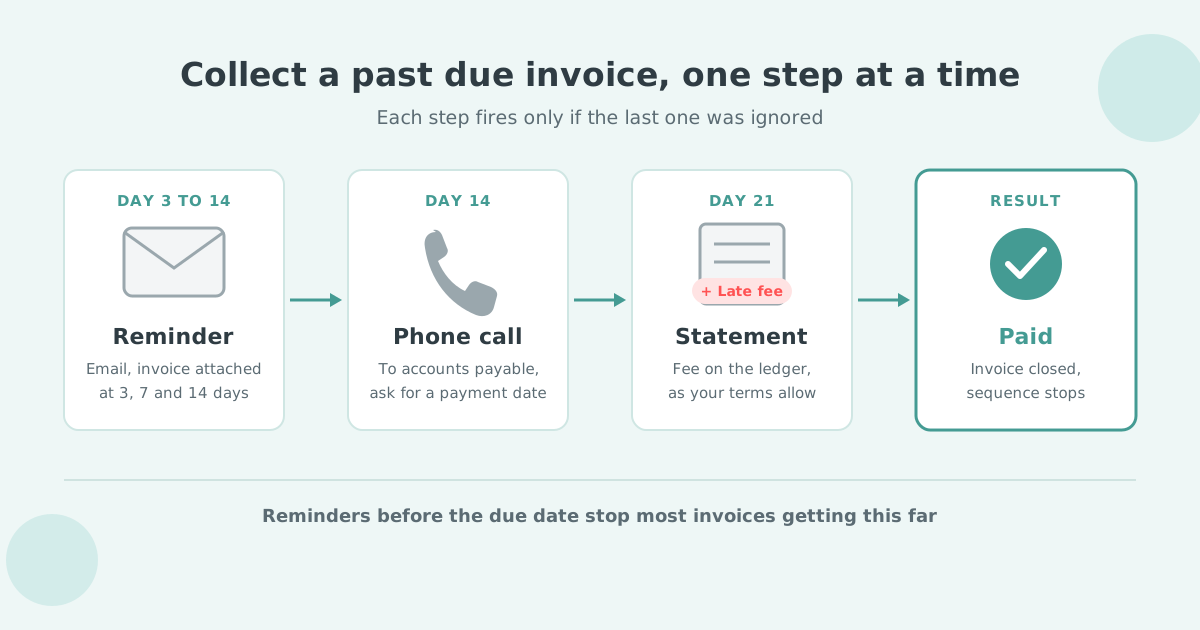
- Reminders before the due date, on it and at 7 days overdue, each naming the invoice, the amount and how to pay.
- Statement and phone call at 14 days overdue, to find out whether the invoice is lost, queried or waiting on a payment run.
- Letter of demand at 21 to 30 days overdue, with a payment date 7 to 14 days out and the next step named.
- Agency, court or tribunal once the demand expires.
- Statutory demand under section 459E of the Corporations Act, for a company debtor owing $4,000 or more.
Xero Small Business Insights measures how long Australian small businesses wait to be paid; every step above counts from that due date.
Source: Xero Small Business Insights, June 2026. See the full data on the Paidnice accounts receivable statistics dashboard.
The full escalation ladder, with the day counts for each rung, is in what to do when a customer ignores invoice reminders.
What rules apply when you collect a debt from another business?
The conduct rules for collecting a debt in Australia are the joint ACCC and ASIC Debt Collection Guideline, ASIC Regulatory Guide 96, issued 13 April 2021. The guideline names creditors collecting their own debts among the collectors it covers, so it binds your accounts team as well as any agency you hire.
RG 96 sets four practical limits. Contact the debtor no more than three times a week, or ten times a month, counting only contact that is made. Phone between 7.30am and 9pm on weekdays and 9am and 9pm on weekends, never on public holidays. Contact only when there is a reason, such as a new demand or a missed promise. Do not mislead the debtor about the debt, the consequences of not paying or your legal position.
Behind the guideline sits the Australian Consumer Law, Schedule 2 of the Competition and Consumer Act 2010, whose bans on harassment, coercion and misleading conduct cover the collection of any payment for goods or services, whether the debtor is a company or a sole trader.
How do you write a letter of demand for an unpaid invoice?
A letter of demand for an unpaid invoice states the invoice numbers, dates and amounts, any late fee or interest your terms allow, a payment deadline of 7 to 14 days, the payment methods, and the next step if the deadline passes. It is sent by email and by post to the registered office of a company, and a copy is kept as evidence for a claim.
The Paidnice letter of demand template covers the Australian wording. Interest and late fees on an Australian business debt are contractual, so they hold only where the customer agreed to them before the invoice was issued; the detail is in late fees in Australia.
Which court or tribunal hears a small business debt claim in each state?
Every Australian state and territory has a small claims court or tribunal for a business debt, with a limit that runs from $10,000 for a minor case in Western Australia to $100,000 in the Magistrates' Court of Victoria. Below the limit the process is informal, fees are lower, and in several jurisdictions lawyers are not allowed at the hearing without leave.
| State or territory | Court or tribunal | Limit for the small claims track | Source |
|---|---|---|---|
| New South Wales | Local Court, Small Claims Division | $20,000 (General Division to $100,000) | Local Court NSW |
| Victoria | Magistrates' Court | $100,000, with defended claims under $10,000 sent to arbitration | Magistrates' Court of Victoria |
| Queensland | QCAT, minor debt dispute | $25,000 | QCAT |
| Western Australia | Magistrates Court, minor case | $10,000 (general civil to $75,000) | Magistrates Court of WA |
| South Australia | Magistrates Court, minor civil action | $12,000 | Courts SA |
| Tasmania | Magistrates Court, minor civil claim | $15,000 | Magistrates Court of Tasmania |
| Australian Capital Territory | ACAT, civil dispute | $25,000 | ACAT |
| Northern Territory | NTCAT, small claim | $25,000 | NT Government |
In the NSW Small Claims Division the rules of evidence do not apply and witnesses are not usually called, so the claim is decided on the documents: the invoice, the terms, the delivery record and the letter of demand. In South Australia a lawyer cannot represent you at a minor civil trial for $12,000 or less except in limited cases. Above the small claims limit the same court's general division applies the rules of evidence, and costs rise.
When should you use a debt collection agency?
Use a debt collection agency when the letter of demand has expired, the debt is not disputed, and the amount justifies a commission on recovery rather than a court filing fee. The agency adds a third party's letterhead and calls, and can lodge the claim for you.
Licensing is a state matter. In New South Wales a collector must hold a licence under the Commercial Agents and Private Inquiry Agents Act 2004. Queensland licenses collectors under the Debt Collectors (Field Agents and Collection Agents) Act 2014, and Western Australia under the Debt Collectors Licensing Act 1964. Ask for the licence number in the state where the debtor trades. Two more checks: a recovery-costs clause in your terms is the only basis for adding the commission to the debt, and a breach of RG 96 by your agent is a breach on your account.
What is a statutory demand under the Corporations Act?
A statutory demand is a formal notice under section 459E of the Corporations Act 2001 that a creditor serves on a company for a debt of $4,000 or more that is due and not disputed. The company has 21 days to pay, secure the debt or apply to a court to set the demand aside. If it does none of those, it is presumed insolvent and the creditor can apply to wind it up.
The $4,000 statutory minimum and the 21-day statutory period are set by regulation 5.4.01AAA of the Corporations Regulations 2001. The minimum was $2,000 until the Corporations Amendment (Statutory Minimum) Regulations 2021 doubled it for demands served from 1 July 2021. A demand for less than $4,000, or for a debt the company genuinely disputes, will be set aside and the court can order costs against you.
A statutory demand only works against a company. A sole trader or partnership is pursued through the small claims track above or through bankruptcy proceedings. Because a defective demand is expensive, most businesses have a lawyer prepare the Form 509H and the supporting affidavit.
How does Paidnice automate the steps before legal action?
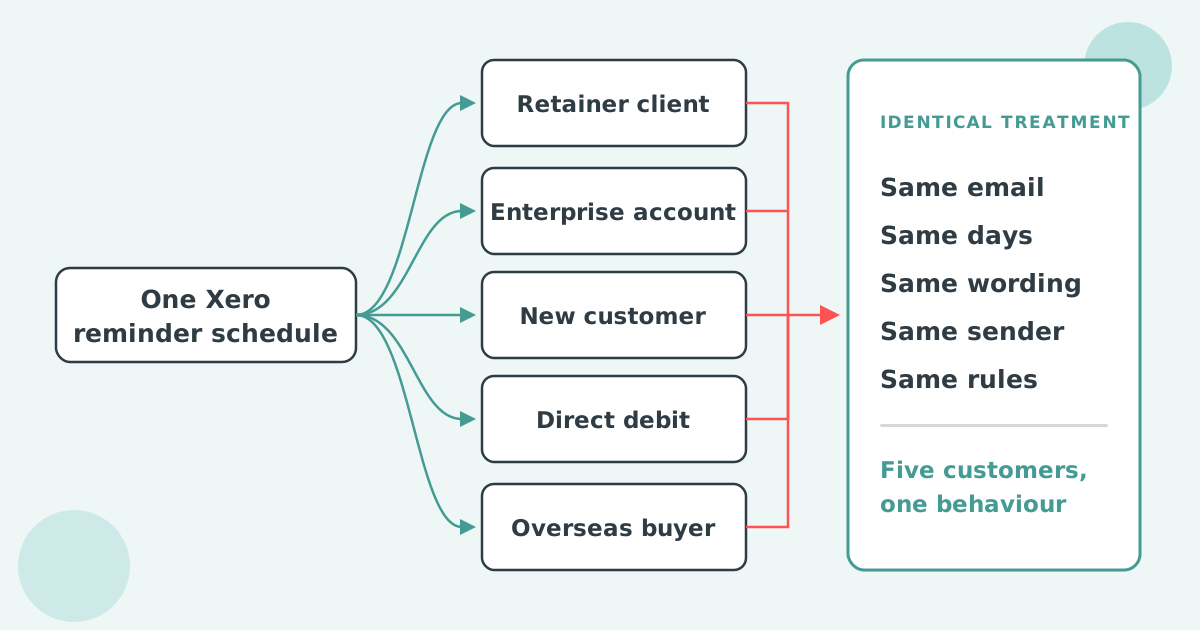
Paidnice runs the first three steps, reminders, statements and the demand-stage escalation, from the invoices already in Xero or QuickBooks Online, so a business only picks up the court form once the automated steps are exhausted. The schedule and wording are set once per customer group and applied to every overdue invoice.
- Reminders by email and SMS on the days you set, with a grace period before the first one fires, and a merge tag that states the late fee to come: "If not paid within N days, a late penalty of $XX.XX will be charged."
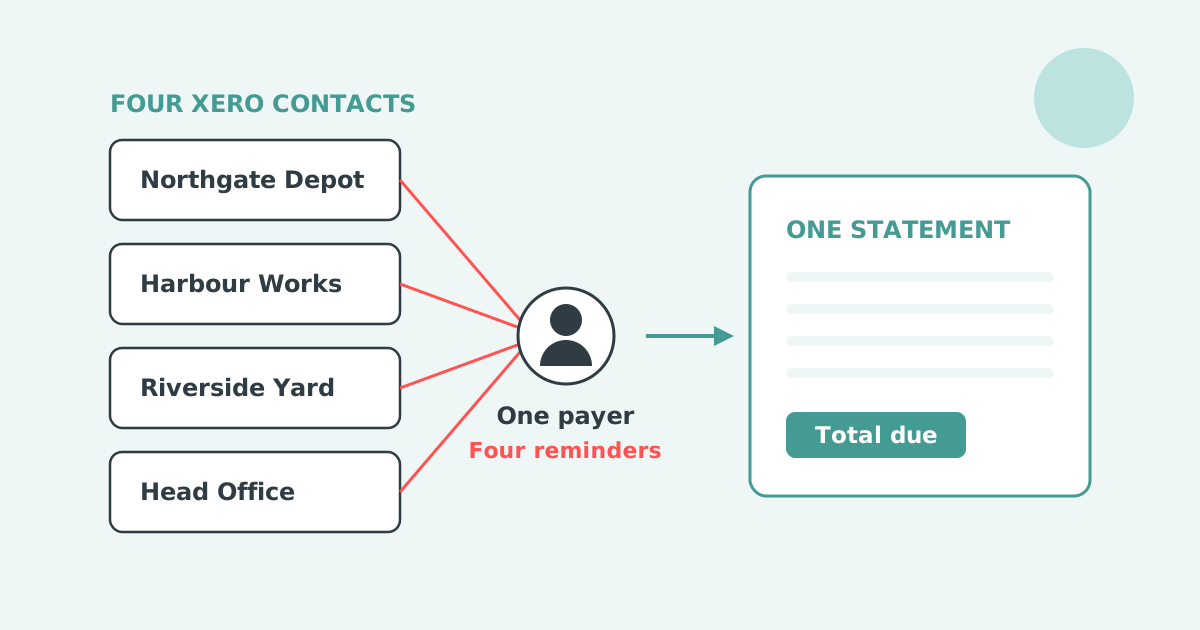
- Automatic statements of open items, consolidated for a parent customer with several entities.
- Late fees and interest on the ledger, raised as an invoice in Xero or QuickBooks under the terms the customer agreed to, so the fee is a receivable and evidence for the demand.
- Escalations at a set number of days overdue, on a total balance or on a credit-limit breach: a phone call task, a stop-credit flag or a template legal letter, assigned to a named person, with call outcomes synced to the invoice in Xero.
- An expected payment date that pauses the sequence while a promised payment run comes through, and payment plans that split an invoice into instalments, with a missed instalment treated as overdue again.
Paidnice is not a debt collector and does not lodge claims. It records every reminder, statement, fee and escalation, so the file you hand to an agency or a tribunal shows each contact and its date. Signing up is free with no card, and the first 20 actions are free.
Frequently asked questions
Do you need a lawyer for a small claims debt?
No. The small claims tracks are built for self-represented parties, and in South Australia a lawyer cannot appear at a minor civil trial without leave. A claim above the limit, or a statutory demand, is where a lawyer earns the fee.
Can a sole trader be served with a statutory demand?
No. Section 459E applies to a company. A sole trader or a partnership is pursued through the small claims court or tribunal, or through bankruptcy proceedings, which have a separate threshold and process.
Sign up for Paidnice and let the reminders, statements and escalations run before you reach for the court form.

Stop chasing invoices.
Start getting paid.
Paidnice is accounts receivable automation that enforces your payment terms, trusted by thousands of businesses on Xero and QuickBooks. Credit control and debtor management, run for you.
Try it Now - It's FreeNo card required.