

Summary
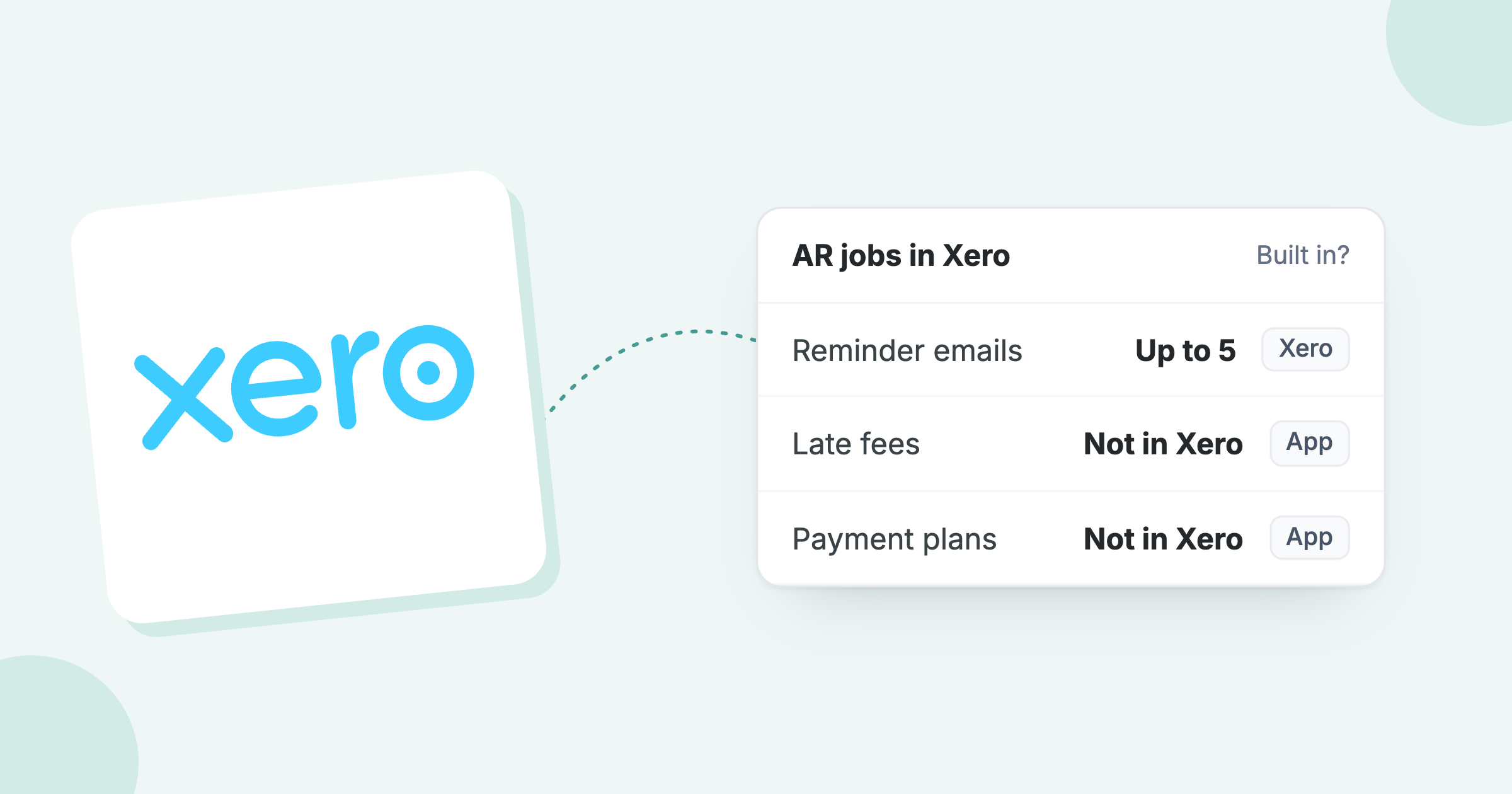
Xero has no native setting to apply early payment discounts automatically. A discount has to be added manually as a negative line item on each invoice, tracked, and removed before it expires, or handled by a connected app such as Paidnice.
- Xero alone: Without an app, the discount is a manual negative line item you add and remove yourself, with no expiry tracking.
- The fix: Paidnice applies a fixed or percentage discount automatically and removes the line when the discount period ends, returning the invoice to its original total.
- The rule: Two settings control it separately: how recent an invoice can be to qualify (default 2 days from issue), and when the discount is removed (anchored to issue or due date).
Why offer an early payment discount on a Xero invoice?
An early payment discount gives a customer a reason to pay days or weeks before the invoice's normal due date, in exchange for a small percentage or fixed amount off the total. For the definition and the 2/10 net 30 shorthand, see early payment discounts explained. On a Xero invoice the discount does four jobs:
- Cash arrives sooner: a 2% to 5% discount moves payment from the due date to inside the discount window.
- Less chasing: an invoice paid inside the window never needs a reminder or a statement.
- Fewer awkward conversations: the offer is on the invoice, so nobody has to negotiate it by phone.
- Steadier forecasting: customers who take the discount pay on a predictable day.
The distance between the two is what the discount has to close.
Before you pay for speed with a discount, try shorter terms. The same customer pays a 14-day invoice about 9 days sooner than a 30-day invoice, and no more invoices go unpaid.
Does Xero apply early payment discounts automatically?
No. Xero has no rule engine for prompt payment discounts, so every discount has to be entered as a negative line item manually, tracked against its expiry date, and removed manually if the customer misses the window. Without an app, that means:
- Calculating and adding the discount line to each invoice.
- Remembering which invoices carry a discount and when each one expires.
- Removing expired discounts and re-sending the invoice at the full amount.
- Emailing customers separately to tell them the offer exists.
How to set up automatic early payment discounts with Paidnice
Paidnice connects to a Xero organisation and applies a prompt payment discount policy automatically, from account connection to setting invoice exclusions, in five steps.
Step 1: Connect your Xero organisation
After signing up for Paidnice (free, no card needed), connect your Xero organisation through the OAuth integration. This takes under a minute and lets Paidnice sync your invoices.
Step 2: Create your discount policy
In Paidnice, open Groups, pick the group of customers, and click Add Discount Policy under Discounts. The policy applies to every customer in that group.
Step 3: Configure your discount settings
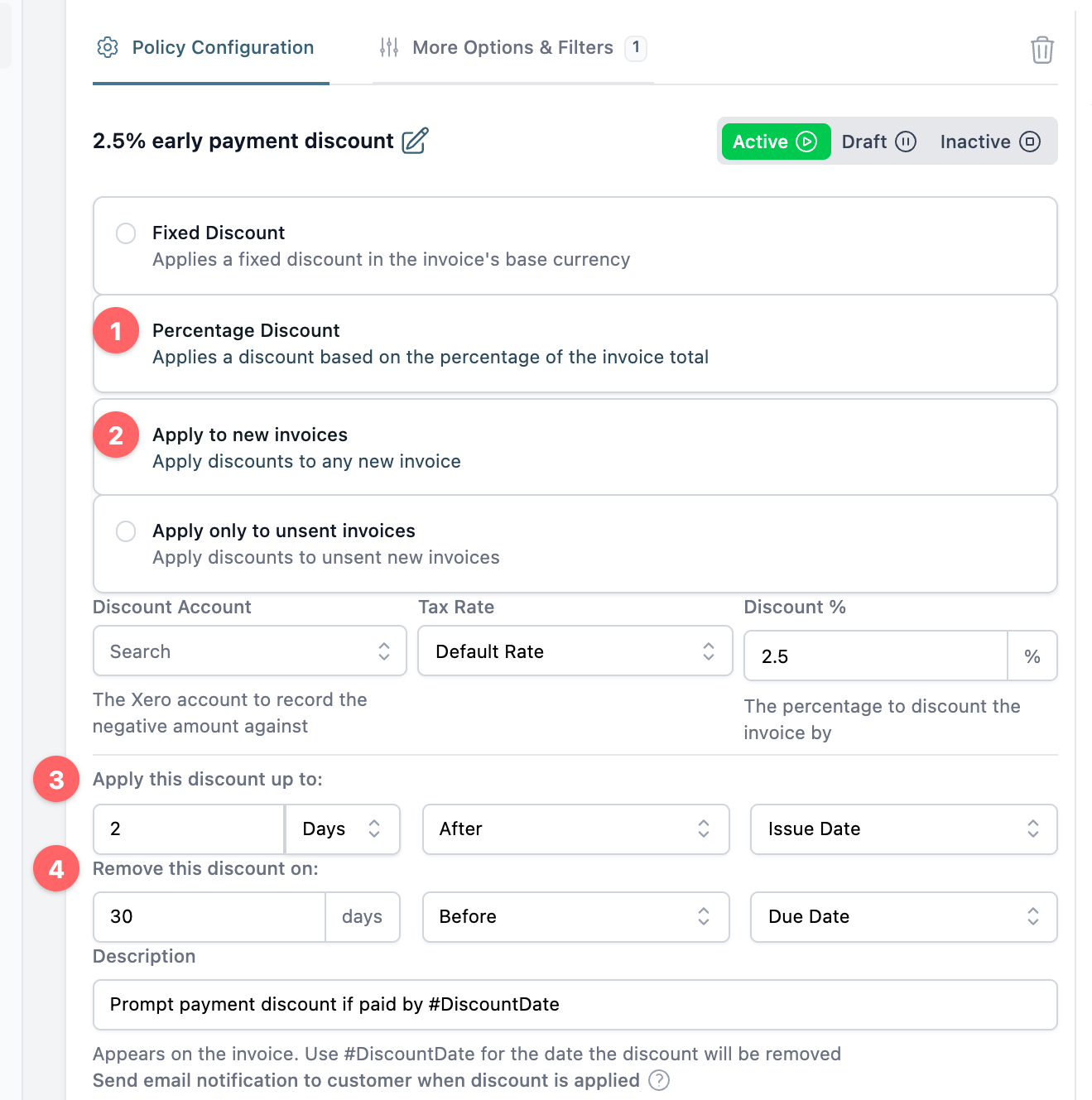
The policy has five settings. The qualifying window and the removal date are two separate rules, not one duration.
| Setting | What it controls | Options |
|---|---|---|
| Discount type | How the discount is calculated | Fixed amount (e.g. $10) or percentage (e.g. 5%) |
| Scope | Which invoices get it | All new invoices, or only invoices not yet sent from Xero |
| Qualifying window | How recent an invoice must be | Anchored to the issue date, default 2 days |
| Removal date | When the discount comes off | Anchored to the issue date or the due date |
| Account and tax rate | Where the discount posts | Its own account and tax rate; editable line description that can carry the expiry date |
Different customer groups can run different discount policies, since each group in Paidnice holds its own policies. Chosen line items can be excluded, so revenue such as disbursements is never discounted.
On the policy screen: (1) the discount type, (2) which invoices get it, (3) the qualifying window, and (4) when the discount comes off.
Step 4: Customise the customer notification
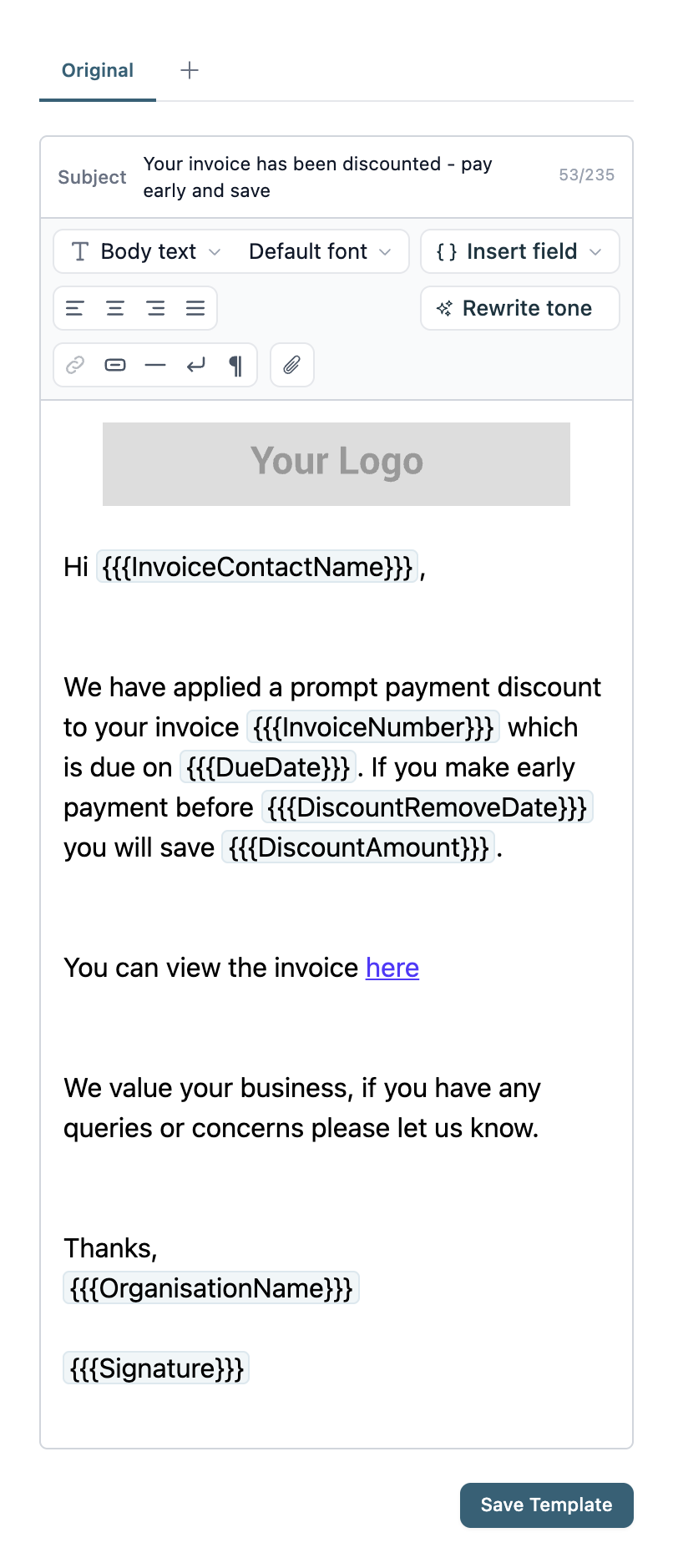
A notification email can be sent when the discount is applied. It is off by default and carries the discount amount, the expiry date, and a pay link at the discounted total.
- Edit the email template to match your brand voice.
- Send from your own domain on the Pro plan and above.
- Customers pay the discounted total from the link via Stripe or Pinch; any processor connected to Xero also works, since Paidnice reads the payment from the ledger.
Step 5: Set exclusions (if needed)
Not every invoice should carry a discount. Paidnice lets you:
- Exclude specific line items or services.
- Set minimum invoice amounts.
- Create different discount policies for different customer groups.
A new policy applies to new invoices only; one older invoice can be processed manually. Editing an invoice after a discount applies does not recalculate it. Rankrise, one Paidnice customer, put it this way: "Since we started using Paidnice only a short time ago, we have seen a drastic improvement in how much quicker our clients are paying our invoices." Across the customer base, businesses see half as many late invoices in the first 30 days.
Does the discount remove itself automatically?
Yes. When a Paidnice discount policy expires, the discount line item comes off the Xero invoice and the invoice returns to its original total, so nobody accidentally honours a discount that has already ended. The removal is logged as a completed action against the invoice in Paidnice, and any reminder or statement sent after that date shows the full amount due.
What is a good early payment discount rate to start with?
A conservative discount of 2% to 3% is the safest starting point for a Xero organisation testing customer response, before widening the policy across more invoices. Five rules keep the policy paying for itself:
- Start conservative: begin at 2% to 3% and watch uptake before raising it.
- Communicate clearly: put the discount and its expiry date on the invoice line and in the email.
- Be consistent: apply the same policy across a customer group, so no customer feels singled out.
- Monitor performance: use the Paidnice analytics to track discount uptake and adjust the rate.
- Check the margin: a 2% discount for payment 20 days early costs the same as borrowing at roughly 36% a year, so the rate has to be worth the faster cash.
Ready to run it on your own invoices? Try Paidnice free, no card needed.
Frequently Asked Questions
Can I offer different discount rates to different customers in Xero?
Yes. Paidnice policies live under customer groups, so one group can run a 5% discount while another runs 2%. A customer sits in one group at a time, and tags handle exceptions inside a group.
What happens if a customer pays after the discount expires?
The discount line has already come off the invoice on the removal date, so the invoice in Xero shows the full amount and that is what the customer owes. Nothing is refunded and no discount is honoured late.
How do early payment discounts appear on my Xero invoices?
The discount appears as a negative line item on the invoice, posted to its own account with its own tax rate, with an editable description such as "Prompt payment discount, 5% if paid by [date]". The invoice total reflects the discounted amount.
Can I exclude certain products or services from early payment discounts?
Yes. Paidnice lets you exclude specific line items, so a business can discount services while leaving products with thin margins at full price.
Do I need to manually approve each discounted invoice?
No. Once the policy is set up, Paidnice applies the discount to eligible invoices automatically. Safe Mode holds automatic sends so you can preview actions before they go out, and a policy can also run in Manual mode where each action waits as pending.
How do customers know about the early payment discount?
Paidnice can send an email when the discount is applied, stating the amount, the expiry date, and a pay link at the discounted total. The email is off by default, and the template is editable.
What is the typical return from early payment discounts?
Results vary by industry and by the rate offered. Across the Paidnice customer base, businesses see half as many late invoices in the first 30 days. The cost of the discount is set against the financing cost and the chasing time it replaces.
Can I track which customers take advantage of early payment discounts?
Yes. Paidnice analytics show discount uptake, customer payment patterns, and each customer's credit score from 0 to 100, so the rate can be tuned over time.
How do you record an early payment discount in accounting?
An early payment discount is recorded as a sales discount, a contra-revenue line that reduces total sales rather than being logged as an expense: the invoice is raised at full value, the discount amount is deducted when the discounted payment arrives, and no adjustment is needed if the customer pays after the window and settles the full amount. For the double-entry steps and a copyable terms template, see early payment discount terms and conditions.
Read the transcript: How to Apply Early Payment Discounts Automatically in Xero
Hi there. In this video, I'm going to show you how to set up an early payment discount or a prompt payment discount inside of Paidnice. Now, Xero and QuickBooks don't let you automatically do this.
So, you're going to have to use an app like Paidnice to be able to do this for you. Now, early repayment discounts or prompt payment discounts are a great way of encouraging payment early. And so I'm going to show you how you can easily set one up inside of Paidnice and then have that automatically be applied to your invoices or maybe only to some of your invoices every every week or every month or however you want or whatever you issued invoices to happen.
So now once you've connected your your accounting system into Paidnice you're going to be presented with this default group here. Ignore the other ones these are ones from previous videos. But this one here we have I've already set one up here.
Now, if you want to set up a new policy, so essentially a new automation that's going to be able to send this discount and automate this discount on your invoices, you're going to click add new automation policy. You're going to click the one that says prompt payment discount. And then it'll create a prompt payment discount policy just like I've got here.
Now, inside of this prompt payment discount, we can automatically create the discount by doing things like either doing a fixed discount. So either a essentially like a $10 or £10 discount across no matter what the invoice value is. We can set it as a percentage.
So I've I've done it as a percentage and it's going to be 5%. You can have this apply to just new invoices in your system. Or you can have it apply to all unsent invoices that is already sitting in your system that you haven't sent yet.
You can then set up what the how long the discount will last for. This one I've I've set it to basically apply the discount for just 7 days after the issue date. But you can customize this to however you want.
You could do this across weekdays. You could also do things maybe applied on the on the, you know, have it only only last for a day. You could also have it be applied against the due date versus the issue date.
So an example here is let's say you only want it once you issue the invoice cuz that might be that might be variable about when that happens and you might want to have that discount only last 7 days from the issue date which is typically what you would mostly do. But you could also have it be removed say 14 days before the due date or something like this. So you can kind of you can get very granular around how you apply the particular discount, but in this one we're just going to set the period of of of 7 days there.
Now you can create set up a chart of account of where to align that to and how to do the discount for and we're all good there. Ignore in terms of the ignore this one, leave this one at 0 days. But you can also use this as another filter of when to how long you want the discount period to last for.
But in this case, we're just going to assign it against the due date or the issue date. With this one the issued it. Now the other thing here is you can update the line item that will go on the invoice.
So what what what this does is it will it will drop a line item on your existing invoice and it will add the discount there and it will obviously have as a negative amount against the total and so it'll be a negative amount against everything that's on it and then the net will be negative the or minus the minus the discount or net the discount. Now, when you send the invoice to the client, you actually want to you actually want to approve it inside of your accounting system. You don't want to approve and send.
You just want to approve it. I mean, you can still send it as the full amount, but you you kind of want the invoice to be received with the discount. And so, Paidnice needs to pick it up first and then send it.
So, this one here where it says send email notification to the customer when it is applied, then that's what you want to do. You want to basically go down, yes, tick to that little box there, and then do that. Obviously, if you don't want to do that, that's fine.
But like this is I'll show you how that sort of works essentially. Now, some other things that you might want to do is you might want to not send the you might want to exclude particular line items from your discounting. So maybe, you know, rent or other particular products that you don't want to discount, but say other things like services and things, maybe you do, then you can do that.
So you click exclude line items here. And how that's going to do is it's going to do it across different charts of account. So you would need to have charts, different chart of accounts for those particular products or line items.
They're very easy to make if you don't have them across that. But that means it it's easy for us to pick up which ones we need to discount, which ones we don't. You can also do things like only apply it to invoices from specific due dates.
So examples, if you got a whole bunch of existing invoices already there or you're setting it up now and you want to maybe apply it to discounts to invoices in the future, that's kind of how you can you can do that too. So, at the moment, we're going to do a 5% discount that will only in the last 7 days after the issue date. So, essentially once it's done, it's out there.
We can already see I have an example invoice I actually created earlier. So, we can see I've got one here created right now for about $10,000 here inside of Xero. This will also be the exact same for QuickBooks as well, by the way.
We can see it right here. There's our invoice. Now, it's in draft mode, so it means I have to actually manually approve it myself.
If it was in active mode, it would actually be automatically scheduled to go right now. Now before we do apply, I do want to show you what the template looks like. So you can edit the template.
You can also use Paidnice to send other things other you send your normal invoices like like in way this one has. You you know you could use this to use this as the same way to basically send the client the the discount as well as the invoice. And this one actually just you know your invoice has been discounted pay and save.
And so it's kind of like viewed as you know kind of here sending the invoice sort of email but with discount applied. It even includes the discount rate as well and and all those other kind of funnel merge tags in there too. So you can kind of use that as as a way of showing, hey, here's a monetary discount that we've applied to your to your to your invoice here.
Now, we can see so we can edit that template and do that. You can also have it come from your own domain too. So if you connect if you come over to your email preferences here, you can connect a custom domain. So you can have it you can connect your own domain into Paidnice and then make sure that everything comes out from your own domain instead of our domain.
It'll still say your your email there in terms of it will still say your your your business name and it will still have a reply to address me being you. But the custom domain kind of makes things a little bit more white labelled and a bit nicer towards your business and builds a bit of trust. This also works really well when you pair it with other things that Paidnice can do such as automatic statements or other email reminders or late charges and things.
So then you kind of have all of your communications a little bit aligned using the same email templates and then and branding and all of those things. Anyhow, so let's come back to the actual discount itself. So we can see here if we move over to the actions tab, we've actually got the the draft action right here.
And we can see that discount's actually going to be applied right now today. Now, I can I mean if if I just let this if this if this was just sitting in its natural state in terms of where when it's due to be scheduled if it was in a sort of on mode like the green mode there, then it would just naturally happen typically within about 5 to 10 minutes of of it being imported in the system and then send it out to the client. You can also determine the time that it actually happens.
You can have all of the stuff happen at say like 5:00 at the end of the day and then all of the invoices go at the end. You can kind of do fun stuff like that. But right now I'm going to actually just manually like force this discount to happen, right?
So we're going to do that right now. And so that's going to apply the discount as if it was to be normally scheduled, but I'm obviously doing it for this particular demo. And now we can go over to our it'll be in the complete.
So we have it here. It shows you some completed actions here. Now this is also where we can see that we can see the original invoice there.
Apply discount. So also send sent so it's also scheduled two other actions here as well. So it's also scheduled the the discount email that basically that I just showed you before.
Was like schedule, right? We're going to send this email. And we're I can force it to happen right now.
Let me do that. We've done that. We've scheduled that action.
So now that's basically that's the email that I showed you earlier. That's that's that's going to go out to the client. And so we can even see that there.
So we've got apply the discount itself has been applied to the invoice. So if I update that, we can see here we've actually had our prompt payment discount be applied already on that discount on that on that on that invoice there. Right.
And you know Yeah. So, so it's automatically there. You can see that had a tax applied, but we can remove tax if we wanted to.
But, I've got the the invoice discount there, and it's all all looking hunky dory. Now, it's also sent the email as well. You can see the email history all there.
See if we can see what that looks like. Great. So, as you can see here, we've got our, email that's come through from that from the email in the discount.
We see, you know, save $500 on that on that invoice. Awesome. Thank you so much.
Let's have a look. Here it is. Prompt payment discount if apply if paid by July 20th.
It's needed out there and it looks really really good. So that's prompt payment discounts and you can automate this with Paidnice. There's a lot of other little intricacies if you wanted to if you have any other questions around how this works or how to maybe customize it a little bit more to yourself that you haven't been able to do yourself with the free trial then hey more than welcome to reach out because we're more than happy to help and would love to.
So thanks a lot. See you later.
Paidnice features in this article
About the editorial team
Denym started Paidnice in 2022 after customers paying late left his own business short on payroll. He has led it to $1 billion collected on time across more than 1 million invoices, and writes about credit control, late fees and getting paid on Xero and QuickBooks.
 App of the Year
