Summary
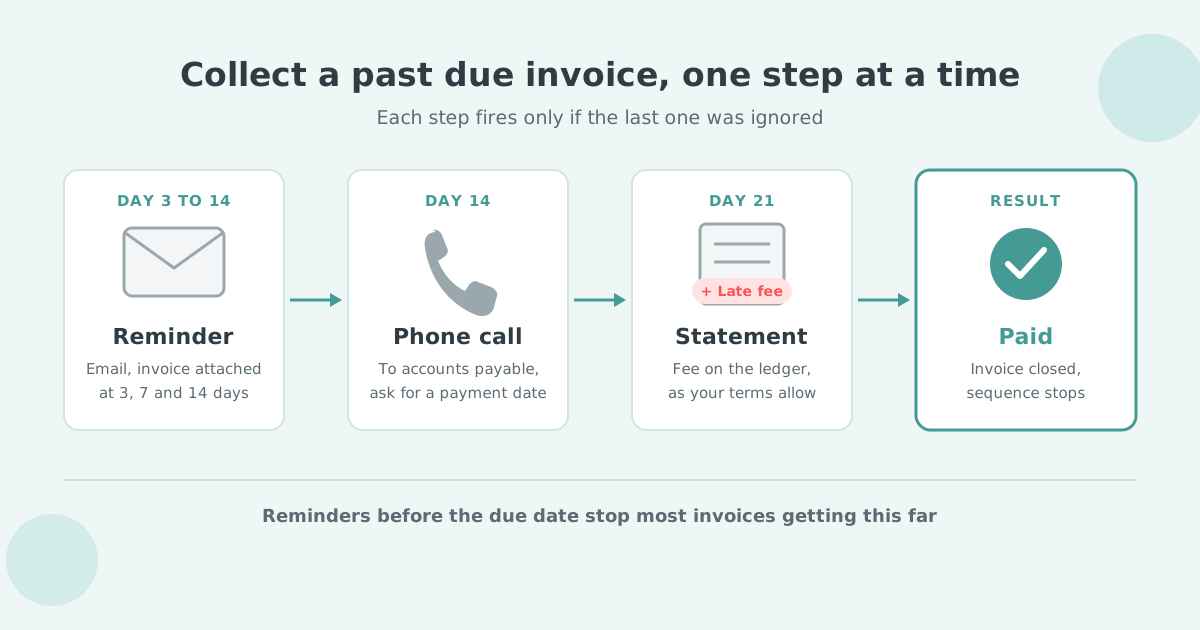
The best way to collect a past due invoice is a fixed, escalating sequence: reminders before and after the due date, a phone call once it is overdue, a late fee if your terms allow it, then a formal demand letter before any collection agency. Each step fires only if the last was ignored.
- Prevent first: Written payment terms, a deposit or milestone billing, and reminders that start before the due date stop most invoices going past due at all.
- Escalate on a schedule: Reminders at 3, 7 and 14 days past due, a phone call at day 14, a late fee on the ledger at day 21, and a letter of demand at day 30.
- The fix: Paidnice runs the reminders, the fee and the escalation task from Xero or QuickBooks Online, and finance teams using it cut manual chasing by up to 90%.
This page covers business-to-business invoices: one company collecting from another. It gives the sequence for an invoice that is already past due, then the terms that stop the next one getting there. The agency decision at the top of the sequence has its own page.
How do you collect a past due invoice?
You collect a past due invoice by working a dated sequence: reminder, phone call, late fee, formal demand, then a collection agency, with each step firing only after the previous one has been ignored.
| Day past due | Step | What it contains |
|---|---|---|
| Day 1 to 3 | Verify | Check the invoice reached accounts payable, matches the purchase order, and has no credit against it. Nothing goes to the customer yet. |
| Day 3, 7, 14 | Remind | Three emails, firmer each time, plus a statement of the whole balance. Invoice number, amount, due date, payment link. |
| Day 14 | Phone | Call the person who pays the bills. One question: is there a reason this has not been paid? |
| Day 21 | Final notice with fee | The late fee or interest your terms allow, posted to the ledger, and the date the next step happens. |
| Day 30 | Letter of demand | Formal demand on letterhead: the debt, the deadline, the consequence. |
| Day 60 to 90 | Agency or court | Collection agency or small claims, with the full dated history as evidence. |
The sequence works because each step costs the customer a little more than the last: attention, then a conversation, then money, then a legal record. A customer who has ranked your invoice behind everyone else's moves it up the queue at the step where staying quiet gets expensive. Most invoices pay at the reminder or phone step. The later steps exist so the ones that do not have somewhere to go.
How common is a past due invoice?
Past due invoices are the normal case, not the exception. Xero Small Business Insights measures the share of invoices paid after the due date in each market, and in every market it is a large share of all invoices issued.
| Country | Paid late | Year on year |
|---|---|---|
| Australia | 4.3% | -2.7 pts |
| New Zealand | 5.1% | -0.5 pts |
| UK | 8.3% | -0.9 pts |
| US | 8.3% | -0.1 pts |
| Canada | 11.4% | +0.8 pts |
Source: Xero Small Business Insights, June 2026. See the full data on the Paidnice accounts receivable statistics dashboard.
Collection work is the follow-up on that share, month after month. A business that reacts to each late invoice as a surprise does the work twice: once to notice, once to chase. A business with a schedule does it once, on the day the schedule says.
What payment terms prevent invoices going past due?
Four terms prevent most late payment: a due date stated as a number of days from the invoice date, a late fee or interest clause, a recovery-costs clause, and a notice that unpaid invoices are referred after a stated number of days.
- The due date, in days from the invoice date. Every day count in the sequence runs from it. "Net 14" or "Net 30" on the invoice itself, not only in a contract the customer signed a year ago.
- The late fee or interest clause. The rate, when it starts, and whether it compounds. In the UK the Late Payment of Commercial Debts (Interest) Act 1998 gives every supplier 8% over the Bank of England base rate plus a fixed sum of £40, £70 or £100 per invoice. In Australia, New Zealand and the US the fee holds only where the customer agreed to it, so it has to be in the terms.
- The recovery-costs clause. That agency fees and court costs are recoverable from the customer where the law allows. Without it, the agency's share comes out of your margin.
- The referral notice. That invoices unpaid after a stated number of days are referred to a collection agency. The final notice then quotes your own terms back to the customer.
Two commercial choices sit alongside the terms. Take a deposit or bill by milestone on larger jobs, so the amount at risk at the end is smaller. Take card payment where the margin allows it: a processing fee on a paid invoice costs less than three reminders on an unpaid one. Paidnice attaches your terms to every invoice email automatically, and takes card payment, partial payment and installments through Stripe from the reminder itself.
How do you politely collect a past due invoice?
A polite collection email names the invoice number, amount and due date, asks whether there is a problem with the invoice, and gives a payment link. Three sentences, sent on a schedule, from your own email domain.
The first reminder goes before the due date, so the invoice is at the top of the pile on the day it falls due. The reminders after it get firmer, not longer: the second names the days overdue, the third names the next step. Wording for each rung is on email templates for invoice payment reminders.
Two things keep a polite reminder polite. Reconcile payments daily, so a reminder never reaches a customer who paid yesterday. And send from your own domain rather than the accounting system's shared one, so the reminder lands in the inbox rather than the spam folder. A reminder the customer never saw is the most common reason a payment is "ignored".
When should you escalate to a phone call or a late fee?
Phone accounts payable at 14 days past due, once three reminders have gone unanswered, and apply the late fee or interest your terms allow at 21 days, with a final notice that states the new balance.
The phone call is the cheapest step that changes behavior. It finds the dispute nobody raised, the invoice that went to the wrong address, and the customer who is short of cash and needs a payment plan. Record the outcome against the invoice, whatever it is, because that record is the evidence for every later step.
The late fee is leverage, not revenue. A fee posted to the ledger is a real receivable that shows in the customer's own aged payables, where their finance team has to deal with it. Give a grace period of a few days after the due date, then apply the fee automatically and waive it deliberately for the customers you choose. Paidnice can name the fee before it lands: a reminder merge tag renders "If not paid within N days, a late penalty of $XX.XX will be charged", so the customer sees the exact cost of staying quiet.
At day 30 the step becomes a task for a person. Paidnice escalations fire at a chosen number of days overdue, with the types Phone Call, Stop Credit and Template Legal Letter, assigned to a named team member, and the outcome syncs back to the invoice in Xero. The letter of demand template covers the wording.
When should you use a debt collection agency?
Use a collection agency at 90 days past due, or 60 days if the customer has gone silent, and only after a statement, a late fee, a final notice and a formal demand have all been sent and ignored.
An agency takes a share of what it recovers, and its share does not fall as the debt ages, so the earlier steps are where the money is. The day count and the fee ranges are on when to send an overdue invoice to a collection agency, and the cost of an agency against software on the same invoices is on credit control software vs a debt collection agency.
Three rules before you place an account. Never place a disputed invoice until the dispute is answered in writing. Confirm your terms allow the recovery costs to be added. And check the rules for your market: debt collection law varies by country and often by state, and some industries have their own route, such as New Zealand's Construction Contracts Act 2002 for construction payment disputes. Paidnice lists debt recovery services by market in its service provider directory.
How does Paidnice collect past due invoices automatically?
Paidnice runs the whole sequence below the agency from the ledger in Xero or QuickBooks Online: reminders by email and SMS, statements, late fees and interest, payment plans and escalation tasks, with every send logged against the invoice.
- Reminders on a schedule per customer group, before and after the due date, from your own domain.
- Statements sent automatically to every customer with an open balance.
- Late fees and interest posted to the ledger as draft or approved invoices, with a Bank of England base rate toggle for UK statutory interest.
- Escalations that create a task for a person at the day count you set, with the full history attached.
Finance teams using it cut manual chasing by up to 90%, and customers cut their average wait for payment in half within 30 days. Start a free Paidnice account: the first 20 actions are free, with no time limit and no card. Or book a call with the team.

Stop chasing invoices.
Start getting paid.
Paidnice is accounts receivable automation that enforces your payment terms, trusted by thousands of businesses on Xero and QuickBooks. Credit control and debtor management, run for you.
Try it Now - It's FreeNo card required.