

Summary
Bad debt expense is calculated with the allowance method, using either a percentage of net credit sales, a percentage of ending accounts receivable, or an aging schedule that applies a higher uncollectible rate to older balances. The adjusting entry debits Bad Debt Expense and credits Allowance for Doubtful Accounts.
- Percentage of sales: Multiply net credit sales by your historical uncollectible rate: $500,000 of credit sales at 2% is a $10,000 bad debt expense for the period.
- Aging method: Split receivables into 0-30, 31-60, 61-90 and 90+ day bands, apply a rising rate to each, and book the difference between the total and the allowance you already hold.
- Journal entry: Debit Bad Debt Expense and credit Allowance for Doubtful Accounts. A later write-off debits the allowance and credits receivables, and creates no new expense.
What is bad debt expense?
Bad debt expense is the portion of your accounts receivable that you have invoiced and do not expect to collect, recorded as an expense in the period the sales were made. Under both GAAP and IFRS it is an estimate booked before any individual invoice is confirmed uncollectible, so revenue and receivables are not overstated.
Bad debt concentrates in industries that extend credit terms: B2B services, wholesale and retail supply, and construction. A supplier on 30-day terms learns over time that a share of customers never pay, and that share is what the estimate has to capture.
A metric needs an outside reference. Xero Small Business Insights measures payment times across five markets.
| Country | Days to be paid | Year on year |
|---|---|---|
| Australia | 20.3 days | -4.3 days |
| New Zealand | 23.2 days | -0.9 days |
| US | 29.1 days | +1.6 days |
| UK | 29.3 days | -0.3 days |
| Canada | 29.5 days | +1.9 days |
Source: Xero Small Business Insights, June 2026. See the full data on the Paidnice accounts receivable statistics dashboard.
Compare your own figure with the market before setting a target.
What are the two ways to record bad debt?
Bad debt is recorded either by the direct write-off method, which expenses each invoice only when it is confirmed uncollectible, or by the allowance method, which estimates the uncollectible share in advance and holds it in a contra-asset account. GAAP requires the allowance method for financial reporting because it matches the expense to the period of the sale.
Direct write-off is the simplest: when a debt is confirmed uncollectible, debit Bad Debt Expense and credit Accounts Receivable for that invoice. It overstates income in earlier periods and is accepted mainly for tax reporting and for businesses with immaterial bad debts.
The allowance method sets up an Allowance for Doubtful Accounts, a contra-asset that sits against receivables on the balance sheet, so net receivables show what you expect to collect. The three ways to size that allowance are below.
How do you calculate bad debt expense with the percentage of sales method?
The percentage of sales method multiplies net credit sales for the period by your historical uncollectible rate, and the result is the bad debt expense for the period. It is an income statement approach: the expense is calculated directly and the allowance balance is whatever it becomes.
Formula: bad debt expense = net credit sales × historical uncollectible rate.
With $500,000 of net credit sales for the year and a three-year average of 2% of credit sales written off, the bad debt expense is $500,000 × 2% = $10,000. The entry debits Bad Debt Expense $10,000 and credits Allowance for Doubtful Accounts $10,000, on top of whatever the allowance already holds.
The rate comes from your own history: total write-offs over the last two or three years divided by total credit sales for the same years. A new business without that history borrows an industry figure and corrects it after the first year.
How do you calculate bad debt expense with the percentage of receivables method?
The percentage of receivables method multiplies the ending accounts receivable balance by an uncollectible rate to get the allowance you should hold, then books the difference between that target and the allowance's current balance as the expense. It is a balance sheet approach: the allowance is set first and the expense follows.
Formula: required allowance = ending accounts receivable × uncollectible rate. Bad debt expense = required allowance minus the existing credit balance in the allowance.
With ending receivables of $120,000, a 5% rate, and an existing allowance credit balance of $1,500, the required allowance is $120,000 × 5% = $6,000, and the bad debt expense is $6,000 minus $1,500 = $4,500. If the allowance had a debit balance of $1,500 because write-offs ran ahead of the estimate, the expense would be $6,000 plus $1,500 = $7,500.
How does the aging method work?
The aging method splits ending receivables into age bands, usually 0-30, 31-60, 61-90 and over 90 days past due, applies a higher uncollectible rate to each older band, and adds the results to get the required allowance. It is the most accurate of the three because the age of a balance is the strongest predictor of whether it will be paid.
| Age band | Balance | Uncollectible rate | Allowance needed |
|---|---|---|---|
| 0 to 30 days | $70,000 | 1% | $700 |
| 31 to 60 days | $25,000 | 5% | $1,250 |
| 61 to 90 days | $15,000 | 15% | $2,250 |
| Over 90 days | $10,000 | 40% | $4,000 |
| Total | $120,000 | $8,200 |
On the same $120,000 of receivables, the aging schedule says the allowance should be $8,200. With the existing $1,500 credit balance, the bad debt expense for the period is $8,200 minus $1,500 = $6,700, which is $2,200 more than the flat 5% method produced, because a third of this ledger is over 60 days old.
The rates per band come from your own history in the same way as the sales rate: for each band, how much of what sat there at past period ends was eventually written off.
What is the journal entry for bad debt expense?
The adjusting entry for bad debt expense debits Bad Debt Expense and credits Allowance for Doubtful Accounts for the estimated amount. A later write-off of a specific invoice debits the allowance and credits Accounts Receivable, and creates no new expense, because the expense was already recognized when the estimate was booked.
- Estimate at period end. Debit Bad Debt Expense $6,700. Credit Allowance for Doubtful Accounts $6,700.
- Write off a confirmed bad debt. A $3,000 invoice is confirmed uncollectible. Debit Allowance for Doubtful Accounts $3,000. Credit Accounts Receivable $3,000. Net receivables do not change, because both the asset and the contra-asset fall by $3,000.
- Recover a debt already written off. The customer pays $3,000 after all. Reverse the write-off (debit Accounts Receivable, credit Allowance), then record the cash (debit Cash, credit Accounts Receivable).
Bad debt expense is an operating expense, usually shown under selling, general and administrative costs. The allowance is a credit-balance contra-asset that reduces gross receivables to the net figure on the balance sheet.
Which bad debt method should you use?
Use the aging method if your accounting software produces an aged receivables report, because it is the most accurate and the report does the work. Use percentage of sales for a quick interim estimate, and percentage of receivables where the ledger is small and evenly aged.
| Method | What it multiplies | What it produces | Best for |
|---|---|---|---|
| Percentage of sales | Net credit sales × rate | The expense directly | Monthly or quarterly interim estimates |
| Percentage of receivables | Ending receivables × rate | The required allowance; expense is the top-up | Small, evenly aged ledgers |
| Aging schedule | Each age band × its own rate | The required allowance, band by band | Year end and any ledger with old balances |
| Direct write-off | Nothing; each confirmed loss | The expense when the loss is certain | Tax reporting and immaterial amounts |
How is bad debt treated for tax in each country?
Tax authorities allow a deduction or a sales tax adjustment only for debts that are genuinely bad and written off in the books, not for the allowance estimate. The rules, and the time limits, differ by country.
| Country | Authority | What is allowed |
|---|---|---|
| United States | IRS | Deduct a business bad debt when it becomes worthless, under the specific charge-off method. The debt must have been included in income, and partial worthlessness can be deducted if proven. |
| United Kingdom | HMRC | VAT bad debt relief once the debt is more than 6 months old and less than 4 years 6 months old, and written off in the VAT accounts. Relief on the unpaid portion of a part-paid invoice. |
| European Union | VAT Directive 2006/112/EC | Most member states allow VAT to be reclaimed on bad debts. The waiting period is set nationally, for example 12 months in France and 6 months in Germany. |
| Canada | CRA | Deduct debts that are genuinely uncollectible and written off in the books, and claim back the GST/HST portion. Keep records of collection efforts. |
| Australia | ATO | Deduct a debt previously included as assessable income and written off as bad in the same income year, and claim a decreasing GST adjustment. A recovered debt is income in the year received. |
| New Zealand | Inland Revenue | Deduct a debt written off as bad before the end of the income year, with a GST adjustment for registered businesses. A recovered debt is income in the year received. |
How do you reduce bad debt expense?
Bad debt expense falls when fewer invoices reach the over-90-day band, so the levers are the ones that shorten the wait for payment: credit checks before terms are extended, reminders on a schedule from the due date, late fees as leverage so your invoice is the one that costs money to ignore, and a decision point at 60 to 90 days.
- Watch the aging report monthly. The 61-90 and over-90 bands are next period's write-offs. Paidnice's aged receivables report shows each customer in 1-30, 31-60, 61-90 and 90+ day buckets with a payment-history score, so the band that drives the allowance is visible before period end.
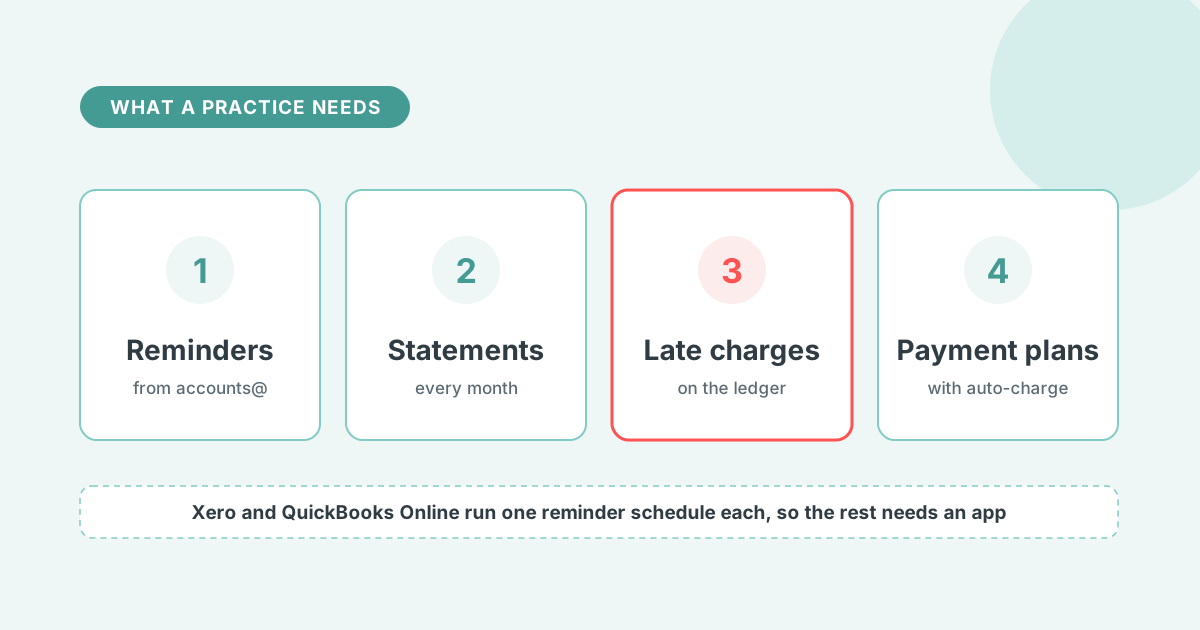
- Automate the follow-up. Reminders on the due date and after, late fees applied by policy, and escalation to a named person at a set age, so no invoice drifts into the 90+ band because nobody was watching.
- Check credit before extending terms with your local credit bureau, and tighten terms for a customer whose average days beyond terms is rising.
The measure to track alongside the expense is your average wait for payment, covered in how to calculate DSO. The Federation of Small Businesses reported in 2022 that over 50% of UK small businesses were affected by late payment (FSB, Time is Money), and the late invoices are where the bad debt comes from.
Common questions
How do you find bad debt expense on the financial statements?
Bad debt expense is a line in operating expenses on the income statement, often inside selling, general and administrative costs. The related Allowance for Doubtful Accounts appears on the balance sheet as a deduction from gross accounts receivable.
Is bad debt expense a debit or a credit?
A debit. The adjusting entry debits Bad Debt Expense and credits Allowance for Doubtful Accounts. The allowance carries a credit balance.
What is the difference between bad debt expense and the allowance for doubtful accounts?
Bad debt expense is the charge for one period on the income statement. The allowance is the cumulative reserve on the balance sheet, increased by each period's expense and reduced by each write-off.
Does a write-off create a bad debt expense?
Not under the allowance method. The expense was recognized when the estimate was booked, and the write-off only moves the loss out of the allowance and out of receivables. Under direct write-off, the write-off is the expense.
What percentage of receivables is normal for bad debt?
There is no single figure. The rate is your own history of write-offs against credit sales or against receivables, by age band, and it should be recalculated each year from the actual write-offs.


 App of the Year