12 Overdue Payment Reminder Emails & Letters Templates That Work
By Denym BirdCo-founder & CEO of Paidnice
13 min read ·
Contents▾
A late invoice is rarely a refusal to pay. More often it is a busy inbox, a misplaced PDF, or an approval stuck on someone's desk. A clear, well-timed payment reminder fixes most of those without a difficult conversation, and a firmer letter handles the few that need one.
This guide covers the full ladder: a friendly reminder before the due date, professional follow-ups once an invoice is overdue, and a strong letter for outstanding payment when an account has gone quiet. You'll find 12 copy-and-paste templates below, plus guidance on tone, timing, and what you can legally add to an overdue invoice. Reminders work best when they sit on top of clear payment terms up front.
Payment reminder best practices (the short version)
Consistency beats firmness
The businesses that get paid fastest are not the ones with the sternest emails, they are the ones that send every reminder on schedule. Across our customers, that consistency is what drives the roughly 50% average drop in days sales outstanding (DSO).
Send at the right moments
A pre-due reminder 3 to 5 days before the due date, a note on the due date, then follow-ups at roughly 3, 7, 14, and 30 days overdue.
Make every reminder self-contained
Include the invoice number, the amount, the due date, and a direct payment link in each one.
Let the tone climb slowly
Start friendly, move to professional, then firm, and only reach a final demand once earlier reminders have gone unanswered.
Keep subject lines clear
Name the invoice and the status, for example "Reminder: invoice #1234 is due on 14 July".
Switch to a letter when email stops working
A posted overdue payment letter, and then a final demand, carry more weight than a tenth email.
How to write a payment reminder email
A good reminder is short, specific, and easy to act on. Five quick principles:
1
Open warmly
A friendly first line keeps the relationship intact, especially early on.
2
State the point quickly
Name the invoice, the amount, and the due date in the first two sentences.
3
Remove friction
Add a direct payment link so paying takes seconds, not a login hunt.
4
Give one clear next step
Tell the reader exactly what to do and by when.
5
Leave the door open
Invite a reply if there's a query or a problem, so a silent delay becomes a conversation.
The templates below put these into practice. Copy the one that matches where the invoice sits, fill in the brackets, and send.
Copy-and-paste payment reminder templates
Twelve ready-to-use emails and letters, from a friendly pre-due nudge to a strong final demand. Fill in the brackets, copy, and send.
1. Pre-due reminder (email)
Send 3-5 days before the due date
Subject: Reminder: invoice #[Invoice Number] is due on [Due Date]

Hi [Client's Name],

Just a friendly reminder that invoice #[Invoice Number] for [Amount] is due on [Due Date].

You can view and pay it here: [Payment Link]

If anything looks off or you have a question, reply to this email and we'll sort it out.

Thanks,
[Your Name], [Your Company]
2. Due-date reminder (email)
Send on the due date
Subject: Invoice #[Invoice Number] is due today

Hi [Client's Name],

A quick note that invoice #[Invoice Number] for [Amount] is due today, [Due Date].

You can pay it in a moment here: [Payment Link]

If you've already sent payment, thank you, and please ignore this note.

Best,
[Your Name], [Your Company]
3. Polite overdue reminder (email)
Send 1-3 days overdue
Subject: Invoice #[Invoice Number] is now overdue

Hi [Client's Name],

Our records show invoice #[Invoice Number] for [Amount], due on [Due Date], is now a few days overdue. We know these things slip through, so this is just a gentle nudge.

You can settle it here: [Payment Link]

If there's a problem with the invoice or the timing, let us know and we'll be glad to help.

Best regards,
[Your Name], [Your Company]
4. Payment follow-up email
Send 5-7 days overdue
Subject: Following up on invoice #[Invoice Number]

Hi [Client's Name],

I'm following up on invoice #[Invoice Number] for [Amount], which was due on [Due Date] and is still showing as unpaid.

Could you confirm when we can expect payment? You can also pay straight away here: [Payment Link]

If it has already been actioned, apologies for the duplicate note. Happy to help if anything is holding it up.

Best regards,
[Your Name], [Your Company]
5. Firm overdue reminder (email)
Send 14-21 days overdue
Subject: Action needed: invoice #[Invoice Number] is 14 days overdue

Hi [Client's Name],

Despite our earlier reminders, invoice #[Invoice Number] for [Amount], due on [Due Date], remains unpaid and is now 14 days overdue.

Please arrange payment within 7 days using the link below: [Payment Link]

If there is a reason for the delay, please reply today so we can agree a way forward. We'd like to resolve this without it affecting our working relationship.

Best regards,
[Your Name], [Your Company]
6. Final notice (email)
Send 30+ days overdue
Subject: Final notice: invoice #[Invoice Number] is now [Days] days overdue

Hi [Client's Name],

This is a final reminder that invoice #[Invoice Number] for [Amount] is now [Days] days overdue. We have not received payment or a response to our previous emails.

Please pay the full amount within 7 days, by [Final Date], using this link: [Payment Link]

If payment is not received by then, the account may be passed to collections and a late fee or statutory interest may be applied. We would much rather settle this directly with you, so please get in touch if there is an issue.

Best regards,
[Your Name], [Your Company]
7. Overdue payment letter (formal)
Posted letter, 14-30 days overdue
[Your Company]
[Your Address]
[Email] · [Phone]

[Date]

[Client's Name]
[Client's Company]
[Client's Address]

Dear [Client's Name],

Re: Overdue invoice #[Invoice Number]

We are writing regarding invoice #[Invoice Number] for [Amount], issued on [Invoice Date] and due for payment on [Due Date]. As at the date of this letter, payment remains outstanding.

We would be grateful if you could arrange payment of the full amount within 7 days of receiving this letter. Payment can be made by [Payment Method], quoting invoice #[Invoice Number] as the reference.

If you have already made this payment, please accept our thanks and disregard this letter. If there is a query or difficulty, please contact us on [Phone] or [Email] so we can help resolve it.

Yours sincerely,

[Your Name]
[Your Title], [Your Company]
8. Strong letter for outstanding payment (final demand)
Posted letter, 30+ days overdue
[Your Company]
[Your Address]
[Email] · [Phone]

[Date]

[Client's Name]
[Client's Company]
[Client's Address]

Dear [Client's Name],

Re: Final demand for payment of invoice #[Invoice Number]

Despite our previous reminders, invoice #[Invoice Number] for [Amount], due on [Due Date], remains unpaid and is now [Days] days overdue.

This letter is a formal final demand for payment of the full outstanding balance of [Amount].

Please make payment in full by [Final Date], a period of [Number] days from the date of this letter, to [Payment Method] quoting reference #[Invoice Number].

If payment is not received by that date, we reserve the right to:
- apply late payment fees and statutory interest on the overdue amount;
- refer the debt to a collections agency; and
- commence recovery proceedings to recover the sum due, together with interest and costs.

We would prefer to resolve this matter directly and amicably. If you are experiencing difficulty or believe this amount is not due, please contact us in writing within [Number] days so we can discuss it.

Yours sincerely,

[Your Name]
[Your Title], [Your Company]
9. Partial payment reminder (email)
When a part-payment is received
Subject: Balance due on invoice #[Invoice Number]

Hi [Client's Name],

Thank you for your part-payment of [Partial Amount] towards invoice #[Invoice Number]. A balance of [Remaining Amount] is still outstanding.

You can clear the remaining balance here: [Payment Link]

Please let us know if you'd like to arrange a short payment plan for the rest. We're happy to help.

Best regards,
[Your Name], [Your Company]
10. Payment received confirmation (email)
As soon as payment arrives
Subject: Payment received for invoice #[Invoice Number]

Hi [Client's Name],

Thank you, we've received your payment for invoice #[Invoice Number].

For your records:
Invoice: #[Invoice Number]
Amount paid: [Amount]
Date received: [Date]

We appreciate your business and look forward to working with you again.

Best regards,
[Your Name], [Your Company]
11. Thank-you for on-time payment (email)
When paid on or before the due date
Subject: Thank you for your prompt payment

Hi [Client's Name],

Thank you for paying invoice #[Invoice Number] on time. We really appreciate it, prompt payment helps us keep doing our best work for you.

If there's anything we can help with, just let us know.

Best regards,
[Your Name], [Your Company]
12. Short payment follow-up (SMS or quick email)
A one-line nudge any time after due
Hi [Client's Name], a quick reminder that invoice #[Invoice Number] for [Amount] is now overdue. You can pay it here: [Payment Link]. Thanks, [Your Company].
Looking for a system to automate these?
Copying templates works, but sending the right one on time for every invoice is the hard part. Paidnice runs the whole sequence for you:
Reminders sent automatically before and after the due date
Late fees and interest applied the moment an invoice is overdue
The firmer accounts escalated with a formal letter
Every message from your own domain, on your schedule
Works with Xero and QuickBooks, across email, SMS and letters.
How to write a strong letter for outstanding payment (final demand)
When polite reminders and follow-up emails have not worked, a strong letter of demand for outstanding payment is the next step. It is firmer in tone and usually sent by post or as a formal PDF attachment, which signals that the matter is now serious. A final demand letter should still be professional, never threatening, and it should:
Reference the invoice and history. State the invoice number, amount, original due date, and that earlier reminders went unanswered.
Make a clear demand. Ask for the full outstanding amount, not a part-payment.
Set a firm deadline. Give a specific final date, commonly 7 to 14 days from the letter.
Explain what happens next. Note that you may apply late fees or statutory interest, refer the debt to collections, or begin recovery proceedings if payment is not received.
Offer a way out. Invite the customer to get in touch if they are in difficulty or dispute the amount.
You'll find a ready-to-use strong letter for outstanding payment and a formal overdue payment letter in the template library above, under the Letters filter. Paste either into your letterhead, fill in the brackets, and save it as a PDF or Word document to send.
Overdue payment letter vs email: which to use
Use email for speed and the first several reminders; switch to a posted letter once email has gone unanswered or you are heading toward a formal demand. Here is when each one wins:
Email reminder
Posted letter
Best for
The first reminders, from pre-due to about 30 days overdue
A formal final demand, or when emails are ignored
Speed
Instant, easy to automate and track
Slow, but creates a paper trail
Tone signal
Routine follow-up
This is now serious
Cost and effort
Effectively free
Postage and time
When to use it
Invoice 0 to about 30 days overdue, customer still responsive
30+ days overdue, no email response, or before legal action
A formal overdue payment letter, followed by a final demand, shows you have acted reasonably and given fair warning, which matters if the debt is ever disputed.
What you can add to an overdue invoice
You can often recover more than the invoice itself. Two common additions:
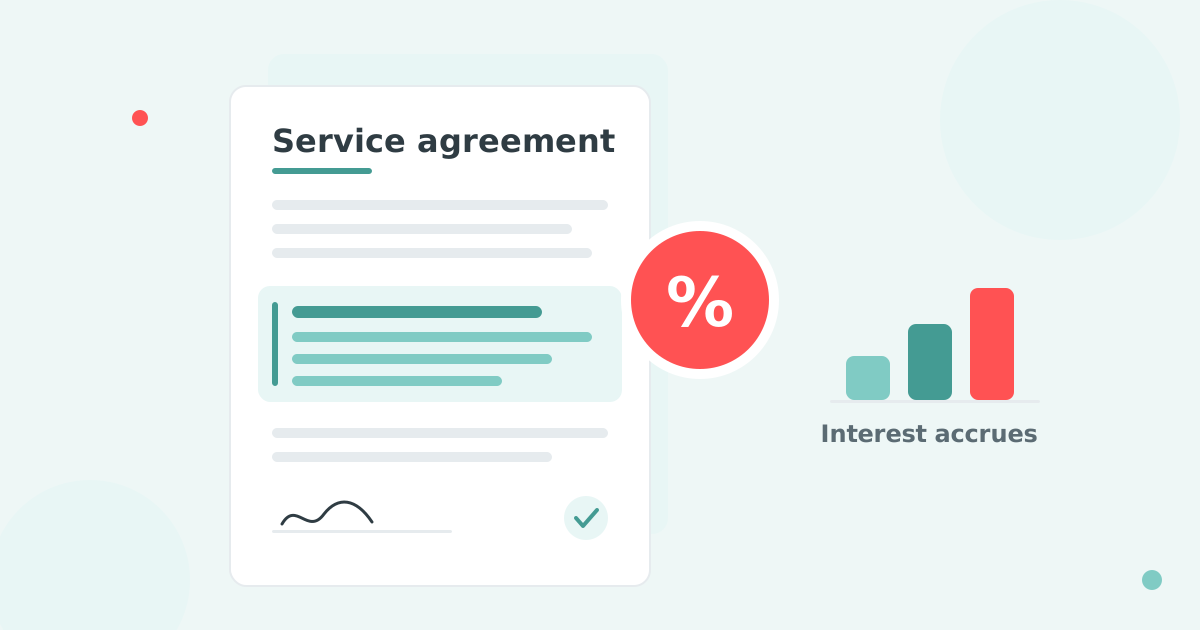
Statutory interest. In the UK, businesses can charge interest at the Bank of England base rate plus 8% on overdue commercial invoices. Work out the figure with our UK statutory interest calculator, or use the late payment interest calculator for other situations.
State any fee or interest clearly in your terms and on the invoice, so it is fair and expected rather than a surprise.
How to handle persistent non-payment
If the full ladder of reminders and a final demand still bring no response:
Pause new work for that customer until the account is settled.
Make a phone call. A direct conversation often unlocks a payment that emails could not.
Consider a collections agency. Choose one that treats your customer respectfully, since it reflects on you.
Take legal advice before issuing proceedings, to weigh the cost against the amount owed.
Most invoices never reach this point if the earlier reminders are consistent and on time.
Be realistic about the end of the road. Reminders and a final demand resolve the large majority of overdue invoices, but not all of them. Past a certain point, an email is not the tool; the choice becomes a collections agency, small claims, or accepting the write-off. And for a genuinely small balance, the answer is that your time is worth more than the effort of collecting it. Knowing when to stop is part of running accounts receivable (AR) well.
A strong letter for outstanding payment, often called a final demand, should reference the invoice number, amount, and original due date, note that earlier reminders went unanswered, and demand the full amount by a firm deadline (usually 7 to 14 days). State clearly what happens next if payment is not received, such as late fees, statutory interest, collections, or recovery proceedings, and offer the customer a chance to get in touch if they are in difficulty. Keep it professional and factual, never threatening. There is a ready-to-use template in the library above under the Letters filter.
An email reminder is fast, links straight to payment, and is right for the first several follow-ups. A posted overdue payment letter carries more weight and creates a formal paper trail, which is useful for larger amounts, for accounts that are ignoring email, and before involving a collections agency or taking legal steps. Many businesses use emails first, then escalate to a formal letter and a final demand.
A common, effective cadence is four to six touches: a pre-due reminder 3 to 5 days before the due date, a note on the due date, then follow-ups at roughly 3, 7, 14, and 30 days overdue. If there is still no response after about 30 days, escalate to a formal letter or final demand, and consider collections after 60 days.
Make each reminder self-contained: the invoice number, the amount due, the original due date (or how many days overdue it is), a direct payment link or clear instructions, and your contact details. That way the customer can act without digging through old emails.
Open warmly, name the invoice, amount and due date in the first couple of sentences, and ask a simple question such as when payment can be expected. Add a payment link, assume good faith ("apologies if this has already been actioned"), and invite a reply if something is holding it up. The payment follow-up template above follows this structure.
Send a final demand once your earlier reminders and follow-ups have gone unanswered, typically around 30 or more days overdue. It should be the last step before collections or legal action, give a firm final deadline, and set out the consequences of non-payment clearly.
Often yes, where your terms allow. In the UK, businesses can charge statutory interest at the Bank of England base rate plus 8% on overdue commercial invoices; you can work out the amount with the UK statutory interest calculator. For other situations, use the late payment interest calculator. State any fee or interest in your terms so it is fair and expected.
Both, in sequence. Be friendly before and just after the due date, professional in the first week or two overdue, firmer beyond that, and reserve a formal final tone for 30+ days. Even firm reminders should stick to facts and next steps rather than emotion, and avoid anything that reads as a threat.
Yes, and it is the most reliable way to stay consistent. Tools like Paidnice connect to Xero and QuickBooks and send your reminders on schedule, apply late fees automatically, and escalate overdue accounts, so the right message goes out at the right time without manual effort.
Mid-week mornings tend to work best. Aim for Tuesday to Thursday, around 10 to 11am or early afternoon in the customer's time zone, and avoid weekends, holidays, and very early or late hours when emails are easy to miss.
Automate your payment reminders
Sending the right reminder at the right moment, every time, is the hard part by hand. Paidnice automates the whole sequence for businesses on Xero and QuickBooks: it sends your email and SMS reminders on schedule, applies late fees and interest when an invoice goes overdue, and escalates the few accounts that need a firmer touch, so you can stay consistent without living in your outbox.
Xero 2025 Global Small Business App of the Year
“It's the debt collection system I've been looking for, for the last 15 years.”
TCTyler CaskeyPartner, The Bean Counters
Rated 5 stars across Xero, QuickBooks and Trustpilot · 100+ reviews
Paidnice is accounts receivable automation that enforces your payment terms, trusted by thousands of businesses on Xero and QuickBooks. Credit control and debtor management, run for you.