
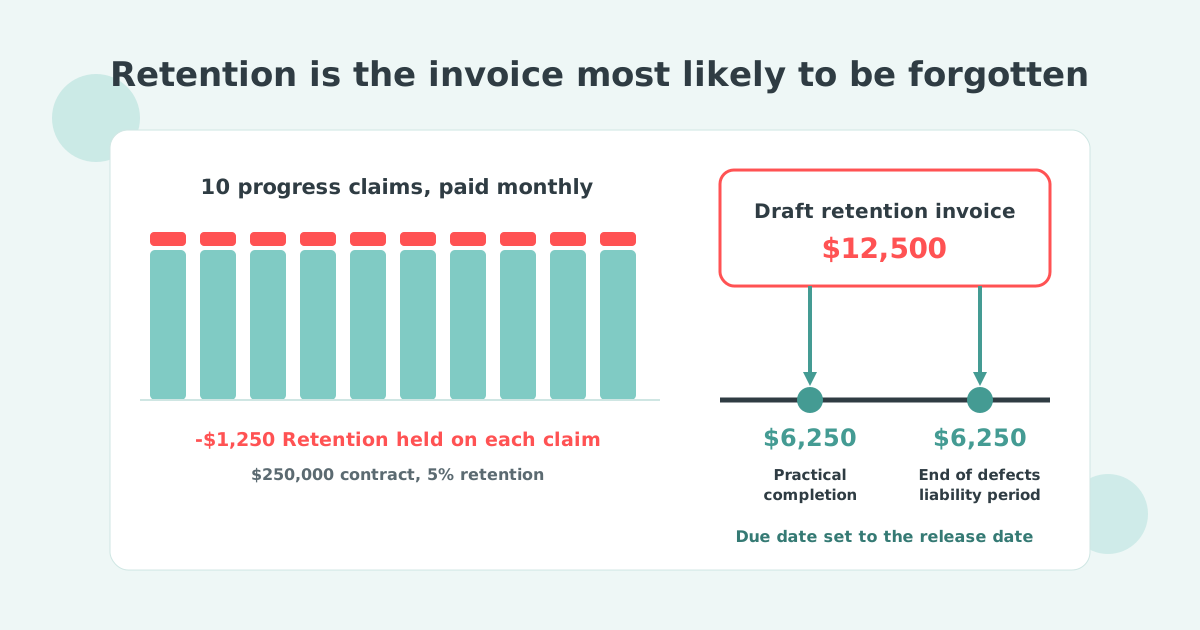

Xero has no native progress-claim or retention feature. You invoice each claim as a normal Xero invoice, hold the retention with a separate line and a tracking category, and raise the retention invoice as a draft with its due date set to the release date. That due date is what your reminders, statements, and late fees key off when the money falls due.
This guide is written for Australian builders and subcontractors on Xero. It covers what Xero's own progress invoice and deposit request do, what a retention is, the ledger workaround, the construction add-ons that fill the gap, the Security of Payment clocks in three states, and how the retention invoice gets followed up at release.
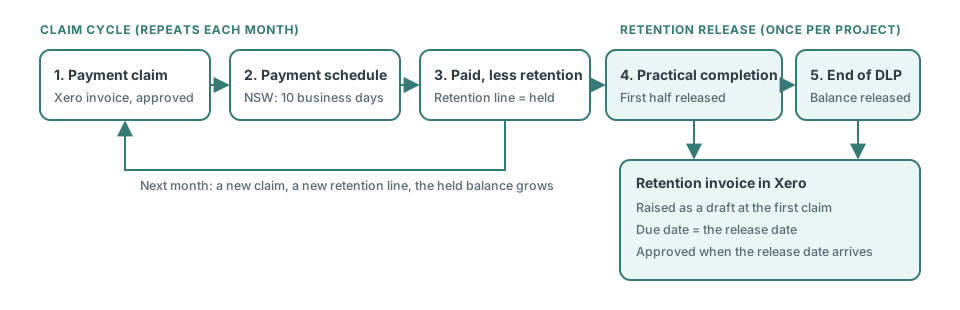
Raise each progress claim as a standard Xero invoice, show the retention held as a negative line, tag every line with a project tracking category, and keep one draft retention invoice per project dated to the release date.
Xero has no progress-claim or retention feature. An open idea on Xero's product board, "Sales Invoices - Ability to specify a % of invoice held on retention", asks for one. Corecon's Xero integration docs state that Xero has no retainage function and describe the same workaround this guide uses: a draft invoice approved when retention falls due, with Tracking Categories per project. The full method takes six steps.
Assumes equal claims. Enter your own contract's percentage, cap, and release split; the figures are the line amounts to put on the draft retention invoice, not tax advice.
Worked example: a $250,000 contract billed in ten equal claims with 5% retention carries a -$1,250 "Retention held" line on each claim. The draft retention invoice is $12,500. If the contract releases half at practical completion, split the draft into $6,250 due at practical completion and $6,250 due at the end of the defects liability period.
Xero's native tools cover a deposit or a lump-sum prepayment on a single invoice. They do not track a contract sum, a percentage complete, or a retention held across many invoices.
Two native features get mistaken for progress-claim support; both stop short of a construction claim. The deposit request adds a percentage or fixed deposit to an invoice. It requires Stripe, is recorded as a part payment, and the deposit is revenue that attracts tax. Xero Projects adds project-level deposit invoicing.
| Need | Xero deposit request | Xero Projects deposit | Standard invoice + workaround |
|---|---|---|---|
| Deposit before work starts | Yes, Stripe required | Yes | Yes, as a normal invoice |
| Monthly claim for work done | No | Partial, time and cost based | Yes |
| Contract sum and percent complete | No | No | No, tracked outside Xero |
| Retention held per claim | No | No | Yes, negative line |
| Retention balance per project | No | No | Yes, tracking category report |
| Retention invoice at release | No | No | Yes, draft approved at the date |
| Security of Payment claim document | No | No | No, the claim document is prepared outside Xero |
Xero Central pages relayed via search snippets in September 2026; re-check the deposit article wording before relying on it.
A retention is a percentage of each progress claim the client holds back as security for defects, released in tranches after practical completion. It is invoiced last, often months after the last person on site has moved on.
The UK industry norm is 5% of each claim, released in two halves: half at practical completion, the balance at the end of the defects liability period. Australian contracts set their own percentage and cap; check the contract and the standard form it is based on. Build UK has campaigned to cap retentions at 1.5% and eventually zero.
Across the Tasman, New Zealand's Construction Contracts (Retention Money) Amendment Act 2023 deems retention money held on trust from 5 October 2023, in a separate account or complying instrument, reported at least every three months, with MBIE able to prosecute breaches. Australian retention trust rules vary by state and project value, so check the rules for your state before assuming any apply.
In most cases the retention goes unpaid because nobody raised the invoice, and only rarely because of a dispute. The monthly claim cycle is routine; the release date sits in a contract clause months away. A draft retention invoice dated to release is the cheapest insurance against that.
Three construction add-ons appear in the search results for progress claims and Xero: Payapps, Viabuild, and Gojee. Retention Track reconciles retention balances only. No evidence was found that any of them follow up the retention invoice.
No top-ranking page compares these tools with each other or with the native workaround. The table sets Retention Track, the one add-on with a Xero App Store listing checked for this page, beside Xero alone. Gojee and Payapps are added from their own documentation. Viabuild is left out until its retention scope is verified.
| Tool | Built for | Progress claims | Retentions | Xero link | Follows up the retention invoice |
|---|---|---|---|---|---|
| Xero alone (workaround above) | Any Xero organisation | Standard invoice per claim | Negative line + draft invoice + tracking category | Native | Native reminders only, one organisation-wide schedule |
| Retention Track | Retention reconciliation | No | Yes, reconciliation only | Xero App Store listing | No evidence found |
| Gojee (add-on) | Job management for trades | Yes, progress invoices as a portion of the job value | Yes, retention % per job, held and defects liability accounts | Xero Connected App | No evidence found |
| Payapps | Construction progress claims | Yes, claim creates an invoice in Xero | Yes, retentions managed in Payapps | Xero integration | No evidence found |
Sources: Gojee knowledge base, Payapps, Retention Track Xero App Store listing, as at September 2026.
The broader trade platforms tell the same story. Buildertrend, Procore, simPRO, Tradify, and Fergus all connect to Xero, and their own integration docs describe invoice, contact, cost-code, and payment sync only. None describes pushing a Security of Payment claim or retention-trust accounting into Xero. They move invoices; the claim logic stays in the trade tool.
Each state's Security of Payment Act fixes how fast a payment schedule must come back and how long the payer has to pay. Put these dates on the claim invoice's due date so Xero and any follow-up tool count from the right day.
| State | Payment schedule due | Payment due (if contract is silent or capped) | Claim window |
|---|---|---|---|
| NSW (SOPA 1999) | Within 10 business days of the claim | 15 business days (head contractor); 20 business days (subcontractor, non-exempt residential); 10 business days (exempt residential) | Within 12 months |
| Victoria (SOPA 2002) | Within 10 business days | Maximum contractual term 20 business days; claims monthly from the last day of the month | Extended from 3 to 6 months after practical completion, reforms effective 15 April 2026 |
| Queensland (BIF Act 2017) | Within 15 days | Contract date or 10 business days after the claim; caps of 15 business days (commercial) and 25 business days (subcontracts) | Within 6 months, 12 months in some cases |
Sources: NSW Government Security of Payment guidance; White & Case summary of the Victorian reforms; buildingindustryfairnessact.com.au. Business days where stated. Confirm against your contract and current legislation.
Two practical consequences follow. First, the invoice date on the claim should be the date the claim is served, because every clock runs from it. Second, set the due date to the Security of Payment payment date rather than your standard net 30 terms, so an overdue flag in Xero means what it says.
Beyond Security of Payment, the Australian Small Business and Family Enterprise Ombudsman's collection ladder applies to any unpaid claim: reminders, negotiation, a letter of demand, then an agency or the courts. NSW Local Court small claims run to $20,000 AUD, with filing fees of $179 for an individual or $358 for a corporation. The limitation period is six years.
Set the retention invoice's due date in Xero to the contractual release date. Xero's own reminders, and any accounts receivable app connected to Xero, take that due date as day zero.
Xero's native reminders send up to five emails per organisation, three on by default, each a fixed number of days before or after the due date. They only fire on an invoice marked as sent, which is why the retention invoice stays a draft until release. Once sent, it joins the organisation-wide schedule. There is no separate schedule for retentions, no SMS, and no scheduled statement.
For most builders that is enough for the first reminder and too little for what follows. A retention released twelve months after the last site visit is exactly the invoice a client's accounts team queries, parks, or pays last. Paidnice runs everything off the same Xero due date, so nothing needs to be re-entered when the retention invoice is approved at release.
Late fees on a retention are leverage: a posted fee enters the client's aged payables and their payment run, which a reminder email never does. The rules for charging them are in the Australian late fees guide. Paidnice's Essentials plan is A$99 a month for up to 150 invoices and two team members, with Pro plans from A$139, pricing as at September 2026.
Progress claims and retentions are payment terms with statutory clocks attached. Write the release trigger, the release date, and the consequences of late release into the contract, then mirror the dates in Xero.
The clause should name the retention percentage, the cap, the release trigger (practical completion certificate, end of defects liability period), the number of days after each trigger the money is due, and the interest or fee payable if it is late. Templates and wording are in payment terms and conditions templates and examples of payment terms on invoices.
Australian small businesses on Xero waited an average of 22.9 days to be paid in the June 2026 quarter, 6.0 days past due, according to Xero Small Business Insights. Retentions sit outside that average because they are rarely invoiced on time. The fix is administrative, and it starts with a draft invoice and a date.
Paidnice is accounts receivable automation that enforces your payment terms, trusted by thousands of businesses on Xero and QuickBooks. Credit control and debtor management, run for you.
Try it Now - It's FreeNo card required.
![An image featuring a vintage red rotary dial telephone on the right side, with the handset lifted off and angled to suggest it's ready for use. The background is a solid teal color. On the left side, there's white text that reads "8 Call Scripts For Payment & Collection Reminders" and below in brackets "[FREE CALL SCRIPTS]". The overall design suggests a promotional or informational graphic related to telephone communication strategies in financial contexts.](/assets/wf/67c598f1ee8aa243f89da1b6_8_Effective_Call_Scripts_For_Payment_-_Collection_Reminders.avif)

Optimize your cash flow with our suite of financial tools designed for AR professionals. Calculate DSO, aging analysis, late fees, and more.