

UK statutory interest under the Late Payment of Commercial Debts (Interest) Act 1998 is simple interest. It does not compound. Interest on interest is only available where your own terms of business set it up as a substantial contractual remedy, which means the compounding has to be written into your contract before the invoice goes out.
The Late Payment of Commercial Debts (Interest) Act 1998 gives simple interest at 8% above the Bank of England base rate, calculated on the debt itself. Every period is measured against the debt as first invoiced. It does not join the balance and it does not earn interest of its own.
As at August 2026 that is 11.75% a year. Re-verify the base rate at the Bank of England before quoting it, because a debt turning late in the second half of the year carries the rate set that 30 June.
The statutory rate is fixed in six-month blocks rather than moving with the base rate. A debt that turns late in the first half of the year takes the rate set the previous 31 December. One that turns late in the second half takes the rate set that 30 June. Our UK late payment fees guide sets out the mechanics, and the same rate has to appear on the customer's statement, which is covered in late payment interest on customer statements.
You are not obliged to take the statutory rate. Write your own into the contract and it displaces the Act, so long as it qualifies as a substantial contractual remedy for late payment. That is where compounding lives.
Compounding is open to you when your terms say interest runs on the outstanding balance with earlier interest rolled in. If they are silent, you cannot, because you fall back to the statutory position and the statutory position is simple.
A compounding clause cannot be applied retrospectively to invoices raised under terms that did not include it. If you are adding one now, it applies to work invoiced from the date the new terms take effect. Wording is in our late fee policy wording examples, and the broader clause set is in payment terms and conditions templates.
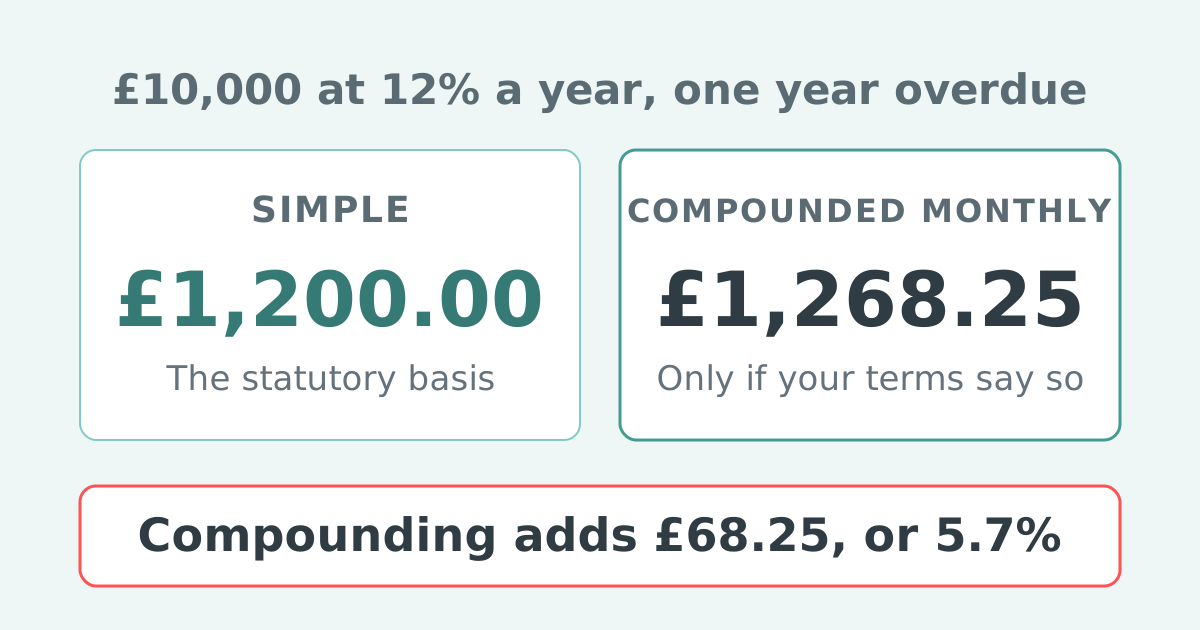
On £10,000 at 12% a year over twelve months, simple interest produces £1,200.00 and monthly compounding produces £1,268.25, a difference of £68.25 or 5.7% more interest.
Run your own numbers below. The basis selector changes how the interest is built, and the comparison line underneath shows all three at once.
Set your own rate. Any rate you charge has to be in your payment terms before the invoice is raised.
Written out, so you can check the numbers.
An invoice of £10,000, 365 days overdue, at 12% a year.
Monthly compounding adds £68.25 over a full year, which is 5.7% more interest. That is the size of it. Compounding is not the difference between collecting and not collecting, and anyone selling it as a step change in recovery is overstating it.
Where it does matter is at the daily level, which is the number your customer feels. At simple interest the debt costs them £3.29 a day. Compounded monthly, by the end of the first year, it costs £3.69 a day and keeps climbing.
In the UK and the EU the right to charge is statutory and automatic, and the statutory basis is simple. Almost everywhere else the right is contractual from the start, which means compounding is available to you on exactly the same footing as any other rate: whatever your terms say, tested under contract law if it is disputed.
| Market | Basis | Can you compound? |
|---|---|---|
| UK | Statutory. Base rate plus 8%, fixed in six-month blocks, plus £40, £70 or £100 per invoice | Only under your own terms, as a substantial contractual remedy |
| EU | Statutory under Directive 2011/7/EU. ECB reference rate plus at least 8 points, plus €40 minimum | Only under your own terms |
| US | State by state, usury caps apply | Contractual, but usury caps bite on the effective rate, and compounding raises it |
| Australia | Contractual. No statutory B2B rate | Yes, if in your terms and proportionate |
| New Zealand | Contractual. Contract and Commercial Law Act 2017 | Yes, if in your terms |
| Canada | Contractual, federal and provincial variation | Yes, but state the annual equivalent rate, not just a monthly percentage |
| South Africa | Prescribed Rate of Interest Act as a statutory fallback | Contractual, subject to National Credit Act caps |
| Singapore | Common law, still applying the older genuine pre-estimate test | Yes, if it remains a genuine pre-estimate of loss rather than a penalty |
The penalty rule applies wherever you rely on your own contract rather than a statutory right, and that includes the UK the moment you set your own rate instead of taking the statutory one. A charge that is out of all proportion to your legitimate interest in being paid on time can be struck down. Compounding raises the effective annual rate, so it moves you closer to that line. In the United States it can also push the effective rate through a state usury cap even when the stated rate looks compliant. Our guide to late fee laws by US state has the caps.
Compounding earns more and is harder to explain. Simple interest plus a fixed fee reconciles to an obvious calculation and waives cleanly. Neither is wrong. Inheriting the setting without noticing is.
Compounding earns more and is harder to explain. A customer who queries an invoice for £1,268.25 when they can calculate 12% of £10,000 themselves will ask why the figure is higher, and you will spend the call on arithmetic rather than on when they are going to pay.
Simple interest plus a fixed fee is easier to justify and easier to waive cleanly. The number reconciles to an obvious calculation, and the fixed fee is what makes a small invoice worth following up at all. Whichever you pick, it has to match what your payment terms on the invoice actually say.
Neither is wrong. What is wrong is inheriting the setting without noticing, then discovering it during a difficult conversation. Look at the setting, decide, and write the decision into your terms.
Compounding is a pricing decision dressed up as a technical setting. Treat it like a pricing decision: pick it on purpose, put it in the terms, and be ready to explain it.
In Paidnice the basis is a setting on the fee policy rather than something you calculate per invoice.
Setting it up is one policy on one customer group, and the basis is one dropdown on the same screen as the rate.
For multiple invoices and several calculation methods, use the advanced late payment interest calculator. For the current UK statutory figure, use the UK statutory interest calculator.
Can you charge interest on unpaid interest?
Only if your terms of business say so. UK statutory interest is simple, so relying on the Act alone gives you interest on the debt and nothing further.
Does UK statutory interest compound?
No. The Late Payment of Commercial Debts (Interest) Act 1998 provides simple interest at 8% above the Bank of England base rate, calculated on the overdue amount.
How much does compounding actually add?
On £10,000 at 12% a year, compounding monthly adds £68.25 over twelve months compared with simple interest. The gap widens the longer the debt runs.
Is monthly or annual compounding better?
Monthly produces more, and is the norm where compounding is used at all, because most businesses raise interest charges monthly anyway. Annual compounding does nothing at all in the first year.
What wording do I need?
Terms that state interest runs on the outstanding balance with any earlier interest rolled in, at a stated annual rate, from the due date until the debt is cleared. Have a solicitor adapt it for your jurisdiction.
Paidnice is accounts receivable automation that enforces your payment terms, trusted by thousands of businesses on Xero and QuickBooks. Credit control and debtor management, run for you.
Try it Now - It's FreeNo card required.





Optimize your cash flow with our suite of financial tools designed for AR professionals. Calculate DSO, aging analysis, late fees, and more.