

Most MSPs invoice on net 30. The MSPs that get paid on time bill recurring services in advance, due on receipt with autopay, keep net 15 to 30 for projects and hardware, and enforce a late fee clause from the first overdue day.
This guide gives you the exact terms by revenue type, the clause wording to put in your MSA, and the statutory interest rules by country that most US-centric advice never mentions. Terms are one lever of five: the full system is in our guide to MSP credit control.
Net 30 in arrears is the industry default: deliver the month's service, invoice at month end, wait 30 days. It is the first term every template MSA reaches for, and nobody ever got questioned for choosing it.
The problem is what net 30 turns into. Atradius' payment practices research puts roughly half of all B2B invoices overdue in the US, with the average overdue invoice paid 20 days past due.
Apply that to net 30 arrears billing and the realistic cycle for a March service month is: work delivered through March, invoiced 31 March, due 30 April, actually paid around 20 May. You financed seven weeks of someone else's IT operation.
So treat net 30 as the ceiling you negotiate away from, not the standard you adopt by default.
Managed services should be billed in advance: the invoice for March goes out in the last week of February and is due on 1 March, before the work is delivered. Your agreement is a subscription; bill it like one. Nobody expects Microsoft to collect for M365 a month after use, and your seat-based agreement is no different.
Mechanically this means invoicing on a fixed calendar date (the 25th for the following month works well), prorating mid-month starts to the next full cycle, and moving existing clients across at renewal with a plain one-line explanation: "From July, invoices cover the month ahead, like every other subscription you run."
Advance billing is the change MSP owners brace hardest for, and the one that costs them the least. I have yet to hear of a client worth keeping who left over it. The pushback, when it comes, is about the switchover month, not the principle.
Which billing model runs underneath these terms is a separate decision, and the invoicing accuracy that stops clients from having an excuse to hold the invoice is covered in the MSP billing guide.
One set of terms for everything is how MSPs end up financing hardware. Different revenue carries different risk, so the terms should differ too.
| Revenue type | Terms that work | Deposit | Autopay | Why |
|---|---|---|---|---|
| Recurring agreements | Billed in advance, due on receipt | None (first month up front) | Mandatory | It is a subscription. Collect it like one. |
| Projects and onboarding | Net 15 to 30 on milestones | 30 to 50% up front | Offered | Milestones cap your exposure; the deposit proves commitment. |
| Hardware and procurement | Prepaid, or 100% on order | Full amount | n/a | You should never own stock a client changed their mind about. |
| License pass-throughs | Prepaid, always | Full amount | Mandatory | Microsoft bills you regardless. Stop financing their licenses. |
| Out-of-scope T&M | Net 15, invoiced weekly | None | Offered | Small, frequent invoices age badly. Keep them short and current. |
A late fee exists to make the due date real. For it to work it has to be written into the agreement, quoted on the invoice, and applied without ceremony the day the invoice goes overdue. The legal footing is different in each of the markets MSPs sell into, and this is the part almost every US-written guide skips.
| Market | Late payment interest | What your contract needs |
|---|---|---|
| United Kingdom | Statutory: 8% a year plus the Bank of England base rate, plus fixed compensation of £40, £70 or £100 per invoice by debt size (Late Payment of Commercial Debts Act) | Nothing. The right exists by law for B2B debts, contract or not. State on invoices that you exercise it. |
| United States | Contractual. 1 to 2% per month is typical for B2B; 1.5% is the common midpoint. Some states cap rates or require grace periods | A late fee clause in the MSA, restated on every invoice. Check your state's cap. |
| Australia | Contractual only. No general statutory right to interest on late B2B invoices | Late payment interest written into your terms of trade before supply, or you cannot charge it. |
| Canada | Contractual only, and rate-capped. No general statutory B2B interest. Interest Act s.4 allows no more than 5% a year on any rate quoted per month unless the contract states the equivalent annual rate | Write it as "1.5% a month (18% a year)", and put it in signed terms, not just an invoice footer. The annual figure is what makes the monthly rate enforceable. |
| New Zealand | Contractual only. Courts can award interest, but there is no automatic entitlement | Same as Australia: the clause is the entitlement. |
The UK figures and the £40 to £100 compensation tiers are set by the Late Payment of Commercial Debts (Interest) Act. The statutory rate is the Bank of England base rate plus 8 percentage points, which is 3.75% + 8% = 11.75% a year at the 2026 reference dates.
Worked example: a £10,000 invoice paid 60 days late. Statutory interest is £10,000 × 11.75% × 60 ÷ 365 = £193.15. The debt is £10,000 or more, so fixed compensation adds £100. Total: £293.15 you are legally owed on that one invoice.
Simple interest at base rate + 8% a year, not compounding: amount × rate × days ÷ 365. Fixed compensation is £40 under £1,000, £70 from £1,000 to £9,999.99, and £100 at £10,000 or more, per invoice.
The reference base rate is the rate in force on the previous 31 December or 30 June, and it stays fixed for the life of that debt even if the Bank moves the base rate afterwards. A guide, not legal advice.
Paidnice tracks the Bank of England base rate automatically, so UK late fees stay compliant without anyone re-reading the legislation. That auto-indexing does not exist in any PSA or payment portal we know of.
The MSPs who get the most out of a late fee clause never argue about it. The fee lands automatically on the first overdue day, and the account manager waives it deliberately, in exchange for payment today, with the reason written on the account. Charging is a system behavior; waiving is a decision a person makes and records.
Clause wording to adapt with your lawyer:
Invoices unpaid after the due date accrue a late payment charge of 1.5% per month (18% per annum), or the maximum permitted by law if lower, calculated daily from the due date until payment. [Provider] may suspend performance under clause [X] while any invoice remains overdue.
[Provider] will exercise its statutory right to interest and compensation under the Late Payment of Commercial Debts (Interest) Act 1998 on any invoice unpaid after the due date, at 8% per annum above the Bank of England base rate, together with the fixed sum applicable to the debt.
New managed services clients sign an ACH or direct debit authority with the MSA. Card autopay with a surcharge where your region allows it is the fallback, and paying invoices manually is the exception, not a preference you cater to.
That single onboarding decision removes the collection problem for every client who signs it, which is why it belongs in the contract rather than in a polite email two years later.
For existing clients, use a three-strikes conversion: the third late payment in six months triggers a written requirement to move to autopay for continued service. It is a fair rule, it is easy to communicate, and it turns your worst payers into your best ones.
The rails are commodity at this point: GoCardless or direct debit in the UK, ACH in the US, and Stripe or Pinch behind your Paidnice payment portal all do the job.
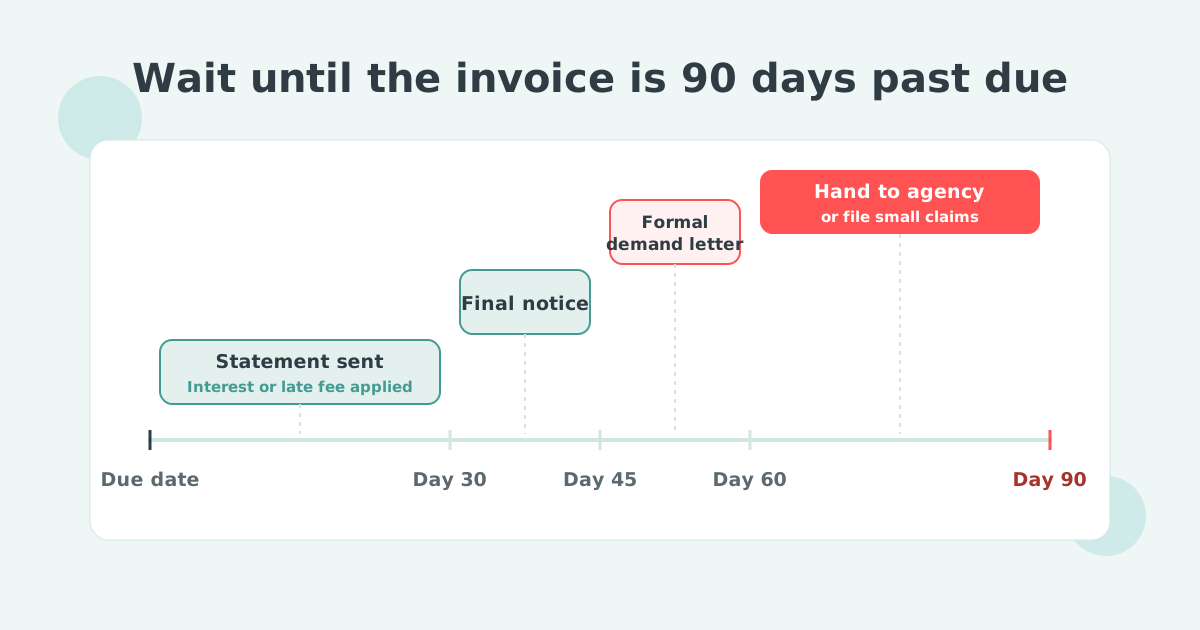
Any client whose monthly agreement would hurt if it went unpaid for 90 days deserves five minutes of credit checking before you offer terms.
For project work, a deposit of 30 to 50% up front is the convention we see in the MSP quotes that cross our desk, rather than a published standard. A client who resists a deposit is telling you something about how they intend to treat the final invoice.
Annual prepay in exchange for a modest discount can work for stable clients, though plenty of MSPs skip discounts entirely and simply hold the line on advance billing. Both positions are defensible; undiscounted arrears billing is not.
Suspension is the consequence that makes everything else credible, so the clause has to be precise. It needs four elements:
If any invoice remains unpaid [30] days after its due date, [Provider] may, on [5] business days' written notice, suspend the Services other than [security monitoring, managed backup and third-party license continuity] until all overdue amounts are paid. Suspension does not relieve the Client of its payment obligations, and time under suspension counts as service delivered for billing purposes.
The process that should happen long before this clause fires, including the credit-hold step that pauses projects while support carries on, is mapped day by day in the MSP collections process.
Terms only change behavior if they are enforced on every invoice, and no owner has the appetite to hand-apply a late fee to a client they had a beer with last month.
That is the actual job Paidnice does: it reads every invoice in Xero or QuickBooks Online, checks it against your rules, and runs the consequences without anyone having to be firm in person. That means late fees and interest, reminders from your own domain, statements and escalations.
Customers cut their average wait for payment in half within 30 days of turning that on. The policy is the bad guy, which is precisely the point. Where this layer sits next to your PSA and your ledger is mapped in our guide to the three MSP tool layers.
What payment terms do MSPs use?
Net 30 billed in arrears is the most common arrangement, but the trend among well-run MSPs is advance billing for recurring services, due on receipt with mandatory autopay, with net 15 to 30 reserved for project milestones and prepayment for hardware and licenses.
Can an MSP charge late fees?
Yes, with regional differences. In the UK, statutory interest of 8% plus the Bank of England base rate applies to B2B debts automatically. In the US it is contractual, typically 1 to 2% per month, with state caps. In Australia, Canada and New Zealand it only works if it is in signed terms before supply, and Canada also needs the equivalent annual rate stated.
Should MSPs require autopay?
For recurring agreements, yes. Make ACH or direct debit authority part of onboarding for every new client, and convert existing clients after repeated late payment. MSPs that mandate autopay for new business stop having a collections problem on the recurring side of the book almost immediately.
Can an MSP legally suspend service for non-payment?
Yes, if the MSA says so. The clause needs a clear trigger, written notice with a cure period, and carve-outs for security and backups so suspension never creates disproportionate harm. Suspend without the contractual right and you trade a payment dispute for a liability one.
See how enforcement runs hands-off: Paidnice pricing starts at US$69 a month flat, with local pricing in seven currencies, and most MSPs are live in about 15 minutes.
This guide is part of a set on MSP credit control. Each piece stands alone; together they cover the whole system.
Paidnice is accounts receivable automation that enforces your payment terms, trusted by thousands of businesses on Xero and QuickBooks. Credit control and debtor management, run for you.
Try it Now - It's FreeNo card required.



Optimize your cash flow with our suite of financial tools designed for AR professionals. Calculate DSO, aging analysis, late fees, and more.