
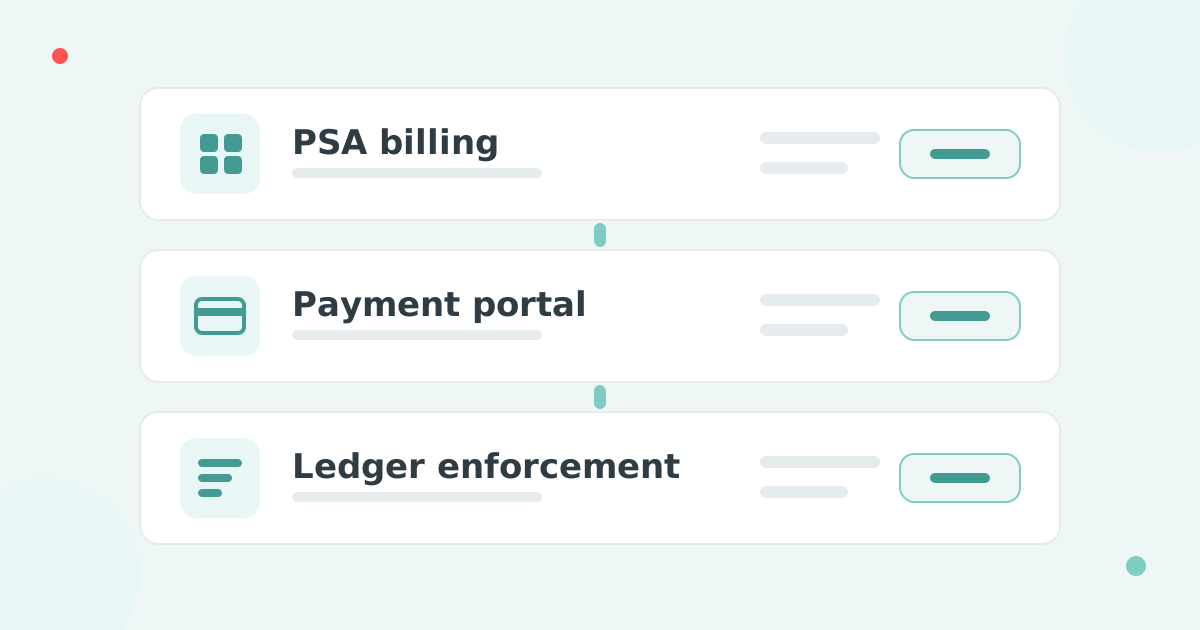

MSP billing software, the tooling a managed service provider uses to invoice clients and get paid, splits into three layers: the PSA that generates invoices, a payments platform that collects them, and an AR enforcement layer on Xero or QuickBooks that chases, charges late fees and escalates. Most MSPs need two of the three.
This guide maps the layers, prints the pricing vendors actually publish, and gives a decision path by stack, including where each layer stops being the answer.
Every tool the MSP community argues about on Reddit slots into one of three layers. Once you see the layers, the shortlists build themselves.
Tooling is the last mile of a wider system. The terms, the ladder and the fees are policy decisions before they are software ones, which is the subject of the complete MSP credit control guide.
PSA billing turns agreements, tickets and seat counts into invoices. ConnectWise PSA, Autotask, HaloPSA, Kaseya BMS, Syncro, SuperOps and N-able MSP Manager all do this, so if you run one of them you already own layer 1. The work is keeping agreements true, which is the subject of our guide to MSP billing models and billing accuracy.
Adjacent specialists like Rev.io and Zomentum extend this layer for telecom-style usage rating and cloud reselling. What layer 1 does not do is get the invoice paid.
Payment platforms make paying easy: branded client portals, saved payment methods, ACH and card rails, autopay against PSA invoices, and reconciliation back to the ledger. This is FlexPoint, Alternative Payments, ConnectBooster (Kaseya), WisePay and Wise-Sync in ConnectWise shops, BenjiPays, and Bill360.
Gradient MSP sits nearby on billing reconciliation. If your clients want to pay you and merely find it awkward, layer 2 is your gap.
The enforcement layer assumes the invoice exists and payment is possible, and supplies the discipline:
It reads the accounting platform rather than the PSA, which is why it survives a PSA migration untouched. Paidnice, Chaser, Upflow and ezyCollect all sit in this layer; the general AR tools serve it without the MSP-specific framing.
Late fees only give you leverage if your contract grants them, so fix the paperwork first: see MSP payment terms and late fee clauses by country. For the chase itself, the MSP collections process has the day-by-day ladder and the templates.
If invoices are accurate and easy to pay but still get paid late, layer 3 is your gap.
| Layer | Does | Does not | Typical names |
|---|---|---|---|
| 1. PSA billing | Agreements to invoices: seats, tickets, proration, contract billing | Chase, enforce terms, or make paying pleasant | ConnectWise PSA, Autotask, HaloPSA, Kaseya BMS, Syncro, SuperOps |
| 2. Payment platform | Portals, saved methods, ACH/card rails, autopay, reconciliation | Apply late fees, run escalation ladders, or fix billing accuracy | FlexPoint, Alternative Payments, ConnectBooster, WisePay, BenjiPays, Bill360 |
| 3. AR enforcement | Reminder ladders, late fees and interest, statements, plans, escalation | Generate the invoice or process the card (rails stay with Stripe/Pinch etc.) | Paidnice, Chaser, Upflow, ezyCollect |
The practical conclusion: an MSP with a PSA and a payment processor is one layer short, and it is almost always layer 3.
A PSA makes the invoice. A portal makes paying easy. Neither of them ever makes not paying expensive.
"We have ConnectWise and Stripe and clients still pay at day 50" is the sentence we hear most often on MSP demo calls. The invoice was correct and paying it was easy. Nothing happened when it went unpaid, and nothing was ever going to.
The quiet scandal of this category is pricing opacity: most vendors selling billing efficiency will not put a number on their own pricing page. Everything below was checked against vendor websites on 21 July 2026. "Sales-led" means no public price existed on the day we looked.
| Tool | Layer | Built around | Best for | Published pricing (checked 21 Jul 2026) |
|---|---|---|---|---|
 Alternative Payments Alternative Payments | 2. Payment platform | ConnectWise / Autotask / Halo + QBO, Xero | PSA-native portals and autopay with pricing you can see up front | AR plans $199/month (to $50k volume) and $499/month (to $100k); custom above |
 Chaser Chaser | 3. AR enforcement | Accounting platforms incl. Xero / QBO | Larger finance teams past £4m turnover that want reminder-led credit control | From £199/month (about $259); higher tiers £599 and £899/month |
 ConnectBooster ConnectBooster | 2. Payment platform | Kaseya / Autotask / ConnectWise ecosystems | Kaseya and Autotask shops that want the long-established portal | Sales-led via Kaseya; no public pricing |
 FlexPoint FlexPoint | 2. Payment platform | PSAs + QBO, Xero | ACH-first collection and client financing inside the PSA workflow | Plan fees sales-led; publishes ACH transaction fees ($1 / $0.50 / $0.25 by tier) |
 Paidnice Paidnice | 3. AR enforcement | Xero / QuickBooks Online, under any PSA | MSPs on Xero or QBO whose gap is enforcement: late fees, reminder ladders, escalation | From £49 / US$69 a month (150 invoices); no per-seat fees, local prices in 7 currencies |
 ti3 ti3 | 3. AR recovery sequences | Recovery workflows on top of your invoicing | Recovering aged receivables without handing them to an agency | Self-serve $49/month (or 99c per invoice); managed from $499/month |
 Upflow Upflow | 3. AR (analytics-led) | Accounting platforms / ERPs | AR visibility and analytics for a team that still chases manually | Free entry tier; paid plans sales-led, no public prices |
Layer 2 first: FlexPoint, Alternative Payments or ConnectBooster will give clients a portal and autopay against PSA invoices, and that alone shortens the cycle. Add layer 3 when you notice the pattern that portals do not fix: the clients who can pay easily and still choose not to.
Layer 3 first. Your billing already lands in Xero; the gap is consequences. An enforcement layer adds the ladder, late fees and statements in an afternoon, without touching the PSA.
HaloPSA or Syncro billing into Xero, with a handful of clients who always pay around day 45, is the most common MSP profile we see. The fix is almost never a new PSA or a new portal. It is a ladder and a late fee that nobody has to decide to send.
Skip layer 2 for now. Your ledger plus Stripe or GoCardless is your payment rail, and a layer 3 tool is the whole credit control department: reminders, fees, statements, plans. Add the PSA when ticket volume demands it, and your AR layer will not notice the migration.
You are leaving the SMB tooling zone: look at Invoiced and the enterprise AR platforms, or a layer 2 + 3 pairing with the multi-entity add-ons. Be honest about this boundary. Tools built for a two-person finance function feel thin at enterprise volume, Paidnice included below its Custom plan.
Paidnice is the layer 3 enforcement engine for MSPs on Xero or QuickBooks Online. It reads every invoice against your rules and acts on the ones that break them, with different policies per client group.
It won the 2025 Xero Global Small Business App of the Year award, holds 4.9 on Capterra, and starts at £49 / US$69 a month. Most MSPs are live in about 15 minutes.
The result, when it lands: 3IT Consulting, an MSP on Xero, cut late payments by 60 to 70% and now sees most invoices paid within 14 days.
Where it is not the answer:
If you want the tools ranked rather than categorized, the best credit control software for MSPs puts the layer 3 field in order, Paidnice included.
MSP payment processing is the rails-and-reconciliation slice of layer 2: accepting ACH and card payments against invoices, saving mandates for autopay, and writing the result back to the PSA and ledger. Two buying notes.
That second note is the quiet argument for running layer 3 on the ledger instead of inside the payment platform.
What software do MSPs use for billing?
Most MSPs bill from their PSA (ConnectWise PSA, Autotask, HaloPSA, Kaseya BMS, Syncro or SuperOps) and sync invoices to QuickBooks Online or Xero.
From there they add a payment platform (FlexPoint, Alternative Payments, ConnectBooster) or an AR enforcement layer (Paidnice, Chaser), depending on whether their gap is payment friction or payment discipline.
What is the best MSP billing software?
There is no single answer, because the category is three different jobs. The strongest stack for a typical SMB-market MSP is your existing PSA for invoice generation, ACH-first rails or a payment platform for collection, and an AR enforcement layer on the ledger for reminders, late fees and escalation.
For the enforcement layer ranked rather than categorized, see the best credit control software for MSPs.
Does Xero handle late fees and invoice chasing on its own?
Xero sends basic invoice reminders, but it has no built-in way to apply late fees or interest automatically. The feature request has been open on Xero's product ideas forum since 2012 with over a thousand votes, and Xero has said there are no committed plans, pointing users to manual line items or third-party apps.
That gap is precisely what the enforcement layer exists to fill.
What does MSP AR software cost?
Published entry points in July 2026 run from £49 / US$69 a month (Paidnice) to £199/month (Chaser) at the enforcement layer, and $199 to $499/month for Alternative Payments' AR plans at the payments layer, with FlexPoint, ConnectBooster and most others sales-led.
Expect transaction fees on top wherever card or ACH rails are involved, and verify current pricing on the vendor's site.
If the gap is enforcement, Paidnice is the 15-minute version: connect Xero or QuickBooks, set the rules, and let the policy be the bad guy.
This guide is part of a set on MSP credit control. Each piece stands alone; together they cover the whole system.
Paidnice is accounts receivable automation that enforces your payment terms, trusted by thousands of businesses on Xero and QuickBooks. Credit control and debtor management, run for you.
Try it Now - It's FreeNo card required.

Optimize your cash flow with our suite of financial tools designed for AR professionals. Calculate DSO, aging analysis, late fees, and more.