
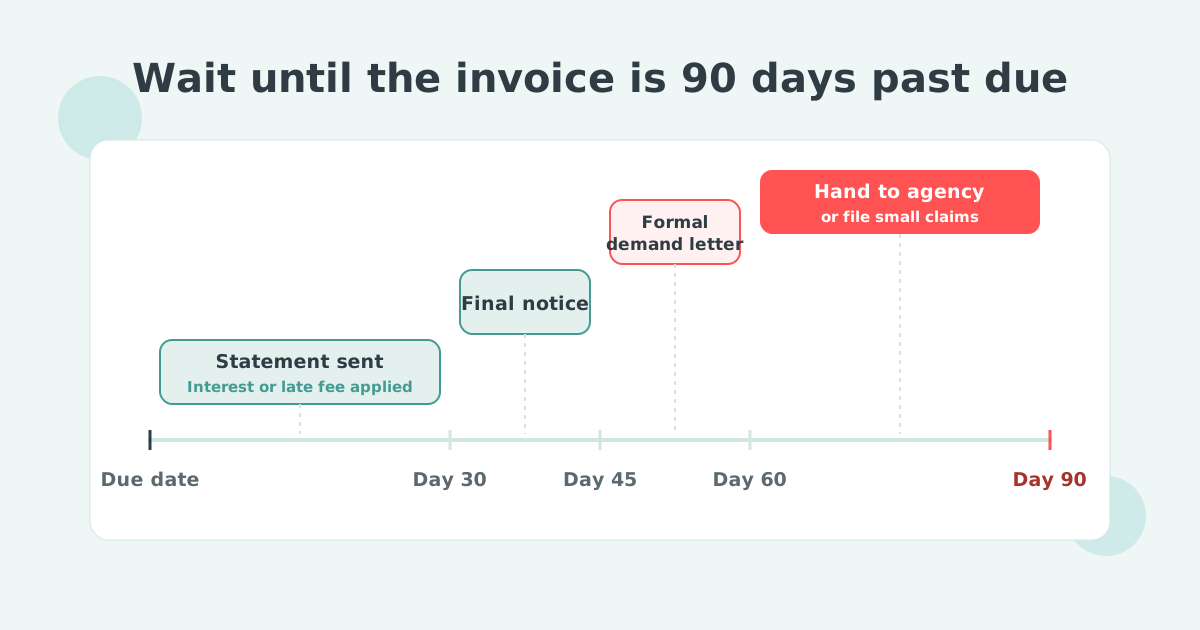

Send an overdue invoice to a collection agency at 90 days past due, or at 60 days if the customer has stopped responding, and only after a statement, a final notice and a formal demand have been ignored. Later, the debt loses value. Earlier, you pay 15% to 45% for a debt you could still collect.
The 60 to 90 day figure appears in every ranking guide, usually without the dates behind it. This page maps the number to a dated ladder for four markets, sets the agency fee against the cost of waiting, and lists the four things that must be on file before day 60.
Wait until the invoice is 90 days past its due date, or 60 days if the customer has gone silent. Count from the due date; the invoice date does not start the clock. Every rung below the agency has to be dated and ignored before you hand the account over.
90 days is the figure most collection agencies and business publishers give (Summit). The reason is arithmetic: a debt is easiest to collect when it is fresh, and each month of silence lowers the recovery rate while the agency's percentage stays the same.
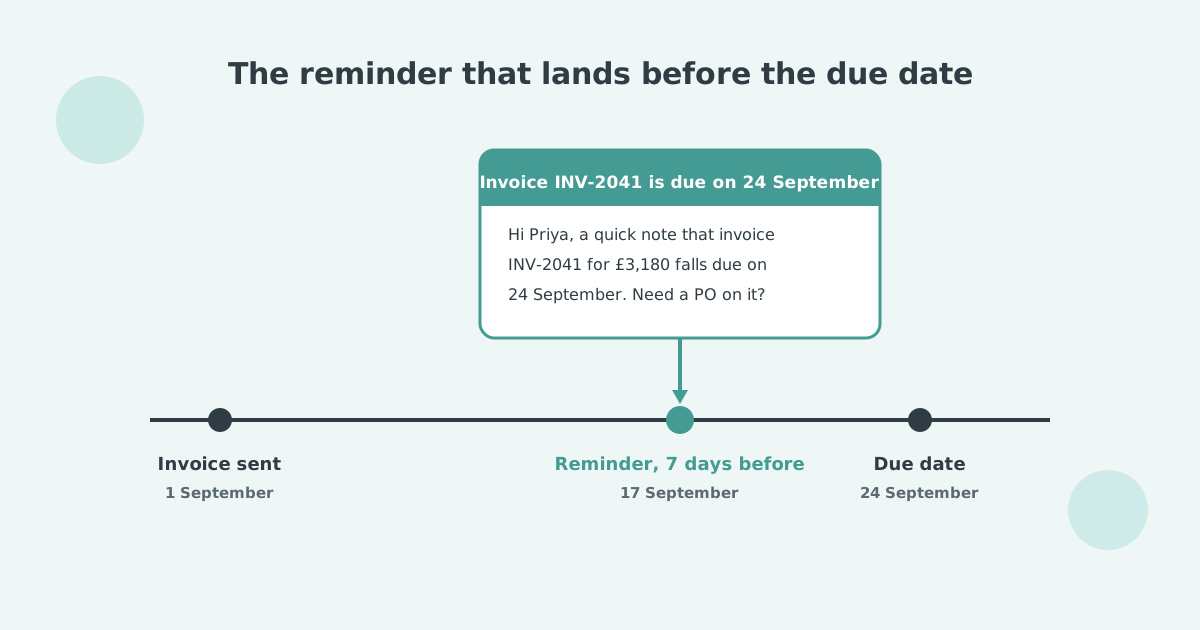
Inside those 60 to 90 days, a common reminder cadence is four to six touches: pre-due, due date, then around 3, 7, 14 and 30 days overdue (source: bill.com payment reminder guide). A final notice follows the last reminder, then the formal demand, then the agency. Three situations move the day count.
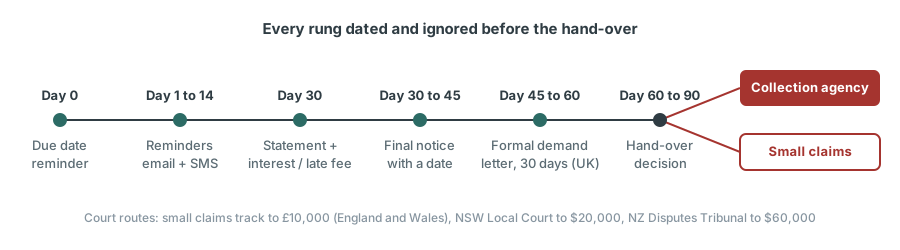
Send it when four things are already on file: a statement showing the full balance, interest or a late fee posted to the account, a final notice with a deadline that has passed, and a formal demand letter that went unanswered.
An agency's first act is to write to the customer with the debt, the interest and a deadline. If your own file already contains all of that, the agency starts from strength and the customer has no procedural gap to hide in. If it does not, you are paying an agency to do your day-30 work.
| Must have happened | Why it matters at the agency | Typical day |
|---|---|---|
| Statement sent | Shows the whole balance across every open invoice, and dates the customer's knowledge of it. | Day 1 to 30 |
| Interest or late fee applied | In the UK statutory interest accrues from the day after the due date with no notice required. A fee on the ledger is a receivable the agency can collect too. | Day 1 to 30 |
| Final notice | Names the consequence (agency, court) and gives a date. Without it the agency letter is the customer's first warning. | Day 30 to 45 |
| Formal demand letter | Letter of Claim (UK, 30 days to respond under the Pre-Action Protocol), letter of demand (AU, NZ), demand letter (US). Required before court in the UK; expected everywhere. | Day 45 to 60 |
| Hand to agency or file small claims | The account is complete and every step is dated. | Day 60 to 90 |
Templates for the demand rung are already on this site: the letter before action template for the UK, the letter of demand template for Australia and New Zealand, and the wider collection letter templates set for the earlier rungs.
The 60 to 90 day trigger holds in every market. What changes is the legal step beside the agency, the interest you can add, and the limitation period that ends the whole exercise.
| Market | Interest and fixed sums | Demand step | Court alternative | Limitation |
|---|---|---|---|---|
| UK (B2B) | 8% plus Bank of England base rate under the Late Payment of Commercial Debts (Interest) Act 1998, automatic from the day after due; fixed sums of £40, £70 or £100 per invoice by size (Insolvency Service technical manual, chapter 31) | Letter of Claim, 30 days, Pre-Action Protocol for Debt Claims, in force since 1 October 2017 (Ministry of Justice) | Small claims track to £10,000 | 6 years, Limitation Act 1980 s5 |
| Australia | Contractual only: the rate must be in your terms | Letter of demand, per ASBFEO's ladder: reminders, negotiation, letter of demand, then agency | NSW Local Court Small Claims Division to $20,000; filing fee $179 individual, $358 corporation (NSW Local Court fee schedule) | 6 years in NSW, Vic and Qld |
| New Zealand | Contractual only | Letter of demand before filing | Disputes Tribunal to $60,000 from 24 January 2026; $468 fee on the top tier, recoverable if you win (NZ Ministry of Justice) | 6 years, Limitation Act 2010; restarts on part-payment or written acknowledgement |
| US (B2B) | Contractual only; the FDCPA covers consumer debt, not business debt (CFPB) | Demand letter, standard pre-litigation step | Small claims limits vary by state: California $6,250 for businesses, Texas $20,000, New York $10,000 in NYC | 3 to 10 years by state for written contracts |
Two UK notes. The Small Business Commissioner runs a free complaints service for small suppliers unpaid by larger customers, and its help stops once legal action starts, so use it before day 60. The Commissioner also recommends choosing an agency that is a Credit Services Association member.
Two Australian notes. The joint ACCC/ASIC Debt Collection Guideline (ASIC RG 96) governs contact hours, methods and frequency for any agency you engage, and bans harassment and misleading conduct. Interest is contractual, so if your terms are silent there is nothing to add: see late fees in Australia and late fees in New Zealand for the terms wording.
A commercial agency commonly charges 15% to 45% of what it recovers (industry guide). The fee is a fixed percentage; the amount it applies to shrinks every month you wait.
Published recovery rates by debt age come from vendor blogs with no primary study behind them, so this page does not quote them. A debt at day 90 is easier to collect than the same debt at day 180.
Here is the arithmetic on a £5,000 UK B2B invoice handed over at day 90, against the same invoice collected by your own ladder at day 45.
| Line | Collected in-house at day 45 | Agency at day 90, 25% contingency |
|---|---|---|
| Invoice | £5,000.00 | £5,000.00 |
| Statutory interest, 8% plus the 3.75% Bank of England base rate | £72.43 (45 days at 11.75%) | £144.86 (90 days at 11.75%) |
| Fixed sum, £1,000 to £9,999.99 band | £70.00 | £70.00 |
| Agency fee on the amount recovered | £0.00 | £1,303.71 |
| You keep | £5,142.43 | £3,911.15 |
Change the figures for your own invoice. The calculator loads with the same numbers as the table.
Your ladder collecting at one day count, against an agency at a later one. Loads with the £5,000 example above.
Waiting for the agency costs you £1,231.28 on this invoice, and assumes the debt is still fully collectable on the day it is placed.
Simple interest, actual days over 365. UK fixed sums: £40 under £1,000, £70 to £9,999.99, £100 from £10,000. Outside the UK interest is only what your terms state, so enter your contractual rate. General information, not legal advice.
The gap is £1,231 on one invoice, and the agency column assumes the debt is still collectable at 90 days. The interest and the fixed sum are yours under the 1998 Act whether or not an agency is involved; the worked figures and band thresholds are in late payment fees in the UK.
The scale of the problem is why the day count matters. Intuit's 2026 US report found 59% of small businesses have invoices 30 or more days overdue, and the average business is owed $17,700 (Intuit QuickBooks, July 2026).
Xero's Small Business Insights for the June 2026 quarter put average days late at 8.3 in the UK, 6.0 in Australia and 4.7 in New Zealand. Most invoices never reach day 60. The ones that do are the ones this ladder is for.
The agency writes to and calls the customer in your name or its own, takes its fee from what it recovers or bills you separately, and reports back. The decision about what the customer is afterwards stays with you.
What is the 7-in-7 rule? It is a US Regulation F limit: a collector of consumer debt is presumed to break the rules if it calls about a consumer debt more than seven times in seven days. It covers consumer debt only, not business invoices (CFPB, 12 CFR 1006.14).
Two things to ask before you sign with an agency: whether the fee applies to payments the customer makes directly to you after placement, and whether the agency can settle for less than the full amount without your approval. Get both answers in the agreement.
The agency decision is easy when every earlier rung has fired on its own, on the day it was meant to, with the evidence on the ledger. That is the part software does; the hand-over itself stays a human decision.
Insight: the agency needs the file
The accounts we see recovered fastest after placement are the ones where the customer already has a statement, a posted late fee and a dated final notice in their inbox. The agency letter is then the fourth warning the customer has received, and there is nothing left to argue about.
Paidnice runs the rungs below the agency from the ledger in Xero or QuickBooks Online.
Customers running the ladder this way cut their average wait for payment in half, within 30 days. Plans start at £49 a month (Essentials, GBP).
Where the agency fits: set the escalation at day 60, type Template Legal Letter, and the demand goes out with the whole file behind it. Day 90 is then a decision with evidence. For the wider ladder design, read the invoice escalation ladder and automatic invoice escalation for Xero and QuickBooks.
Do not hand over a disputed invoice, and do not wait past year one
A dispute pauses the ladder until it is answered in writing. On the other side, the limitation clock runs six years in the UK, Australia and New Zealand and as few as three in some US states. Most businesses lose the money long before that, at the point the customer stops answering and nobody sets a date for the next step. Set the date.
Paidnice is accounts receivable automation that enforces your payment terms, trusted by thousands of businesses on Xero and QuickBooks. Credit control and debtor management, run for you.
Try it Now - It's FreeNo card required.


Optimize your cash flow with our suite of financial tools designed for AR professionals. Calculate DSO, aging analysis, late fees, and more.