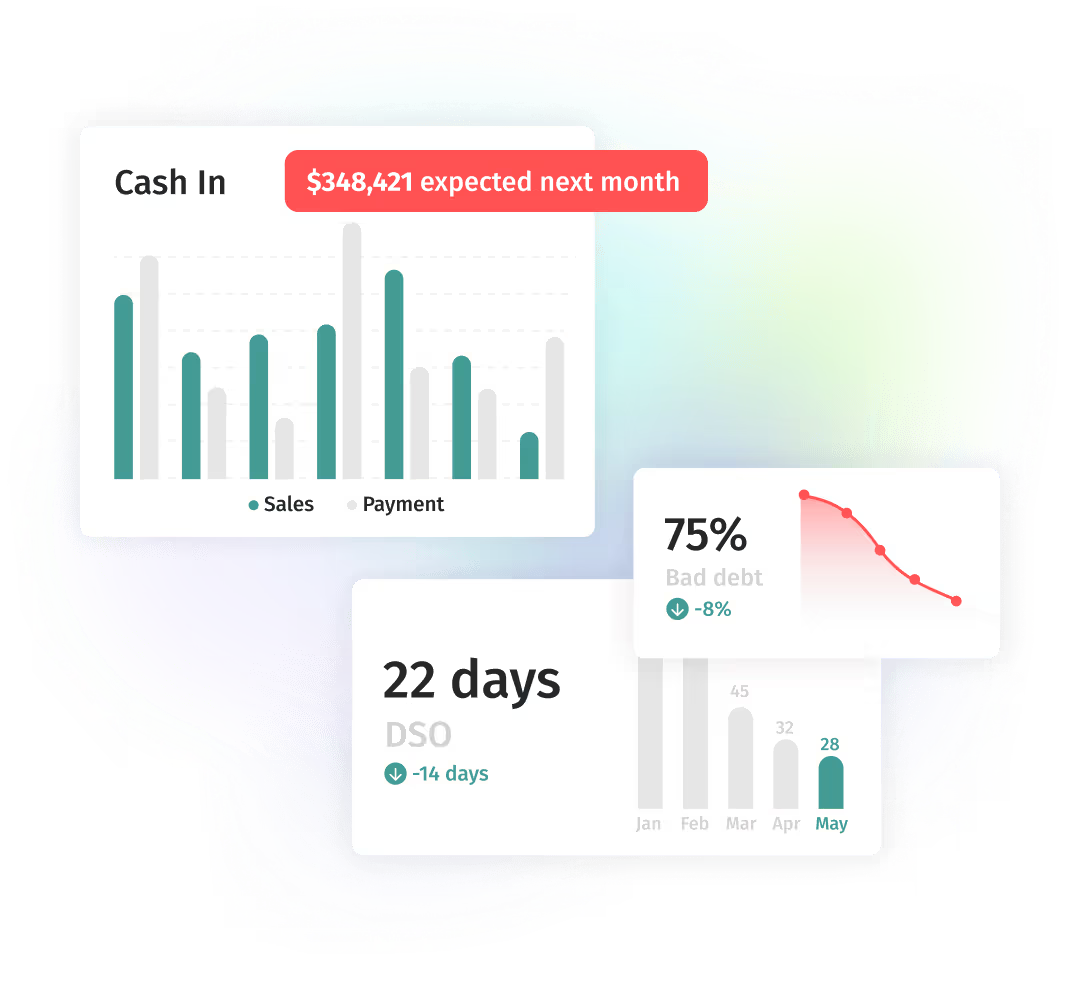
Paidnice automates invoice reminders, tracks accounts receivable and recovers overdue payments from the invoices already in your Xero organisation. Australian pricing starts at AUD 99 a month.
No credit card. Your first 20 actions are free.


Debtor management is the business process: setting credit terms, watching your ageing, following up, and escalating an account that will not pay. That is what most Australian search results explain, and it is a process question, not a product question.
Debtor management software is the buying decision. It automates invoice reminders, tracks accounts receivable and recovers overdue payments, working from the invoices on your ledger so every debtor gets the same follow-up without a person doing it by hand. Paidnice does this from your Xero organisation, and from QuickBooks Online where you run one.
Australian small businesses waited an average of 20.3 days to be paid in June 2026, and settled invoices 4.3 days late, in our own Australian receivables research built on Xero Small Business Insights. The national average hides the spread: mining waited 31.3 days in the same month and hospitality 8.3 days.
If your sector sits at the slow end, an average is not your number, and the fix is a follow-up that runs every week rather than when someone remembers. See also credit control software for the wider process, and debtor management for Xero for the ledger detail.
Email and SMS reminders send from your own address, in business hours, in your words. SMS is part of the plan rather than a separate product, charged at AUD 0.15 a message.

"Being able to send all communications directly from my own domain, everything looks fully branded and professional, with delivery tracking built in."
Fixed fees, a percentage or a per annum rate, with a grace period before anything applies. The charge is raised on the ledger, so it reaches your customer as a real invoice.
"First round of late penalties and everyone magically paid their bill."
Statements go out weekly or monthly with a payment link. An account still overdue, or over its credit limit, escalates to a named person. Customers view and pay on a branded portal.
"Within 1 week of implementing this tool we received a tidal wave of cash from overdue receivables."
Who each tool is built for, what it connects to, and what it is known for. Paidnice is listed alongside the others, in alphabetical order.
| Tool | Target | Integration | Key feature | Published monthly price |
|---|---|---|---|---|
| CreditorWatch Collect | Australian finance teams wanting credit risk data alongside collections | Xero, MYOB, QuickBooks | Overdue follow-up with CreditorWatch credit risk data attached | Not published on the product page |
| ezyCollect | Mid-market Australian businesses, often construction and business services | Xero, MYOB, QuickBooks | Accounts receivable automation with credit applications and credit checks | Not published on the product page |
| FeeSynergy Collect | Australian and New Zealand accounting and legal firms | MYOB practice software, Xero | Collections built around professional services billing and fee funding | Not published on the product page |
| Paidnice | Small and medium businesses on Xero or QuickBooks Online | Xero and QuickBooks Online | Reminders, statements, fees and escalation from the invoices already on the ledger | From AUD 99 a month, Essentials |
Paidnice plans are month to month, with no contract. Your first 20 actions are free, with no credit card and no time limit. An action is anything Paidnice performs: an email sent, an SMS sent, an escalation created, a late charge generated. Prices as at July 2026. See pricing.
1. Audit. Connect your Xero organisation and read what is already there: your debtor days, your oldest ageing buckets, and which customers make up most of the overdue balance. This takes minutes, and nothing sends while you look.
2. Configuration. Set the reminder timing before and after the due date. Set the grace period. Set the trading terms your late fees rest on, by customer group where different customers get different treatment.
3. Automation. Turn on the pre-due and overdue triggers. Start in approval mode, so you see every action before it goes, then let it run once the wording reads the way you want. Statements and automated customer statements follow the same schedule, and your customers pay on the customer payment portal.
The law worth knowing before you switch fees on. Australia has no statutory late payment interest rate for business-to-business invoices, so a fee stands on terms your customer agreed to before you supplied, and it must be reasonable rather than punitive.
Since 9 November 2023 the unfair contract terms reforms govern a term in a standard form small business contract, which is the regime a late fee clause now sits under (ASIC). Our post on late fees in Australia has the detail.
The Payment Times Reporting Scheme is not a job for your business. Reporting entities are large businesses with annual consolidated revenue of $100 million or more, and the reformed scheme commenced on 7 September 2024 (paymenttimes.gov.au). It matters to you in the other direction: it tells you which of your large customers must publish how fast they pay, before you set their terms.
Read the full comparison of debtor management software in Australia.Results across Paidnice customers
Paidnice runs every step. Reminders, late fees, statements and escalation follow the rules you set for each customer group, on the invoices already in your ledger.
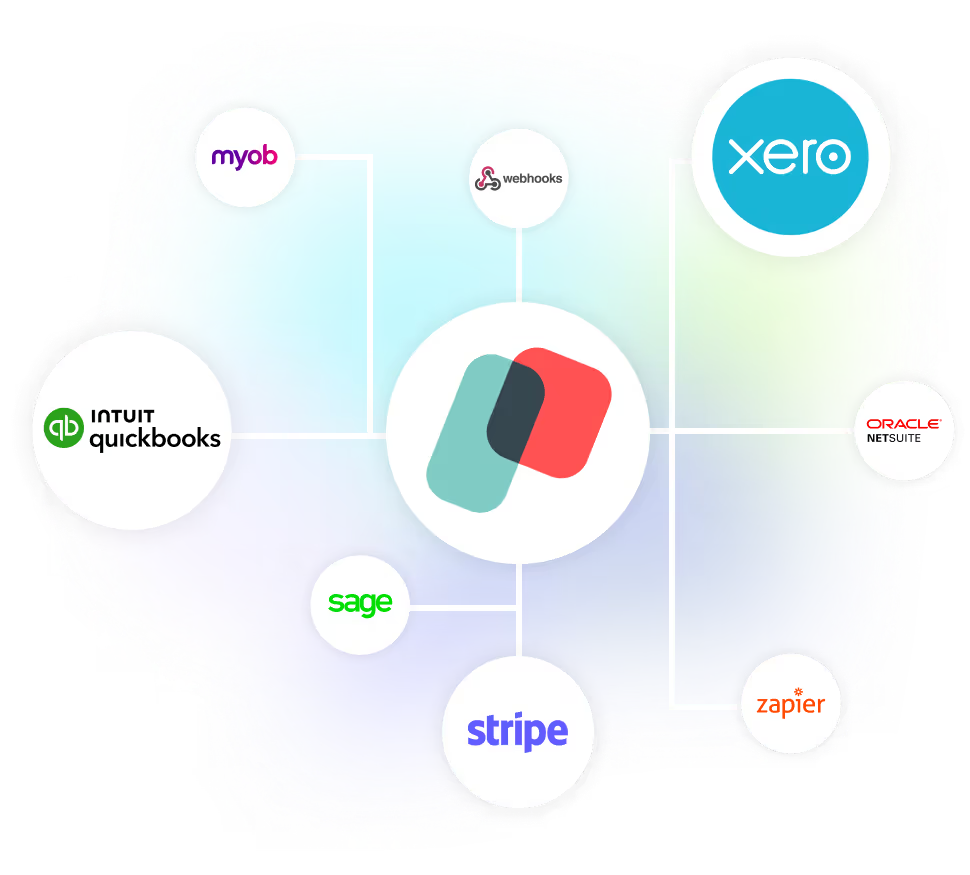
Nothing changes in Xero or QuickBooks unless a rule you set makes it happen. Paidnice connects through the official Xero and QuickBooks integrations, so we never see your accounting password.
It’s the debt collection system I’ve been looking for, for the last 15 years.


Within the first month of implementing Paidnice, we saw late customer payments decrease from over 20% to zero.
Alex Hamilton, Paintvine, New Zealand
Read the case study →
The biggest impact from using Paidnice has really been man hours for me. Just by using Paidnice, it's freed up loads and loads of time. We're talking five hours already of admin per month, and we're a scaling business. In a year, that could be 15 to 20 hours a month.
Jon Murphy, Salt Silo, United Kingdom
Read the case study →
Before Paidnice, over 25% of our payments were late, which we were manually chasing up. With Paidnice automating this for us, that has dropped to less than 5%
Louis Fourie, Venture Workspace, South Africa
Read the case study →Debtor management is the process of getting paid for work you have already done. It covers the credit terms you set, the ageing you watch, the follow-up you send on an overdue invoice, and the escalation when an account still will not pay. It is a process, run by a person or by software.
Debtor management software automates invoice reminders, tracks accounts receivable and recovers overdue payments. It works from the invoices already on your accounting ledger, sending reminders and statements, applying late fees, and escalating accounts that stay overdue. Paidnice does this from your Xero organisation or QuickBooks Online.
Xero holds the majority of the Australian cloud accounting market, with MYOB the next largest and QuickBooks Online also widely used. Paidnice connects natively to Xero and QuickBooks Online. MYOB is supported on the Custom plan.
No. A collections CRM is built for an agency working a book of purchased or assigned debt, with dialler queues and agent scripts. Debtor management software works your own ledger: your invoices, your customers, your trading terms. Paidnice is the second kind, and is not a debt collector.
There is no statutory late payment interest rate for business-to-business invoices in Australia. You can charge a fee or interest where your terms of trade provide for it and the customer agreed before you supplied, and the amount should be reasonable rather than punitive. Our post on late fees in Australia covers the detail.
Only if it is large. Reporting entities are businesses with annual consolidated revenue of $100 million or more, and the reformed scheme commenced on 7 September 2024. For a small business the value is the other way round: the public register shows how quickly your large customers pay their small suppliers.
A few minutes. Connect your Xero organisation in one click, choose a preset template, and preview your upcoming actions before anything sends. Approve each action at the start, then let the schedule run.
There is a free action period rather than a time-limited trial. Your first 20 actions are free, with no credit card and no time limit. Paid plans start at AUD 99 a month, priced by invoice volume rather than your revenue, and are month to month.
Debtor management software Australia
No credit card. Your first 20 actions are free.