
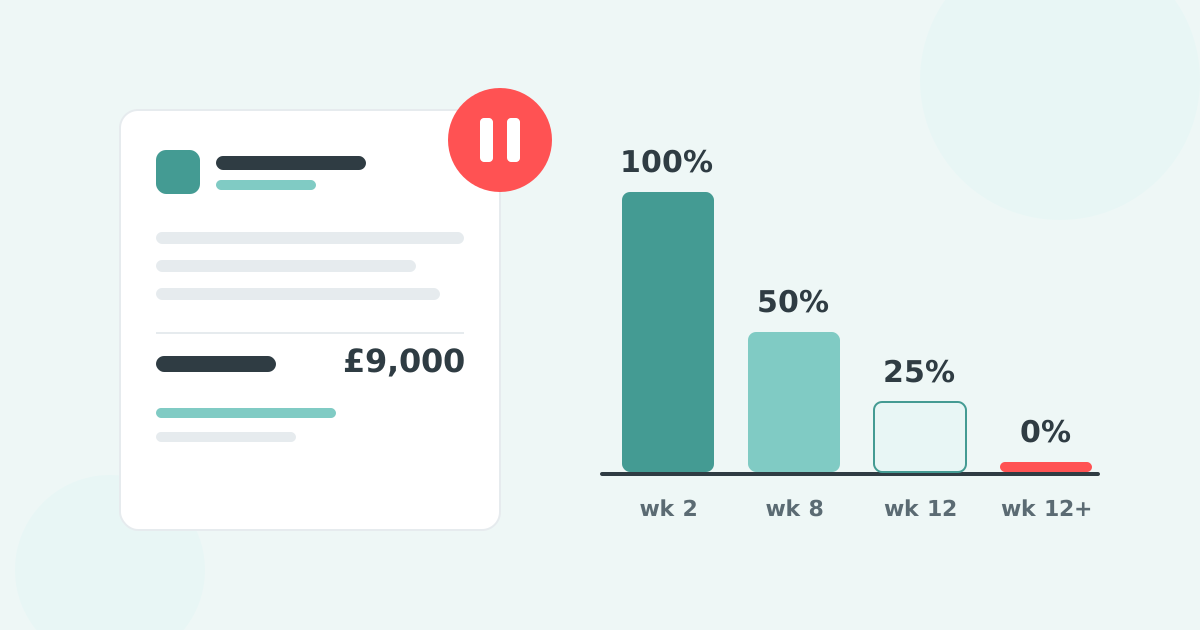

A rebate clause refunds part of a permanent placement fee if the candidate leaves early. It is not a reason to delay payment: unless your terms say the fee is payable in full regardless of any rebate entitlement, clients will treat the rebate window as a 12-week payment term. Fix the wording, then manage disputes as process.
Key takeaways
The bad-debt figures come from REC's 2024/25 UK Recruitment Industry Status Report; the placement example assumes a typical UK perm fee of 15 to 20% of first-year salary.
A rebate clause gives the client part of the placement fee back if the candidate leaves within an agreed window.
Clients often call the same window a guarantee period; the mechanics are identical. Keep two questions separate: does the client owe the fee (yes, on your terms, from the start date), and might they later be owed something back (also yes, inside the window). Your terms keep them apart: a rebate is not an acceptance period or probation insurance, and it works just as well after payment.
Staffing and support services sit in their own bracket. Xero Small Business Insights publishes the industry figure.
| Market | Administrative and Support Services | All industries | Gap | Rank, slowest first |
|---|---|---|---|---|
| Australia | 23.0 days | 20.3 days | +2.7 days | 10th of 19 |
| New Zealand | 22.8 days | 23.2 days | -0.4 days | 6th of 10 |
| UK | 33.4 days | 29.3 days | +4.1 days | 6th of 14 |
Source: Xero Small Business Insights, June 2026. See the full data on the Paidnice accounts receivable statistics dashboard.
Margin per placement decides how much of that wait a business can carry.
The standard shape is a sliding scale across 8 to 12 weeks: a full refund if the candidate leaves in the first fortnight, stepping down to nothing by week 12, with a free replacement offered before any cash moves.
| Candidate leaves | Typical rebate | What usually happens |
|---|---|---|
| Weeks 0 to 2 | 100% | Replacement search first; credit note if declined |
| Weeks 3 to 8 | 50% | Replacement offered; partial credit if declined |
| Weeks 9 to 12 | 25% | Goodwill territory; many terms are at nil here |
| After week 12 | Nil | The placement stands |
Typical structure, not a rule: Reed's published terms tie the guarantee period to the service tier, from eight weeks on standard service to six months on premium. Replacement-first matters for your ledger: while the search runs, the original invoice stays outstanding, and silent terms let it age past 60 days with nobody allowed to follow it up.
Unless your terms state that the fee is payable in full regardless of any rebate entitlement, every perm invoice carries de facto 12-week terms, because clients treat the rebate window as permission to wait.
The conversion always sounds reasonable: "we'll pay once they pass probation". Your 14-day terms quietly become roughly 90 on a 12-week taper. The fix is wording, then process.
Model wording, not legal advice
The three clauses in this article are drafting starting points for UK terms of business. Contract law and unfair terms rules differ by market. Have your solicitor adapt them to your terms, clients, and jurisdiction before relying on them.
The Client’s obligation to pay the Fee in full by the due date is not conditional on, and shall not be reduced, deferred, or withheld by reason of, any rebate or replacement entitlement under clause [X], any probationary period, or the Candidate’s continued employment.
Any rebate falling due under clause [X] shall be settled by credit note or repayment within [14] days of the entitlement arising.
The Client’s entitlement to any rebate or replacement is conditional on the Client having paid the Fee in full by the due date, and on written notice to the Agency within [7] days of the Candidate’s resignation or dismissal.
Drafting notes:
A genuine dispute arrives unprompted, cites the clause, and names dates. Stalling arrives only after your reminder, stays vague, and never quite gets to specifics. The correct responses are opposites.
| Signal | Genuine dispute | Stalling |
|---|---|---|
| When it arrives | Unprompted, soon after the invoice or the exit | Only after a reminder, often the second one |
| What it cites | The rebate clause, the invoice number, the amount | "A query on this one", nothing you could check |
| Dates | Start and leaving dates, named and checkable | Absent or approximate ("it didn't work out") |
| The ask | A credit note or replacement under the terms | More time, a call "next week", the invoice resent |
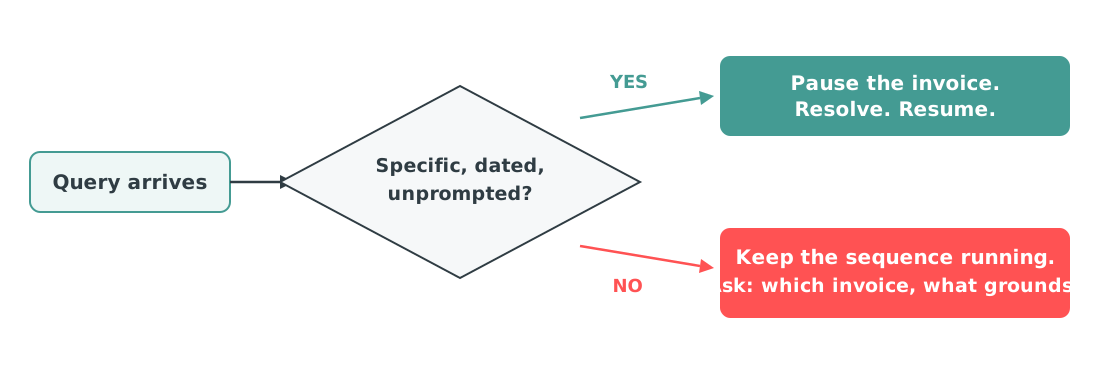
If it is genuine: acknowledge same day, confirm in writing what is agreed and what is contested, pause the invoice, set a resolution deadline, and start any replacement search immediately.
If it is stalling: ask one question in writing: "Which part of invoice [number] is disputed, and on what grounds?" Most stalls evaporate when asked to be specific. Past your final reminder, a letter of demand is the last step before proceedings; if a genuine dispute deadlocks, mediation is cheaper than court and keeps the relationship recoverable.
A third category is the introduction dispute: the client says the hire did not come through you.
UK case law turns on whether your introduction was the effective cause of the engagement, which is why your terms should do three things: define what counts as an introduction, set a validity window of six or 12 months, and require the client to tell you when an introduced candidate is engaged in any role.
A backdoor hire discovered inside that window is an invoice, not an argument.
The moment a dispute is genuine, take that invoice out of the automated sequence and never let late fees touch it. Pause, resolve, resume.
A reminder, or worse an interest charge, landing on a properly disputed invoice turns a solvable disagreement into a grievance. Same when the defect is yours: applying late payment fees to a missing PO or a wrong rate wrecks the whole policy's credibility. The counterweight is a dispute window in your terms: a query arrives early and specific, or the invoice stands.
An invoice, or part of an invoice, not disputed in accordance with paragraph 1 is deemed accepted, and shall be paid in full by the due date.
The undisputed part of a disputed invoice remains payable by the original due date.
The parties shall use reasonable endeavours to resolve a notified dispute within [10] business days. Any amount found payable shall be paid within [7] days of resolution.
Drafting notes:
UK law is moving the same way: the Commercial Payments Bill includes a supplier right to a fixed sum where a purchaser raises a dispute late or without adequate information. Still before Parliament (Lords Committee stage, August 2026) and not expected in force until 2027 at the earliest, it makes late, vague disputes the payer's cost.
Temp desks rarely see rebate disputes, but they get the same behaviour through timesheets: practitioners consistently report timesheet and rate mismatches as the leading cause of disputed invoices in staffing.
The invoice cannot exist until someone at the client approves a timesheet, so an approver on leave silently extends your terms; what that approval lag costs in funded payroll is covered in our guide to recruitment agency cash flow. The fix is a deemed-approval clause: silence cannot hold your ledger hostage.
💡 Paidnice insight
One wrong rate outlasts one late payment. Across the recruitment agencies we run credit control automation for, the pattern repeats: the client catches a single billing error, then double-checks every invoice that follows, and payment slows on the whole account for months.
A timesheet neither approved nor rejected within that period is deemed approved, and the Agency may invoice against it.
The Client shall not dispute an invoice on grounds of hours worked where the invoice is based on a timesheet approved, or deemed approved, under this clause. Errors in rates or other invoicing details may still be queried under clause [dispute window].
Approval of a timesheet confirms that the hours were worked as recorded and authorised. It does not constitute acceptance of the quality of the work performed, which is governed by clause [Y].
Drafting notes:
Under the Conduct of Employment Agencies and Employment Businesses Regulations 2003, UK terms must be agreed in writing with the hirer before the introduction is made, including the fee. Skip that and the fee claim itself is weakened.
The familiar failure mode: a trusted contact moves companies, asks for CVs on day one, the paperwork will follow "once we're up and running", and the agency ends up negotiating its own terms after the candidate has started.
The fix is a gate, not a reminder: no CV goes out until terms are signed, the credit check has cleared, and the billing contact is captured (who owns it: our guide to credit control for recruitment agencies).
Everything above works with a spreadsheet and discipline. The hard part is consistency: pausing one disputed invoice while eleven others keep their reminders, statements, and late fees running.
💡 Paidnice insight
What we see across recruitment agencies: the damage is rarely the disputed invoice itself, it is the eleven clean ones that stop being followed up while everyone argues about one. Agencies that exclude only the disputed invoice keep the rest collecting, and customers cut their average wait for payment in half, within 30 days.
Paidnice automates that consistency on top of Xero and QuickBooks. Exclude an individual invoice from the sequence while the rest of the account keeps moving, with automatic statements on the schedule you choose and escalation workflows assigning the dispute to a named person. For the wider toolkit, see our roundup of the best credit control software for recruitment agencies.
Can a client wait until the candidate passes probation before paying?
Not if your terms include a fee-payable-regardless clause: payment falls due on your normal terms, and the rebate entitlement exists separately as a refund. Silent terms leave little leverage on invoices already raised; fix the wording for the next engagement.
Should we offer a replacement or a refund?
Replacement-first is standard practice and usually better for both sides: the client gets the hire they wanted, you keep the fee. Spell it out: replacement first, then the tapered credit note if none arrives within a defined period. The original invoice remains payable on its due date either way.
What if the client hires our candidate without paying?
If your terms were signed before the introduction and the engagement falls inside your validity window, the fee is due; the legal test is whether your introduction was the effective cause of the hire. Assemble the evidence (CV submission, interview arrangements, dates), then invoice with the paper trail attached.
Can we charge late payment interest on a disputed invoice?
On a genuinely disputed invoice, no: pause it and only restart the clock on what survives resolution. On a stall, the dispute-window clause decides: once the window passes without a specific written dispute, the invoice is accepted and interest runs normally.
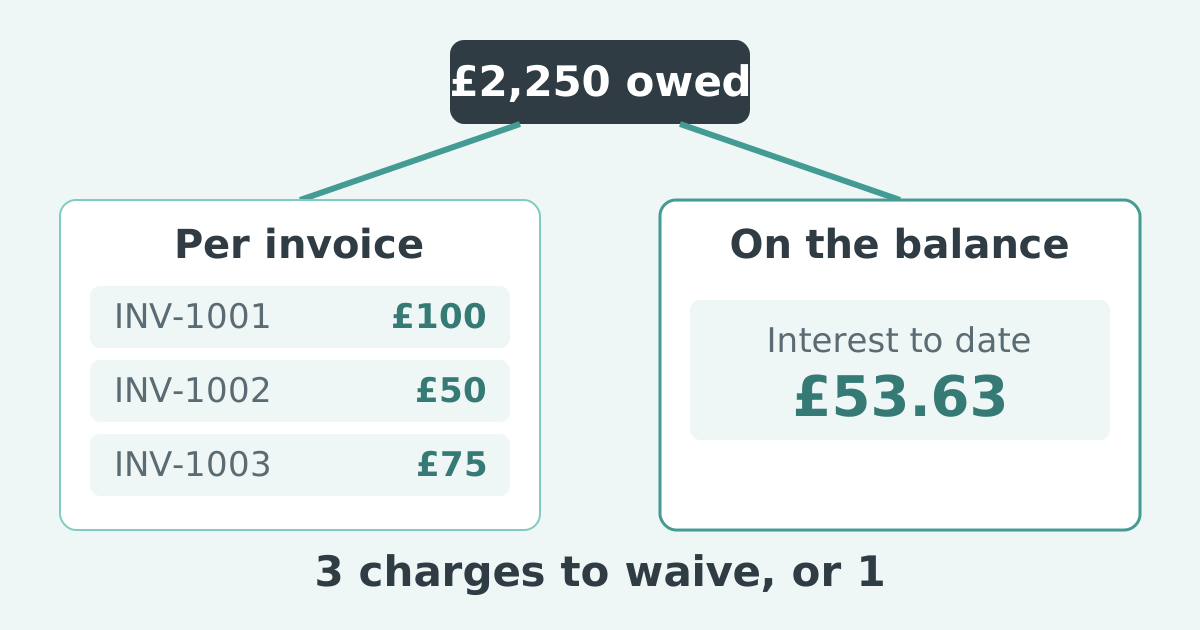
In the UK the statutory rate is 8% a year over the Bank of England base rate under the Late Payment of Commercial Debts (Interest) Act 1998; our statutory interest calculator shows the accrual.
Paidnice is accounts receivable automation that enforces your payment terms, trusted by thousands of businesses on Xero and QuickBooks. Credit control and debtor management, run for you.
Try it Now - It's FreeNo card required.


Optimize your cash flow with our suite of financial tools designed for AR professionals. Calculate DSO, aging analysis, late fees, and more.