
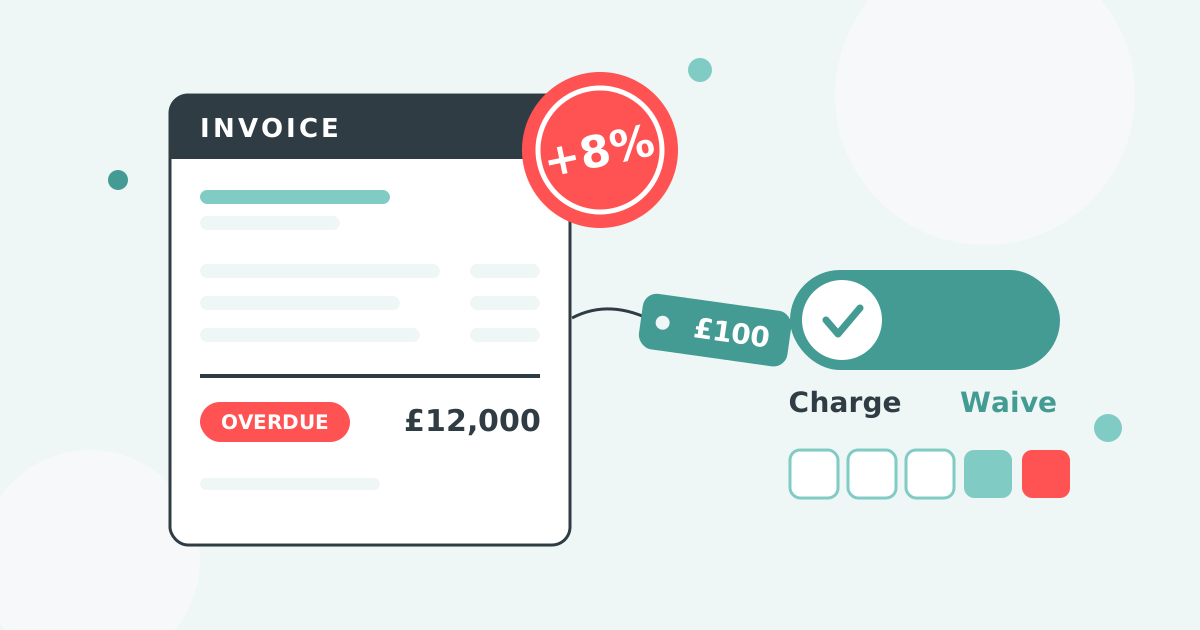

UK recruitment agencies can charge statutory interest at 8% a year over the Bank of England base rate, plus £40 to £100 fixed compensation per invoice, under the Late Payment of Commercial Debts (Interest) Act 1998. Apply fees automatically on every overdue invoice; let a named person waive them deliberately.
Key takeaways
REC's 2024/25 UK Recruitment Industry Status Report found 35% of member firms experienced bad debt in the past year, against a 29% cross-sector average. Charging interest feels like a decision nobody wants to own; the fix is making it stop being one.
Under the Late Payment of Commercial Debts (Interest) Act 1998, a UK agency can charge statutory interest at 8% a year over the Bank of England base rate on an overdue commercial invoice, plus fixed compensation of £40 to £100 on every invoice.
You do not need a late fee clause: the Act implies the entitlement into every business-to-business contract, perm fees and temp invoices alike. State it in your terms anyway.
Interest runs from the day after your due date. Where no payment terms were agreed at all, the Act supplies a default: payment becomes late 30 days after the invoice or the delivery of the service, whichever is later.
The fixed compensation, set out in section 5A, is tiered by debt size and applies per invoice, not per customer:
| Debt size | Fixed compensation per invoice |
|---|---|
| Under £1,000 | £40 |
| £1,000 to £9,999.99 | £70 |
| £10,000 or more | £100 |
Where your reasonable recovery costs exceed the fixed sum, the Act lets you claim the difference on top. Statutory interest and the compensation are outside the scope of VAT.
Two mechanics matter. Interest is simple, not compounding: the daily amount never grows. And the reference rate is frozen in time: for a debt falling due between 1 January and 30 June you use the base rate in force on the previous 31 December, for one falling due between 1 July and 31 December the rate on 30 June.
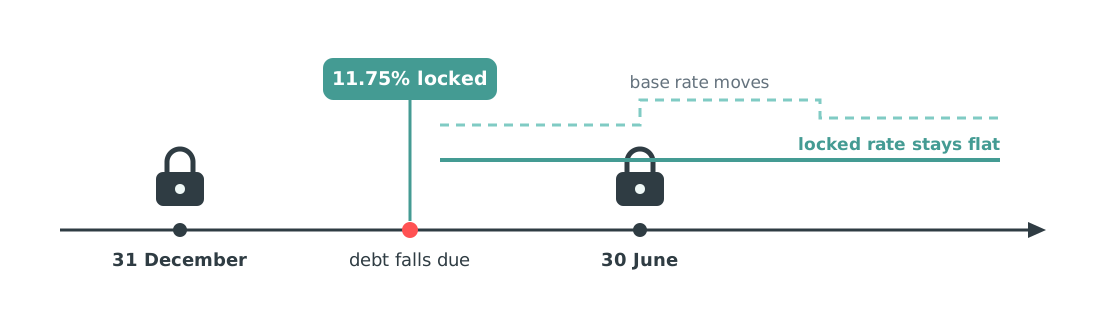
As of August 2026 the statutory rate is 11.75% a year: the 3.75% Bank of England base rate in force on 30 June 2026 plus 8 percentage points, fixed for debts falling due until the next reference date.
Clients cannot write the Act out of the contract. Under sections 7 to 9, statutory interest can only be excluded or varied where the contract provides a substantial remedy for late payment; a token contractual rate risks being struck down and the statutory rate reinstated.
An £8,500 perm invoice paid 30 days late accrues £8,500 × 11.75% × 30 ÷ 365 = £82.09 in interest, plus £70 compensation for the £1,000 to £9,999.99 tier. Total: £152.09. Deeper mechanics and templates: late payment fees in the UK.
Staffing and support services sit in their own bracket. Xero Small Business Insights publishes the industry figure.
| Market | Administrative and Support Services | All industries | Gap | Rank, slowest first |
|---|---|---|---|---|
| Australia | 23.0 days | 20.3 days | +2.7 days | 10th of 19 |
| New Zealand | 22.8 days | 23.2 days | -0.4 days | 6th of 10 |
| UK | 33.4 days | 29.3 days | +4.1 days | 6th of 14 |
Source: Xero Small Business Insights, June 2026. See the full data on the Paidnice accounts receivable statistics dashboard.
Margin per placement decides how much of that wait a business can carry.
Fixed compensation applies per invoice, not per client: one temp client at £12,000 a week, eight weeks overdue, owes £800 in compensation before a penny of interest.
Sonovate puts the average agency's wait at 56 days: exactly eight weekly invoices deep. Each £12,000 invoice clears the £10,000 tier: 8 × £100 = £800. Interest runs on top: £96,000 × 11.75% ÷ 365 is roughly £30.90 a day. (Funding side: recruitment agency cash flow.)
Simple interest at base rate + 8% a year: amount × rate × days ÷ 365. Interest keeps accruing daily until payment. A guide, not legal or financial advice.
Take a £20,000 invoice that is 45 days overdue, with the Bank of England base rate at 3.75% on the reference date. The statutory rate is 3.75% + 8% = 11.75% a year. A full year's interest would be £20,000 × 11.75% = £2,350, so 45 days is £2,350 × 45 ÷ 365 = £289.73. The debt is £10,000 or more, so fixed compensation adds £100.
Total: £389.73, with interest still accruing at roughly £6.44 a day until payment. A standalone version lives at our statutory interest calculator.
Agencies do not skip late fees because the law is unclear. They skip them because the account manager who owns the client is paid on billings, and a fee feels like a threat to next month's placements.
The credit controller wants to apply interest; the account manager wants one more week of grace. The account manager wins, because they argue revenue and the controller argues principle (I unpacked that ownership problem in credit control for recruitment agencies).
The fix: take the decision off individuals and hand the credit controller leverage a polite reminder never has. A client short of cash runs a priority list; interest moves you up it, and on-time payment becomes the path of least resistance.
Interest and compensation apply automatically at ledger level and appear on every statement; no individual decides to charge. Waiving stays deliberate: a named person removes the fee, records the reason, and trades it for something real, payment this week, a direct debit mandate, or shorter terms. Never waive by switching the rule off for an account: that converts a concession into an entitlement.
Industry margin guides put temp net margins at 8 to 15%, so one written-off invoice wipes out the profit on roughly 7 to 12 invoices of the same size (arithmetic from the margin range, not a survey finding).
💡 Paidnice insight
Across Paidnice customers, eight in ten invoices get paid on time once reminders and fees run consistently, and the leverage effect shows before any fee is actually collected.
Charge direct SME accounts past day 30 and repeat offenders. Accrue silently on enterprise accounts and spend the number at renewal. Never charge a self-billing account, a disputed invoice, or an invoice your own paperwork got wrong.
| Policy | Which accounts | How it runs |
|---|---|---|
| Charge | Direct SME accounts past day 30; any client past terms twice in a rolling 12 months | Applied automatically, shown on every reminder and statement |
| Accrue | Enterprise direct accounts | Accrues at ledger level, appears on the statement, spent at terms renewal |
| Never | Accounts where the client raises the invoice under a self-billing agreement; genuinely disputed invoices; invoices your own paperwork got wrong | Segmented out of the fee rules so the policy never fires by accident |
On enterprise accounts you will rarely collect the fee, but accrued statutory interest is a quantified number, and it negotiates: "You currently owe £4,200 in interest we have not charged. We are happy to keep not charging it if we move to 30-day terms."
A genuinely disputed invoice comes out of the sequence: pause, resolve, resume; no fee lands while the dispute is live (rebate clauses and disputed fees covers the triage). If your own paperwork was defective, a missing PO, a wrong rate, no signed timesheet, charging interest on your own error destroys the policy's credibility.
On a temp desk the strongest lever is not financial. The worker on the client's site is. A contractual right to suspend supply for non-payment is enforced by the client's own operational need, not your willingness to escalate.
Interest compensates for delay; suspension ends it. Write the stop-work right into your terms, pair it with a credit hold so new placements stop landing on a non-paying account, and trigger it around day 30 on weekly billing: every week of tolerance adds an unpaid invoice.
The Commercial Payments Bill entered Parliament on 18 May 2026: a maximum 60-day payment term, interest at 8% over base becoming mandatory rather than optional, and fining powers for the Small Business Commissioner. None of it is in force yet.
The government says late payment costs the UK economy £11 billion a year and closes 38 businesses a day. Alongside the 60-day cap and mandatory interest, the Bill's factsheet sets out a supplier right to a fixed sum when a purchaser raises a dispute late.
The Bill is still before Parliament, at Lords Committee stage as of August 2026, and is not expected to come into force until 2027 at the earliest.
Two measures land on recruitment. Mandatory interest ends the "we do not pay late fees" conversation, and the late-dispute fixed sum targets the classic stall: the vague timesheet query that surfaces on day 55 of a 60-day term.
The UK is the outlier. In Australia, New Zealand, the US, and Canada there is no statutory fallback to lean on: the fee you want must be in your signed terms of business.
Australia has no statutory interest on B2B debts: the fee is purely contractual, and it must be proportionate. Since Paciocco v ANZ (2016) the test is whether a fee is out of all proportion to the legitimate interest it protects, and since 9 November 2023 an unfair term in a standard form contract is a penalised contravention, with most SME clients protected.
The practitioner pattern: peg the fee at or below your documented cost of delay, your invoice finance rate say, and have a lawyer check the clause. CreditorWatch's April 2026 Business Risk Index put Australian late payments at their highest level since January 2020.
New Zealand has no statutory interest and no payment-practices register: the Business Payment Practices Act 2023 was repealed in March 2024 before it took effect. Your signed terms and commercial credit data are the only instruments you have: the interest clause, suspension right, and credit check carry the entire load.
In the US, late fees are contractual only, and 1.5% a month (18% a year) is the de facto standard, according to state-by-state legal guides. Caps vary by state, some 18% a year, some none, so check yours. The fee must be in the signed agreement before work starts; a fee added to an already overdue invoice is generally unenforceable.
Canada's Interest Act caps interest at 5% a year unless the contract states the annual equivalent rate. Write the clause as "1.5% a month (18% a year)", because a monthly rate on its own can be knocked down to 5%. It must also be in signed terms: an invoice-footer line is not an agreement.
Everything above runs manually: a calculator, a spreadsheet of accrued interest, a Friday statement habit. What breaks is consistency.
That is why we built Paidnice. It sits on top of Xero and QuickBooks Online and applies your late fees and interest automatically, flat, percentage, or compounding, with the UK statutory rate auto-indexed to the Bank of England base rate.
Fees appear on automatic statements, accounts where the client self-bills segment out of the rules entirely, and waiving stays a documented human decision.
Customers cut their average wait for payment in half, within 30 days. Plans start at £49 a month, no per-seat fees; here is the Xero setup. Or compare the field: best credit control software for recruitment agencies (2026).
Can we charge interest if our terms of business never mention it?
In the UK, yes: the 1998 Act implies statutory interest and fixed compensation into business-to-business contracts; the entitlement exists even where your terms are silent. Outside the UK the answer flips: Australia, New Zealand, and the US need the fee in your signed terms, and in Canada an improperly stated rate collapses to 5% a year.
Do we add VAT to statutory interest and compensation?
No. Statutory interest and the fixed compensation sums are outside the scope of VAT, so they are claimed without VAT on top. Show them as separate line items and the paper trail stays clean.
Will charging interest damage client relationships?
Not when the fee is applied by the system and waived by a person: practitioners consistently report that consistent enforcement plus a personal waiver preserves the relationship rather than straining it. No controlled study shows that late fee threats speed up payment, so be wary of anyone quoting proof. Charging is a system behaviour; forgiving is a relationship gesture.
Paidnice is accounts receivable automation that enforces your payment terms, trusted by thousands of businesses on Xero and QuickBooks. Credit control and debtor management, run for you.
Try it Now - It's FreeNo card required.




Optimize your cash flow with our suite of financial tools designed for AR professionals. Calculate DSO, aging analysis, late fees, and more.