
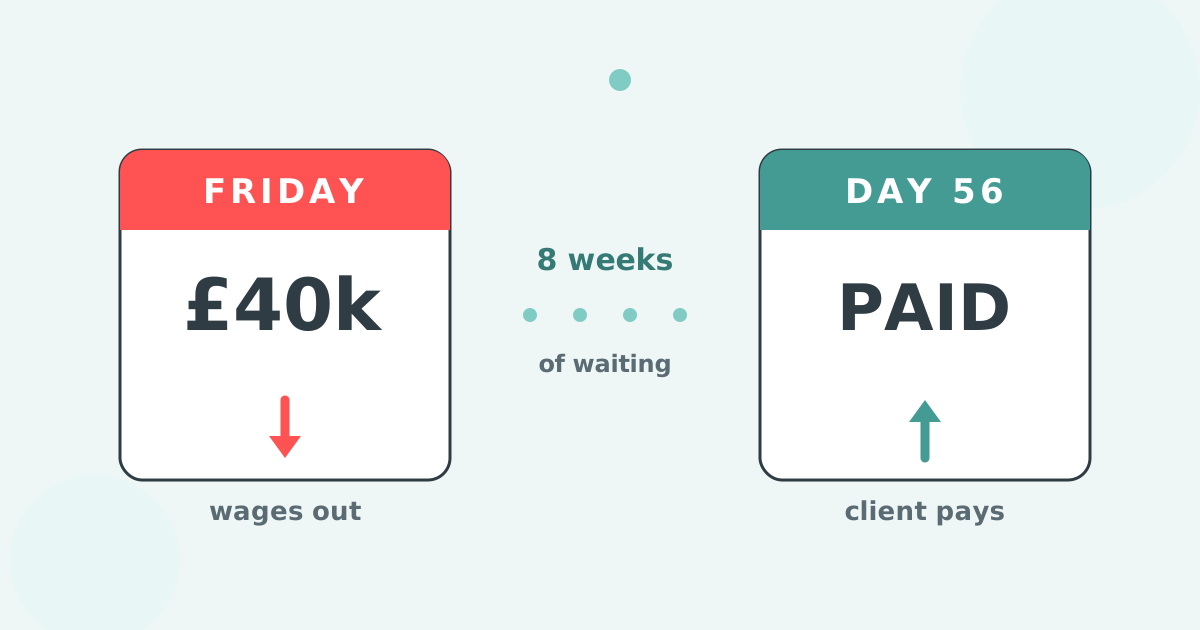

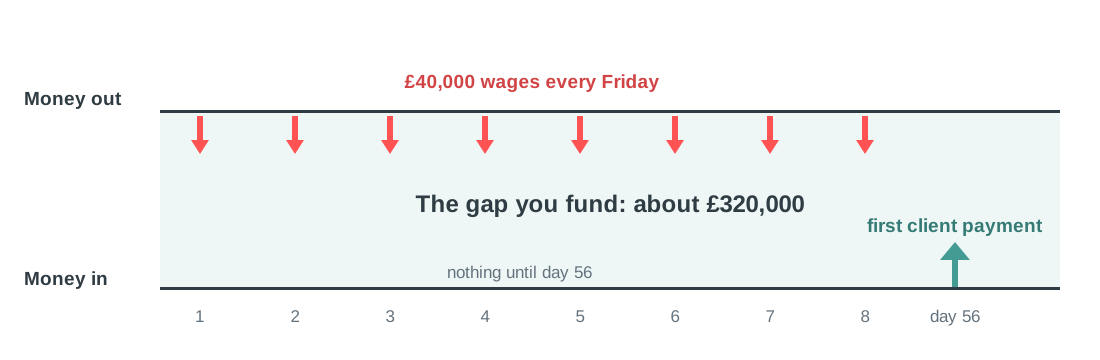
A recruitment agency paying temps weekly while clients pay in 30 to 60 days must fund roughly seven to eight weeks of gross payroll from its own cash or borrowing. Attack the gap in this order: invoice faster (free), collect faster (cheap), then finance only what is left, at 1.5 to 3% of invoice value.
Key takeaways
The average recruitment agency waits 56 days to be paid, Sonovate's data shows, while paying its temps and contractors every week regardless. That interval, from paying the contractor to collecting from the client, is the cash conversion cycle, and in recruitment it is structurally seven to eight weeks of gross payroll carried as working capital.
Recruitment fares worse than the wider economy: REC's UK Recruitment Industry Status Report 2024/25 found 35% of member firms experienced bad debt against a 29% cross-sector average, and Atradius's Payment Practices Barometer UK 2025 puts 51% of UK B2B invoices overdue, with 7% written off.
The consequence is visible in the insolvency data: accountancy firm Armstrong Watson reported 181 UK recruitment businesses entered liquidation in the six months to August 2025, up 18% year on year.
Nor is it a UK quirk: CreditorWatch's April 2026 Business Risk Index put Australian late payments at their highest since January 2020, with administrative and support services, the division containing labour hire, carrying the second-highest sector insolvency rate at 1.25%.
Staffing and support services sit in their own bracket. Xero Small Business Insights publishes the industry figure.
| Market | Administrative and Support Services | All industries | Gap | Rank, slowest first |
|---|---|---|---|---|
| Australia | 23.0 days | 20.3 days | +2.7 days | 10th of 19 |
| New Zealand | 22.8 days | 23.2 days | -0.4 days | 6th of 10 |
| UK | 33.4 days | 29.3 days | +4.1 days | 6th of 14 |
Source: Xero Small Business Insights, June 2026. See the full data on the Paidnice accounts receivable statistics dashboard.
Margin per placement decides how much of that wait a business can carry.
Industry cost guides put recruitment invoice finance at roughly 1.5 to 3% of invoice value, and funders' own guides treat recruitment as a preferred sector because timesheet-backed debt is easy to verify.
The product goes by several names: invoice finance, recruitment factoring, or payroll funding. All work the same way: the funder advances typically 80 to 90% of each invoice within a day or two of issue, and pays the balance, minus fees, when the client settles. Factoring includes the funder's collections service and is disclosed to your clients; invoice discounting is confidential and leaves the follow-up with you.
| Market | Specialist recruitment funders |
|---|---|
| UK | Sonovate, Bibby Financial Services, Close Brothers |
| AU / NZ | APositive, ScotPac, Earlypay |
| US | Advance Partners, altLINE |
Named for orientation, not endorsement.
At 2% of invoice value on a 56-day cycle, every 10 days cut is worth roughly 10 ÷ 56 × 2% = 0.36% of turnover a year, 0.3 to 0.5% across the fee range: £8,000 to £13,500 a year on £2.7 million of billing, before any bad-debt effect.
Assumes the 56-day average collection cycle. Typical all-in costs run 1.5 to 3% of invoice value. A guide, not financial advice.
One client sector deserves its own risk settings: construction. Construction News reported large contractors paid one in seven invoices late in 2025, and a 2025 industry survey covered by UK Construction Online put smaller builders' payment delays at an average of 53 days beyond agreed terms. If your temp desk supplies construction, set terms, credit limits, and funding assumptions for that reality.
The mistake is paying 2% to fund delay you created yourself.
On 60-day terms, a five-day timesheet-approval lag plus a three-day invoice-issue lag is eight days of payroll funded for nothing, and both lags sit entirely inside the agency's control.
Three fixes, none needing client negotiation:
Back it with a deemed-approval clause ("a timesheet not disputed within three working days of submission is deemed approved"); drafting notes are in our guide to rebate clauses and disputed fees.
Some larger clients self-bill: their system raises the invoice once timesheets are approved, so you control neither the invoice date nor the terms, and reminder emails achieve nothing. Keep those accounts out of reminder sequences, measure approval-to-invoice lag as its own weekly number, and take queries to the client's dispute queue rather than the inbox.
Eight days at £40,000 a week of payroll is £45,714 of working capital (£40,000 × 8 ÷ 7), released without touching your payment terms.
Credit-control practitioners agree on timing: the first overdue week matters far more than the fifth, so the follow-up rhythm does more work than any late fee.
| Day | Action |
|---|---|
| -5 | Timesheet approval reminder to the client approver. The invoice does not exist yet; this is where most delay lives. |
| 0 | Invoice sent with signed timesheet attached, PO on the face, and a payment link. |
| +1 | Soft reminder, assuming an oversight. |
| +7 | Firm reminder with a statement of account. |
| +14 | Phone call from the account manager, who holds the relationship and the leverage. |
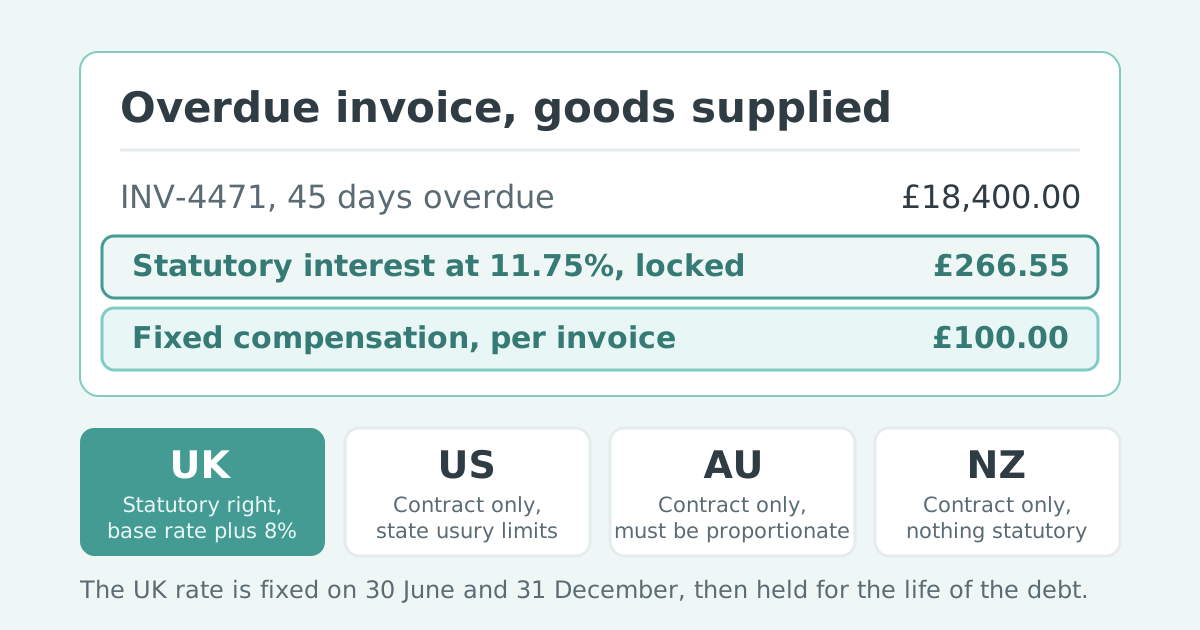
| +21 | Interest and fixed compensation applied, visible on the next statement. |
| +30 | Credit hold: no new placements. Stop-work notice issued under the suspension clause. |
Statements go weekly on weekly-billed accounts: a monthly statement buries four invoices in one document, so automatic statements and email and SMS reminders carry the rhythm. Day 21 needs a policy, including when to waive: the framework is in our guide to late payment fees for recruitment agencies. For a client in genuine difficulty, a documented payment plan beats a write-off.
Temp and contract desks run net margins of 8 to 15%, industry margin guides show, so one invoice written off in full wipes out the profit on roughly 7 to 12 equivalent invoices. The multiple is arithmetic: at a 15% net margin a write-off takes about seven invoices' profit to earn back (100 ÷ 15); at 8%, about twelve (100 ÷ 8).
On a weekly-billed account that is two to three months of one client's contribution, and you have already paid the workers.
Credit control in recruitment is therefore a sales-stage activity: run the credit check when you take the vacancy, not at placement, because by invoice time the wage cost is sunk, and enforce the credit limit in the ATS, where placements happen. The full six-point onboarding gate is in our pillar guide to credit control for recruitment agencies.
From 6 April 2026, UK recruitment agencies are responsible for operating PAYE on umbrella-company workers they supply, and are liable for the unpaid tax if the umbrella fails, under HMRC's new umbrella rules, summarised by the FCSA. The effect: more cash out the door, earlier, on the same 56-day wait.
That widens the gap on every umbrella placement. If umbrella workers are a material share of your book, rerun the calculator below on 2026 payroll figures.
Cash permanently deployed equals weekly payroll multiplied by average days to get paid, divided by seven. If you do not know your days to get paid, work it out with our DSO calculation guide.
Worked example
An agency bills £52,000 a week with £40,000 a week of payroll underneath it, and gets paid in the industry-average 56 days.
Cash permanently deployed: £320,000
A 10-day collection cut releases: £57,143
Finance cost avoided at 2% of invoice value: £9,657 a year
Arithmetic to size the problem, not a quote. Assumes a 10-day reduction and finance at 2% of invoice value; provider pricing varies. Cash deployed = weekly payroll × days ÷ 7.
You can run all of this by hand: a reminder calendar, a Friday statement run, an interest policy someone remembers to apply. Volume breaks it: a temp desk raising 80 invoices a week cannot hand-time 400 reminders.
This is the job Paidnice does, on top of Xero or QuickBooks Online:
From £49 a month for 150 invoices, no per-seat fees. To compare tools first, see our ranked guide to the best credit control software for recruitment agencies.
💡 Paidnice insight
Customers cut their average wait for payment in half, within 30 days, and eight in ten invoices get paid on time.
How much working capital does a recruitment agency need?
Weekly payroll multiplied by average days to get paid, divided by seven. At the industry-average 56 days that is eight weeks of gross payroll: £320,000 on £40,000 a week.
How do recruitment agencies fund payroll before clients pay?
Four sources, usually in combination: retained profit, a bank overdraft, invoice finance or factoring, and the specialist funders in the table above. Whatever the mix, fix approval and invoicing lag first, or you are financing removable delay.
Is invoice finance worth it for a temp desk?
Often, yes. It converts an unpredictable gap into a predictable cost, typically 1.5 to 3% of invoice value. The discipline: fund the structural gap, not your own process delay.
What is a good average time to get paid for a recruitment agency?
The Sonovate industry average is 56 days. As a working target, direct SME accounts should collect inside 35 to 45 days; enterprise books run longer because terms sit in the master agreement. The better measure is stated terms versus actual collection: on 30-day terms and 56-day collection, 26 days are behaviour, not contract.
Paidnice is accounts receivable automation that enforces your payment terms, trusted by thousands of businesses on Xero and QuickBooks. Credit control and debtor management, run for you.
Try it Now - It's FreeNo card required.





Optimize your cash flow with our suite of financial tools designed for AR professionals. Calculate DSO, aging analysis, late fees, and more.