

 Read by Denym Bird10 min
Summary
For a recruitment agency on Xero or QuickBooks, Paidnice fits weekly-billed temp desks and growing perm books of any size up to $50m a year, from £49 a month with no per-seat fees and native credit checks on every plan. Chaser suits agencies that already run a dedicated credit control team and want bureau credit checks in the same tool, from £199 a month.
- Paidnice: Best for weekly-billed temp desks and perm books on Xero or QuickBooks Online that want reminders, late fees and statements per client group, from £49 a month for 150 invoices.
- Chaser: Best for agencies with a named credit controller that want bureau credit checks in the same tool, from £199 a month on turnover tiers.
- Satago: Best for small UK agencies that want invoice finance and chasing in one login, from £45 a month standalone or £25 embedded in Sage 50.
- ezyCollect: Best for AU and NZ agencies on MYOB or a local ERP with 200-plus debtors, from about A$275 a month plus setup.
- Kolleno: Best for multi-entity groups from £10m upward that need cash application on an enterprise ERP, from $650 per user a month (cash application is Enterprise only, by quote).
Credit control software guide▾
What do recruitment agencies need from credit control software?
Recruitment agencies need credit control software that sits on the ledger, because the ATS and pay-and-bill layer (Bullhorn, JobAdder, ETZ, FastTrack360) raises the invoice and Xero or QuickBooks holds it, and nothing in that chain follows it up. The sharper requirements are weekly invoice volume, self-billed client accounts, and late fees that stay inside the UK statutory rate.
The industry starts from behind. REC's 2024/25 UK Recruitment Industry Status Report found 35% of member firms experienced bad debt in the past year, against a 29% average across other sectors. The Atradius Payment Practices Barometer UK 2025 found 51% of UK B2B invoices are overdue.
The mismatch is structural: temp desks pay contractors weekly while clients settle on 30 to 60 day terms, so the person chasing the invoice is often the same person who made the placement.
Software will not fix weak terms, but it enforces them without anyone drafting an email. See accounts receivable software for recruitment agencies for how it runs. Creative and marketing agencies have their own guide to credit control software for agencies.
Bullhorn's invoicing product covers billing profiles and invoice formats, with no follow-up features at all. Credit control software fills that gap, sitting on the ledger.
The full process is in our guide to credit control for recruitment agencies. The category goes by several names, credit control software, invoice chasing software, accounts receivable automation; they describe the same job: getting the invoices in your ledger paid.
Five criteria matter more for recruitment than for a generic buyer:
- Pricing that survives invoice volume. A temp desk raises hundreds of invoices a month. Per-user and revenue-tiered pricing punishes the agencies that need automation most.
- Sequences that differ per client group. Firm reminders for SME accounts, a softer touch for enterprise, and self-billed accounts excluded entirely.
- Statements that match weekly billing. A weekly-billed client can hold six open invoices at once, so a monthly statement on that account is structurally late. Weekly consolidated statements are the recruitment default.
- Late fees that stay inside the law. In the UK that means 8% a year over the Bank of England base rate plus fixed compensation per invoice under the Late Payment of Commercial Debts (Interest) Act 1998. Auto-indexing to the base rate beats a hard-coded percentage that goes stale.
- A route to money as well as reminders. Payment portals, payment plans, and escalation workflows turn an overdue balance into a payment.
See the current payment times for administrative and support services, the sector that includes recruitment, before picking a tool.
Free: Payment reminder email templatesCopy the reminder emails for before, on and after the due date.Which credit control apps work with Xero for a recruitment agency?
For a recruitment agency on Xero, the shortlist is Paidnice, Chaser and Satago, all listed on the Xero App Store. Xero's own reminders stop at five emails per invoice with no per-client-group control, no SMS and no scheduled statements.
Xero's native reminders are worth switching on and worth knowing the edges of: up to five reminders, three on by default, set in days before or after due, with one minimum-amount threshold. They cannot vary by contact group, so self-billed clients and direct clients get the same emails, and Xero cannot schedule statements (1,178 votes on Xero's ideas board), so weekly-billed accounts get no scheduled statement run.
Xero App Store ratings: Paidnice 5.0 from 85 reviews, Chaser 4.98 from 374, Satago 4.93 from 92, ezyCollect 4.9 from 35, Kolleno 5.0 from 18. Paidnice is the volume-priced option with per-group late fees, weekly statements and native credit checks; Chaser is the established choice with bureau credit checks built in; Satago adds invoice finance. Prices are in the comparison table below.
How do the six tools compare?
Paidnice serves agencies of any size up to $50m a year on Xero or QuickBooks, Chaser agencies up to £100m with a credit control team, Satago small UK agencies that also want funding, ezyCollect the AU and NZ mid-market, Kolleno groups that want cash application on enterprise ERPs, and Access Financials agencies already on the Access finance and pay-and-bill stack.
| Tool | Best for | Size fit | Price from (monthly) | Ledger | Late fees | Per-group sequences | Statements | Payment plans | Portal | Credit checks | Rating |
|---|---|---|---|---|---|---|---|---|---|---|---|
| Paidnice | Per-group fees and weekly statements | Any size up to $50m a year | £49 / $69 | Xero, QuickBooks Online on every plan; newer ledgers such as Rillet, Campfire and Odoo on every plan via closed testing; Sage Accounting and other ERPs on Custom | Yes (per group) | Yes | Yes (any schedule) | Yes (Pro) | Yes | Yes: native from payment behavior, plus Creditsafe on Custom | 5.0 (Xero App Store) |
| Chaser | Bureau credit checks with a credit control team | Compact under £4m, Core from £4m, Complete to £100m | £199 | Xero, QuickBooks, Sage, NetSuite, Dynamics 365 Business Central | Yes (one set of rules) | Yes | Monthly only | Yes | Yes | Yes | 4.98 (374, Xero App Store) |
| Satago | Invoice finance beside the chasing | Small UK businesses | £45 (£25 embedded in Sage 50) | Xero, Sage, QuickBooks | Optional, added to reminder emails | Not documented | Monthly | Not documented | Yes | Yes | 4.93 (92, Xero App Store) |
| ezyCollect | MYOB and local ERP coverage | AU/NZ mid-market, 200+ debtors | A$275 + setup (last published; now hidden) | Xero, MYOB, NetSuite, SAP B1; QuickBooks logo on homepage, no connector page | No | Yes (higher tiers) | Monthly | Yes | Yes | Yes | 4.9 (35, Xero App Store AU) |
| Kolleno | Cash application at group scale | Turnover bands from under £1M (per-user) | $650 USD/user | NetSuite, SAP, Sage Intacct, Business Central, Xero, QuickBooks | None found | Yes | Via portal | Yes | Yes | Yes | 4.9 (117, G2) |
| Access Financials (The Access Group) | Credit control inside the Access recruitment stack | Agencies on Access Financials and Pay & Bill | Quote only; Access Collect module from £3,600 a year | Access Financials only (native) | Not documented | Not documented | Not documented | Access Collect Professional tier | No | Yes (risk scoring, Professional tier) | Not published |
"Not documented" means the vendor's public materials do not list the feature. Prices are each vendor's published from-prices and move often, so verify current pricing on the vendor's site; Access Financials does not publish pricing, so confirm by quote; ezyCollect now hides its prices on ezycollect.io. ezyCollect's last published prices were A$275 a month for ezyStart, with a setup fee from A$900 (Wayback Machine). Current prices are hidden and must be requested.
How we ranked these recruitment credit control tools
We scored the six tools on five criteria. Each covers one or more columns of the comparison table above, and the weights add up to 100%.
- Late fees and per-group sequences (25%): each vendor's help docs, covering the "Late fees" and "Per-group sequences" columns. "Not documented" means the vendor's public materials do not list the feature.
- Statements, payment plans, portal and credit checks (25%): each vendor's help docs and product pages, covering four columns of the table. We count shipped features only.
- Ledger and size fit (20%): each vendor's integration pages and plan limits, covering the "Ledger" and "Size fit" columns.
- Price (15%): each vendor's own pricing page, covering the "Price from (monthly)" column. Prices a vendor does not publish are given as last reported, with the year, or as quote only.
- Reviews (15%): the "Rating" column, from the Xero App Store first, then G2, with the review count beside each score: Paidnice, Chaser, Satago, ezyCollect and Kolleno.
Every entry, Paidnice included, lists its limit. The weights are our editorial judgment.
1. Paidnice, best for agencies up to $50m

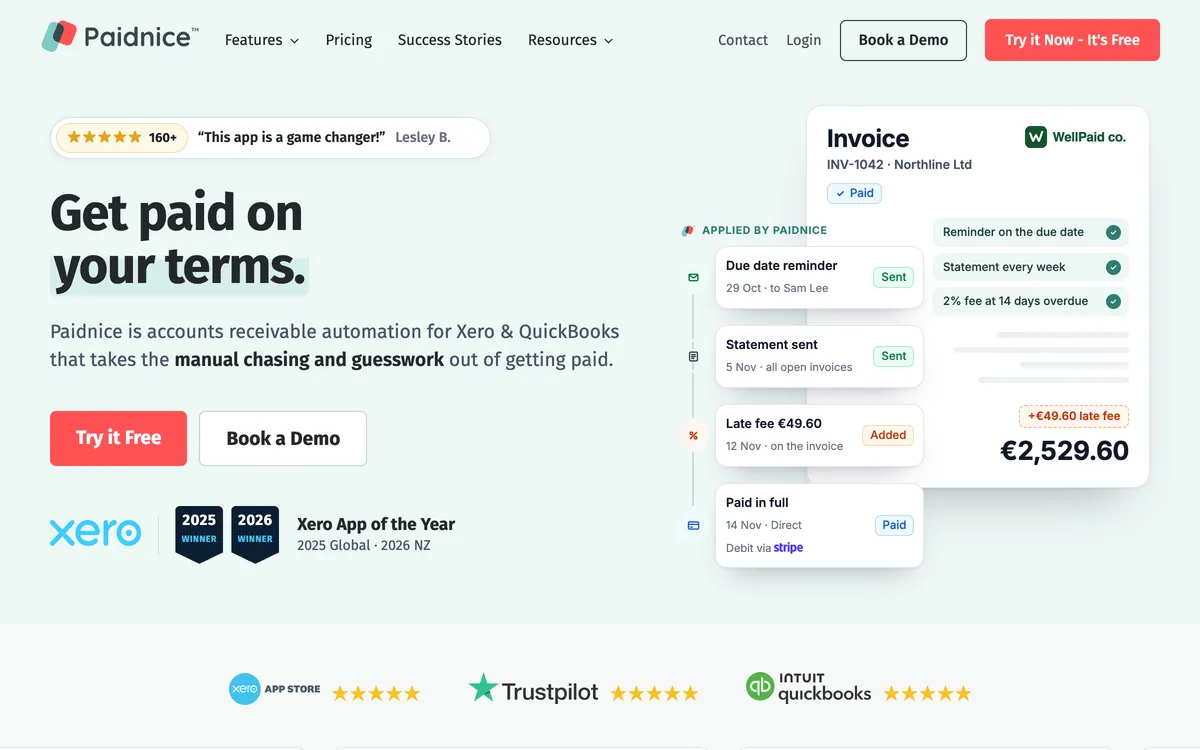
Paidnice is credit control software for recruitment agencies on Xero or QuickBooks Online: reminders, late fees, statements and payment plans per client group, priced by invoice volume from £49 a month with no per-seat fees.
- Fits
- any agency on Xero or QuickBooks Online, from its first invoice up to $50m a year or 50,000 invoices a year, with or without a dedicated credit controller
- Regions
- strongest anywhere Xero is strong: the UK, Australia, and New Zealand; also the US, Canada, and South Africa
- Entry cost
- £49/mo (US$69), 150 invoices; Pro from £74/mo. No per-seat fees
- Rated
- 5.0/5 from 84 Xero App Store reviews
- Awards
- Xero Global Small Business App of the Year 2025 and NZ Small Business App of the Year 2026; Innovation App of the Year finalist 🏆


- Runs on
- Xero and QuickBooks Online on every plan; newer ledgers such as Rillet, Campfire, Digits, DualEntry, Puzzle, Accounting Seed and Odoo on every plan through Paidnice's closed testing program; Sage Accounting and other ERPs on the Custom plan; Stripe, Pinch Payments, HubSpot, Pipedrive, Zapier
- Statutory late fees
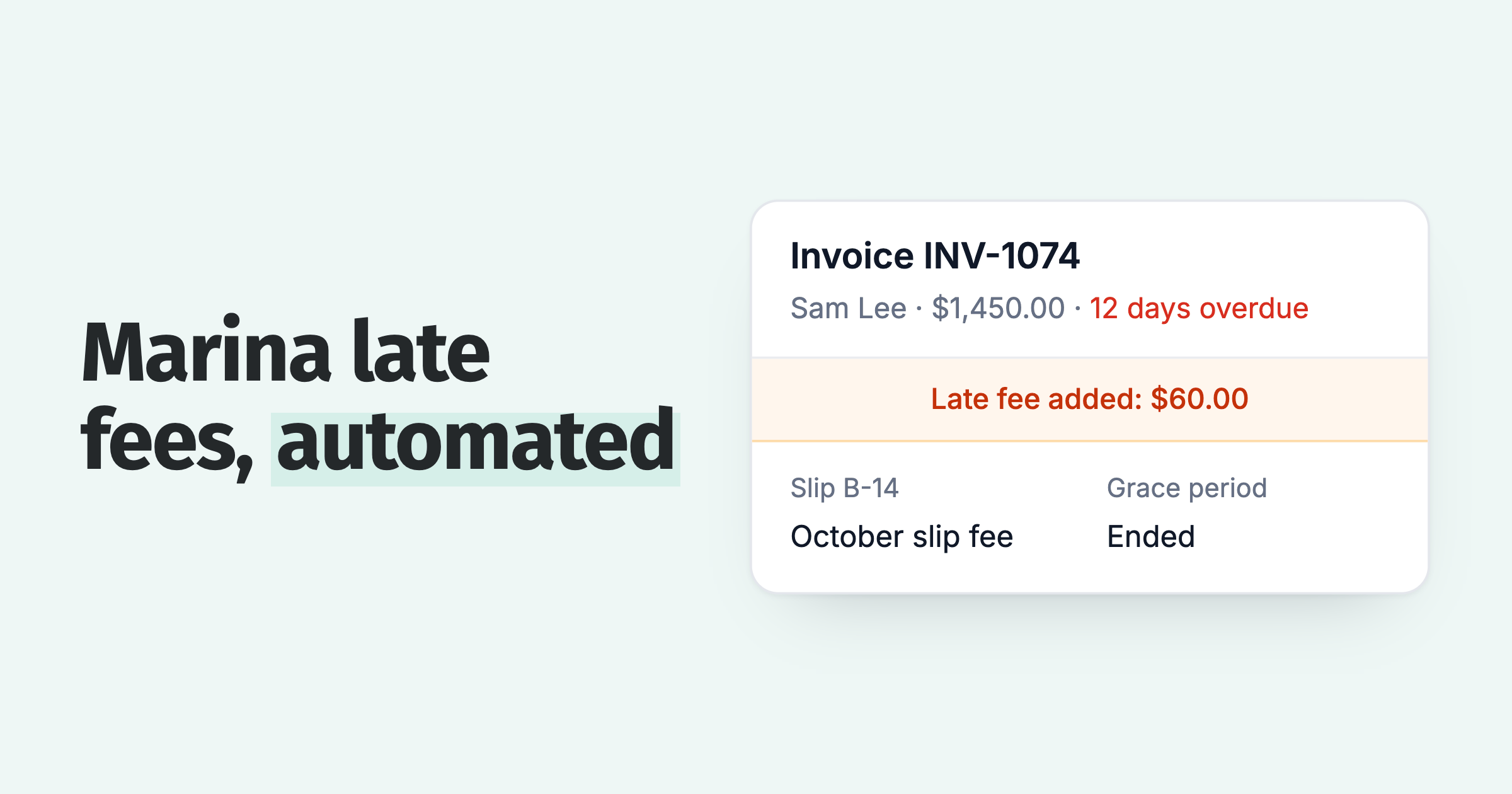
- in the UK, auto-indexed to the Bank of England base rate; everywhere else, set your own flat, percentage, or compounding rates. Applied automatically, waived with a documented audit trail
- The one thing it does best
- the whole policy runs itself: sequences per client group, statements on your schedule, fees applied and waivers recorded
Paidnice is built for the agency where the policy has to run itself: reminder sequences per client group with self-billed accounts excluded, separate late fee policies per group, statements on the schedule you choose including consolidated accounts, payment plans, and a customer payment portal. Payment plans and sending from your own domain start on Pro. Customers see half as many late invoices in the first 30 days. Sign-up is free with no card.
Best suited for: any agency on Xero or QuickBooks Online, from its first invoice up to $50m a year or 50,000 invoices a year, with or without a dedicated credit controller.
The limit: Not an enterprise cash-application platform (Paidnice matches payments through Xero and QuickBooks Online and Stripe; bank-file matching is not documented), bureau credit checks only through Creditsafe on Custom (native credit checks from payment behavior run on every plan), and some features vary between Xero and QuickBooks.
What results look like: three Paidnice customers
| Customer | Before Paidnice | After Paidnice |
|---|---|---|
| Paintvine Events, New Zealand | Over 20% of payments late | Zero late payments within the first month |
| Venture Workspace Co-working, South Africa | Over 25% of payments late | 75% fewer late payments within 30 days, now under 5% late |
| My Two Cents Bookkeeping, New Zealand | $60,000 outstanding, payment delays of 45+ days | $24,000 outstanding, payment delays under 25 days |
Figures as each customer reported them in their success story. More stories on the Paidnice success stories page.
2. Chaser, best for established agencies

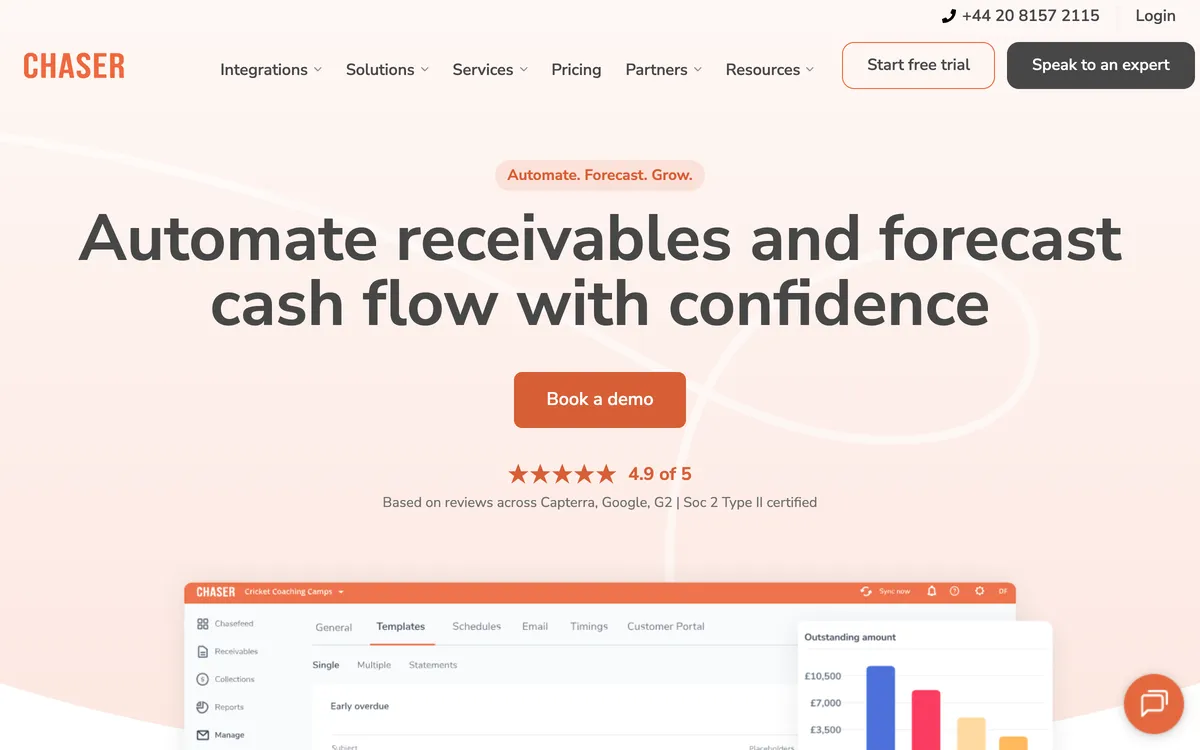
Chaser was incorporated in 2013 (Companies House) and offers email and SMS reminders plus credit checks, for agencies with a finance function and serious invoice volume, priced by company turnover from £199 a month.
- Fits
- established agencies, £4m to £100m revenue, with a named credit controller
- Regions
- UK-based; sells worldwide
- Entry cost
- £199/mo for Compact, which is for revenue under £4m; above £4m a team is on Core from £599
- Rated
- 4.98/5 from 374 Xero App Store reviews
- Runs on
- Xero, QuickBooks, Sage, NetSuite, Business Central, Gmail, Outlook
- Statutory late fees
- one set of late-fee rules, across the account or for selected debtors, not tied to schedules; no documented way to run different rules per group
- The one thing it does best
- credit checks and monitoring in the same tool as email and SMS chasing; credit checks need Chaser billing, not Xero App Store billing, and monitoring is not offered in Australia
Chaser is one of the most established names in UK credit control: reminders send from your own Gmail or Outlook inbox, with payment plans, a payer portal, and built-in credit monitoring.
Customers named on Chaser's website include Bright Network, Mindful Education and Pact Coffee.
Best suited for: established agencies, £4m to £100m revenue, with a named credit controller.
The limit: One set of late-fee rules, across the account or for selected debtors, with no documented way to run different rules per group, and statements send monthly only on a fixed day, an awkward fit for weekly temp billing.
3. Satago, best for chasing plus invoice finance

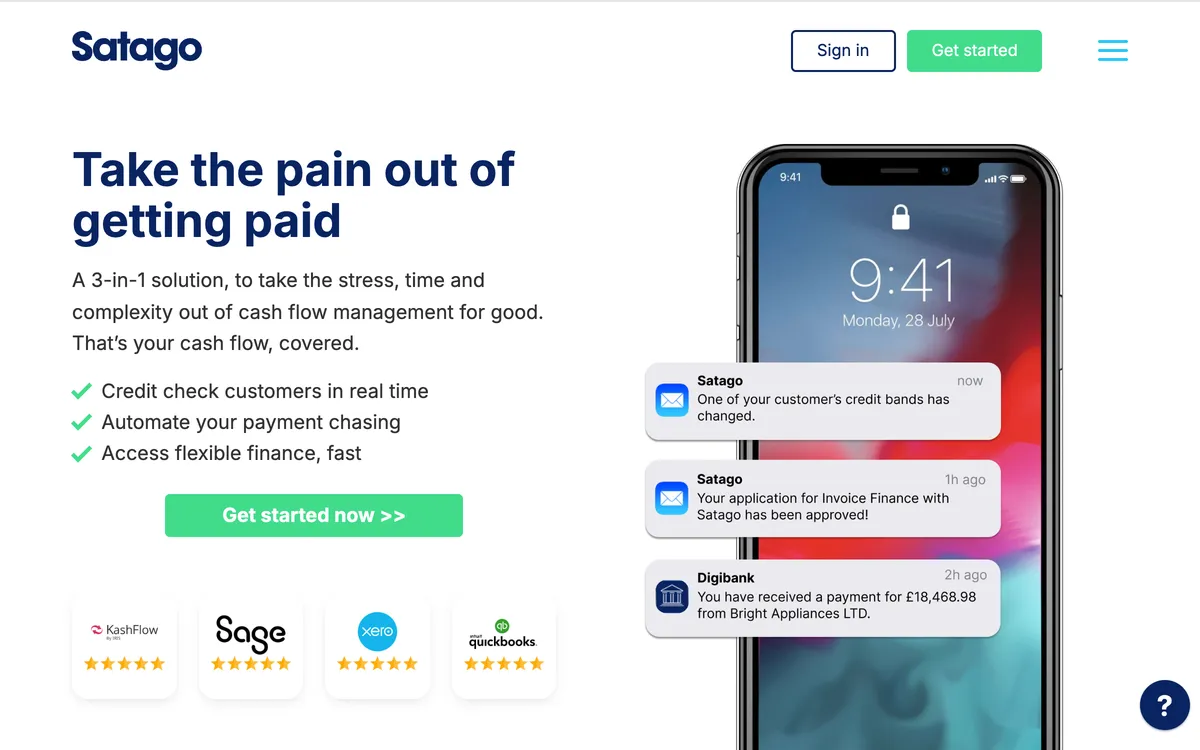
Satago is a credit control and invoice finance hybrid for small UK agencies: the same login that reminds your clients can fund the invoice while you wait, from £45 a month standalone or £25 embedded in Sage 50.
- Fits
- small UK agencies that want reminders and invoice finance in one login
- Regions
- UK only
- Entry cost
- £45 a month standalone, £80 and £200 above; £25 Standard and £45 Plus embedded in Sage 50
- Rated
- 4.93/5 from 92 Xero App Store reviews
- Runs on
- Xero, Sage, QuickBooks, KashFlow, FreeAgent
- Statutory late fees
- optional, calculated in line with statutory limits and added to payment reminders once an invoice is overdue
- The one thing it does best
- single-invoice or whole-ledger finance inside the same product; Satago is owned by TruFin (about 97.7%, last seen) and Lloyds holds a minority stake
For a small agency funding weekly payroll out of 30-to-60-day receipts, the follow-up need and the borrowing need arrive together, and Satago serves both, with customer risk insights and credit control as a service on top. If the funding gap is the bigger problem, start with the guide to recruitment agency cash flow.
Best suited for: small UK agencies that want reminders and invoice finance in one login.
The limit: Per-group sequences are not verifiable from public materials, statements are monthly, and the platform is finance-first, so the credit-control layer runs thinner than the dedicated tools here.
4. ezyCollect, best for MYOB agencies

ezyCollect is the AU and NZ receivables specialist: Sidetrade-owned automation with the deepest MYOB and local ERP coverage in this list, from about A$275 a month plus setup.

- Fits
- AU and NZ mid-market agencies with 200-plus active client accounts on MYOB or local ERPs
- Regions
- Australia and New Zealand, with US payment support
- Entry cost
- last published A$275/mo plus setup on a 12-month plan; next tier A$950/mo. Current prices are hidden, so request a quote
- Rated
- 4.9/5 from 35 Xero App Store (AU) reviews; 4.7/5 on G2
- Runs on
- MYOB AccountRight, Exo and Essentials, Xero, NetSuite, SAP Business One, Pronto Xi; QuickBooks logo on homepage, no connector page
- Statutory late fees
- none; interest is handled manually in your ledger
- The one thing it does best
- AU-native credit insights on Experian data plus the SimplyPaid payment portal
Sydney-founded and acquired by Sidetrade in October 2025, ezyCollect is the strongest fit where the ledger is MYOB or a local ERP the UK tools ignore, with consolidated reminders, monthly statements, and payment plans.
Customers named on ezyCollect's website include Skillinvest, Feral Brewing and Hampers with Bite. ezyCollect's case study with Skillinvest reports average days overdue cut by 91.63%.
Best suited for: AU and NZ mid-market agencies with 200-plus active client accounts on MYOB or local ERPs.
The limit: No late-fee or interest automation at all, so interest is handled manually in your ledger, and setup fees plus annual contracts raise the true entry cost.
5. Kolleno, best for large groups

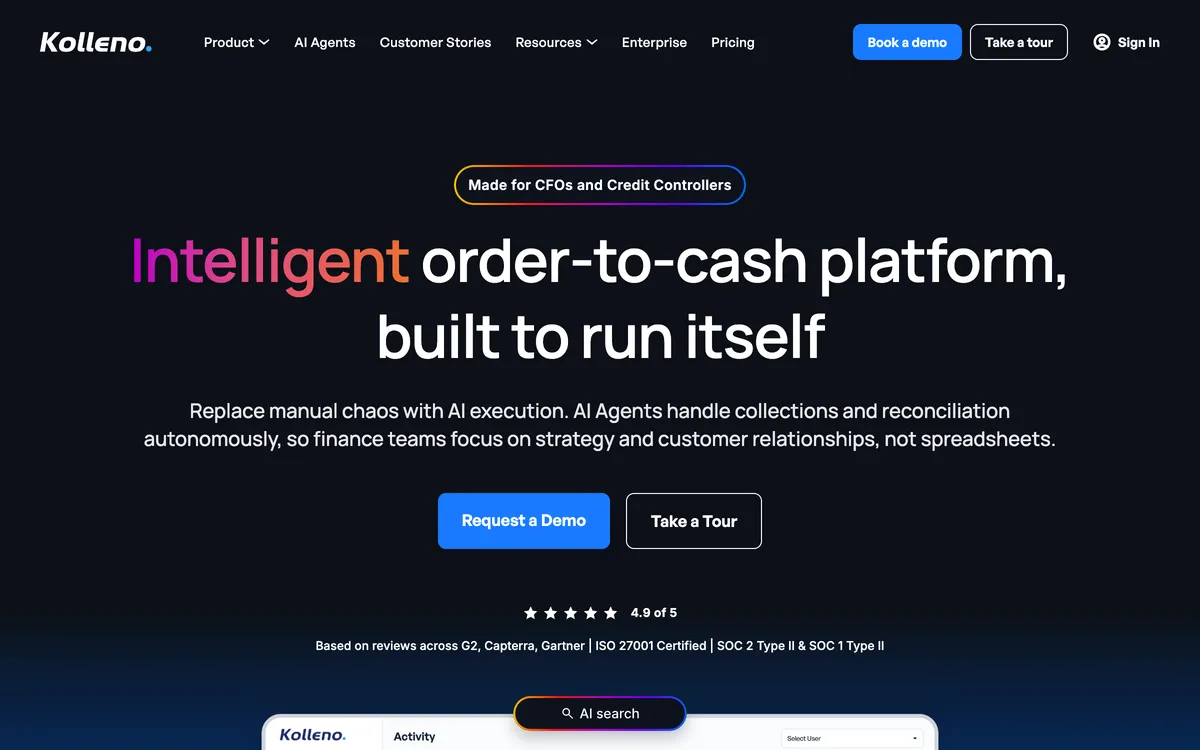
Kolleno is an AI order-to-cash platform for enterprise finance teams: cash application and reconciliation at a scale the SMB tools in this list do not attempt, from $650 per user a month; auto-reconciliation starts on Enterprise.
- Fits
- multi-entity groups from £10m upward on enterprise ERPs with a finance team
- Regions
- London-based with global enterprise customers
- Entry cost
- $650 USD per user/mo (BusinessPay, which does not include cash application); next tier $1,245 per user/mo; Kolleno matches payments to invoices (auto-reconciliation) on Enterprise only, by quote
- Rated
- 5/5 from 18 Xero App Store reviews; 4.9/5 from 117 on G2
- Runs on
- Xero, QuickBooks and Sage Intacct (BusinessPay and Business Plus); NetSuite, SAP and Business Central (from Enterprise)
- Statutory late fees
- none found
- The one thing it does best
- cash application: remittance parsing, bank-file matching (BAI2, NACHA, ISO 20022), and foreign-exchange postings into NetSuite
London-founded Kolleno is AI-led order-to-cash for the problem the other four do not solve: matching thousands of client payments to invoices across entities and currencies, alongside reminder workflows, payment plans, a branded portal, and credit risk scoring.
Customers named on Kolleno's website include Wise, Marshmallow and Laundryheap.
Best suited for: multi-entity groups from £10m upward on enterprise ERPs with a finance team.
The limit: Per-user pricing is a different budget class from everything else here, and no late-fee or interest feature was found, ruling out the statutory-interest pattern for UK agencies.
6. Access Financials, best for Access users

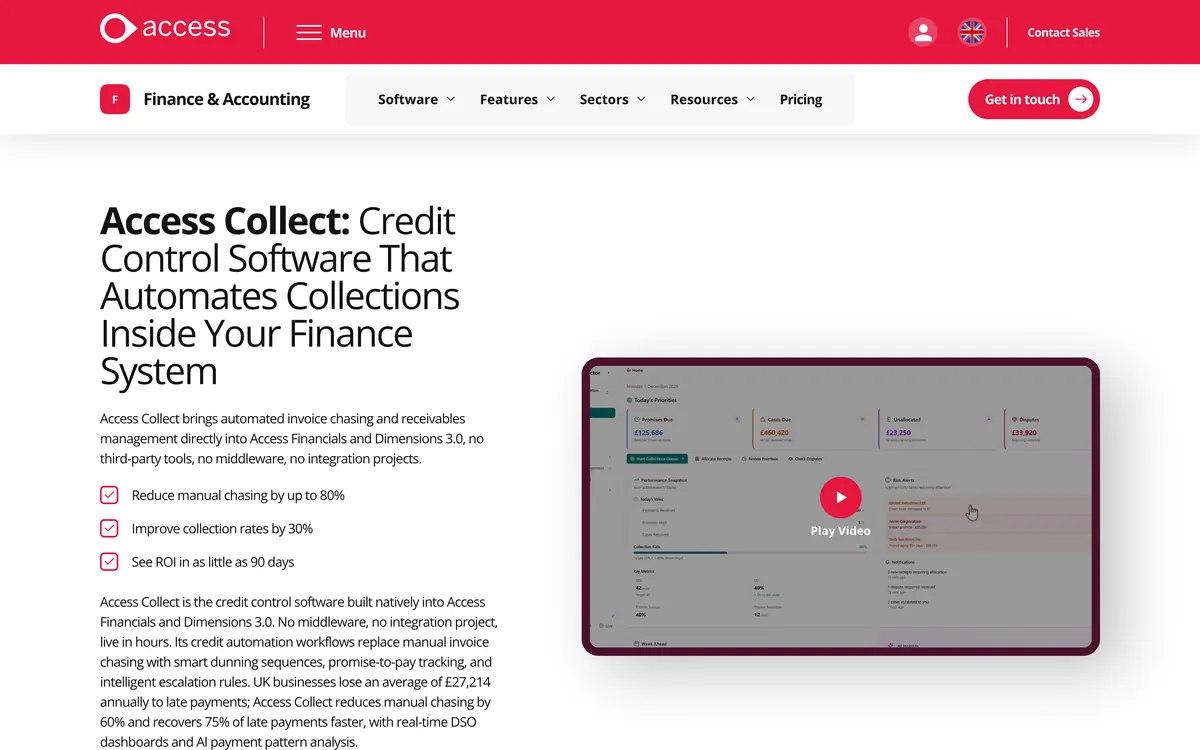
Access Financials is the recruitment accounting suite from The Access Group with in-built credit control: risk scoring, credit-limit alerts and collection workflows, quote only, plus the Access Collect module from £3,600 a year.
- Fits
- UK agencies that run Access Pay & Bill and want the ledger, payroll billing and credit control from one vendor
- Regions
- UK led
- Entry cost
- quote only for Access Financials; Access Collect, the automated chasing module, publishes £3,600 a year on its entry tier with unlimited users
- Rated
- no product-level review base found
- Runs on
- Access Financials and Access Dimensions only; no connector to Xero, QuickBooks or Sage
- Statutory late fees
- no evidence found in vendor documentation
- The one thing it does best
- credit risk data and credit-limit alerts inside the same ledger the pay-and-bill run posts into
Customers named on Access Collect's website include Betfred, Countrywide and Friends of the Elderly.
Best suited for: UK agencies that run Access Pay & Bill and want the ledger, payroll billing and credit control from one vendor.
The limit: It is only an option for an agency already on the Access finance stack, and payment plans sit on the Access Collect Professional tier at £6,600 a year.
Does Xero track debtor days for recruitment agencies natively?
Xero does not track debtor days per client natively: its aged receivables report shows who owes what for one organisation on the day you run it. Credit control software adds the tracking a temp desk needs: ageing per client, a credit score, and an alert when a client's total balance crosses a limit.
Xero's report does not rank clients by how they usually pay, and it does not tell anyone when a client's open balance passes the credit limit agreed in the terms of business.
Paidnice adds an Aged Receivables by Contact view with 1-30, 31-60, 61-90 and 90+ day buckets across every connected organisation, exportable, plus a credit score from 0 to 100 against each contact and an opt-in weekly summary email. Escalations can fire on a client's total overdue balance or a credit-limit breach rather than on a single invoice.
Chaser and Satago carry their own debtor dashboards; Satago adds credit-risk data on each debtor. For all ten tools by size and ledger, see the wider credit control software comparison.
Which credit control software fits which agency size?
Pick credit control software by agency size and ledger platform first, features second: Paidnice for any agency on Xero or QuickBooks up to $50m a year, Chaser where a credit control team wants built-in bureau credit checks, ezyCollect on MYOB, Kolleno for multi-entity groups.
- Under £4m on Xero or QuickBooks. Paidnice: the £49 tier and per-group automation fit an agency with no dedicated credit controller, sitting on top of Xero. Satago is the UK alternative if invoice finance matters more than fee automation.
- £4m to £10m. The genuine head-to-head. Paidnice for per-group late fees, statements on any schedule, and pricing by invoice volume; Chaser if built-in bureau credit checks justify Core from £599 a month. At every size, pause sequences on genuinely disputed perm fees, covered in our guide to rebate clauses and disputed fees.
- £10m and up, or multi-entity. Paidnice carries to $50m a year or 50,000 invoices a year on Xero or QuickBooks; Chaser's upper tiers carry to £100m turnover; Kolleno adds cash application at volume for groups on NetSuite or SAP.
- AU or NZ on Xero. Paidnice: the same invoice-volume pricing, with contractual late fees you set per client group. Australia and New Zealand have no statutory fallback, so the contract does the work; the country-by-country rules are in late payment fees for recruitment agencies.
- AU or NZ on MYOB or local ERPs. ezyCollect. Put late-payment terms in the contract, because the software will not apply interest for you.
- Funding the gap as well as collecting. Satago combines both at the small end; or pair a recruitment-specialist funder with any tool here.
💡 Paidnice insight
The pattern we see from the recruitment agencies on Paidnice is consistent: one firm sequence for direct clients, self-billed accounts excluded, consolidated statements weekly, and interest applied automatically then waived by a named person as a goodwill lever. Which tool you run matters less than making those four decisions once.
Frequently asked questions
What does credit control software cost for a recruitment agency?
Credit control software for a recruitment agency starts at £49 a month for Paidnice (150 invoices), £199 a month for Chaser on turnover tiers, about A$275 a month plus setup on an annual contract for ezyCollect, and $650 per user per month for Kolleno; Satago publishes £45, £80 and £200 a month tiers.
Watch the pricing metric, not the headline number: per-user and revenue-tiered models climb steeply as a temp desk grows, while invoice-volume tiers do not.
What is the best Chaser alternative for a recruitment agency?
Paidnice is the strongest Chaser alternative for a recruitment agency if Chaser's single set of late-fee rules (no documented way to run different rules per group) or monthly-only statements are the constraint: it applies fees and statements per customer group at a lower entry price. Satago is the alternative if you want invoice finance in the same platform. If bureau credit checks matter most and the Custom plan is out of budget, Chaser remains the better buy. Paidnice runs native credit checks from payment behaviour on every plan.
Why can't the ATS or pay-and-bill system handle this?
The ATS and pay-and-bill systems cannot handle credit control because they stop at invoice creation. Bullhorn's invoicing product describes billing profile capture and invoice formatting, not follow-up, and ETZ's automatic overdue texts and emails work per invoice, with no statements, interest, or escalation. The receivable lives in your ledger, so credit control has to run there.
Do late fees or reminder timing matter more?
Both matter, and they work together. The earlier the follow-up, the likelier the payment, and the first overdue week matters far more than the fifth. The fee is the leverage behind the reminder: a charge on the ledger moves the invoice up the client's payment run, so apply it automatically and waive it deliberately. Automated reminders plus fee automation beat either alone. When to charge and when to waive is covered in late payment fees for recruitment agencies.
Should self-billed accounts get reminder emails?
Self-billed accounts should not get reminder emails. A client that self-bills raises the invoice itself and pays to the terms in its master agreement, so reminder emails achieve nothing and can irritate the client's payables team. Your tool must exclude those accounts from sequences and manage them on statements and approval-lag reporting instead.
Which credit control software works with Xero for a recruitment agency?
Paidnice, Chaser, Satago, ezyCollect and Kolleno all connect to Xero. Access Financials runs on its own Access ledger only, so it suits agencies that already use it.
Can a UK recruitment agency charge statutory interest on late invoices?
Yes. The Late Payment of Commercial Debts (Interest) Act 1998 lets a UK business charge statutory interest on late business invoices. Paidnice applies the statutory rate auto-indexed to the Bank of England base rate, and Chaser has a base-rate option within one set of late-fee rules.
Read the transcript: Credit control software for recruitment agencies
A recruitment agency pays its contractors on Friday and waits 56 days for the client to pay the invoice. 35% of agencies had a bad debt last year. This video covers what an agency needs from credit control software, the apps that can support you, Paidnice among them, and how to choose by the size of your desk.
Here is what we cover. One, why recruitment is different. Volume, self-billing, and weekly timesheets.
Two, the four things you need. Sequences by client group, weekly statements, statutory late fees, and a route to payment. Three, the apps that can support you.
Four, choosing by the size of your agency. A temp desk raises hundreds of invoices a month, so anything priced per invoice or per user gets expensive fast. Some clients self-bill, and those accounts must be excluded from reminders entirely, or you chase an invoice they raised themselves.
Weekly timesheets mean one client can hold six open invoices at once, so a monthly statement is structurally late. And nothing in the pay and bill stack, Bullhorn, JobAdder, ETZ, or FastTrack, follows up an unpaid invoice. The REC found 35% of member firms had bad debt in the past year against 29% across other sectors.
Sonovate puts the average wait to be paid at 56 days. Credit control has to sit on the ledger on Xero or QuickBooks, because that is where the invoice lives. Chapter two.
The first thing you need is a reminder sequence per client group. Self-billed clients, no sequence. Key accounts, two polite steps.
Everyone else, the full ladder. Due date, a reminder with a payment link. Day seven, a firmer email and an SMS to the hiring manager's accounts contact.
Day 14, a final notice naming the fee. Sent from your own domain. And when the client replies with a date, the sequence pauses. Second, weekly statements.
A client running three contractors on weekly timesheets holds a stack of open invoices, and a statement every Monday is the only document that shows the whole stack. Invoiced £14,200, paid 9,600, outstanding 4,600, with 1,550 past 30 days. One payment link clears the lot.
Third, statutory late fees. In the UK, the late payment of commercial debts act gives you 8% a year over the Bank of England base rate plus a fixed sum per invoice. Today, that is 11.75%.
A £3,200 weekly invoice, 30 days late, £30.90 in interest plus a £70 fixed sum, £100.90. On a client with six invoices late, that is six fixed sums, not one. The software should calculate it, raise it in Xero or QuickBooks, allow a grace period, and let you waive it for the client you want to keep.
Most agencies apply the fee and then waive it on the call. The fee is the leverage that gets the call returned. Fourth, a route to payment.
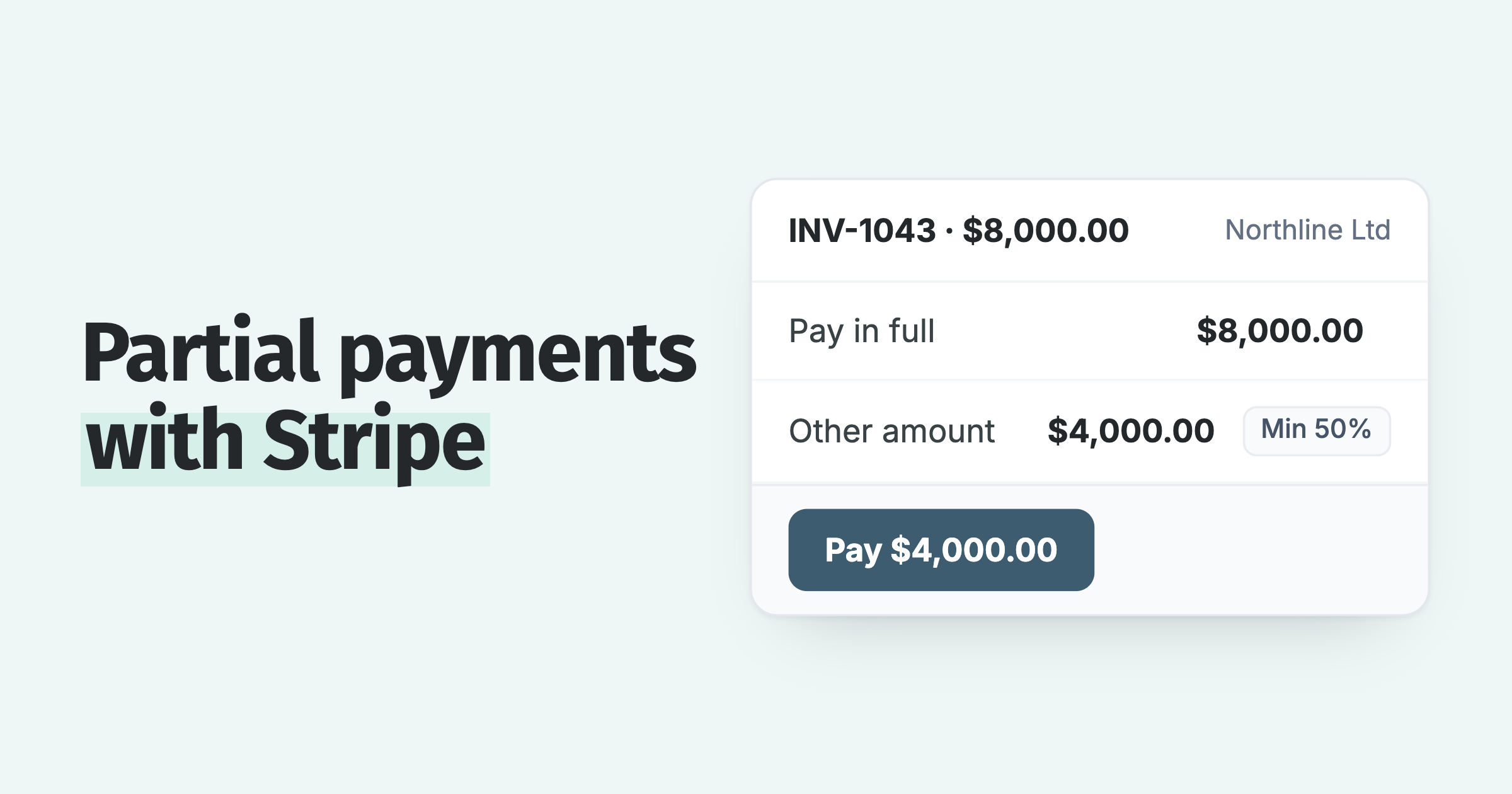
A portal where the client sees every open invoice and pays them in one go, a payment plan for the client who has fallen behind on a placement fee, a 9,000 pound fee becomes three payments of 3,000 card on file charged on each date, and an aged receivables view by contact 30, 60, 90 days with a payment history score so the desk knows who to place with next. Chapter three, the apps. Paidnice suits an agency on Xero or QuickBooks Online that raises a lot of invoices, needs self-billed clients left alone, and has nobody dedicated to chasing.
It runs all four sequences by client group with self-billed accounts excluded, weekly statements, statutory late fees raised on the ledger, plans, and the portal at a flat monthly price by invoice volume with no per seat fee on pro from 49 pounds a month. Rated 5.0 from 83 App Store reviews. It is built to automate fees and run the whole process end-to-end at a low price.
Other apps also serve agencies and one may suit you for a particular reason. One, Chaser, one of the oldest names in UK credit control with credit checks from 199 pounds for agencies past 4 million with a named credit controller. Two, Paidnice, the end-to-end option for agencies from 500,000 to 10 million on Xero or QuickBooks.
Three, Satago, reminders plus invoice finance in one login. Four, ezyCollect, the Australian and New Zealand specialist with the deepest MYOB coverage. Five, Kolleno, an AI order-to-cash platform for enterprise finance teams per user.
Match the app to the four needs. Chapter four, under 2 million, no credit controller on Xero or QuickBooks, an invoice priced app that runs itself. 4 to 10 million with a named credit controller, a suite with credit checks earns its price.
10 million and up, multi-entity on an enterprise ERP, a per user platform with a finance team behind it. In Australia and New Zealand on Xero, the same four needs apply. On MYOB, the local specialist, if you fund invoices as well as collect them, take the hybrid.
That is what a recruitment agency needs, sequences by client group, weekly statements, statutory late fees, and a route to payment sitting on the ledger where the invoice lives. The five tool comparison is in the article at
Paidnice features in this article
About the editorial team
Denym started Paidnice in 2022 after customers paying late left his own business short on payroll. He has led it to $1 billion collected on time across more than 1 million invoices, and writes about credit control, late fees and getting paid on Xero and QuickBooks.

 App of the Year