

Credit control for recruitment agencies means deciding who gets credit before the placement, invoicing fast from approved timesheets, following a fixed reminder cadence, and applying interest consistently. Most agencies fail at it for structural reasons: the software stack has no collections layer, and account managers are paid on billings, not collections.
Key takeaways
Recruitment agencies suffer bad debt at roughly 1.2 times the cross-sector rate. REC's 2024/25 UK Recruitment Industry Status Report found 35% of member firms experienced bad debt in the past year, versus a 29% average across other sectors.
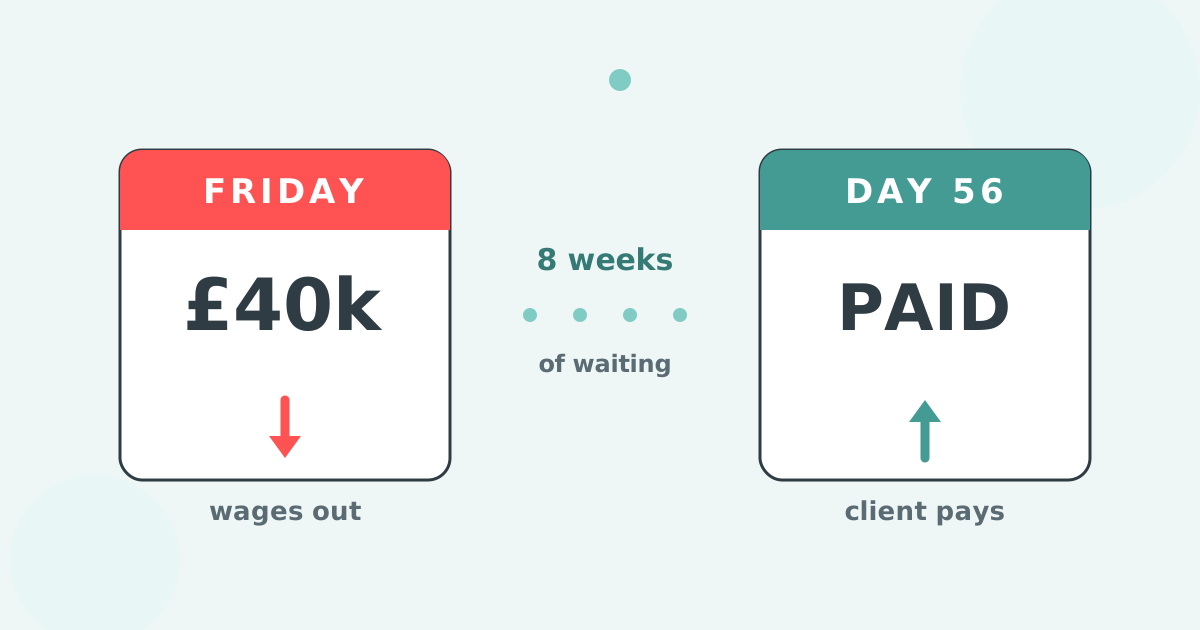
Sonovate's research puts the average recruitment agency's wait for payment at 56 days, and finds over 37% of medium businesses take 90 days on average to pay contractors. Across the whole UK economy, Atradius's 2025 Payment Practices Barometer reports 51% of B2B invoices overdue and 7% written off.
And agencies are going under: accountancy firm Armstrong Watson, citing government insolvency statistics, reported 181 UK recruitment businesses entering liquidation in the six months to August 2025, up 18% year on year.
Temp and contract desks typically run net margins of 8 to 15% per industry margin guides, so one written-off invoice wipes out the profit on roughly 7 to 12 equivalent invoices. That is arithmetic, not a survey finding.
Australia is no kinder: CreditorWatch's April 2026 Business Risk Index put Australian late payments at their highest level since January 2020, and Administrative and Support Services, the division containing labour hire and employment placement, carries the second-highest insolvency rate of any sector at 1.25%.
Staffing and support services sit in their own bracket. Xero Small Business Insights publishes the industry figure.
| Market | Administrative and Support Services | All industries | Gap | Rank, slowest first |
|---|---|---|---|---|
| Australia | 23.0 days | 20.3 days | +2.7 days | 10th of 19 |
| New Zealand | 22.8 days | 23.2 days | -0.4 days | 6th of 10 |
| UK | 33.4 days | 29.3 days | +4.1 days | 6th of 14 |
Source: Xero Small Business Insights, June 2026. See the full data on the Paidnice accounts receivable statistics dashboard.
Margin per placement decides how much of that wait a business can carry.
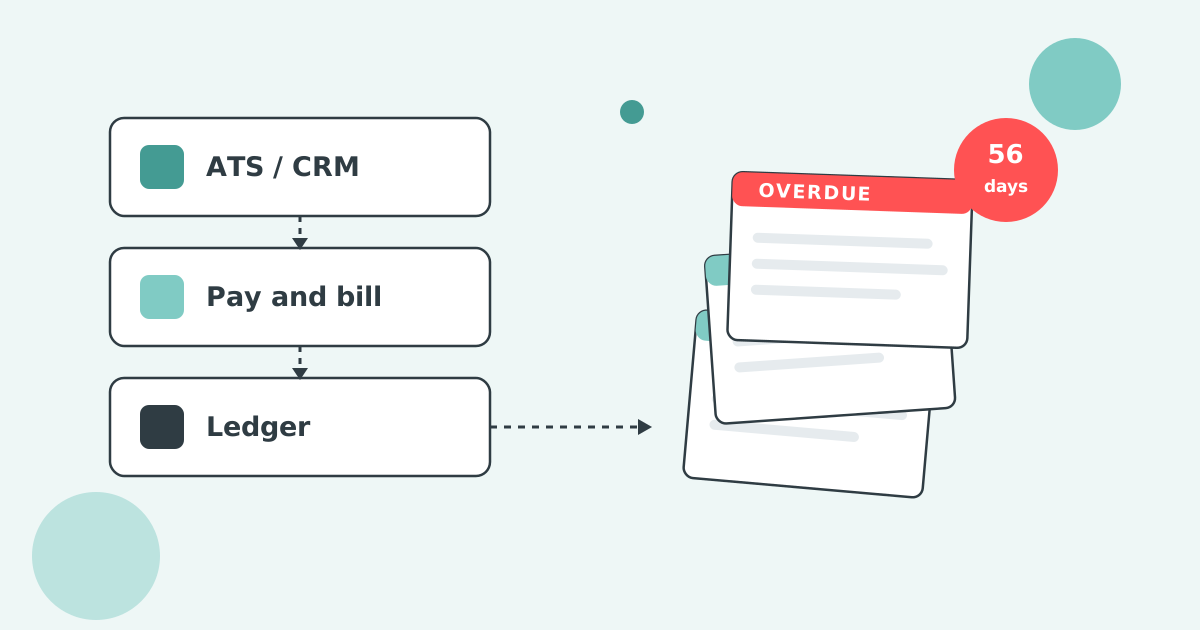
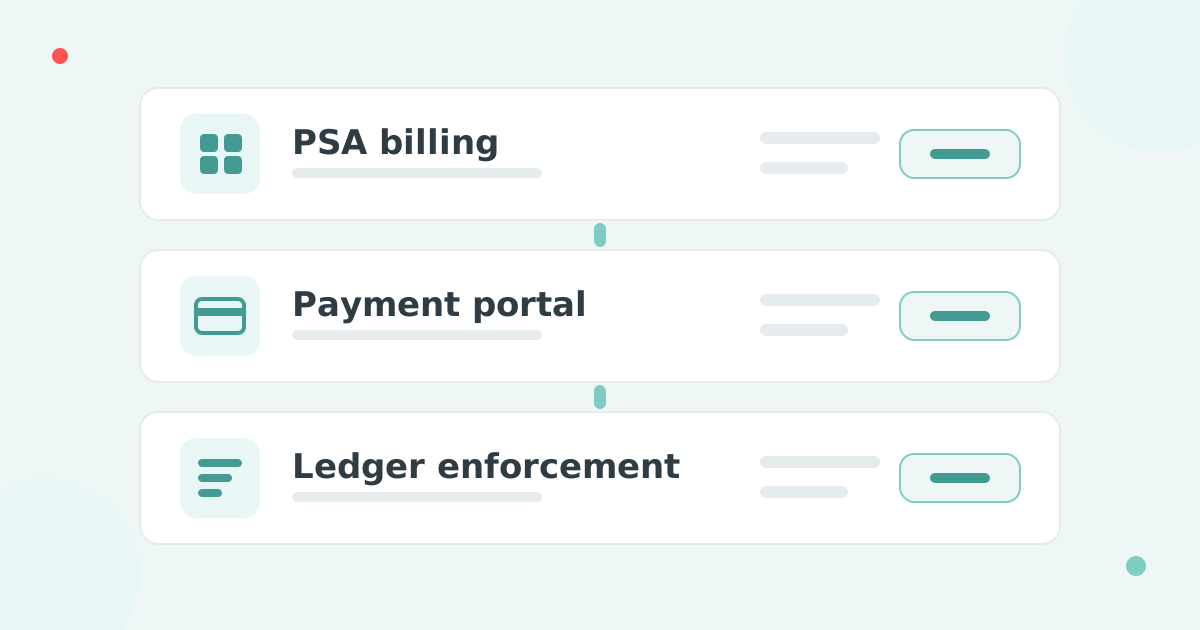
No system in the recruitment stack owns collection: the ATS wins the work, the pay-and-bill engine raises the invoice, the ledger stores it. The typical agency runs three separate systems, and the gap between them is where unpaid invoices live.
| Layer | What it does | Typical products | What it does about overdue invoices |
|---|---|---|---|
| Front office (ATS/CRM) | Candidates, jobs, clients, placements | Bullhorn, JobAdder, Vincere, Firefish | Nothing |
| Middle office (pay and bill) | Timesheets, rates, payroll, invoice generation | ETZ, Access Pay & Bill, FastTrack360, Bullhorn Back Office, Timesheet Portal | Raises the invoice, then stops |
| Back office (ledger) | Sales ledger, GL, bank reconciliation | Xero, QuickBooks Online, MYOB, Sage | Holds the aged receivables. Collection is left to whoever logs in |
Bullhorn's own invoicing page describes billing profile capture, contract compliance, and invoice formatting; collections is not mentioned. Cash application, the closest term in the list, is matching money that has already arrived. Nothing in that list makes money arrive. The nearest exception is ETZ, which can send automatic overdue texts and emails: invoice-level nudging, not statements, escalation, or interest.
By default the job lands in the ledger, which stores the problem rather than solving it; credit control has to be built as its own layer on top.
The account manager who owns the client relationship is paid on billings. The credit controller who owns the ledger has no relationship capital. When those two argue about whether to press a slow-paying client, the ledger loses.
It is incentives, not character: the same client places another temp next week, so every firm reminder reads as a threat to next week's billings, and the policy evaporates account by account.
The fix is taking the repeated decisions away from individuals:
💡 Paidnice insight
Across the agencies we work with, apply-then-waive is the pattern that survives contact with a real account manager. Interest applied automatically gives the credit controller leverage they never had before: clients prioritise the invoices that cost money to ignore. And when a named person waives the charge in exchange for payment today, that documented gesture builds more goodwill than never charging at all.
You have three ways to staff this: an in-house owner (part of a finance role is enough below roughly £5m of billing), an outsourced credit control service that follows up in your name for a monthly fee, or automation software on top of your ledger. Outsourcing buys hours; it does not fix the segmentation and ownership decisions above, which stay yours either way.
Credit-check a new client when you take the vacancy, not when you make the placement. By placement day the wage cost is committed and your leverage is gone.
The bureaux depend on your market: Experian, Creditsafe, and Dun & Bradstreet in the UK; illion, CreditorWatch, and Equifax in Australia; Centrix and Equifax in New Zealand; Dun & Bradstreet and Experian Business in the US; Equifax and TransUnion in Canada. Look for court judgments and adverse filings, not just a headline score.
Free checks almost nobody uses
Large UK companies must publish their payment performance at check-payment-practices.service.gov.uk; large Australian businesses report to the Payment Times Reports Register. Read an enterprise client's published average payment days before onboarding, and quote them back to procurement.
Then set a credit limit per client, sized in weeks of billing, and enforce it at placement in the ATS, not at invoice in the ledger; by invoice stage the wages are already sunk. A limit that blocks a new placement on an account past terms is the most effective enforcement mechanism an agency has.
No placement starts until six things are green: signed terms, a clear credit check, a credit limit, a PO or cost-centre reference, a named billing contact with AP portal details, and a confirmed invoice submission channel.
Point one is also a legal requirement in the UK: under the Conduct of Employment Agencies and Employment Businesses Regulations 2003, terms must be agreed in writing before the introduction is made; introduce first and you have weakened your own fee claim.
Timing beats firmness: the earlier the follow-up, the likelier the payment, and practitioners consistently find the first overdue week matters far more than the fifth. The cadence has to run on rails, not on memory.
One number circulates widely in credit control marketing: that two reminders recover 80% of overdue invoices. No published methodology sits behind it, so treat it as a sales claim, not a benchmark.
💡 Paidnice insight
What we can say from our own customers: once a consistent cadence runs, eight in ten invoices get paid on time. The change is rarely the wording of the reminders; it is that they stop being skipped.
| Day | Action | Owner |
|---|---|---|
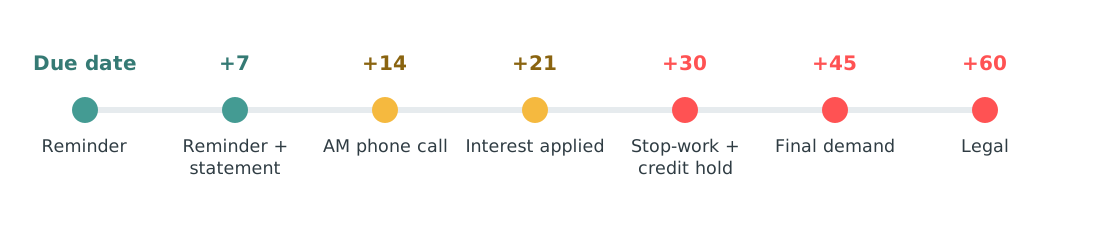
| Due date | Polite reminder, invoice attached, payment link included | Automated |
| +7 | Firm reminder plus a statement of account | Automated |
| +14 | Phone call from the account manager, not credit control. The AM has the relationship and the pipeline leverage | Account manager |
| +21 | Interest and fixed compensation applied and shown on the statement | Automated |
| +30 | Credit hold: new placements blocked in the ATS, stop-work notice issued under your suspension clause | Finance, AM informed |
| +45 | Final demand, letter before action | Finance |
| +60 | Legal action or a third-party collections referral | Finance |
Three recruitment-specific notes. First, the real cadence on weekly-billed accounts starts before the invoice exists: the timesheet-approval nudge at day minus five is where most delay lives (the cash flow post covers those free days). Second, send statements weekly on weekly-billed accounts, not monthly; automatic statements take the manual work out. Third, perm desks compress the ladder: one invoice, no stop-work lever, escalate faster.
On the +21 step, you already have the entitlement whether or not your terms mention it: the Late Payment of Commercial Debts (Interest) Act 1998 provides interest at 8% a year over the Bank of England base rate, plus fixed compensation of £40, £70, or £100 per invoice depending on the debt's size.
When to charge, accrue, or waive it has its own guide: late payment fees for recruitment agencies. Never run the sequence against a genuinely disputed invoice: pause, resolve, resume; the triage test is in rebate clauses and disputed fees.
If you carry credit insurance
Trade credit insurance policies typically require you to notify the insurer once an account runs roughly 30 to 90 days past due, and bar further supply beyond the policy's maximum extension period, or cover lapses, per credit insurance industry guides and Allianz Trade. If you are insured, the day-30 stop-work step is not just leverage; it is a policy obligation.
The rules are changing
The UK Commercial Payments Bill entered Parliament on 18 May 2026: a maximum 60-day payment term, interest at 8% over base becoming mandatory rather than optional, and fining powers for the Small Business Commissioner.
The government says late payment costs the UK economy £11 billion a year and closes 38 businesses a day. It is still before Parliament (Lords Committee stage as of August 2026) and is not expected to come into force until 2027 at the earliest.
A 20-person direct client and an enterprise procurement function should never sit in the same reminder sequence: the terms, the leverage, and the metric that matters are all different.
| Direct SME | Direct enterprise | |
|---|---|---|
| Typical terms | 14 to 30 days | 30 to 45 days (price anything longer) |
| Invoice raised by | You | You, unless a self-billing agreement applies |
| Reminder sequence | Full automated cadence | Cadence plus a named AM contact |
| Interest | Apply automatically | Accrue, use at terms renewal |
| Stop-work | Day 30 | Escalate first |
| The metric | Days overdue | Days overdue; approval lag if self-billed |
Some larger clients raise invoices themselves under self-billing agreements. Exclude those accounts from reminder sequences and watch timesheet-approval lag instead; every day between shift worked and invoice raised is payroll you fund before terms begin. A weekly automatic statement from Xero keeps the account reconciled without a single reminder email.
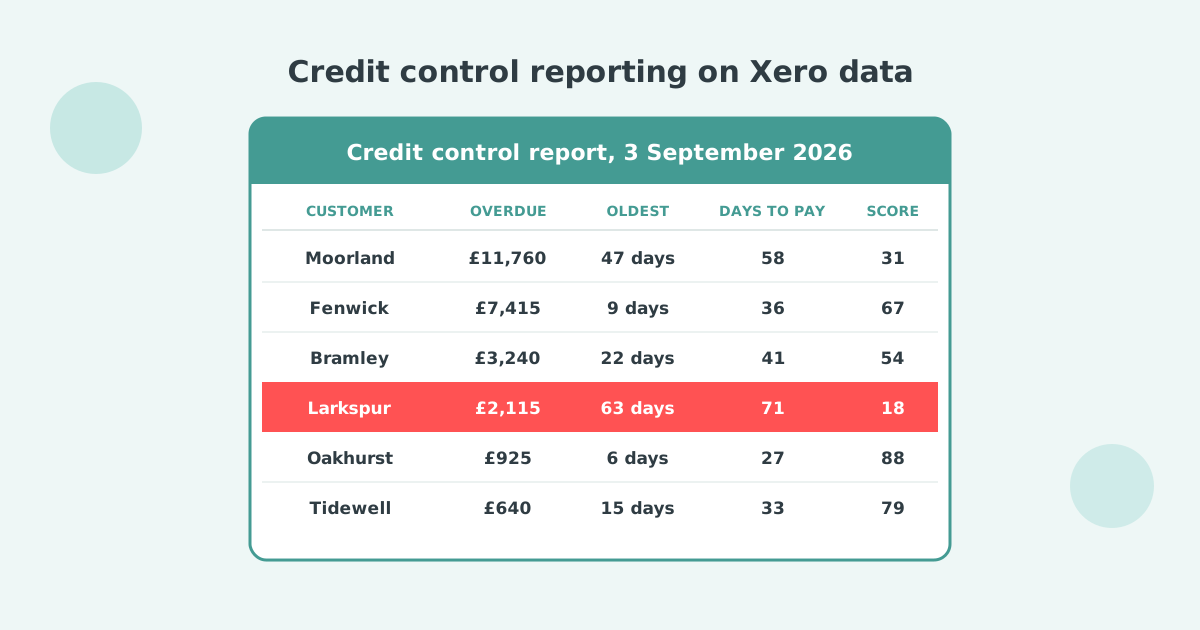
Days sales outstanding (DSO) alone hides the problem: a recruitment ledger needs four numbers weekly, average days delinquent, disputes as a share of invoices, invoices raised within 24 hours of approval, and interest accrued versus waived.
Fifteen minutes every Monday: aged receivables by segment (SME, enterprise, self-billed), the four numbers above, accounts crossing day 30 with an owner's name against each, and whether any placement went to a held account. That last one should always be zero.
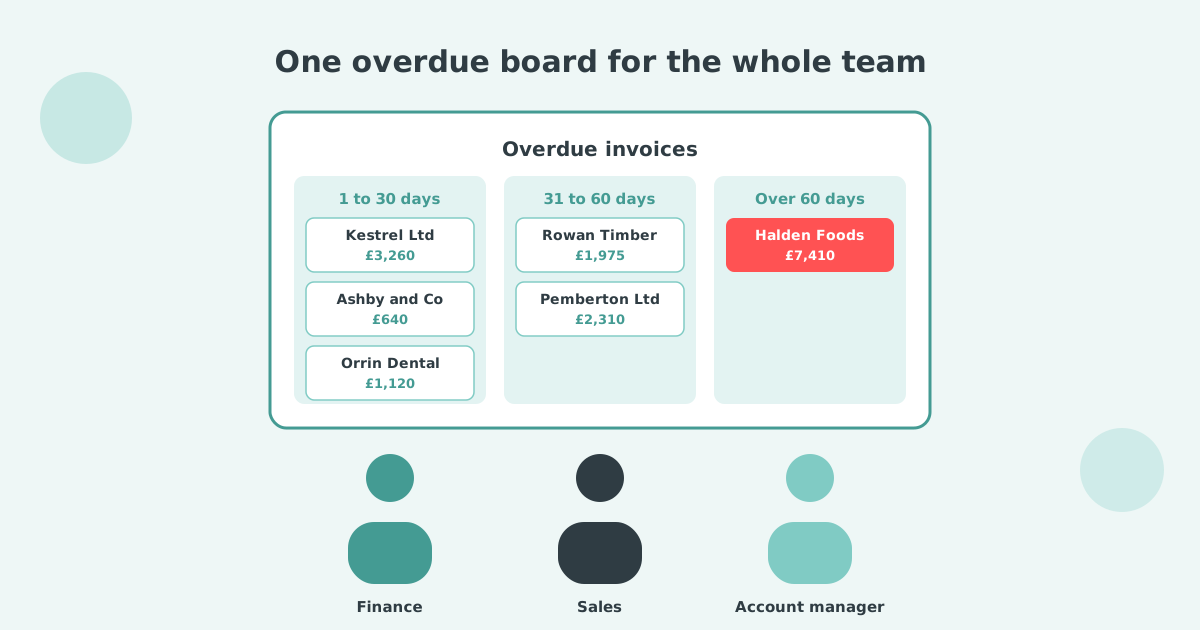
Everything above works as a manual process; what breaks it is depending on somebody doing the same 40 follow-ups every week, forever. This is the layer Paidnice adds on top of Xero and QuickBooks:
Customers cut their average wait for payment in half, within 30 days. Comparing options first? The ranked comparison in the best credit control software for recruitment agencies covers the field honestly, Paidnice included.
Why do recruitment invoices go unpaid?
Rarely because the client cannot pay. The usual causes are process gaps: invoices raised days after timesheet approval, missing PO numbers, rate mismatches (practitioners consistently report timesheet and rate mismatches as the leading cause of disputed invoices), terms never signed before the introduction, and no owned follow-up cadence once the invoice goes overdue.
Who should chase invoices in a recruitment agency?
One named finance owner runs the ledger and the cadence, with account managers scripted in at two fixed points: the day-14 phone call and the day-30 stop-work decision. Leaving it wholly to account managers fails because they are paid on billings; leaving it wholly to a credit controller fails because they have no relationship leverage. Automate the routine reminders so people only handle the two touches that need a human.
What payment terms should a recruitment agency offer?
Standard B2B terms in the UK are 30 days from invoice date, and recruitment mostly trades inside that: 14 days from start date is common on perm invoices, 14 to 30 days on direct temp accounts, and 7 days for new clients with no history.
Enterprise programmes usually impose 45 to 60 day terms in the master agreement; those are rarely winnable, so price the funding cost into the rate instead.
Should recruitment agencies charge late payment fees?
UK agencies already hold the entitlement: 8% a year over the Bank of England base rate plus £40 to £100 fixed compensation per invoice under the Late Payment of Commercial Debts (Interest) Act 1998. What works in recruitment is applying interest automatically at ledger level, then letting a named person waive it for a documented reason.
The full decision framework is in late payment fees for recruitment agencies: when to charge, when to waive.
Paidnice is accounts receivable automation that enforces your payment terms, trusted by thousands of businesses on Xero and QuickBooks. Credit control and debtor management, run for you.
Try it Now - It's FreeNo card required.

Optimize your cash flow with our suite of financial tools designed for AR professionals. Calculate DSO, aging analysis, late fees, and more.