
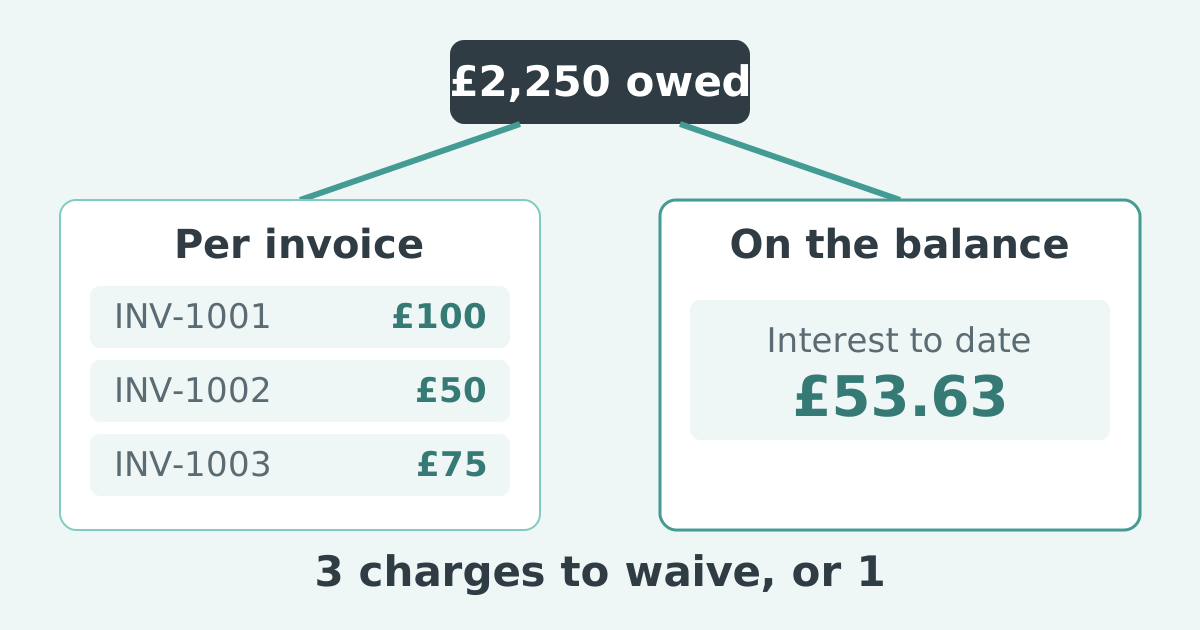

An invoice late fee charges each overdue invoice separately. Statement interest charges one figure against the customer's whole overdue balance. Use invoice late fees when customers owe you one or two invoices at a time. Use statement interest when a customer runs a rolling ledger of many small invoices, because one monthly charge is easier to explain than thirty.
An invoice late fee and statement interest both charge a customer for paying late. One attaches to a single overdue invoice, the other to everything they owe you.
An invoice late fee attaches to a single overdue invoice. Invoice 1001 is late, so invoice 1001 gets a fee. Ten overdue invoices produce ten fees. It is usually set as a flat percentage of the invoice, or a fixed amount.
Statement interest attaches to the customer, not the invoice. It looks at everything they owe you, works out the interest that has accrued across the whole balance, and raises one charge for the period. Ten overdue invoices still produce one charge.
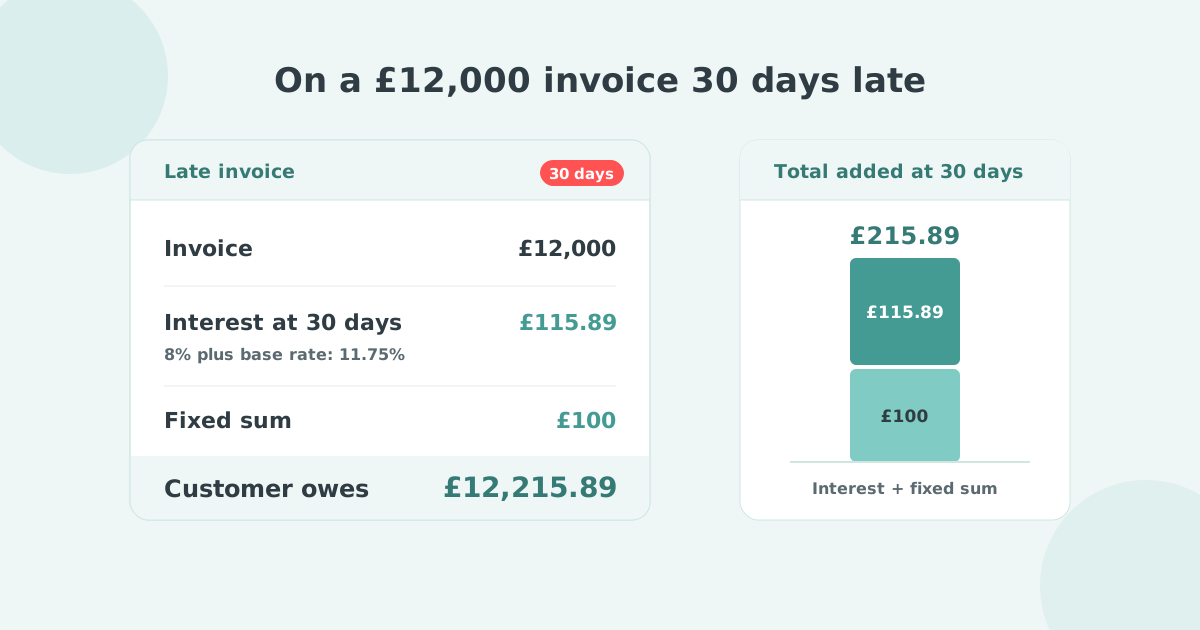
Neither is more legitimate than the other. In the UK the statutory regime actually uses both at once: daily interest on the debt, plus a fixed sum per invoice. Our UK late payment fees guide has those rates in full.
Here is a customer with three overdue invoices totaling £2,250, at different ages. Change the numbers to match your own ledger.
The flat fee charges 4.2 times as much, and leaves 3 charges to waive instead of 1.
Statement interest is calculated daily on each invoice from its due date, at the annual rate you set, then billed as one figure. The invoice late fee is a flat percentage and does not change with time.
Here are the same numbers written out, so you can check them.
Three overdue invoices: £1,000 at 60 days, £500 at 30 days and £750 at 45 days.
As invoice late fees at 10%, that is £100, £50 and £75. £225 in total, across three separate charges.
As statement interest at 18% a year, each invoice accrues daily from its own due date: £29.59 on the first, £7.40 on the second, £16.64 on the third. £53.63 in total, as one charge.
Same ledger. Same day. A four-fold difference, and three things to waive instead of one.
A percentage-based invoice late fee does not care how late the invoice is. Ten per cent on an invoice five days late is the same charge as ten per cent on one 200 days late. Statement interest is the opposite: it grows every day the balance sits there.
On a barely late invoice the flat fee looks punitive. On a very late one it looks like a rounding error, and the customer has no reason to pay this week rather than next.
Statement interest cares about nothing else. It grows every day. A customer watching a balance climb has a reason to act today, and a supplier who does nothing still accrues a claim.
A flat late fee is a one-off penalty for crossing a line. Statement interest is a running cost for staying over it. Only one of those gets more persuasive the longer it is ignored.
That is why a flat fee works best as a sharp early signal on a small number of invoices, and interest works best on an account that has been drifting for months.
Forget the size of the debt. Look at how the debt arrives.
| Your ledger looks like | Charge | Why |
|---|---|---|
| A handful of large invoices, one or two overdue at a time | Invoice late fee | The fee names the invoice. The customer knows exactly which one to pay. |
| Many small invoices, billed weekly or monthly, rolling | Statement interest | One monthly charge is explainable. Thirty is an argument. |
| Retainers or subscriptions on the same date each month | Statement interest | The balance is the relationship. Charging per invoice fragments it. |
| Project work with milestone invoices | Invoice late fee | Each milestone is its own negotiation, so each fee should be too. |
| A long-overdue account you are close to escalating | Statement interest | You need one growing number for a letter before action, not thirty small ones. |
Whichever model you choose, the charge only works if it reaches the customer's accounts payable system. That means it has to be a real invoice on your ledger, not a note on a statement.
A posted invoice lands in their aged payables, their approval queue and their next payment run, and it can be settled through a customer payment portal like anything else. A number that exists only inside your software lands nowhere, because the person on the other side cannot pay something that was never invoiced.
The most common reason a late fee gets ignored is not that the customer refused it. It is that it never entered their system as something payable. If your fee is not an invoice, it is a threat. If it is an invoice, it is a debt.
The two models look different from their side, too. An invoice late fee arrives as a small invoice they can match to an original. Statement interest arrives as a charge against the account, which is cleaner to read but harder for a strict AP process to match to a purchase order. That is the limitation of the statement model, and it is worth knowing before you switch a large customer onto it. What the customer reads when the charge lands is covered in how to tell a customer you are charging a late fee.
Thirty invoice late fees in a month is thirty charges to explain, thirty to reverse, and thirty credit notes at year end. One statement interest charge is one of each.
Most businesses apply a late fee and then cancel it once the customer settles. That is the right way to run it. It also means every fee you raise is a fee you may have to reverse.
If you are choosing between models and the numbers are close, the admin is the tiebreaker. Either way, what matters in the end is what it does to your average wait for payment, not what the charge collects.
In the UK and the EU the right to charge is statutory and automatic. Almost everywhere else it is contractual, which means the right is established by your payment terms, and if the customer disputes it a court decides under contract law.
| Market | Basis | What it means for the model you pick |
|---|---|---|
| UK | Statutory, automatic on B2B | Both models are built in: daily interest at base rate plus 8%, plus a fixed sum of £40, £70 or £100 per invoice. |
| EU | Statutory (Directive 2011/7/EU) | ECB reference rate plus at least 8 points, plus €40 minimum per invoice. Same shape as the UK. |
| US | State by state, usury caps | Typically 1% to 1.5% a month, which is an interest model by default. |
| Australia, New Zealand | Contractual | No statutory B2B rate. Whatever your terms say, so both models are available. |
| Canada | Contractual, federal and provincial variation | State the annual equivalent rate in your terms, not just a monthly percentage. |
| South Africa | Statutory backstop | Prescribed Rate of Interest Act sets a fallback, 10.25% from March 2026. An interest model fits it naturally. |
| Singapore | Common law, and the only one of these markets still applying the older genuine pre-estimate of loss test | The charge must be a genuine pre-estimate of loss, not a punishment. |
The penalty rule applies wherever you rely on your own contract rather than a statutory right, and that includes the UK. Statutory interest cannot be a penalty because it comes from the Act. A rate you set yourself can be struck down anywhere if it is out of all proportion to your legitimate interest in being paid on time.
That is where the flat-fee model carries more risk than interest. A large flat percentage on an invoice only a few days late is hard to defend as proportionate. Interest, which scales with the delay, is easier to justify.
In every contractual market, the clause has to exist before the invoice does. Our late fee policy wording examples and payment terms templates cover the wording.
Invoice late fees and statement interest can run at the same time on different customer groups, and on most ledgers they should. The common setup is statement interest on accounts with a rolling balance, and invoice late fees on accounts that owe you one thing at a time.
You can also split by behavior rather than by ledger shape, which is covered in running different late fee policies for different customers.
What you should not do is apply both to the same invoice. Charging a flat fee and interest on the same debt at the same time is the fastest way to turn a routine charge into a dispute.
Paidnice sits on top of Xero or QuickBooks Online and offers both charge types on the same customer group, so you are not picking a product to fit a model.
Paidnice launched in 2022 built specifically to generate late fees, not as an accounts receivable suite that added them later, which is why both charge types sit on the same policy screen. Setting it up is one policy on one customer group. Most people start with a single group, watch it for a month, then split it.
Use the advanced late payment interest calculator for multiple invoices and several calculation methods, or the UK statutory interest calculator for the current Bank of England figure.
Can I charge both an invoice late fee and statement interest?
Yes, on different customers. Not on the same invoice at the same time. UK statutory charges are the exception, because the fixed compensation sum and the daily interest are designed to work together.
Which one makes more money?
On a short delay, usually the flat invoice fee. On a long one, interest overtakes it and keeps going. But the goal is a paid invoice, not fee income, and the model that gets paid fastest is the one your customer can understand.
Does statement interest show on a customer statement?
It should. Neither Xero nor QuickBooks can calculate it on a statement by themselves, which is covered in late payment interest on customer statements.
Is a late fee subject to VAT?
UK statutory interest and compensation are outside the scope of VAT, so they should be raised with no tax rather than at a zero rate. Treatment differs by market, and how to account for late fees covers it.
What if the customer disputes the invoice?
Do not apply either charge to a genuinely disputed invoice. Resolve the dispute first, then resume. A fee on a disputed invoice hands the customer a reason to stop talking about the debt.
Paidnice is accounts receivable automation that enforces your payment terms, trusted by thousands of businesses on Xero and QuickBooks. Credit control and debtor management, run for you.
Try it Now - It's FreeNo card required.

Optimize your cash flow with our suite of financial tools designed for AR professionals. Calculate DSO, aging analysis, late fees, and more.