

If you invoice other UK businesses, you can charge statutory interest on late payments at the Bank of England base rate plus 8% a year. The catch is that the statutory rate is fixed from the base rate on two reference dates a year, so a debt that stays overdue past a reference date carries more than one rate. Tracking that by hand is the kind of job that quietly gets dropped.
The short version: you can auto-charge Bank of England interest on overdue invoices by connecting Paidnice to Xero or QuickBooks. It reads the base rate at each 31 December and 30 June reference date, adds the statutory 8%, and applies the correct rate to each six-month block an invoice spans, automatically. This applies to UK business-to-business invoices; statutory interest does not apply to consumer debts, and Paidnice works with Xero and QuickBooks Online.
The rate is base rate plus 8%.UK B2B invoices can carry statutory interest of the Bank of England base rate plus 8% a year, plus fixed compensation per invoice.
It is fixed in six-month blocks.The rate comes from the base rate on 31 December or 30 June, so a debt overdue past a reference date is charged at each block's own rate, never at every Bank decision.
Paidnice keeps it correct.Paidnice picks the correct base rate for each block an invoice spans and charges the right interest on every overdue invoice, with a full audit trail.
The statutory rate for debts that fell overdue between 1 January and 30 June 2026 is 11.75%: the 3.75% base rate on 31 December 2025 plus 8%. Debts overdue in late 2025 run at 12.25%.
The rate is not re-read every time the Bank of England meets. It is fixed twice a year, from the base rate in force on 30 June and 31 December, and applied to debts that fall overdue in the following six months. So one ledger can carry two rates at once, and the rate for debts overdue from 1 July 2026 comes from the 30 June 2026 base rate.
Paidnice's Bank of England base rate toggle picks the correct reference rate for each period an invoice spans, so the interest invoice matches the Act rather than today's headline rate.
The statutory rate is not a number you can set and forget. It follows the Bank of England base rate, and the legal mechanism fixes it in six-month blocks from the 31 December and 30 June reference dates, a detail buried in the 2002 Rate of Interest Order. A Bank decision in the middle of a block changes nothing until the next reference date. When a debt stays overdue past a reference date, doing it properly means splitting the debt there and charging each block at its own rate. Our guide to UK late payment fees covers the legal side in full.
Here is what that looks like on a year-old debt.
Picture a £10,000 invoice that falls overdue on 1 November 2025 and stays unpaid for a year, crossing the 31 December and 30 June reference dates. Charging the right interest means splitting the debt at each reference date and applying that block's rate. Paidnice does this automatically.
The base rate held at 3.75% on 30 June 2026, so blocks two and three run at the same 11.75%. To check a debt of your own, use the UK statutory interest calculator or check the Bank of England base rate on the reference date. Each block is charged at its own rate, prorated by the day. You never touch a spreadsheet or watch for rate decisions.
Reference base rate plus 8%, divided by 365 for the daily rate, multiplied by the overdue amount and the days late, plus £40, £70 or £100 fixed compensation per invoice.
On a £5,000 invoice paid 40 days late in the first half of 2026 that is £64.40 interest plus £70 compensation, £134.40 in total. Our UK late payment fees guide carries the full worked example and calculator; the GOV.UK guidance and the Small Business Commissioner calculator use the same method.
The 1998 Act gives the right to simple interest from the day after the due date; the 2002 Rate of Interest Order sets 8% over the six-monthly reference base rate; section 5A adds the fixed sums.
The Act covers business-to-business and public sector debts only, so consumer invoices are outside it. Where no due date was agreed, the debt is late 30 days after the later of delivery and the customer receiving the invoice. Interest is simple, not compound, and both the interest and the fixed sum are outside the scope of VAT. A claim can reach back six years.
Paidnice applies each of these rules in the policy: simple interest is one toggle, the tax rate is "not applicable", and the fixed sum is a line item with its own income account.
Paidnice does the tracking, the maths and the charging for you:
Charging Bank of England interest correctly is fiddly to do yourself and trivial to automate. Here is the difference.
Because the rate is indexed to the Bank of England base rate at each reference date and prorated by the day, your charges stay right as the statutory rate moves, and every action is logged for a clean audit trail. If you want to sense-check a figure yourself, our free UK statutory interest calculator applies base rate plus 8% to any invoice, and the support article on Bank of England interest explains the proration in detail.
Statutory interest on late commercial payments is 8% per year above the Bank of England base rate. You can also claim fixed compensation per invoice on top of the interest. Our guide to late payment fees in the UK covers the detail.
Yes. Paidnice reads the Bank of England base rate at each reference date, adds the statutory 8%, and charges interest on your overdue invoices automatically, so you never have to look the rate up or recalculate it by hand.
Nothing until the next reference date. The statutory rate is fixed from the base rate on 31 December or 30 June, so a mid-block Bank decision feeds the next block only. A debt that stays overdue past a reference date is split there, each block charged at its own rate, then totalled, all automatically.
Yes. Paidnice picks up the base rate for each reference date, so your interest charges stay correct as the statutory rate moves, without any manual updates from you.
You can use our free UK statutory interest calculator to work out the interest and compensation on any overdue invoice. It applies the base rate that stood on the reference date (31 December or 30 June before the invoice fell due), plus 8%, for you.
Yes. Paidnice connects to both Xero and QuickBooks Online and applies your interest rules to overdue invoices automatically. See late fees and interest for how it works.
Charging Bank of England interest correctly means using the base rate from the right reference date and splitting any debt that runs past the next one. That is tedious by hand and automatic with Paidnice: it reads the rate, adds the statutory 8%, and charges your overdue invoices for you.
On Xero or QuickBooks? Start a free trial of Paidnice and auto-charge the right interest, every time.
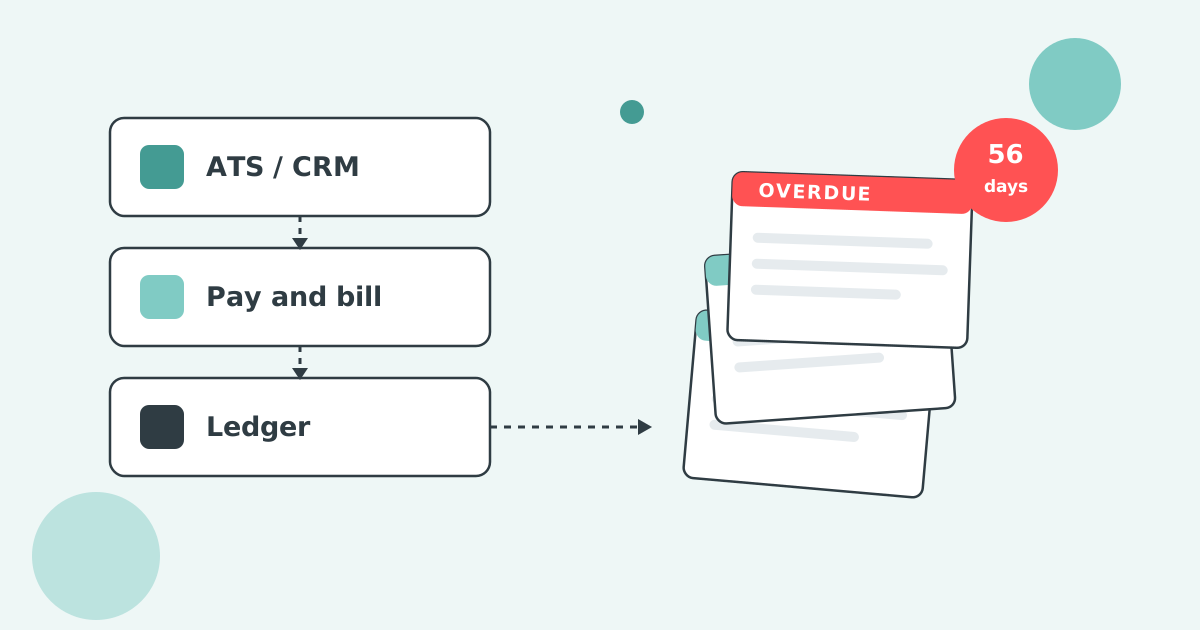
Paidnice is accounts receivable automation that enforces your payment terms, trusted by thousands of businesses on Xero and QuickBooks. Credit control and debtor management, run for you.
Try it Now - It's FreeNo card required.




Optimize your cash flow with our suite of financial tools designed for AR professionals. Calculate DSO, aging analysis, late fees, and more.