
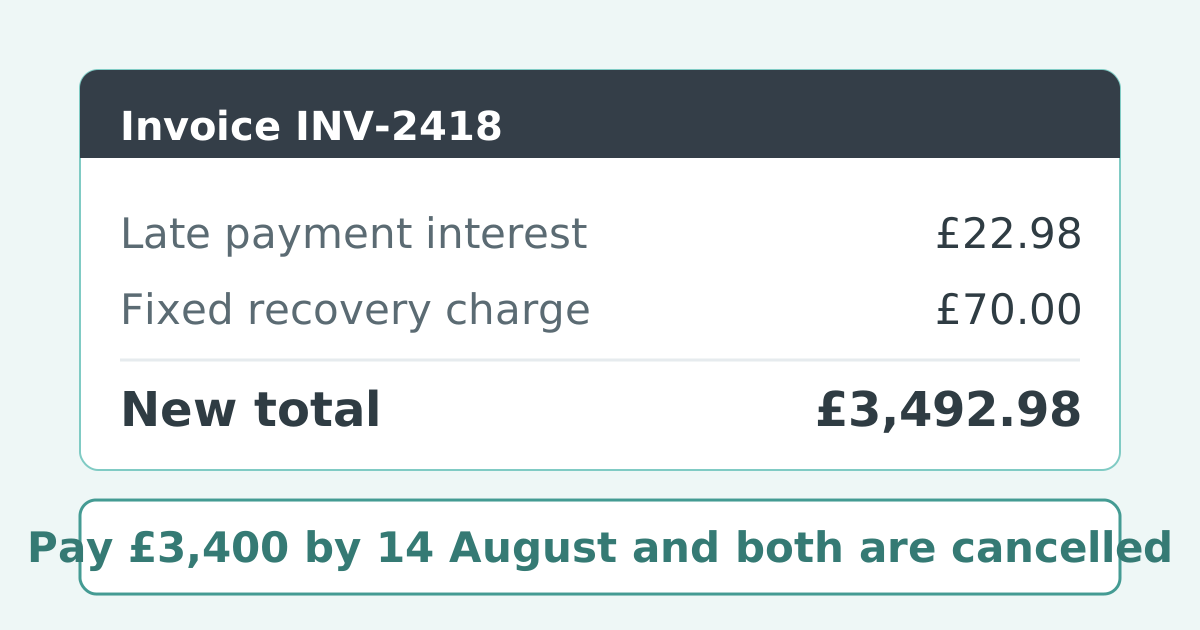

Break the numbers out in the email: the interest, the fixed fee, the new balance, and the deadline that makes the whole charge disappear if they settle the original. A late fee email that states one lump sum reads as a penalty. One that shows the working and offers a way out reads as a process.
Itemize it: interest, fixed fee, new balance, and the deadline that cancels the charge. A lump sum looks like something a person decided this morning. An itemized charge looks like something your system produced, and only one of those is worth arguing with.
One number, no derivation. The customer cannot check it, so their only options are to accept it or argue about it.
Most people argue.
Every figure is checkable, and the exit is stated before they have to ask for one.
Most people pay.
An itemized charge reads as system output. A lump sum reads as a decision someone made this morning, and a decision can be argued with.
The message that collects the most money is the one sent before any charge exists.
Subject: INV-2418 is due on Friday
Hi [Name],
A quick note that invoice INV-2418 for £3,400 falls due on Tuesday 14 July.
Under our payment terms, invoices that pass their due date attract a fixed recovery charge of £70 straight away, plus late payment interest of about £1.09 a day. It starts from Wednesday.
If the payment is already scheduled, ignore this. If anything is holding it up, tell me today and I will get it sorted.
It is a diary note with a consequence attached, sent while there is still nothing to argue about.
The email that applies the charge should state interest, fixed fee, charge total, new balance, daily accrual, and the deadline that cancels it if they settle the original. Six figures, and the customer can check every one.
Subject: Invoice INV-2418, and how to avoid the late payment charge
Hi [Name],
Invoice INV-2418 for £3,400 was due on 14 July and is now 21 days overdue. We have been in touch on 21 July, 28 July and 4 August without a payment or a reason for the delay.
In line with clause 6 of our terms, the following charges now apply and have been raised as invoice INV-2419:
Late payment interest: £22.98
Fixed recovery charge: £70.00
Total charge: £92.98
New balance: £3,492.98
Interest continues to accrue at £1.09 a day until the invoice is settled.
If the original £3,400 reaches us by Friday 14 August, we will cancel the charge in full.
If there is a problem with the invoice itself, tell me what it is today and I will put the charge on hold while we sort it out.
The contact history and the daily accrual figure do most of the work here, and the daily figure matters more than the total because it is what makes waiting feel expensive.
The email that cancels the charge once they pay is in waiving a late payment fee.
Some customers will pay the invoice and simply ignore the charge. That is usually fine and is often the outcome you wanted. Some will write back and refuse.
Subject: Re: INV-2419
Hi [Name],
Understood, and thanks for coming back to me.
The charge is not a penalty we have applied at our discretion. It reflects clause 6 of the terms signed on 3 March 2025, and in the UK it also reflects the statutory right to interest and compensation on overdue business invoices.
That said, our preference is always to close this out rather than collect it. If the outstanding £3,400 is with us by Friday, I will cancel the charge in full and we will treat it as done.
If the invoice itself is the issue, tell me which part and I will look at it today.
Point at the clause, not at their behavior. The moment the exchange becomes about how patient you have been, you have moved from a contractual position to an emotional one, and the contractual position is the stronger of the two.
A final notice states the accrued total, the full contact history, a specific date, and what happens after it. It does not threaten, and it is never followed by a second final notice.
Subject: INV-2418, final notice before we escalate
Hi [Name],
Invoice INV-2418 for £3,400 is now 35 days overdue, and the accrued charges stand at £108.31. The full balance outstanding is £3,508.31.
We have contacted you on 21 July, 28 July, 4 August, 11 August and 18 August.
Unless the balance is settled or you contact me with a payment proposal by Friday 28 August, this account will be passed for formal recovery. At that point the accrued interest and recovery costs form part of the claim and we will not be able to cancel them.
I would much rather agree something with you this week. If cash flow is the issue, a payment plan is available and I can set it up today.
Two rules for this one. State a date, and mean it, because a final notice that is followed by another final notice teaches the customer that none of them are real. And offer the alternative, because a lot of accounts that reach this stage are cash flow problems rather than refusals, and a payment plan collects more than a legal letter does.
What comes after this is a formal letter before action. The full sequence is set out in our invoice escalation ladder.
Never apply a late fee to a genuinely disputed invoice. A queried invoice is not late, it is unresolved, and charging it hands the customer a legitimate grievance to raise instead of the payment.
If a customer has genuinely queried an invoice, the invoice is not late in any useful sense. It is unresolved. Applying a charge to it does three things, all bad: it tells them you were not listening, it gives them a legitimate grievance to raise instead of the payment, and if the dispute turns out to be valid, you charged interest on money you were never owed.
Pause the account, resolve the query, then resume. If part of the invoice is agreed and part is disputed, ask for the agreed part now and hold the charge on the rest.
A vague delay is not a dispute. "We are waiting on approval" and "we do not pay until month end" are stalling, and the charge should apply. A specific objection to a specific line is a dispute, and it should be fixed before anything else happens.
The wording changes slightly depending on where your right to charge comes from.
In the UK and the EU the right is statutory and automatic on business-to-business invoices, so you can reference the legislation as well as your terms. That is a strong position and it is worth stating plainly: the charge exists whether or not the contract mentions it.
Almost everywhere else, including Australia, New Zealand, Canada, the United States, South Africa and Singapore, the right is contractual. The email must reference the clause in your terms, because the clause is the entire basis of the charge. "In line with clause 6 of our terms of business, signed 3 March 2025" is doing real work in those markets, not just sounding formal.
In a contractual market, confirm the clause existed before the invoice was raised, and that the rate you are charging is the rate the clause states. If your terms say 1.5% a month, do not send an email charging 2%. Wording is in our late fee policy wording examples, and rates by country are in how much can I charge for late fees.
The reason these emails do not get sent is rarely that people cannot write them. It is that sending one requires deciding to, on a specific morning, about a specific customer.
Setting it up is one policy and one message template on one customer group.
More reminder wording is in our email templates for invoice payment reminders and collection letter templates. To work out the figures for a specific invoice, use the late payment interest calculator.
Do I have to warn a customer before charging a late fee?
Legally, usually not, and in the UK the statutory right applies without notice. Practically, always. The warning collects more invoices than the charge does, and it removes the "nobody told us" reply.
What if they say they never agreed to late fees?
In the UK and EU, point to the statutory right, which applies regardless of the contract. Elsewhere, point to the clause and the date they accepted it. If there is no clause, you have a terms problem rather than an email problem.
Should the fee email come from a person or an accounts address?
A person, with a real reply address. An accounts inbox invites being ignored, and the whole point of the message is that someone is watching this account.
How long should I give them to avoid the charge?
Seven to ten calendar days. Long enough to clear an approval process, short enough to fall inside one payment run.
Can I charge a fee and still keep the relationship?
Yes, and consistency is what makes that possible. A charge that applies to everyone every time is a policy. A charge that appears only when someone is annoyed is personal, and that is what damages relationships.
Paidnice is accounts receivable automation that enforces your payment terms, trusted by thousands of businesses on Xero and QuickBooks. Credit control and debtor management, run for you.
Try it Now - It's FreeNo card required.



Optimize your cash flow with our suite of financial tools designed for AR professionals. Calculate DSO, aging analysis, late fees, and more.