
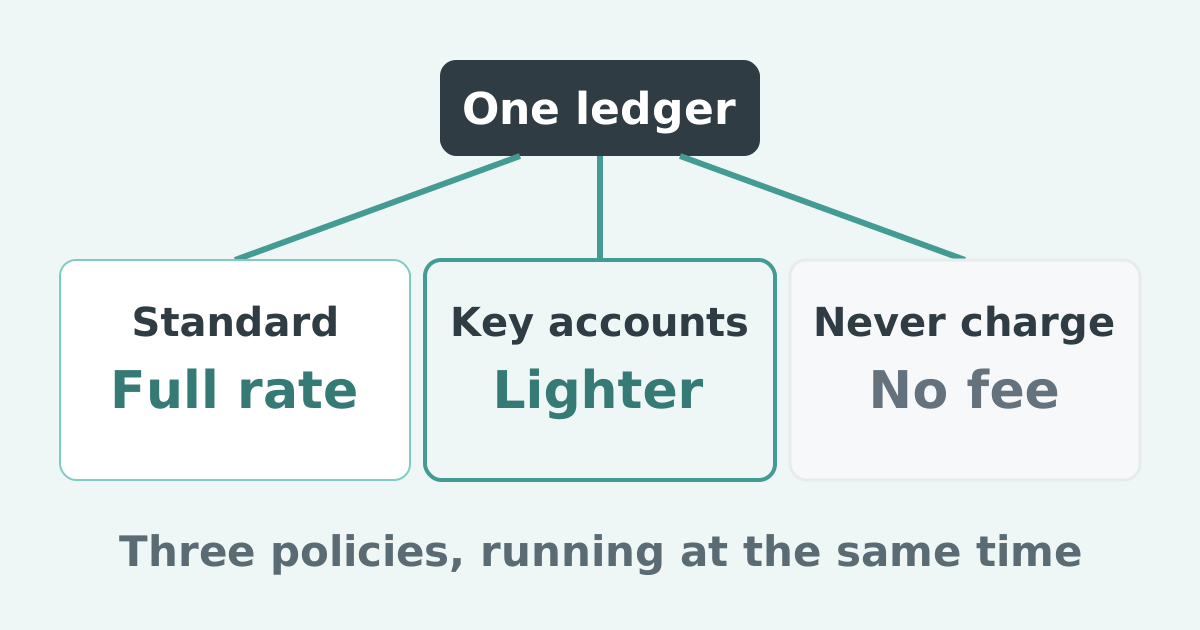

You can run more than one late fee policy at once by putting customers into groups and giving each group its own policy. Most businesses need three: a standard policy, a lighter one for long-standing accounts, and an explicit no-fee group. A no-fee group you configure once beats an exclusion somebody has to remember.
A single late fee policy is either too soft for your worst payer or too harsh for your best customer. There is no rate that is right for both.
If you design it around your best customer, the one you would never want to upset, it ends up so lenient that it does nothing to the customer who is actually costing you money. Long grace period, low rate, applied reluctantly. Your worst payer notices immediately that nothing happens.
If you design it around that worst payer, it is aggressive enough to land on a fifteen-year account who paid four days late because their finance manager was on leave. That costs more than the invoice was worth.
So most people compromise into a policy that is wrong for both, then quietly stop applying it. Late fee policies rarely get canceled. They get excepted to death.
A fee policy answers a measured behaviour. Xero Small Business Insights reports the share of invoices paid late.
| Country | Paid late | Year on year |
|---|---|---|
| Australia | 4.3% | -2.7 pts |
| New Zealand | 5.1% | -0.5 pts |
| UK | 8.3% | -0.9 pts |
| US | 8.3% | -0.1 pts |
| Canada | 11.4% | +0.8 pts |
Source: Xero Small Business Insights, June 2026. See the full data on the Paidnice accounts receivable statistics dashboard.
Write the policy for that share, not for the whole ledger.
Most businesses need three late fee groups: a standard policy at the full rate, a lighter policy for long-standing accounts with a longer grace period, and an explicit no-fee group. Anything finer starts costing more to run than it collects.
You do not need a policy per customer. You need enough policies that no group forces you to make exceptions by hand.
Most of your ledger. The charge applies from day one overdue, at your published rate, with a fixed fee where your market allows one.
Who: everyone not deliberately placed elsewhere.
A longer grace period, often 14 or 30 days, and interest without the fixed fee. The charge still exists, so the account still sees a cost to delay.
Who: long relationships with a good payment record.
No charge under any circumstances, set as a rule rather than remembered. The account still gets reminders and statements.
Who: disputes in progress, payment plans, related entities, and the handful of accounts where a fee would be commercially wrong.
The middle group is the one people skip, and it is the one that keeps the policy alive. Without it, every good customer who pays a week late becomes a manual exception, and manual exceptions are how the whole thing erodes.
The instinct is to group by industry or by invoice size. Both are poor predictors.
Sector tells you almost nothing about how a customer reacts to a late fee. Two construction firms on the same terms will respond completely differently, and the difference tracks the relationship rather than the trade.
Invoice size is worse, because it correlates with how much you want to keep the customer rather than with how they pay. Charging small customers harder than large ones is a policy most businesses would not defend if they said it out loud, and it is what size-based grouping produces.
Use two signals instead.
Average days beyond terms over the last twelve months, and whether it is getting worse.
Consistently over 15 days beyond terms belongs in standard, whatever the relationship.
How long they have been a customer, and whether they have ever been in dispute.
Multi-year accounts with a clean record belong in key accounts.
Review the split quarterly. A customer who has moved from paying on time to 40 days beyond terms should move group, and moving them is a clearer signal than gradually applying more pressure inside the same policy.
Almost every business has accounts that should never receive a late fee. Related entities, a customer already on a payment plan, an invoice in genuine dispute, a client going through something difficult.
The usual approach is to remember. Somebody knows not to charge that account, and it works until they are on holiday, or leave, or the policy runs automatically one weekend.
Make the exclusion a group. It takes a minute, it survives staff changes, and it turns a piece of tribal knowledge into something anyone can see and audit. It also gives you a number: if a quarter of your ledger has ended up in the never-charge group, that is worth knowing.
Watch the size of the never-charge group. When it starts growing, the cause is usually the standard policy rather than the customers: people quietly exclude rather than tell you the rate is wrong. It is the cheapest signal you have that the rate needs revisiting.
Commercially, yes. This is ordinary account management, and no customer is entitled to know what terms another customer has.
Legally, it depends on where you invoice from, and the distinction matters.
In the UK and the EU the right to charge is statutory and automatic on business-to-business invoices. You are choosing not to exercise a right you already have, which is entirely your call.
Almost everywhere else, including Australia, New Zealand, Canada, the United States, South Africa and Singapore, the right is contractual. It comes from your payment terms, so each customer's fee is whatever their signed terms say. If different groups are on different terms, different charges follow naturally. If they are all on the same terms and you charge inconsistently, a customer can argue you waived the term on their account, which is narrower but still an argument you do not want.
To see what a given rate actually produces on a real invoice, use the late payment interest calculator. In a contractual market, the defense against "you did not charge anyone else" is a written policy with stated groups and stated rates, applied consistently within each group. Wording is in our late fee policy wording examples and payment terms templates. Rates by country are in how much can I charge for late fees.
Three late fee policies is usually the ceiling, four if you genuinely operate in two markets with different legal bases. Past that you are managing policies instead of collecting money.
Past that, the limitation shows up: every extra policy is another set of rules to remember when someone asks why a particular customer was charged a particular amount. The value of a policy is that it removes decisions. A ledger with seven policies has reinstated them.
If you find yourself wanting a fifth, the usual cause is that the standard policy is wrong rather than that you need more granularity.
Policies live under customer groups, so running several at once is the normal way to use Paidnice rather than an advanced configuration.
Setting it up is one group and one policy to start with. Split it once you can see which accounts keep becoming exceptions.
Deciding what to charge before deciding who to charge is covered in invoice late fee or statement interest. The waiving rules that go with any policy are in waiving a late payment fee, and the wording that goes out when a charge applies is in how to tell a customer you are charging a late fee. Once the groups are set, how to account for late fees covers posting them correctly.
Can I charge different late fees to different customers?
Yes. Group your customers and give each group its own policy. In contractual markets, make sure each group's terms actually say what you are charging them.
How do I exempt one customer entirely?
Put them in an explicit no-fee group rather than remembering to skip them. The exclusion then survives staff changes and automated runs.
Should a customer on a payment plan still get charged?
No. They are doing what you asked. Interest on top of an agreed plan undermines the arrangement and usually breaks it.
How often should I review the groups?
Quarterly. Look at average days beyond terms per account, and move anyone whose behavior has changed materially in either direction.
What if a key account starts paying badly?
Move them to standard and tell them you have done it. The move is a clearer signal than slowly becoming firmer within the same policy.
Paidnice is accounts receivable automation that enforces your payment terms, trusted by thousands of businesses on Xero and QuickBooks. Credit control and debtor management, run for you.
Try it Now - It's FreeNo card required.



Optimize your cash flow with our suite of financial tools designed for AR professionals. Calculate DSO, aging analysis, late fees, and more.