
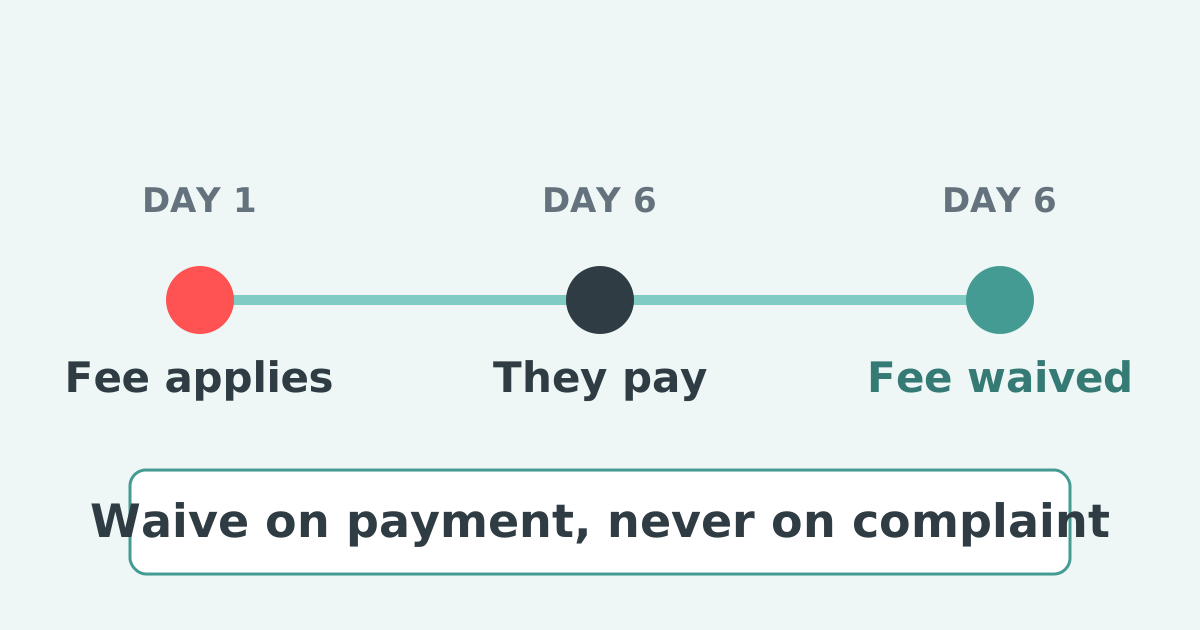

Apply the late fee automatically the day the invoice goes overdue, then cancel it in exchange for payment inside a stated window. The fee creates the deadline. The waive protects the relationship. Waive when the money arrives, not when the customer complains, and waive with a credit note against the fee invoice rather than by editing the original.
An overdue invoice competes for attention inside your customer's accounts payable process against every other invoice they owe. A late fee makes yours the one that costs money to ignore, which is the only thing that moves it up their payment run.
Nothing else distinguishes your invoice from the other four hundred in their queue. The charge is what turns it into the one an accounts payable clerk raises with their manager.
Collection is not the point of the charge. Leverage is. The fee has to be real, visible, and growing, and offering to remove it in exchange for immediate payment hands the customer a reason to move this week rather than next, without anyone having a difficult conversation.
The businesses that collect the most late fee revenue are almost never the ones with the highest rates. They are the ones that apply the fee to every overdue invoice without exception, then waive deliberately. Consistency is what makes the charge credible. A fee that appears on some invoices and not others is read, correctly, as negotiable.
Waive a late fee when the payment clears, never when the customer objects. Objection-triggered waiving teaches every customer that complaining is cheaper than paying, and it is what most businesses do by default because it feels like good service.
The instinct is understandable. Somebody rings up annoyed, you do not want the argument, you remove the charge.
It is the most expensive habit in credit control I see. You have just taught that customer, and anyone they talk to, that the fee disappears if you complain about it. The next overdue invoice will produce a complaint instead of a payment, because complaining is cheaper.
Waive on the arrival of money instead. The trigger is the payment clearing, not the tone of the phone call. That way the fee is removed by a rule rather than by whoever is most persistent.
If they pay outside the window, you have a decision to make rather than a rule to follow. Most businesses still waive the first time and say so explicitly, which keeps the deadline meaningful for next time.
If you raised the fee as its own invoice, which is what you should do, you have two ways to remove it.
| Action | Use when | What it leaves behind |
|---|---|---|
| Void | The fee invoice was never sent, or was sent in error | The invoice number is retained but the transaction disappears from reports. Cleanest for a fee that should not have existed. Not available once the period is locked or the year is closed. |
| Credit note | The customer received the fee and you are choosing to remove it | Both documents stay on the ledger. The charge, the concession, and the date are all visible. |
For a deliberate waive, use a credit note. A void makes the fee vanish as though you never charged it, which is exactly the wrong record to keep. The credit note is the proof that you charged, and then chose not to collect. That is the document you want in front of you the next time this customer is late, and it is what your accountant expects to see at year end.
Full detail on the tax and account treatment is in how to account for late fees.
A common objection to automatic late fees is that people do not want charges landing in the ledger before a human has looked at them. That is reasonable, and it does not require keeping the fee out of your accounting system.
Raise the fee as a draft invoice. It exists, it is calculated, it is attached to the right customer, and nothing has been sent. Approve the ones you want to go out and delete the rest. Once you trust the policy, switch it to approve automatically.
What you should not do is keep the fee outside the ledger entirely. A charge that only exists inside a reporting tool never reaches the customer's payables system, so it never enters their approval queue or their payment run. It also cannot be reconciled when paid, has no tax treatment, and is not evidence if you escalate. There is more on that in invoice late fee or statement interest.
A waived fee is a documented concession, and it earns its keep three times over.
Three situations where a late fee should not be waived: repeat offenders who have already had two concessions, accounts already heading for formal recovery, and invoices in genuine dispute, which should never have carried a fee at all.
Repeat offenders. If a customer has had a fee waived twice already, a third waive is not goodwill, it is a discount they have learned to expect. Charge it and say why.
Accounts heading for escalation. Once you are drafting a letter before action, accrued interest is part of the claim. Waiving it weakens what you are about to send.
Anything genuinely disputed. This one is different: a disputed invoice should never have received a fee in the first place. Pause the account, resolve the dispute, then resume. Applying a charge to an invoice the customer has legitimately queried hands them a reason to stop discussing the debt and start discussing your conduct.
If the customer genuinely cannot pay rather than will not, a payment plan is the better instrument than either charging or waiving.
Two short messages do the whole job. The first offers the waive, the second confirms it.
Subject: Invoice INV-2418, and how to avoid the late payment charge
Hi [Name],
Invoice INV-2418 for £3,400 was due on 14 July and is now 21 days overdue. In line with our payment terms, late payment interest of £22.98, charged at 11.75% a year, and a fixed recovery charge of £70 have been applied. We have raised these as invoice INV-2419.
If the original £3,400 reaches us by Friday 14 August, we will cancel that charge in full. We would much rather close this out than collect it.
If something is holding the invoice up, tell me what it is and I will sort it.
Subject: Payment received, charge canceled
Hi [Name],
Thanks, the £3,400 landed this morning. As promised, I have canceled the late payment charge of £92.98 and credited invoice INV-2419 in full, so there is nothing further to pay.
For future invoices the same terms apply: the charge is raised when an invoice passes its due date, and canceled if it is settled within ten days.
The second message matters more than it looks. It restates the rule at the moment the customer is feeling good about you, which is exactly when a payment terms reminder lands best. More templates are in our guide to telling a customer you are charging a late fee.
In the UK and the EU your right to charge is statutory and automatic, so waiving is purely your commercial choice. Almost everywhere else the right is contractual, established by your payment terms and tested, if disputed, under contract law.
That distinction changes one thing about waiving. In a contractual market, waiving inconsistently is a risk, not just a habit. If you charge some customers and not others with no stated rule, a customer can argue you waived the term on their account, which is narrower but still an argument you do not want. Write the policy down, apply it the same way, and record the exceptions.
Outside the UK and EU, an unwritten late fee is usually an unenforceable one. The clause has to exist before the invoice does. See our late fee policy wording examples and payment terms templates. Country-by-country detail is in how much can I charge for late fees.
The apply-then-waive pattern is hard to run by hand, because it needs someone to charge consistently and then remember to reverse. Paidnice takes the first half off you entirely.
Setting it up is one policy on one customer group, and most people start in draft for the first month.
Should I tell the customer the fee might be waived?
Yes, in the same message that applies it. A fee with a stated way out reads as a process. A fee with no way out reads as a punishment, and gets treated like one.
Does waiving a fee weaken my position later?
Not if it is recorded and consistent. What weakens your position is waiving silently, because then there is no evidence the charge was ever a real term.
Can I waive part of a fee?
Yes, with a partial credit note. It is common on a large balance where you want to acknowledge a genuine delay on your side without dropping the charge entirely.
What if they pay the original but not the fee?
That is the normal outcome, and usually the one you wanted. Waive it, confirm it in writing, and restate the terms.
Do I have to charge VAT on a fee I am about to waive?
UK statutory interest and compensation are outside the scope of VAT, so the charge should carry no tax at all rather than a zero rate. How to account for late fees covers the detail and the other markets.
Paidnice is accounts receivable automation that enforces your payment terms, trusted by thousands of businesses on Xero and QuickBooks. Credit control and debtor management, run for you.
Try it Now - It's FreeNo card required.


Optimize your cash flow with our suite of financial tools designed for AR professionals. Calculate DSO, aging analysis, late fees, and more.