

Quick answer: Controller KPIs are the financial and operational metrics a financial controller uses to measure the health, efficiency and accuracy of a business. The most important ones are days sales outstanding (DSO), budget variance, days to close, forecast accuracy and operating cash flow ratio, backed by liquidity, accounts receivable, close, and profitability metrics.
The job of a financial controller has quietly shifted. For years controllers were measured on completion: closes finished on time, reports delivered, variances explained. That work still matters. But leadership now expects finance to say what is happening right now, and what is coming next, not just what already happened.
The right KPIs are how you make that shift. They turn a pile of month-end numbers into a small set of signals you can act on, and they give you an objective way to show the value the finance function adds.
This guide lays out the 30 financial controller KPIs worth tracking, grouped into six areas, each with its formula, a sensible benchmark, and how often to review it. You can download the full list as an Excel or CSV file and start tracking this month.
Controller KPIs are the metrics a financial controller tracks to measure financial health, operational efficiency and the accuracy of the numbers. They cover how quickly cash comes in, how reliable the close and the forecasts are, how disciplined spending is against budget, and how profitable the business is. Good controller KPIs do more than report the past. They flag problems early, while there is still time to act.
There is no single correct list. What a controller tracks depends on the size of the business, the industry and how the role is structured. In a small business the controller and CFO are often the same person. In a larger one the controller owns operational accounting and reports up to the CFO.
Controller KPIs vs CFO KPIs. A controller's KPIs focus on operational accounting: accuracy, compliance, the close, reconciliations, collections and cash control. A CFO's KPIs are more strategic: capital structure, growth, return on investment and valuation. Put simply, the controller owns whether the numbers are correct, timely and well controlled. The CFO owns what the business does with them.
Thirty KPIs every financial controller should know, grouped by what they tell you, with the formula, a benchmark and how often to review. Download the full list as Excel or CSV and start tracking this month.
| KPI | Formula | What good looks like | Cadence |
|---|---|---|---|
| Liquidity & cash flow | |||
| Operating cash flow (OCF)Cash generated by core operations in the period | Net cash from operating activities | Positive and growing | Monthly |
| Operating cash flow ratioWhether operations alone cover short-term bills | Operating cash flow / Current liabilities | Above 1.0 | Monthly |
| Current ratioShort-term liquidity cushion | Current assets / Current liabilities | Roughly 1.5 to 3.0 | Monthly |
| Quick ratio (acid test)Liquidity excluding slow inventory | (Current assets - Inventory) / Current liabilities | 1.0 or higher | Monthly |
| Working capitalOperating buffer of assets over liabilities | Current assets - Current liabilities | Positive, sized to needs | Monthly |
| Cash conversion cycle (CCC) DSO legDays to turn spend back into cash | DSO + Days inventory outstanding - DPO | Lower is better | Monthly |
| Days cash on handOperating runway if inflows paused | Cash / (Operating expenses / 365) | Often 3 to 6 months | Monthly |
| AR & collections | |||
| Days sales outstanding (DSO) PaidniceAverage days to collect after a sale | (Accounts receivable / Credit sales) x days | Within ~1.5x your terms | Monthly |
| Accounts receivable turnover PaidniceTimes AR is collected per period | Net credit sales / Average AR | Higher is better | Quarterly |
| Collection effectiveness index (CEI) PaidniceQuality of collections vs collectable | (Begin AR + Sales - End AR) / (Begin AR + Sales - End current AR) x 100 | Above 80%; near 100% is strong | Monthly |
| Average days delinquent (ADD) PaidniceAverage lateness beyond best possible | DSO - Best possible DSO | Trend toward zero | Monthly |
| Days beyond terms (DBT) PaidniceAverage days invoices paid past due | Average (payment date - due date) | Near zero | Monthly |
| Bad debt to sales PaidniceRevenue written off as uncollectable | Bad debt written off / Total sales x 100 | Under ~1% is common | Quarterly |
| AR aging (% overdue / >90 days) PaidniceRisk concentrated in old receivables | Overdue AR / Total AR x 100 | Minimize the >90 day bucket | Monthly |
| Accounts payable | |||
| Days payable outstanding (DPO)Average days you take to pay suppliers | (Accounts payable / COGS) x days | Balanced, not punishing suppliers | Monthly |
| Accounts payable turnoverHow fast you clear supplier balances | Total purchases / Average AP | Watch the trend | Quarterly |
| Close & reporting | |||
| Days to close (close cycle time)Speed and predictability of close | Business days from period end to close done | ~5 days or less (average ~6) | Monthly |
| On-time reporting rateReliability of reporting deadlines | Reports on time / Reports due x 100 | 100% | Monthly |
| Post-close adjustmentsEntries booked after close sign-off | Count of post-close journal entries | Trend toward zero | Monthly |
| Reconciliation completion rateAccounts reconciled on schedule | Accounts reconciled on time / Total x 100 | 100% | Monthly |
| Reporting error / restatement rateAccuracy and trust in the numbers | Errors or restatements / Reports x 100 | Near 0% | Monthly |
| Budget & forecast | |||
| Budget varianceDiscipline of actuals against plan | (Actual - Budget) / Budget x 100 | Within ~+/-5% to +/-10% | Monthly |
| Forecast accuracy (MAPE)Reliability of your forecasts | Avg of |Actual - Forecast| / Actual x 100 | MAPE under ~10% | Monthly |
| Revenue growth rateTop-line momentum vs prior period | (Current - Prior) / Prior x 100 | Positive and on plan | Monthly |
| Profitability & leverage | |||
| Gross profit marginProfitability of core delivery | (Revenue - COGS) / Revenue x 100 | Higher and stable | Monthly |
| Net profit marginBottom-line profitability | Net income / Revenue x 100 | Higher; trending up | Monthly |
| Operating marginProfit from operations | Operating income / Revenue x 100 | Higher; watch trend | Monthly |
| Return on assets (ROA)How well assets generate profit | Net income / Average total assets x 100 | Higher vs peers | Quarterly |
| Debt-to-equity ratioLeverage and solvency risk | Total liabilities / Shareholders' equity | Lower is safer (often <2.0) | Quarterly |
| Operating expense ratioCost efficiency vs revenue | Operating expenses / Revenue x 100 | Lower; track trend | Monthly |
Benchmarks are general rules of thumb, not universal targets. Paidnice automates the accounts receivable KPIs tagged above (DSO, AR turnover, CEI, ADD, DBT, bad debt and aging) for Xero and QuickBooks. On the cash conversion cycle it only moves the DSO leg, not inventory or payables.
These KPIs answer the most basic question a controller has to be able to answer at any moment: can we pay our bills, and for how long?
Operating cash flow (OCF) is the cash your core operations generate in a period, straight from the cash flow statement. It should be positive, growing, and large enough to cover capital spending and debt service. Profit on paper means little if the cash is not arriving.
Operating cash flow ratio divides operating cash flow by current liabilities. Above 1.0 means operations alone cover your short-term obligations, which is exactly where you want to be.
Current ratio (current assets divided by current liabilities) and the stricter quick ratio (which strips out inventory) measure your short-term cushion. A current ratio in the range of 1.5 to 3.0 is generally healthy, and a quick ratio of 1.0 or higher means you can meet near-term bills without selling stock.
Working capital is simply current assets minus current liabilities, and the cash conversion cycle ties the whole operating engine together: how many days it takes to turn money spent on inventory and operations back into cash. It is DSO plus days inventory outstanding minus days payable outstanding, and lower is better. Pulling in your DSO shortens it directly. You can work the numbers with our cash conversion cycle calculator.
This is the cluster where a controller usually moves the numbers fastest, because it is so directly tied to process. Receivables are where cash gets stuck.
Days sales outstanding (DSO) is the headline metric. It measures the average number of days it takes to collect after a sale. The formula is accounts receivable divided by credit sales, multiplied by the number of days in the period. A good DSO is generally within about 1.5 times your payment terms, so on net 30 terms a DSO under roughly 45 days is healthy. Lower is better, and the trend matters more than any single reading. Our DSO calculator does the math for you, and our days sales outstanding dictionary entry explains the formula and benchmarks in full.
Accounts receivable turnover shows how many times you collect your average receivables balance in a period. Higher is better. Use the AR turnover calculator to check yours.
Collection effectiveness index (CEI) is the quality measure: of everything that was collectable this period, how much did you actually collect? It is expressed as a percentage, and the closer to 100% the better. Anything above 80% is strong. The collection effectiveness calculator walks through the formula, and the collection effectiveness index dictionary entry covers how to read it.
Average days delinquent (ADD) and days beyond terms (DBT) both measure lateness: how far past due, on average, your invoices are paid. You want both trending toward zero.
Bad debt to sales is the share of revenue you end up writing off. Keep it as low as you can, and treat anything creeping above 1% as a signal to tighten credit control. The bad debt expense calculator helps you size it.
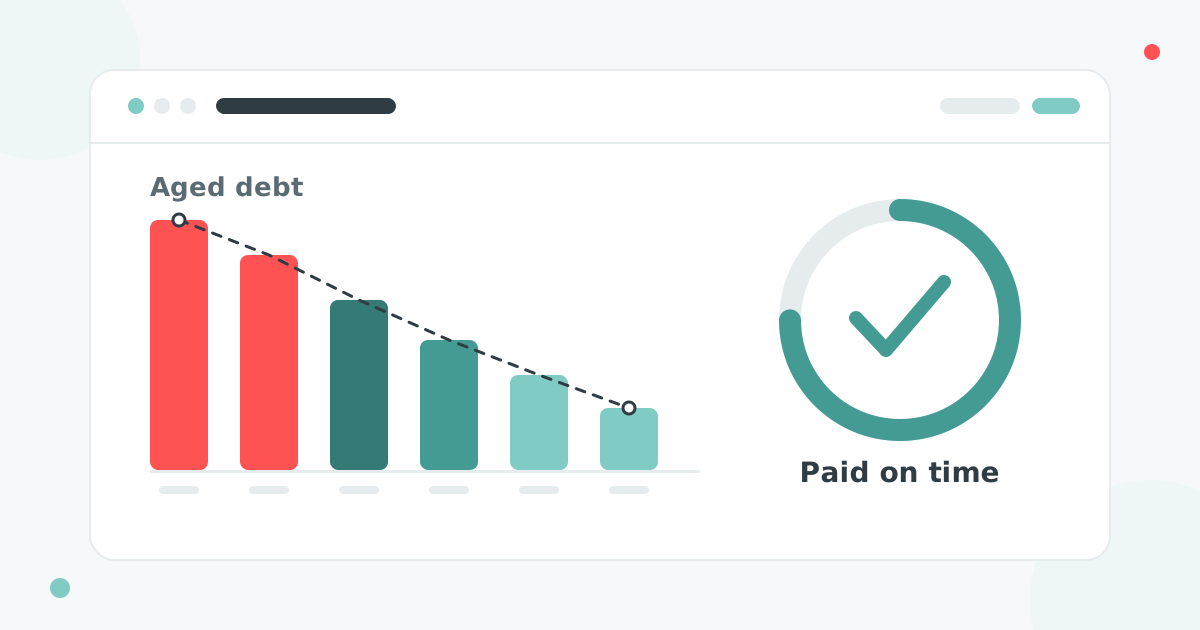
AR aging rounds out the picture by showing where risk is concentrated. Watch the proportion of receivables sitting in the over-90-days bucket, because that is the money most likely to never arrive. The AR aging analysis tool builds the buckets for you.
Venture Workspace, a coworking provider in South Africa, had more than 25% of its payments coming in late, which threatened cash flow and operations. By automating its receivables and tracking metrics like AR turnover and DSO, late payments dropped to under 5%, freeing up cash and time for growth.
Receivables get the attention, but a controller manages both sides of the cash cycle.
Days payable outstanding (DPO) measures how long, on average, you take to pay suppliers. The art here is balance: long enough to preserve your own cash, but not so long that you damage supplier relationships or lose early-payment discounts. The days payable calculator makes it easy to track. Accounts payable turnover is the companion metric, showing how quickly you clear supplier balances.
These are the KPIs that are uniquely a controller's responsibility, because they measure the engine room of finance itself.
Days to close is the number of business days from period end to a finished close. It is the clearest measure of how fast and predictable your finance operation is. The benchmark has moved: industry close benchmarks put the average at roughly five to six business days, with many finance teams taking more than a week. The top quartile wraps up in about five days or less. Treat these as a rule of thumb rather than a published standard, since the numbers drift year to year. If your close is slow, it is usually a sign of manual reconciliations and last-minute adjustments rather than a lack of effort.
On-time reporting rate, reconciliation completion rate, post-close adjustments and reporting error rate all measure reliability and accuracy. The target for the first two is 100%, and for the last two it is as close to zero as you can get. Rising post-close adjustments are an early warning that something upstream is breaking down.
This is where the controller's work connects to planning and decision-making.
Budget variance compares actuals to plan, as a percentage: actual minus budget, divided by budget. A variance within roughly 5% to 10% is usually acceptable, and the useful part is not the number itself but the story behind it. Forecast accuracy, often measured as mean absolute percentage error (MAPE), tells you how much your forecasts can be trusted. A MAPE under about 10% is strong. Revenue growth rate tracks top-line momentum against the prior period, and is best read alongside the plan rather than in isolation.
Finally, the KPIs that show whether all that activity is producing a sound, profitable business.
Gross profit margin, net profit margin and operating margin track profitability at three levels, from core delivery down to the bottom line. Return on assets shows how efficiently your assets generate profit. Debt-to-equity ratio measures financial leverage and solvency risk, where lower is generally safer, though the right level depends heavily on your industry. Operating expense ratio keeps an eye on cost efficiency relative to revenue. Review the margins monthly and the leverage ratios quarterly.
Thirty metrics is a reference list, not a monthly report. Trying to track everything is the fastest way to track nothing well. A few principles help:
Start with five and build from there. DSO, budget variance, days to close, forecast accuracy and operating cash flow ratio give you cash, discipline, speed, reliability and solvency in a single glance. Add a profitability metric such as gross margin, and a collections quality metric such as CEI, and you have a strong core of seven or eight.
Match the KPI to the decision. A KPI earns its place if someone changes something because of it. If a metric never triggers an action, drop it from the monthly pack and check it quarterly instead.
Set targets from your own history. Benchmarks like "DSO under 45 days" or "close in five days" are useful starting points, but your real target should come from your industry, your terms and your own trend. Beat last quarter.
Pick the right cadence. Cash and receivables KPIs deserve a monthly look, and the fast-moving ones reward a weekly glance. Slower ratios like return on assets and debt-to-equity are fine quarterly.
Once you have chosen your KPIs, the work is in keeping them current and accurate. Manually pulling AR data, recalculating DSO and rebuilding an aging report every month is slow and error-prone, which is exactly why so many controllers automate it.
Build a dashboard, not a binder. A controller dashboard gives you a live, visual snapshot of your key metrics: overdue invoices, aging, payment trends and collection performance. Tools like Paidnice deliver AR insights and reporting out of the box, pulling directly from Xero and QuickBooks so the receivables KPIs update themselves.
Automate the receivables KPIs. The accounts receivable metrics improve when collections stop depending on someone remembering to follow up. Automating email and SMS reminders, late fees, customer statements and a self-service payment portal is what brings DSO, CEI and aging in line, consistently, without adding headcount.
Benchmark and review on a fixed cadence. Set a target for each KPI, compare actuals against it every period, and act on the gap. That loop, target, measure, act, is the difference between a KPI that controls the business and one that just describes it. For wider context on receivables performance, our accounts receivable statistics dashboard is a useful reference.
Report to your audience. The board wants a handful of headline numbers and a trend. The finance team needs the detail. Build the monthly pack once, then cut it two ways.
Paidnice is accounts receivable automation for businesses on Xero and QuickBooks, so it moves one cluster of this list directly: DSO, the collection effectiveness index, AR turnover, aging and bad debt. It sends reminders, applies late fees and interest, issues statements, offers customers a payment portal, and surfaces those receivables metrics on a live dashboard, so the numbers you report each month are accurate without the manual rebuild.
The other twenty-odd KPIs on this list, your close cycle time, AP turnover, budget variance, forecast accuracy and the profitability and leverage ratios, are not what Paidnice does. Those belong in your accounting platform and your FP&A or close tooling. We are deliberately narrow: we make the receivables half of the cash cycle run on its own, and we leave the rest to the tools built for it.
The finance team at Bustle Studios cut their DSO by automating reminders and late fees through Paidnice, reclaiming the hours they used to spend on manual follow-up and improving cash flow.
Controller KPIs are the financial and operational metrics a financial controller tracks to measure the financial health, efficiency and accuracy of a business. They typically cover liquidity and cash flow, accounts receivable and collections, the month-end close, budget and forecast accuracy, and profitability. Good controller KPIs move the focus from reporting what already happened to spotting issues early.
If you track only five, track days sales outstanding (DSO), budget variance, days to close, forecast accuracy, and operating cash flow ratio. Together these tell you whether cash is coming in on time, whether actuals match the plan, whether the close is fast and predictable, whether your forecasts can be trusted, and whether operations are funding the business. Most controllers then add a profitability metric such as gross margin.
The key financial KPIs for a controller fall into six groups: liquidity and cash flow (current ratio, quick ratio, operating cash flow, cash conversion cycle), accounts receivable and collections (DSO, AR turnover, collection effectiveness index, bad debt to sales), accounts payable (days payable outstanding), close and reporting (days to close, on-time reporting rate), budget and forecast (budget variance, forecast accuracy), and profitability (gross margin, net margin, return on assets, debt-to-equity).
A controller's KPIs focus on operational accounting: accuracy, compliance, the close, reconciliations, collections and cash control. A CFO's KPIs are more strategic: capital structure, growth, return on investment, valuation and stakeholder outcomes. The controller owns whether the numbers are correct, timely and well controlled; the CFO owns what the business does with them. In small businesses one person often carries both sets.
A good DSO is generally within about 1.5 times your payment terms. On net 30 terms, a DSO under roughly 45 days is healthy, and the lower the better. DSO is best judged against your own terms, industry and trend rather than a single universal number, so set a target from your history and work to beat it each month.
Review cash and accounts receivable KPIs such as DSO, aging and the collection effectiveness index monthly, alongside the close and budget variance. Review slower-moving ratios such as return on assets and debt-to-equity quarterly. Many teams report a core set monthly to leadership and do a deeper review each quarter to reset targets.
KPI control is the practice of setting a target for each metric, measuring the actual against it every period, and acting on the gap. For a controller that means defining the target (for example, DSO under 45 days), tracking the live number, flagging when it drifts out of range, and changing a process to bring it back. KPIs become a control system rather than a backward-looking scorecard.
The fastest way to improve DSO, the collection effectiveness index, aging and bad debt is to make collections consistent and automatic. Sending reminders on schedule, applying late fees, issuing statements and offering a self-service payment portal removes the manual follow-up that lets invoices slip. Paidnice automates these accounts receivable workflows directly inside Xero and QuickBooks, which is how customers move late payments down and pull DSO in.
Ready to put the receivables KPIs on autopilot? Book a free demo with Paidnice and see your DSO, aging and collection metrics tracked and improved automatically.
Paidnice is accounts receivable automation that enforces your payment terms, trusted by thousands of businesses on Xero and QuickBooks. Credit control and debtor management, run for you.
Try it Now - It's FreeNo card required.


Optimize your cash flow with our suite of financial tools designed for AR professionals. Calculate DSO, aging analysis, late fees, and more.