


No. AI is not replacing accountants, and the people saying otherwise are usually selling something. What it does replace is preparation: data entry, transaction matching, first-draft reports, routine chasing. What it does not touch is judgment, accountability and the client relationship, because none of those can be signed off by software. The job shifts rather than disappears, and the part that shifts fastest is the part juniors currently do.
Key takeaways
The work that goes has a written right answer and no decision in it. Coding transactions, matching a bank feed, drafting the same three documents for the thirtieth client.
The work that stays needs somebody accountable. A machine cannot hold a practising certificate, cannot be sued, and cannot sit with a client through a bad year.
Entry-level is where it lands first. That is a real training problem for the profession and it is worth saying plainly rather than dressing up as opportunity.
There is a hard technical limit. An AI assistant cannot watch a ledger and cannot act on a schedule. Every run starts because a person asked. That limit is what keeps enforcement work human or automated, never assistant-driven.
This question gets asked about two and a half thousand times a month in the United States alone, and the answers fall into two unhelpful piles. Vendors say no and then sell you their AI. Commentators say yes and quote a decade-old automation study at you. Neither group has run a month-end.
Here is the version from people who build accounting software and use AI in the work every day.
AI takes over data entry and coding, reconciliation, first-draft documents, routine analysis and invoice chasing. The common thread is that each has a documented right answer and no judgment call inside it, which is exactly why software can hold it.
Look at that list honestly and it is most of what a first-year is charged out for. That is the real story, and it is uncomfortable enough that most articles on this question skip past it.
AI does not touch accountability, judgment on ambiguity, or the client relationship. None of those three are sentimental holdouts. Each is a structural reason the work stays with a qualified human.
Accountability. Somebody has to sign. A practising certificate carries liability, professional standards and a regulator, and none of those attach to a model. When the numbers are wrong, a human is answerable. That is not a technology gap that closes with a better model, it is the structure of the profession.
Judgment on ambiguity. Most interesting accounting questions do not have a documented right answer. Is this capital or revenue. Is the treatment defensible. Is the client telling you everything. An assistant can lay out the options and will sound equally confident about the wrong one.
The relationship. Clients pay for somebody who knows their business, will tell them something they do not want to hear, and is still there next year. Nothing about that is automatable, and firms that treat it as overhead are the ones with a real problem coming.
AI is not replacing accounts receivable jobs, but scheduled automation is already replacing the chasing inside them. This question gets searched and almost nobody answers it directly, so here it is from the part of the ledger we work in every day.
The chasing work goes, and it is already going, but not to AI. It goes to automation, which is a different thing and matters more than the distinction sounds.
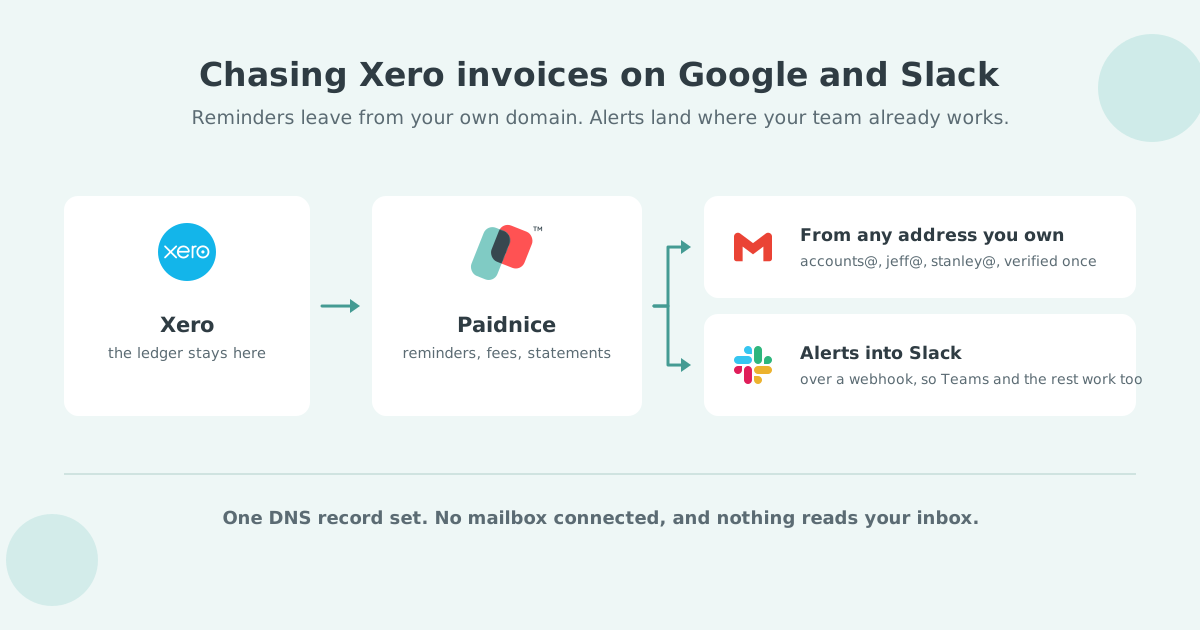
An AI assistant can tell you who to chase and draft eleven emails. It cannot notice on a Saturday that an invoice has gone twenty days past terms, send the reminder, apply the fee the contract allows, and escalate when that reminder is ignored. Nothing triggers on an overdue invoice in either the Xero or the QuickBooks connection, and the Xero connection has no email tool at all. Every assistant run starts because a person asked.
So the credit controller's job does not get taken by an assistant. It gets taken by rules that run without anyone present, and what remains for the human is the part that was always the actual job: the difficult conversation, the payment plan, the judgment call about a customer worth keeping.
💡 Paidnice insight
We build both and the split is unambiguous from where we sit. Judgment on demand is what an AI assistant is good at. Doing the same thing to every invoice, on time, without being asked, is what software is good at. Customers using Paidnice cut their average wait for payment in half within 30 days, and none of that came from somebody remembering to run a report on a Saturday.
Yes, and there will probably be fewer of them doing more valuable work, which is what happened to the profession when spreadsheets arrived and again when bank feeds arrived.
The honest worry is not the head count. It is the training pipeline. If the coding, the reconciliation and the first-draft work are what juniors learn on, and that work is now done by software, the profession has to find another way to produce a competent senior in five years. Nobody has solved that yet, and pretending it is not a problem does not help anyone deciding whether to start this career.
| Work | What happens to it | Who does it in 2030 |
|---|---|---|
| Transaction coding | Automated, already mostly gone | Software, with exception review by a human |
| Bank reconciliation | AI drafts, human reviews the breaks | Software plus a reviewer |
| Management pack commentary | AI drafts, human edits and signs | A qualified person, faster |
| Chasing overdue invoices | Moves to scheduled automation, not AI | Rules, with humans on the hard accounts |
| Advisory and planning | Grows, because the preparation cost falls | A qualified person |
| Sign-off and accountability | Unchanged | A named human with a certificate |
The practices handling this well write down their repeatable work, move every calculation into software rather than into prompts, and separate judgment from enforcement. Three unremarkable things, done early.
If you want the practical version of this, we wrote up what AI can actually do with a client ledger, including the six workflows firms build first, and a free open-source skill you can install today. The connection steps are in connecting Claude to Xero, what a Claude Skill is in Claude Skills for accountants, and the software itself in the AI tools accountants are actually installing.
No. Preparation tasks inside the job are being replaced. Firms are hiring fewer people to do coding and reconciliation, and the same or more people to do advisory work. The role is being recomposed rather than removed.
Bookkeeping is more exposed than accounting because more of it has a documented right answer. What survives is the part that involves chasing information out of a client, spotting that something looks wrong, and being trusted with the numbers. Bookkeepers who own the client relationship are in a very different position from ones who own a data entry queue.
Because the profession is built on somebody being accountable. A model cannot hold a practising certificate, cannot carry liability, and cannot be struck off. Until that changes, a qualified human signs.
Yes, with a clear eye on what you will be paid for. The preparation work you would have learned on is going. The judgment, the client work and the ability to direct software well are what the job becomes. That is a better job than the one being automated.
It can tell you who to chase and draft the emails. It cannot watch the ledger and, through a Xero connection, it cannot send at all. Anything that has to happen on a schedule without a person present belongs in accounts receivable automation rather than an assistant.
Paidnice is accounts receivable automation that enforces your payment terms, trusted by thousands of businesses on Xero and QuickBooks. Credit control and debtor management, run for you.
Try it Now - It's FreeNo card required.


Optimize your cash flow with our suite of financial tools designed for AR professionals. Calculate DSO, aging analysis, late fees, and more.