
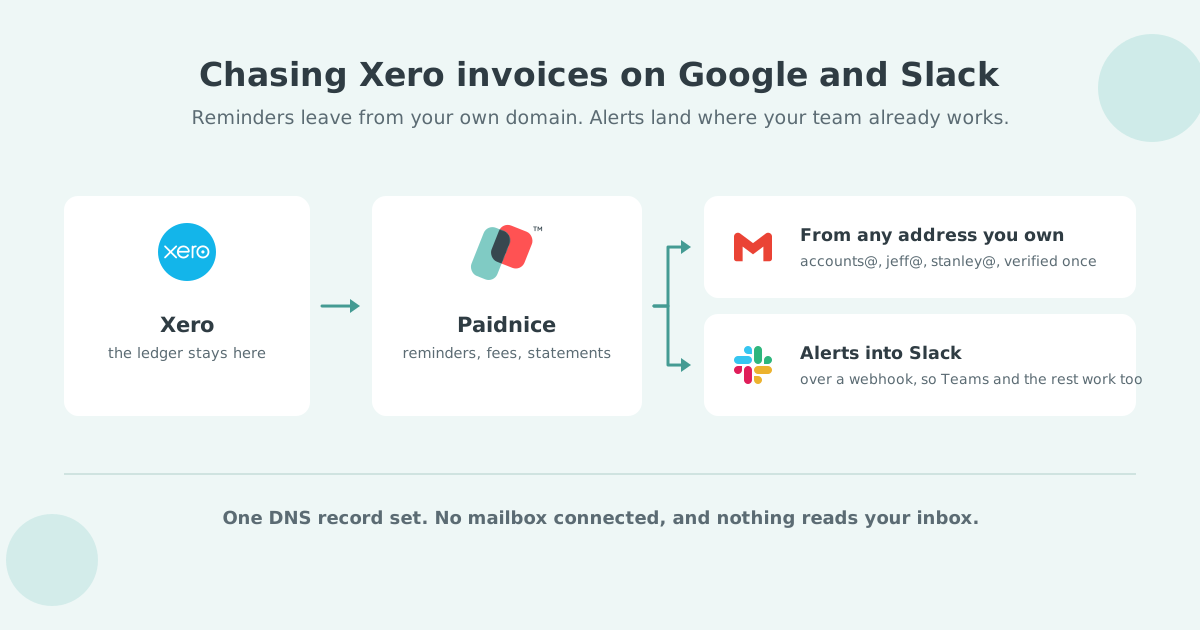

Paidnice and Upflow are the credit control apps most often shortlisted for a Xero, Gmail and Slack stack, and the difference is how they send. Paidnice authenticates your Google Workspace domain once and posts alerts into Slack. Upflow sends from its own infrastructure by default, with a custom subdomain or your own SMTP as options.
Xero holds one reminder schedule at organization level, with up to five reminders in it, and sets three of them up for you when you first turn the feature on. Every reminder fires against every invoice marked as sent.
Each reminder goes to the primary person on the contact plus anyone with "Include in emails" selected. The only balance control is a checkbox, Don't send reminders for amounts owing on an invoice under, and Xero applies that setting to all reminders. Xero's own setup article tells readers to search the Xero App Store for apps that allow more advanced invoice reminder options.
Those reminders leave from a Xero address with your name on them. No setting in Xero changes the sending domain.
A reminder only works if it arrives and is read. Xero Small Business Insights shows how much late payment there is to chase.
| Country | Paid late | Year on year |
|---|---|---|
| Australia | 4.3% | -2.7 pts |
| New Zealand | 5.1% | -0.5 pts |
| UK | 8.3% | -0.9 pts |
| US | 8.3% | -0.1 pts |
| Canada | 11.4% | +0.8 pts |
Source: Xero Small Business Insights, June 2026. See the full data on the Paidnice accounts receivable statistics dashboard.
That volume is why the sending address matters.
A credit control app can put your Gmail address on a Xero reminder in two ways: a mailbox connection that sends through one person's Google account, or domain authentication that sends on the domain's behalf after a one-off DNS change. To the customer the two look identical. What differs is what you hand over, what happens at volume, and what breaks when somebody leaves.
Signing in authorizes one mailbox DNS records authorize your domain
Signing in and granting an app access authorizes one mailbox. Your domain's sending records are untouched, and the app is relaying through that account.
Domain authentication is a DNS change. You publish records that let the sending service sign mail as your domain, which is what a receiving server checks. Both routes get described as connecting your email, so the distinction is easy to miss on a pricing page.
Several tools will connect to a Gmail mailbox and send as that person, and if that is what you want, it is available. Our view is that it is the weaker design. You are granting access to a mailbox and borrowing its send quota to get a From line you can have another way.
The failure modes are the giveaway. Somebody moves on and the chasing quietly stops. Somebody gets phished and the attacker inherits your invoice threads. Neither happens when the sending belongs to the domain instead of to a person. Domain authentication also sidesteps Google Workspace's per-account daily sending limits, and it keeps a chasing round's bounces and spam complaints off the reputation of the mailbox the team uses for everything else.
Paidnice never connects to a mailbox and never reads your inbox: on Pro plans you add your domain under Email Preferences, Paidnice returns the DNS records, and you or your IT team publish them and verify. Sending runs through SendGrid.
Paidnice's setup guide is explicit about what follows: verify your top level domain once, then set up sending addresses inside Paidnice with no further verification.
One DNS job covers [email protected], [email protected] and [email protected], with no extra mailbox licenses and no second approval.
That is what makes an escalation ladder practical. A sender profile carries a From name, a From address and a reply-to, so the due-date nudge comes from Accounts, the fortnight-overdue chase comes from a named credit controller, and the late fee notice comes from a director. The customer reads it as the matter moving up the building, and nobody forwarded anything.
Sent copies of every Paidnice reminder, statement and late fee notice land wherever the BCC field on the sender profile points: your own Gmail inbox, a shared accounts mailbox, or a CRM logging address. The field takes any address you like.
Point it at your own inbox and every reminder, statement and late fee notice arrives there as it goes out. Point it at a CRM logging address instead and the same thread lands on the customer record. Pipedrive, HubSpot and Salesforce all accept mail this way, as does any system that logs by BCC.
Replies are separate and simpler. The reply-to address on the sender profile decides where a customer's answer arrives, so it can go to the person who sent it, to a shared accounts inbox, or to both.
Paidnice publishes a Slack integration alongside its Xero integration, and of the four apps in the comparison table below it is the only one that does. Paidnice posts notifications into the Slack channel your team already watches, so an account that needs attention is picked up by whoever is free rather than by whoever opens the shared inbox first.
Paidnice's Slack connection is an incoming webhook that Paidnice fires directly, not a Zapier or Zoho Flow workflow sitting in between. That is why the destination is a setting rather than a product decision: Microsoft Teams, Discord, Telegram and WhatsApp all accept incoming webhooks, and so do Zapier and Make for anything else you run. Our team will set it up with you.
Chaser, ezyCollect and Satago document ledger, email and payment integrations, and nothing that posts into a Slack channel. Upflow, covered after the table, lists Slack among its integrations.
Paidnice and Upflow are the two apps most often shortlisted for a Xero, Gmail and Slack stack, and the difference is the sending mechanism: Paidnice authenticates your Google Workspace domain once, Upflow sends from its own infrastructure by default with a custom subdomain or your own SMTP as the alternatives. Chaser, Satago and ezyCollect also come up for Google-stack teams, and the four apps in the table differ on the sending mechanism more than on the feature list.
| Tool | Authentication | At volume | Slack alerts | Price from | Size fit | Ledger | Best for |
|---|---|---|---|---|---|---|---|
| Chaser | One mailbox login | Caution | None | £199/mo | £4m to £200m turnover | Xero, QBO, Sage, NetSuite | Reminder-led credit control for a finance team |
| Paidnice | Your own domain | Safe | Yes, via webhook | £49 / US$69/mo | Any size up to $50m a year | Xero, QBO | Own-domain sending, late fees and Slack alerts |
| ezyCollect | Not published | Not published | None | About A$275/mo | Not published | Xero, MYOB, QBO, NetSuite | Australia and New Zealand, ERP-connected AR |
| Satago | One mailbox login | Caution | None | £45/mo (£25 in Sage 50) | UK small business | Xero, Sage 50, QBO | Chasing plus credit reports and invoice finance |
Your own domain. You publish DNS records once and the app sends as your domain. No mailbox is connected, nothing reads your inbox, and there is no per-person send limit to hit.
One mailbox login. The app signs into one person's Gmail or Outlook and sends as them. Chasing shares that account's daily send limit and its bounce reputation, it stops when that person leaves, and a compromise of that mailbox reaches your invoice threads too.
The vendor documents neither method, so we have not assumed one either way.
Prices are entry tiers from each vendor's own materials; verify current pricing before you buy.
Upflow is an accounts receivable platform for recurring-revenue businesses that connects Xero and lists Gmail and Slack among its integrations; pricing is quote only, set by gross invoice value. Its reminders send from Upflow's own infrastructure by default, with a custom DNS subdomain or your own SMTP server as the alternatives, so it is neither a Gmail mailbox connection nor a one-off domain verification. Upflow's pricing page lists five tiers (Starter, Grow, Scale, Accelerate, Entreprise), though its structured data lists Starter at $333 and Grow at $833 a month. It suits teams that run collections by DSO dashboards; late fees run only through an ERP such as NetSuite.
Connecting a credit control app to a Google and Slack stack is a DNS job and two integrations. Budget an afternoon.
That last step is the one teams forget. Two systems chasing the same invoice is worse than one.
The wider buying criteria, including late fees, statements and disputes, are in credit control software for Xero. The Microsoft version of this page is credit control software for Xero, Outlook and Teams, and the DNS walkthrough is in sending Xero invoices from your own domain. To see the Paidnice setup, go to credit control for Xero.
Will my Xero reminders go out from my own Gmail address?
They can, by one of two mechanisms. Some apps connect to your Gmail mailbox and send as you. Others authenticate your domain and send on its behalf. The customer sees the same From line either way.
Do I have to give an app access to my Gmail mailbox?
Only with tools built that way. Paidnice does not connect to a mailbox and does not read your inbox. It publishes DNS records against your domain and sends through SendGrid, so nothing is granted on anyone's Google account.
Does Google Workspace limit how many reminders I can send?
Google Workspace applies daily sending limits per account, and those limits apply to anything sending through that mailbox. Sending on the domain's behalf through dedicated infrastructure is not bound by one user's quota.
What happens when the person whose mailbox is connected leaves?
With a mailbox connection, chasing stops until somebody reconnects an account. With domain authentication the setup belongs to the domain, so a leaver changes who reads the replies and nothing else.
Which Xero credit control apps post alerts into Slack?
Paidnice posts to Slack over an incoming webhook, which also covers Teams, Discord, Telegram and WhatsApp. Among the others, availability varies by tier, so check which plan the integration sits on before you compare prices.
Can I still keep a copy of every reminder in my own inbox?
Yes. Put your inbox in the BCC field on the sender profile and every reminder, statement and late fee notice arrives there as it goes out. The customer cannot see it.
Paidnice is accounts receivable automation that enforces your payment terms, trusted by thousands of businesses on Xero and QuickBooks. Credit control and debtor management, run for you.
Try it Now - It's FreeNo card required.
Optimize your cash flow with our suite of financial tools designed for AR professionals. Calculate DSO, aging analysis, late fees, and more.