


Irish law gives a business creditor statutory interest at the European Central Bank rate plus 8 percentage points, and a fixed €40, €70 or €100 per late invoice. Xero's own reminders send five emails, then stop, and apply neither.
This guide covers where Xero's reminders run out, what the law lets you charge, and which of six accounts receivable apps fits your situation best.
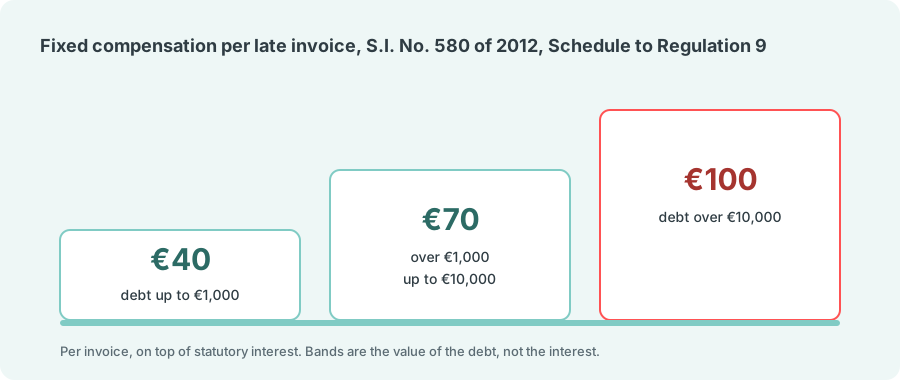
Under the European Communities (Late Payment in Commercial Transactions) Regulations 2012, S.I. No. 580 of 2012, a business creditor in Ireland can charge statutory interest at the ECB main refinancing rate plus 8 percentage points, plus fixed compensation of €40, €70 or €100 per late business-to-business invoice, with a 30-day default payment period.
The rate is not read from today's ECB figure. The regulations fix it twice a year: the ECB rate in force before 1 January applies from 1 January to 30 June, and the rate in force before 1 July applies from 1 July to 31 December.
The ECB's main refinancing rate was 2.40% with effect from 17 June 2026, so the Irish statutory rate for 1 July to 31 December 2026 is 10.40% a year.
The ECB moved its main refinancing rate to 2.65% with effect from 16 September 2026. That does not change the Irish statutory rate. The next reference date is 1 January 2027, so 10.40% stands until then. A tool that reads the ECB rate live, rather than on the reference date, will overcharge by a quarter of a point for the rest of the year.
On a €5,000 invoice, 10.40% is about €1.42 a day. Two months late is €85.48 in interest plus €70 in compensation. The calculator below does the arithmetic for any invoice, and our EU late payment directive calculator covers the other member states.
Whether you collect every cent of that is your call. The point of the charge is leverage: an invoice that accrues interest and compensation on the ledger moves up your customer's payment run. The same mechanism under UK law is covered in late payment fees in the UK.
Xero's own credit control covers the first stretch: five reminders on one schedule and a statement you send by hand. Neither applies the 10.40% or the €40 to €100, and the by-hand parts are what stop holding as the list grows.
Each of the four native tools does one job, and each stops in the same place.
What none of them do: charge the 10.40%, add the €40 to €100, escalate to a named person, pause on a disputed invoice, or take payment on a plan.
Xero's own setup guide points readers at the Xero App Store once they need more than that.
Two signs you have hit the ceiling: the overdue list stops shrinking between runs, and someone is chasing by hand after the fifth reminder. At that point an app costs less than the hours it replaces.
Accounts receivable software automates invoice reminders, tracks accounts receivable, and recovers overdue payments without a person chasing. Four capabilities decide whether it works.
Those four make a tool usable. What makes it worth buying is everything Xero cannot do at all: posting the statutory interest and compensation to the ledger, taking payment on an instalment plan, escalating to a named person, pausing on a disputed invoice, and giving the customer a portal to settle in.
That is the dividing line in this category. A chasing tool sends better emails. An automation platform enforces the terms you already agreed, and the six below split between the two. Our own accounts receivable software page sets out the second kind in full.
The six tools below are not competing for the same job. Start here rather than with the list, because the right answer is decided by your size, your ledger and what your real bottleneck is.
| If this is you | Start with |
|---|---|
| Larger business, happy to sign a longer contract, and you need credit checks as well as chasing |  |
| Enterprise B2B running many entities and wanting one system that does everything |  |
| Real invoice volume on Xero or QuickBooks Online, statements going out constantly, and you want the Irish rate applied per customer group |  |
| You want to finance an invoice as well as chase it |  |
| You want AI-driven order-to-cash, and matching payments is the real bottleneck |  |
| Collecting the payment itself is the problem, and you would rather pay per collection than a subscription |  |
Each tool is placed against the job it genuinely does best, rather than scored out of ten. A €700k contractor and a €40m distributor are buying different products, so a single winner would be wrong for most readers.
Prices are as at September 2026 and shown in the currency each vendor publishes. Prices change; verify current pricing before you buy.
If you are a larger business and credit checks matter as much as chasing
The most established suite here, founded in 2014, and the one to pick if vetting customers matters as much as chasing them. The pricing tiers are built for businesses well past the typical Xero small business.
The limitation. It is the oldest product on this list and it shows in how little bends. The late fee rule is global. Statements go monthly on a fixed day, with recipients and senders you cannot change. Payment plan chasing follows the invoice due date rather than the instalment dates, which their own documentation tells you to work around by hand.
Pricing on company revenue is the other thing to model carefully. A low-volume, high-value business can land on a £599 tier for a handful of invoices a month.
Best for: businesses past £4m that want credit data and chasing in one product and can absorb a rigid configuration.
If you are an enterprise B2B running many entities
The enterprise answer in this list. Built for large B2B finance teams running many entities who want one system covering collections, analytics and payments, rather than a chasing tool with reporting attached.
The limitation. No late fees, no payment plans beyond promise-to-pay, and pricing has moved entirely to contact-sales, which usually signals a move upmarket. Automatic actions fire once a day on business days only.
Best for: enterprise B2B teams with several entities who want one platform rather than a chasing tool plus three add-ons.
If you send a lot of invoices and statements, and you live in Xero or QuickBooks Online
Paidnice is accounts receivable software that automates invoice reminders by email and SMS from your own domain, scheduled statements, late fees and interest, payment plans, a customer payment portal and escalation, in one plan. Priced in euro for Ireland, and the value option when you are sending a lot of invoices and statements.

The limitation. No credit checks. There is no bureau data, no risk score and no monitoring feed, so vetting new accounts has to happen somewhere else. The Irish rate is a setting you enter, and you update it yourself on 1 January and 1 July. Native support is Xero and QuickBooks Online only; other ledgers are a Custom-plan conversation.
Being built for two ledgers rather than eight is the trade. It is why the integration goes deeper than a sync, and why a Sage or NetSuite business should look elsewhere on this list. Customers cut their average wait for payment in half, within 30 days.
Best for: Xero and QuickBooks Online businesses pushing real invoice and statement volume that want the whole receivables process, statutory charges included, in one plan.
If you want invoice finance alongside the chasing
Half accounts receivable software and half lender, with credit reports and single-invoice finance in the same subscription. Strongest inside the Sage 50 ecosystem, where it is bundled cheaply.
The limitation. Roughly half the product serves the lending side, so a business that only wants chasing pays for a finance product it may never use. UK only, so an Irish business should confirm availability and euro invoicing before a demo.
Best for: UK businesses that want to vet customers, chase them and fund the invoice in one place.
If you want AI-driven order-to-cash
An AI order-to-cash platform where chasing is one module beside reconciliation, remittance parsing and credit risk.
The limitation. Per-user pricing punishes the setup that works best, which is several named senders escalating an invoice as it ages. No late fee automation found, and the product has moved upmarket from small business credit control.
Best for: larger finance teams whose real problem is matching payments, not sending reminders.
If collecting the payment is the problem and you would rather pay per collection
A UK payment collection platform with credit control attached. Pay-by-bank, direct debit and cards on one rail, reminders by email, WhatsApp and SMS, and AI agents that propose the next action for you to approve. No subscription; a fee on each successful collection.
The limitation. Pricing has grown since the flat 1% at launch in July 2024. Adfin has added a fixed fee, card surcharges, a branding fee and a paid tier for late fees. Reporting is a dashboard rather than a suite, there are no credit checks, and the compensation split means the €40 to €100 would not be yours.
Best for: UK businesses whose customers agree to pay but whose payments do not arrive, and who want the rails and the chasing from one vendor.
What each one automates, whether it can apply the Irish statutory rate, and what it costs. The statutory column is the one to read first: it separates a tool that sends better emails from a platform that enforces the terms the law already gives you.
| Tool | Fits | Automates | Applies the Irish statutory rate | Entry cost |
|---|---|---|---|---|
| Chaser | £4m to £100m | Email and SMS chasing, credit checks | One global rule | £199/mo |
| Upflow | Large B2B, by invoice value | Chasing, collection analytics | No | Not published |
| Paidnice | €1m to €20m | Chasing, statements, fees, plans, portal | Yes, as a configured rate | EUR 59 / US$69/mo |
| Satago | UK, Sage 50 or Xero | Chasing, credit checks, invoice finance | Not published | £25 to £45/mo |
| Kolleno | Above US$1m | Chasing, cash application, credit risk | Not published | US$650 per user/mo |
| Adfin | UK, small to scaling | Payment collection, chasing | UK rate only | 20p + 1% per collection |
Row order follows the list above, not a ranking. A cell reads "not published" where the vendor documents nothing either way, rather than where a capability is known to be absent. "As a configured rate" means you enter 10.40% yourself; no tool here reads the Irish reference-date rate for you.
The fourth column is the one worth a second look. Applying the rate is half the job. The other half is where the charge lands: an interest invoice posted into Xero or QuickBooks reaches your customer's accounts payable and their payment run, and a figure on a dashboard does not.
Take a €5,000 invoice paid 60 days after its due date, at the 10.40% rate for 1 July to 31 December 2026. Interest is €5,000 × 10.40% × 60 ÷ 365, which is €85.48. The debt is over €1,000 and not over €10,000, so compensation is €70. The total owed on top of the invoice is €155.48.
Put your own figures in below. The rate defaults to 10.40%, the figure for the 1 July to 31 December 2026 reference period from S.I. No. 580 of 2012 and the ECB key interest rates table. Change it if the invoice fell due in a different half year, or if your contract sets another rate.
Simple interest, actual days, 365-day year. Compensation follows the Schedule to Regulation 9: €40 up to €1,000, €70 over €1,000 up to €10,000, €100 over €10,000. A guide, not legal advice.
Whether that interest should compound is a separate question, covered in compound or simple interest on overdue invoices. The regulations give you the simple figure above as a floor.
Most shortlists collapse once you answer two questions: how big is the ledger, and what is the actual problem. Five common situations and where they land.
| Your situation | What to look at |
|---|---|
| Under €500k, fewer than 25 invoices a month | Automated reminders and a scheduled monthly statement run are a complete use case on their own. Put the 10.40% and the compensation on your terms of trade now so the right is on paper when you need it. Fees and interest can come later. |
| Real invoice volume on Xero or QuickBooks Online, statements going out weekly or monthly | Look for scheduled statements, statutory interest and plans in the base product rather than as paid add-ons. |
| Extending trade credit to accounts you cannot vet | Credit data. This is the one job the cheaper tools genuinely do not do. |
| Several entities, and a board asking about DSO every month | An enterprise platform with multi-entity reporting, not a chasing tool with a dashboard bolted on. |
| Payments arrive but nobody can match them | Cash application and reconciliation. Your problem is not chasing, and a chasing tool will not fix it. |
For the native-versus-app decision on its own, see Xero invoice reminders vs a credit control app: what changes.
Feature grids look identical across this category because every vendor writes to the same checklist. Six questions separate them in a demo, and none of them appear on a pricing page.
The question that changes the most demos is the second one. Ask the vendor to raise the statutory interest on a real overdue invoice during the call, then show you that charge sitting in Xero as an approved invoice against the customer. Plenty of tools show a fee on a dashboard. Fewer show one on the ledger, and only the ledger version reaches your customer's payment run.
Most of this decision comes down to two questions: how much of the process you want automated, and what your ledger looks like. If you have read this far and still cannot tell, ask us.
We would rather point you at the right tool than sell you the wrong one. Three of the six above do things Paidnice does not, and we will tell you when one of them is the better answer.
What is the late payment interest rate in Ireland?
The ECB main refinancing rate plus 8 percentage points, under S.I. No. 580 of 2012. For 1 July to 31 December 2026 that is 10.40% a year, because the ECB rate in force before 1 July was 2.40%. The rate resets on 1 January and 1 July, and the ECB's later moves do not change it between those dates.
Can I charge compensation on a late invoice in Ireland?
Yes, on a business-to-business invoice. The regulations give you a fixed €40 for a debt up to €1,000, €70 for a debt over €1,000 up to €10,000, and €100 for a debt over €10,000, per debt, in addition to the interest. No contract clause is needed, although stating it on your terms makes it easier to enforce.
Which accounts receivable tools work with Xero in Ireland?
All six here list a Xero integration. Paidnice is priced in euro and built natively for Xero and QuickBooks Online. Chaser, Kolleno and Upflow sell internationally. Satago and Adfin are UK products, so confirm Irish availability and euro invoicing before a demo.
What is the most popular accounts receivable software?
By verified review count on the Xero App Store, Chaser has the deepest base at 374 reviews. Popularity is a poor guide to fit, though: the right tool depends on your ledger, your invoice volume and whether you need credit data, statutory charges or cash application.
What is the most popular accounting software in Ireland?
Sage, Xero and QuickBooks Online are the common small business ledgers in Ireland, and there is no reliable published share figure between them. All six tools here run on Xero and QuickBooks Online. Sage is the Irish ledger the list covers least: Chaser, Satago, Upflow and Kolleno each connect to the Sage products they list, and Paidnice and Adfin do not connect to Sage.
What is the best software for accounts payable and receivable?
None of the six tools here handles payables. They automate the receivable side only: reminders, statements, interest, plans and escalation. A business that wants payables and receivables in the same seat should start with its own ledger's payables features, then add a receivable app on top.
What is the best accounting software for accounts receivable?
Xero and QuickBooks Online both handle invoicing, basic reminders and an aged receivables report well. Neither applies statutory interest, schedules statements or escalates an invoice. That is the layer an accounts receivable app adds on top.
Is there any free software for accounts receivable?
Not meaningfully. Xero's own reminders, statements and credit limits come with your subscription and are enough for a short overdue list. Beyond that the category is paid, though some tools offer a free tier or a free action period rather than a time-limited trial.
Can AI do accounts receivable?
Parts of it. Kolleno and Upflow use AI for cash application and payer risk, Adfin's agents propose the next chasing action for approval, and Paidnice has an AI Credit Controller in beta that reads replies and drafts responses with a human approving before anything sends. The statutory rate and the compensation ladder are rules, and a rule engine applies them without AI.
Does the 10.40% rate apply to consumer invoices?
No. S.I. No. 580 of 2012 covers commercial transactions between businesses, and between businesses and public authorities. Invoices to consumers fall outside it, and any charge there rests on your contract and consumer law.
Paidnice is accounts receivable automation that enforces your payment terms, trusted by thousands of businesses on Xero and QuickBooks. Credit control and debtor management, run for you.
Try it Now - It's FreeNo card required.


Optimize your cash flow with our suite of financial tools designed for AR professionals. Calculate DSO, aging analysis, late fees, and more.