
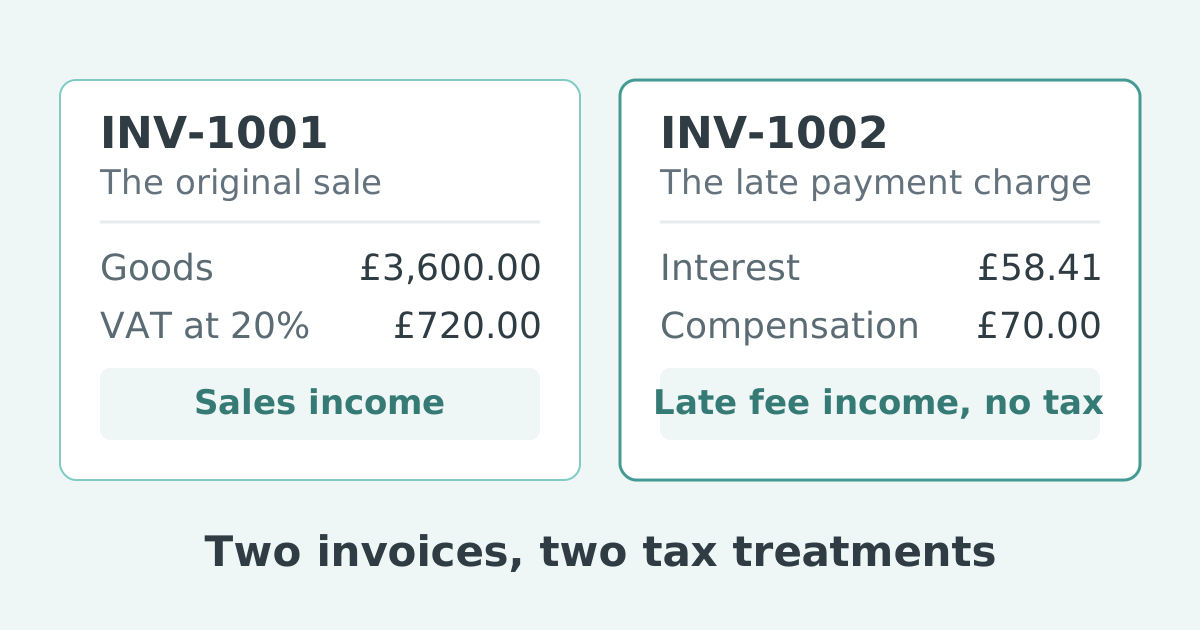

UK statutory interest and the fixed compensation fee are outside the scope of VAT, so raise them as no-VAT line items on their own invoice, not on the original. Sales tax in the US, GST in Australia and New Zealand, and GST or HST in Canada all differ, so set the tax rate on the fee explicitly.
This is general information about how these charges are usually treated, not tax or legal advice. Tax treatment varies by jurisdiction and by the nature of the charge. Check the specifics with your accountant.
In the UK, statutory interest and the fixed compensation sum are outside the scope of VAT. They are compensation for late payment, not consideration for a supply, so there is nothing to charge VAT on. That is why they belong on their own invoice, raised alongside the tax invoice for the sale. Our UK late payment fees guide lists the rates.
Elsewhere the treatment differs, and it is worth checking rather than assuming.
| Market | Basis of the charge | Usual treatment |
|---|---|---|
| UK | Statutory. Late Payment of Commercial Debts (Interest) Act 1998 | Interest and compensation are outside the scope of VAT |
| EU | Statutory. Directive 2011/7/EU | Interest and the €40 minimum are compensation, generally outside the scope |
| US | Contractual, so it rests on your payment terms, state by state, usury caps apply | Sales tax treatment varies by state. A finance charge is usually not a taxable sale, but check your state |
| Australia, New Zealand | Contractual | Interest for late payment is generally not a taxable supply for GST. A service or admin fee may be |
| Canada | Contractual, federal and provincial variation | Interest is generally exempt for GST and HST. State the annual equivalent rate in your terms |
| South Africa | Prescribed Rate of Interest Act | Interest is generally not a taxable supply for VAT |
| Singapore | Common law, genuine pre-estimate of loss test retained | Compensatory interest is generally outside GST |
The pattern across every market is the same. Interest that compensates you for being kept out of your money is not payment for anything you supplied, so it usually sits outside the tax net. An administration or handling fee is more likely to be treated as a service, and therefore taxable. If you charge both, split them onto separate lines so each can carry its own treatment.
A 0% rate tells your accounting system the charge is a taxable supply taxed at nothing, so it lands on your VAT return as a zero rated sale and inflates your reported turnover. "Not applicable" tells the system the charge is outside the scope of VAT, so it stays off the return entirely. Both print the same number on the invoice, which is why the error survives so long.
Tells your accounting system the charge is a taxable supply, taxed at nothing.
It appears in your VAT return as a zero rated sale, inflating your reported turnover for the period with something that was never a supply.
Tells your accounting system the charge sits outside the scope of VAT entirely.
It stays off the VAT return, which is where a compensation payment belongs.
Both produce the same number on the invoice, which is why the error survives so long. They produce different returns, and the difference only surfaces when someone reconciles turnover to the VAT account and finds it does not agree.
Whatever you use, set the rate explicitly on the fee. Inheriting the account default is how a late fee ends up carrying 20% VAT on an invoice that should have carried none.
Raise the late fee as its own invoice, never as a line added to the original sale. The original stays the record of the sale, the fee can be voided or credited in one action, and a no-tax charge never gets mixed into a tax invoice.
The mechanics are in adding late fees in Xero and in QuickBooks, with the step by step in adding late payment fees to Xero invoices and applying finance charges in QuickBooks Online.
Give late fees their own nominal account. Not sales, and not a miscellaneous catch-all.
Two reasons. The first is visibility: once late fee income has its own line, you can see what late payment is actually worth to you, and what you gave away by waiving. Most businesses have never seen that number, and it usually surprises them in both directions.
The second is that the account is how you separate the two charges. Interest and an administration fee often have different tax treatments, so posting them to one account makes the return harder to prepare. Use one account for interest and another for fixed or admin charges.
The number worth watching is interest raised against interest waived. A business raising £4,000 a quarter and waiving most of it is running the policy correctly: the fee is working as leverage and the customers are paying. A business raising £4,000 and collecting all of it has customers who have decided the fee is cheaper than paying on time, which is a different problem.
A fee raised as an invoice reconciles like any other receipt. A fee that exists only in a report arrives as an unallocated payment that someone has to code by hand, every time.
If the fee was raised as an invoice, the payment matches it like any other receipt. The customer pays £134.11, it allocates against INV-1002, and the account clears.
If the fee only ever existed in a report or on a PDF, the cash arrives with nothing to allocate it to. You have an unallocated receipt to code by hand, every time, on every account, and a bank reconciliation that does not agree until someone works out what the odd amount was for.
Customers often pay the original and the fee in one lump, so expect to split receipts. If you take payment through a customer payment portal, the allocation usually comes back already matched.
Use a credit note rather than a void for any fee you have deliberately waived.
A void removes the transaction as though it never happened. A credit note leaves both documents in place: the charge, the reversal, and the date of each. At year end your accountant sees a policy that was applied and then partly conceded, which is a normal and explicable pattern.
Void is for a fee that should never have been raised, such as one applied to an invoice that turned out to be disputed. Those are different events and the ledger should show them differently.
If a customer holds unallocated credit notes, the interest should be calculated on the net balance, not the gross.
Charging interest on money the customer has already been credited for is a small error with a large effect. It is immediately visible to the person checking the statement, it makes every other figure look questionable, and it turns a routine charge into a dispute about your competence rather than their payment.
This is also one of the practical reasons the fee belongs in the ledger. A charge calculated inside a separate tool has no view of the credit notes sitting against the customer, so it cannot net them off. The same netting applies when the balance appears on a statement, covered in late payment interest on customer statements, and whether that interest compounds is in compound or simple interest.
In Paidnice the accounting settings are part of the fee policy, so they are set once rather than on each charge.
Setting it up is one policy, and the accounting choices sit on the same screen as the rate.
Is a late payment fee subject to VAT in the UK?
No. Statutory interest and the fixed compensation sum are compensation for late payment rather than consideration for a supply, so they are outside the scope of VAT. Raise them with no VAT rather than at a zero rate. To work the figure out, use the UK statutory interest calculator.
What account should late fees be posted to?
Their own income account, separate from sales. Use a second account if you charge an administration fee alongside interest, because the two can have different tax treatments.
Can I add the late fee to the original invoice?
You can, and it causes more problems than it solves. It changes a document the customer already holds, it is harder to waive, and it mixes tax treatments.
Void or credit note?
Credit note for a deliberate waiver, because it preserves the record. Void for a fee that should never have been raised at all.
Do I charge tax on an admin fee?
More likely than on interest, because an administration fee looks like a service rather than compensation. Put it on its own line so it can carry its own rate, and confirm the treatment with your accountant.
Paidnice is accounts receivable automation that enforces your payment terms, trusted by thousands of businesses on Xero and QuickBooks. Credit control and debtor management, run for you.
Try it Now - It's FreeNo card required.

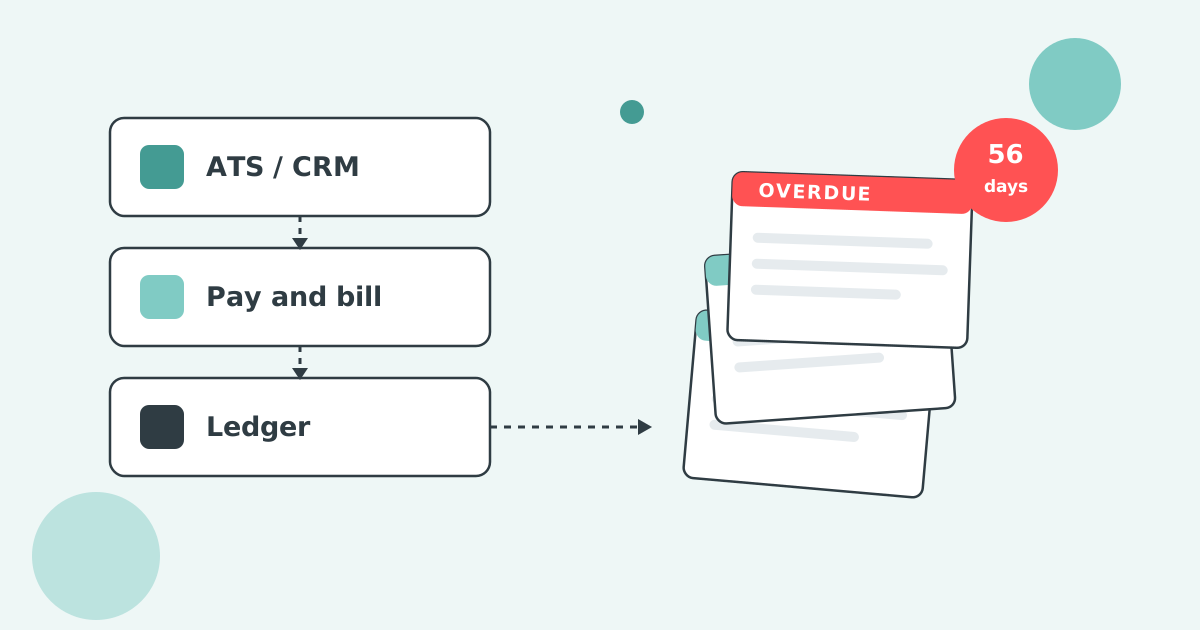

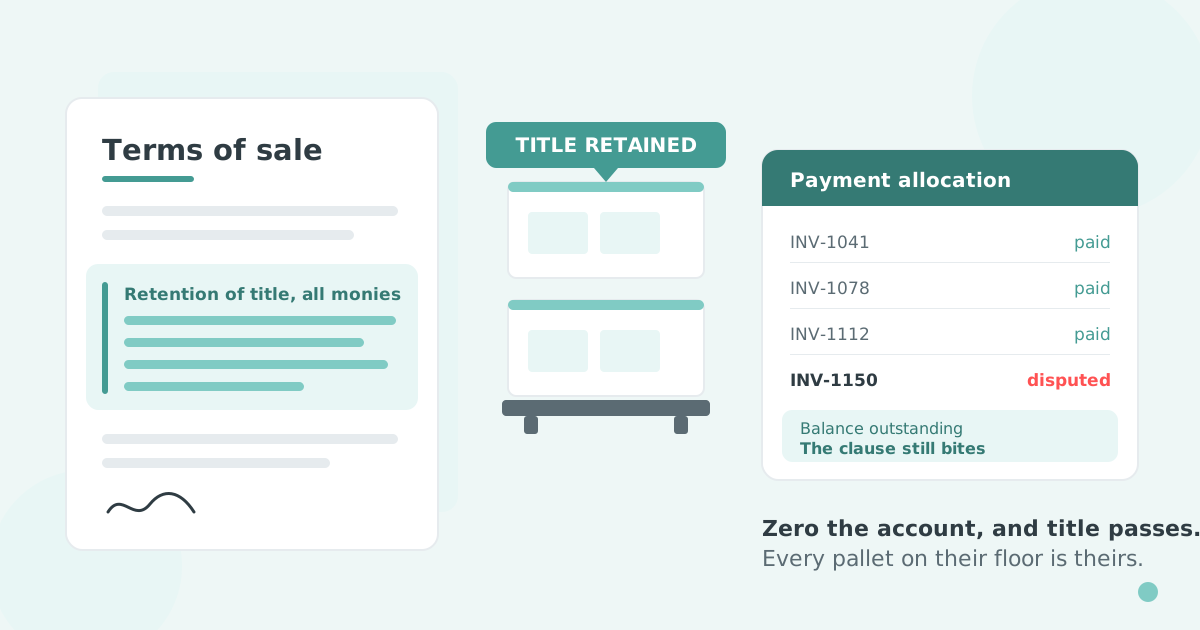

Optimize your cash flow with our suite of financial tools designed for AR professionals. Calculate DSO, aging analysis, late fees, and more.