What is predictive AR modeling?
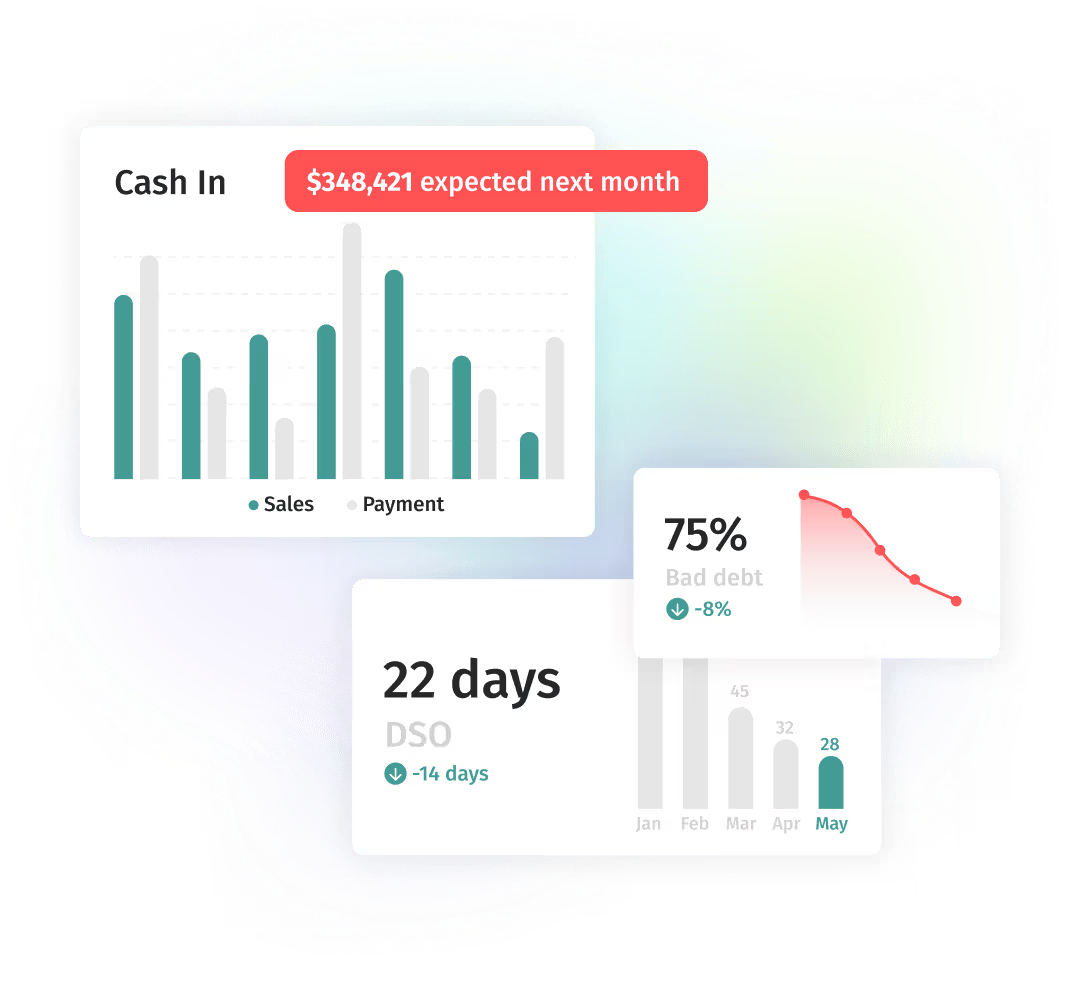
Predictive AR modeling uses your historical invoice and payment data to forecast what will happen to your receivables next: when each invoice is likely to be paid, which customers are likely to slip, and how much cash you can expect to land and when. Instead of looking only at what a customer owes today, it estimates what they will do tomorrow, based on how they and similar accounts have behaved before.
In accounts receivable, this turns reporting from a rear-view mirror into a forecast. A standard aging report tells you an invoice is 20 days overdue. A predictive model tells you that, given this customer's history, that invoice will most likely be paid on day 41, so you can plan cash and target follow-up accordingly. The shift is subtle but powerful: you stop reacting to what already went wrong and start acting on what is about to.
It forecasts, it does not just report.The model predicts payment dates, late risk and expected cash, not only what is already overdue.
Your own data is the fuel.Past invoices, payment dates and customer behavior train the model, so accuracy grows with history.
The point is action.A forecast is only useful if it changes who you chase, what you promise the bank, and which terms you set.
How predictive AR modeling works
A predictive model learns patterns from your past receivables, then applies those patterns to your open invoices to produce a forecast. The cycle runs continuously as new payments come in and the model gets a little sharper each time.
The model takes your closed invoices: amounts, due dates, actual payment dates, terms, customer and any disputes or part-payments.
It finds the relationships that predict payment, such as how a customer's size, terms and past lateness link to when invoices actually clear.
Each unpaid invoice gets a predicted pay date and a probability of being late, based on the patterns the model has learned.
Predictions roll up into an expected cash timeline and a prioritized chase list, then feed credit and collections decisions.
As each invoice is actually paid, the outcome feeds back in, so the next forecast is a little more accurate.
You do not need to build any of this yourself. Most teams get predictive AR modeling through their AR reporting and insights tool, which already holds the invoice history the model needs.
What predictive AR modeling can forecast
The same underlying data supports several useful predictions. These are the outputs finance teams lean on most.
Expected payment dateThe most likely day each open invoice will actually be paid.
Late and default riskThe probability an invoice misses its due date or is never paid.
Cash collection forecastHow much you will collect over the next 30, 60 and 90 days.
Expected bad debtA realistic estimate of what is unlikely to be recovered.
What models does predictive AR modeling use?
The methods range from simple to sophisticated, and you rarely need the heavy end to get value. At the practical level, many tools start with statistical models that learn each customer's typical days-to-pay and adjust for terms and amount. From there, machine learning models such as classification (will this invoice be late, yes or no) and regression (how many days until it pays) add accuracy by weighing many factors at once. Time-series methods forecast the cash curve for the whole ledger. The right choice is whichever is accurate enough to trust and simple enough to explain, because a forecast your team does not believe will not change behavior. These techniques sit alongside related payment predictive analytics, which apply the same idea to individual payment timing.
Why predictive AR modeling matters
It sharpens the three decisions that most affect cash: who to chase, how much to expect, and how much credit to extend. By ranking open invoices on predicted late risk, it points predictive collections at the accounts that need attention before they go overdue, which is far more efficient than chasing everything equally. By forecasting expected cash, it gives finance a credible number to plan and report against rather than a hopeful one. And by flagging likely defaults early, it reduces write-offs. Built into broader AR automation, these predictions run quietly in the background and surface as a prioritized worklist, so the insight turns into action without a separate analysis step.
The compounding benefit is focus
A finance team that knows which 10 percent of invoices carry most of the late-payment risk can spend its time there instead of sending the same reminders to everyone, regardless of whether they are likely to be needed. That is the difference between a collections process that scales only when you add people and one that gets sharper as your data grows.
How accurate is predictive AR modeling, and where does it fall short?
Predictive AR modeling is accurate enough to be useful, not perfect, and treating it as a guide rather than a guarantee is what keeps it trustworthy. A good model will get the broad shape right, which invoices are risky and roughly when cash will arrive, and that alone beats a flat assumption that everyone pays on terms. But three things limit it. It needs enough history, so brand-new customers and one-off accounts are hard to predict until a pattern forms. It cannot see outside your data, so a customer's sudden cash crisis or a disputed delivery will surprise it. And it reflects the past, so if you change your terms or collections approach, the model needs time to relearn. The practical answer is to use predictions to prioritize and plan, while keeping human judgment for the accounts the model is least sure about.
Is predictive AR modeling only for big companies?
No. Predictive AR modeling works for small and mid-sized businesses too, because it runs on the invoice history you already keep in Xero or QuickBooks rather than on a custom data science project. The model improves with more history, but even a year of invoices is enough to beat guesswork. The realistic path for most teams is a tool that builds and updates the model automatically from existing records, not hiring analysts to build one from scratch.
A sensible first step is to start with the simplest useful prediction, each customer's typical days-to-pay, and act on it: chase the slow payers earlier and base your cash forecast on predicted dates rather than due dates. Once that is paying off, layering on richer late-risk and default predictions is a smaller leap. Predictive modeling rewards starting early, because every paid invoice makes the next forecast better, so the sooner the history starts feeding the model, the sooner it earns its keep.