
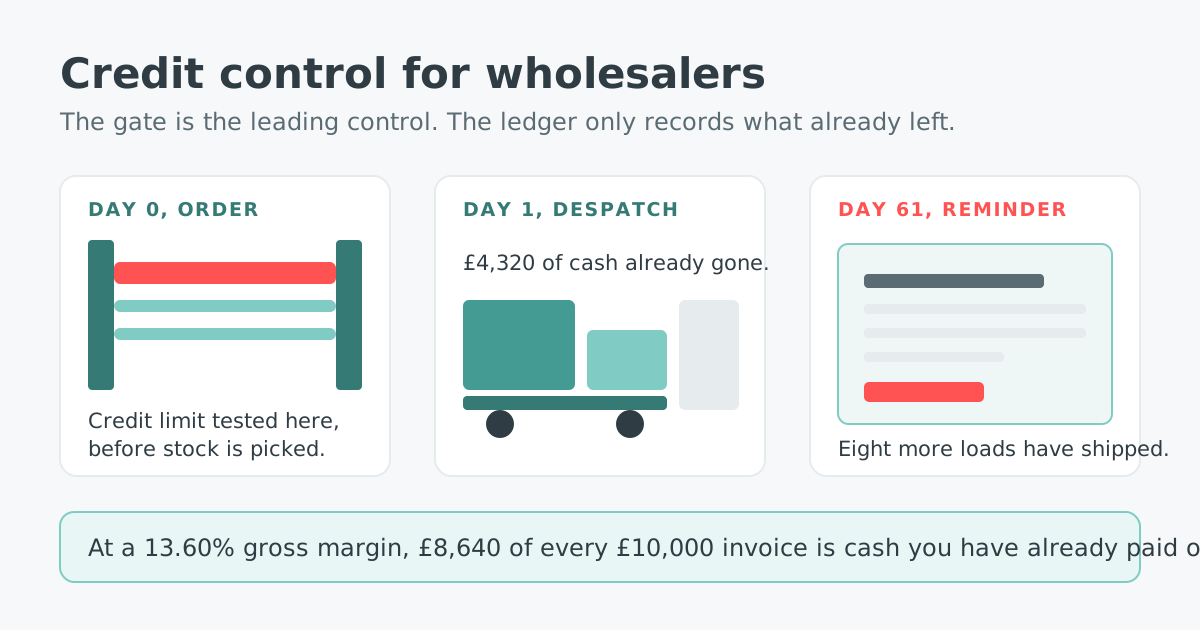

Credit control for wholesalers means checking whether a trade customer will pay before the first order ships, setting a credit limit sized to that risk, and gating every later order against the limit and the aged balance. Wholesale credit risk sits at despatch: the goods leave the building weeks before the invoice falls due.
Credit control is the process of checking whether a trade customer will pay, setting a credit limit that reflects that, and collecting the invoice once goods have shipped. In wholesale it splits across two systems, because the order book and the sales ledger are different places.
Three jobs sit inside it: credit checking establishes creditworthiness before the account opens, the credit terms and limit turn that judgement into a number to trade against, and collection works the ledger after despatch.
A credit control policy is the written version: who grants credit, on what evidence, at what limit, who releases a held order, and what happens each day past due.
One disambiguation: this is trade credit control, the supplier-side discipline of granting and collecting customer credit, not the central-bank sense of restricting lending across an economy.
Wholesale credit risk is a despatch problem, not an invoice problem, because a wholesaler that is not paid has already spent the cash. At the divisional gross margin proxy, £8,640 of every £10,000 invoice is money paid to your own suppliers and physically shipped out of the building.
UK wholesale, SIC Division 46, turned over £1,018,705m across 101,213 enterprises in 2024 against purchases of £880,158m, in the ONS Annual Business Survey released on 26 May 2026. One minus 880,158 divided by 1,018,705 is a gross margin proxy of 13.60%.
Read that proxy carefully: fuels wholesaling drags it down. SIC 46.71 is 36.9% of divisional turnover at a 6.54% proxy, and excluding it lifts the division to 17.74%, nearer a typical wholesaler. The figures below use the 13.60% divisional proxy, so treat them as the conservative end.
A wholesaler needs 4.4 times more replacement revenue than a service business to survive the same bad debt.
Wholesale and retail trade recorded 3,463 UK company insolvencies in the 12 months to June 2026, second only to construction at 3,805. The Insolvency Service Industry Tables put Division 46 alone at 1,125 in 2025, up 7.4% on 2024 and 44% on 2019. You can see how wholesale and retail customers are currently paying before you set a limit.
Day 61 is when the first reminder reaches a customer on 30 day end of month following terms who stopped paying after an invoice dated the 1st. By then eight further weekly deliveries have shipped and roughly £40,000 of extra exposure sits on the ledger.
"30 days end of month following", the standard builders merchant term, means payment not later than the end of the month following the invoice month. It does not mean 30 days.
Two customers on identical terms get 31 and 60 days of credit, decided only by when in the month they ordered.
Now put a customer on it. A trade account takes a £5,000 delivery every week and stops paying after the invoice dated the 1st, which falls due on day 60. The first reminder lands on day 61.
Ordinary monthly spend on this account is £21,667. The first reminder arrives at 2.1 times that.
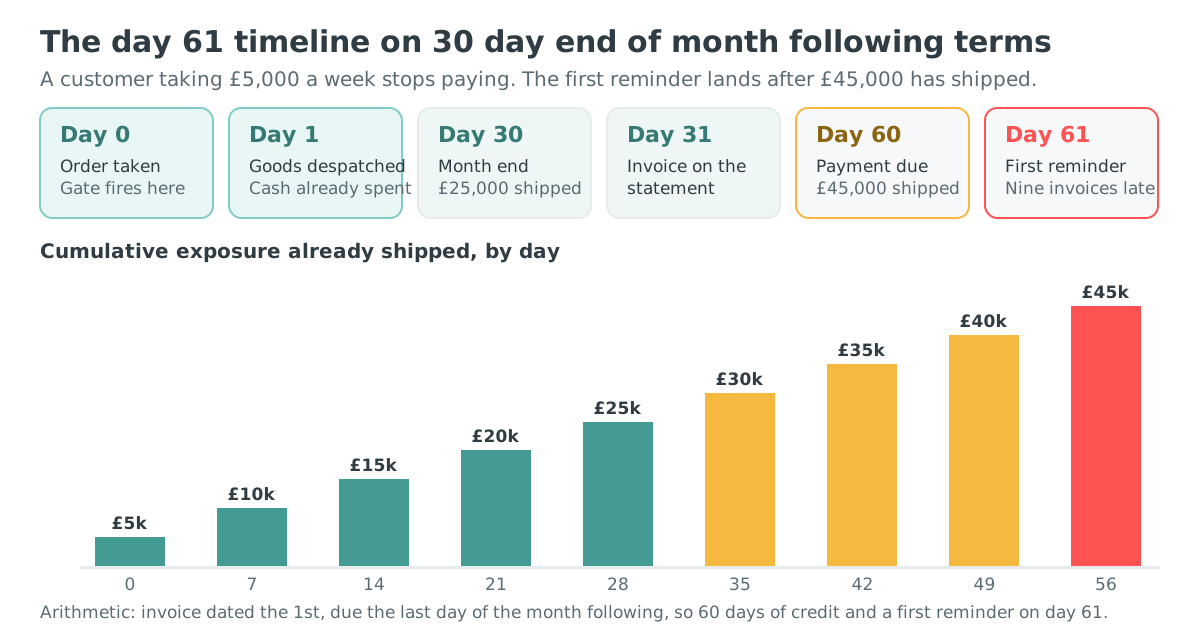
No reminder sequence can touch that £40,000. It shipped while the account was inside terms and looked healthy. Only a control at order entry, pick or despatch could have stopped it.
It is also why a debtor days target set without normalising for order timing measures very little. Debtor days for wholesalers covers the formula, the VAT error in it, and what each day costs.
A credit limit only protects a wholesaler if it fires at order entry, before stock is picked. In Xero and QuickBooks Online it cannot, because neither product has a sales order or a despatch event, so the gate lives in the order system or with the person releasing the pick.
Those negatives mean no evidence found in the vendors' own documentation, not proof of absence. Order-layer systems do enforce: Sage 200 auto-holds orders over the limit, and NetSuite's Enforce Holds blocks sales order entry outright.
So most SME wholesalers run a split stack: the order system cannot chase or charge interest, and the ledger cannot see the order book. The ranked comparison of credit control software for wholesalers scores tools on where the block fires.
Worth saying plainly, because it decides what to buy: Paidnice charges and chases on the ledger. It does not block an order at entry, because it sits on the ledger, not the order book.
A trade account is opened once and relied on for years, so capture the registered company number, signed terms with a retention of title clause, a bureau check and expected monthly spend before the first despatch.
Check creditworthiness three ways: a bureau report, two or three trade references with account numbers, and for any large buyer their filings on the free UK payment practices register. One correction that saves money: a bureau recommended limit is a total across all that customer's suppliers, not yours to grant.
Take personal guarantees as a separate signed instrument. Retention of title, deductions and disputes covers the clause drafting and the ledger habits that keep it live.
Setting that account at one month's spend guarantees a monthly false alarm and destroys the gate's credibility.
The six-point onboarding gate is the checklist a wholesaler clears before a first despatch: legal entity confirmed, terms signed, credit check complete, trade references taken, credit limit set by formula, and release authority written down.
Legal entity confirmed. Registered name, company number, legal status, registered office and every delivery address. Status decides the pre-action route later, so record it as a field.
Terms signed and returned by someone with authority to bind the company: all-monies retention of title, an interest clause, a narrowly drawn set-off exclusion.
Credit check complete. Bureau report, plus the last four payment practices filings for any large buyer. The bureau limit is a total across all suppliers, not yours.
Two to three trade references taken with account numbers, and expected monthly spend captured. Expected spend is what lets a limit be sized rather than guessed.
Limit set as a formula. Expected monthly spend x (effective credit days / 30) x safety factor. On 30 day end of month terms use 45.5 effective days, the mean, not 30.
Release authority written down. Who may release a held order, to what value and how far past terms, with every override logged against a reason code and an expiry.
Point six decides whether the other five survive a sales team. Release authority must sit outside the sales line, and a temporary limit increase with no expiry is permanent.
A statement-traded account needs a cadence built around the month-end statement, because on end of month terms the customer reconciles against a monthly statement and pays the balance in one transfer, so the statement, not the invoice, is the collectible unit.
That changes the rhythm twice over. Chasing an invoice dated the 4th on day 31 chases something not yet due and not on a statement, and every timing runs off the due date. The highest-yield contact is the statement confirmation call, days before anything is late.
| Timing | Action | Owner |
|---|---|---|
| Month end | Statement issued with open-item detail, PO numbers and proof of delivery references | Automated |
| Month end +3 to +5 | Statement confirmation call: agreed, anything in query, which pay run | Credit control |
| Due date −7 | Pre-due reminder confirming the amount and the invoices it covers | Automated |
| Due date | Statement due. Reminder with a payment link | Automated |
| +7 | Firm reminder restating the balance, plus notice that the account moves to order hold at +30 | Automated |
| +14 | Phone call from a named person who knows the account, not a generic inbox | Account owner |
| +21 | Statutory interest and the fixed sum applied and shown on the statement | Automated |
| +30 | Credit hold and stop supply. New orders pro forma or cash before despatch | Finance |
| +45 | Final demand, then letter before action on the route the legal status dictates | Finance |
| +60 | Escalation decision: solicitor, county court claim or statutory demand | Finance |
Escalate by consequence, not volume. A fifth email changes nothing; moving the account to pro forma changes everything, which is why +30 ties collections to the gate.
At +21, UK suppliers of goods hold the entitlement whether or not their terms mention it: 8 percentage points over the official dealing rate, plus £40, £70 or £100 per invoice under section 5A of the 1998 Act. The rate is fixed for the life of each debt, a rule charging interest on overdue invoices when you supply goods works through, alongside the US, Australia and New Zealand.
The rules are changing
The government confirmed on 24 July 2026 a 60 day statutory maximum on B2B terms, and mandatory statutory interest with the alternative remedy option removed. A cut to 45 days was expressly rejected, and commencement is no earlier than 2027. End of month following terms sit exactly on that boundary. The detail is in the Commercial Payments Bill and UK late payment law.
A wholesaler can stop supply or move a customer to pro forma at any point its contract allows before insolvency. Once the customer enters a relevant insolvency procedure, stopping the lorries until the old account is paid is unlawful under section 233B of the Insolvency Act 1986.
Before insolvency, stopping supply is a contractual and commercial question. Converting to pro forma usually beats terminating: you keep a customer you may want back and add no exposure.
Afterwards the position changes. Section 233B of the Insolvency Act 1986, inserted by the Corporate Insolvency and Governance Act 2020, provides that a supplier may not make pre-appointment arrears a condition of later supply. Termination triggered by the insolvency itself also ceases to have effect.
So the decision turns on incremental contribution against incremental unsecured exposure, never the historic balance. Continue where new supply is cash in advance or ranks as an administration expense; stop where it is neither.
A wholesaler should watch five numbers every Monday: aged debt plus true exposure, orders held, statements agreed by day 5, disputes by cause, and average days delinquent. Debtor days alone will not show a wholesale problem, because half of it lives in the order book rather than the ledger.
One caveat on benchmarks. Large UK businesses took an average of 32 days to pay in 2025 and paid 15% of invoices late by number, with wholesale and retail reporters at 37 days. That is what they pay out, not what wholesalers get paid in.
Paidnice runs the ledger side of wholesale credit control on top of Xero or QuickBooks Online: statements, reminder sequences, statutory interest and escalations. The order-entry credit gate stays in the order or ERP system. Every step above works manually; what breaks is one person doing the same 80 follow-ups every month while statements go out late.
On-ledger charging is the difference that matters. A fee posted into Xero or QuickBooks enters the customer's payables and payment run; a number typed into an email does not. Statement interest recalculates at send, so the figure is accurate that morning.
Customers cut their average wait for payment in half, within 30 days. Pricing is by invoice volume, from £49 / US$69 a month for 150 invoices, Pro from £74 / US$99, no per-seat fees.
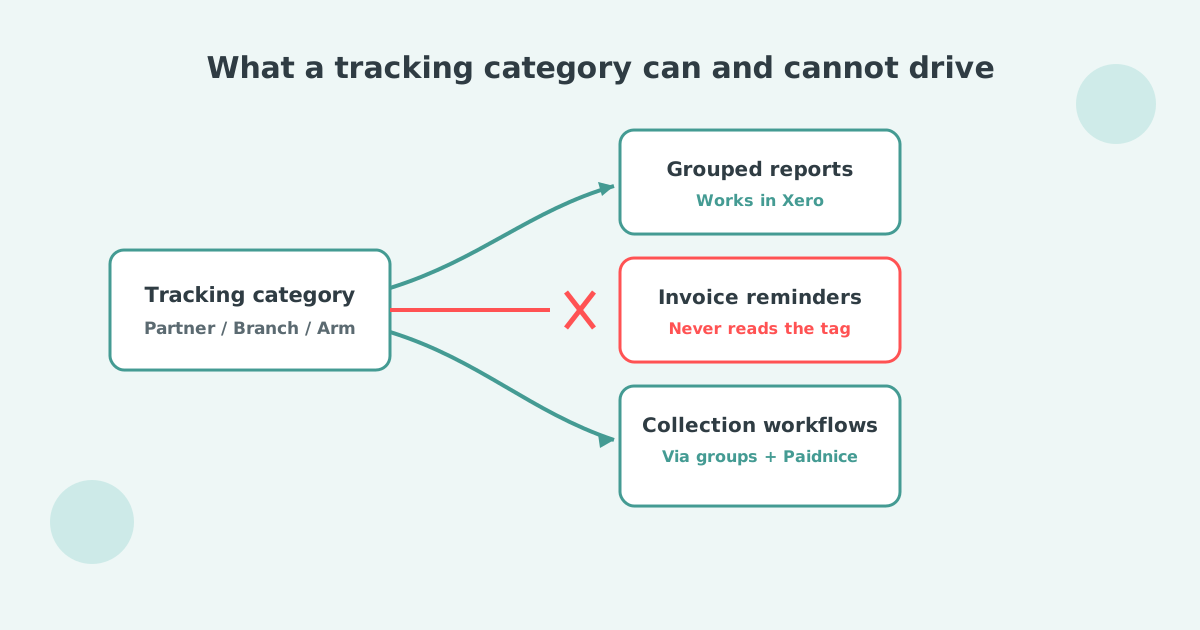
The limit, again: Paidnice does not enforce a credit limit at order entry. A credit-limit breach or a total overdue balance can trigger a Paidnice escalation to a named person, who then holds the pick. Pair it with whatever holds the order, and let each system do its own job.
How do you set a credit limit for a trade customer?
Size it off the trading requirement, not a bureau number: expected monthly spend, multiplied by effective credit days divided by 30, multiplied by a safety factor of about 1.2. On 30 day end of month terms the mean is 45.5 days, so £20,000 a month needs about £36,400 of limit.
Can you stop supplying a customer who has not paid?
Before any insolvency procedure, yes, subject to your contract, and converting to pro forma usually beats terminating. Afterwards, section 233B of the Insolvency Act 1986 stops you making pre-appointment arrears a condition of supply.
Does Xero or QuickBooks Online block an order over the credit limit?
Neither can. Xero has no sales order object, so its optional block applies at invoice approval or send, and Xero said on 8 February 2024 that it has no plans to build automatic credit hold. No customer credit limit field appears in QuickBooks Online's documentation, so the gate has to live in the system that creates the sales order.
Does credit control software stop an order shipping to a customer over their credit limit?
Only when the software owns the sales order. Sage 200 auto-holds orders over the limit and NetSuite's Enforce Holds blocks sales order entry, because both hold the order object. Ledger-side tools on Xero or QuickBooks Online, Paidnice included, see the invoice after despatch, so they can flag a breach and escalate it to a person, but the hold itself is applied in the order system or by whoever releases the pick.
Paidnice is accounts receivable automation that enforces your payment terms, trusted by thousands of businesses on Xero and QuickBooks. Credit control and debtor management, run for you.
Try it Now - It's FreeNo card required.





Optimize your cash flow with our suite of financial tools designed for AR professionals. Calculate DSO, aging analysis, late fees, and more.