
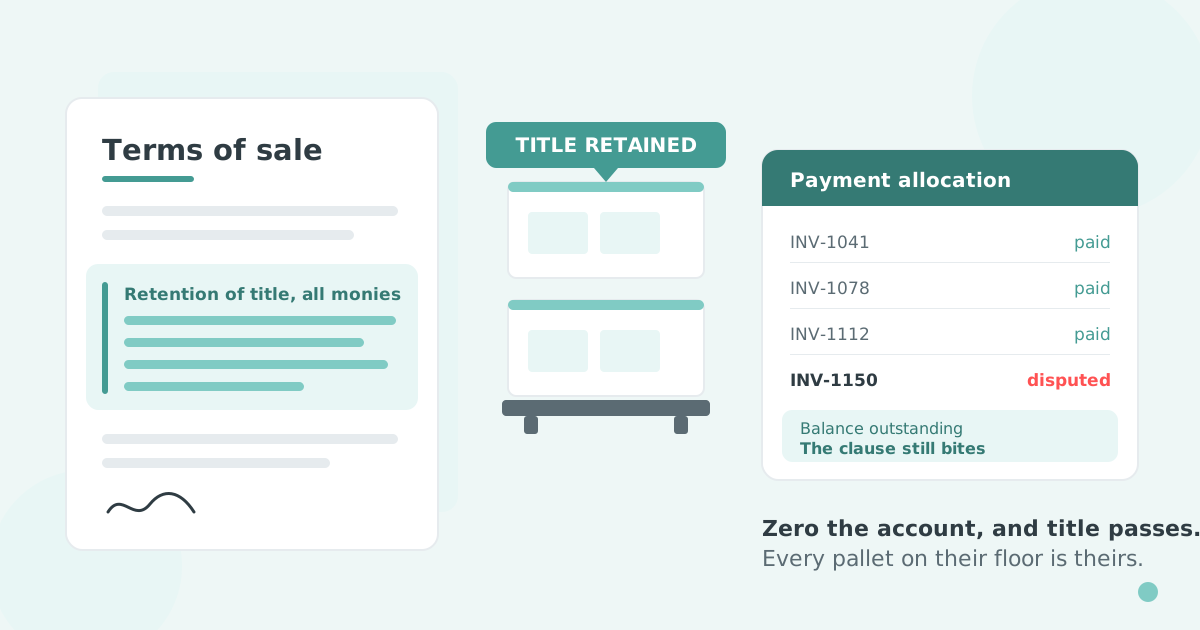

A Romalpa clause, also called a retention of title clause, is a contract term letting the supplier keep legal ownership of delivered goods until the buyer pays, under the right reserved by section 19(1) of the Sale of Goods Act 1979. An unpaid invoice becomes an asset claim if the buyer turns insolvent before payment clears.
A Romalpa clause is a retention of title clause, also called a reservation of title or a title retention clause: a term of the sale contract under which you keep legal ownership of goods you have already delivered, until a payment condition is met. Most pages treat it as an insolvency remedy invoked after collapse; it is a live control, and it runs off the sales ledger.
The name comes from Aluminium Industrie Vaassen BV v Romalpa Aluminium Ltd [1976] 1 WLR 676, Court of Appeal, where a clause over unmixed foil was upheld. The proceeds limb of that case rested on a fiduciary relationship the buyer conceded on the facts, which is why it has almost never been repeated.
The statutory hook is section 19(1) of the Sale of Goods Act 1979: the seller may, by the terms of the contract, reserve the right of disposal, and notwithstanding delivery of the goods, property does not pass until those conditions are fulfilled.
Read "by the terms of the contract" carefully. A clause printed on the back of a delivery note arrives after the contract was made. It is the signed credit account application, the portal click-wrap or the EDI trading partner agreement that carries it.
Three drafting patterns, in ascending order of ambition and descending order of reliability.
Extended retention of title clauses usually fail because they are charges, and almost nobody registers them. A simple or all-monies clause is not a charge, because you never parted with title; an extended clause over proceeds or mixed goods is, because the buyer has to grant rights back out of property the buyer owns.
Retaining ownership of goods is not security. Claiming the money someone else received for reselling them, or the chipboard made from your resin, is. In Re Bond Worth Ltd [1980] Ch 228 a clause reserving equitable and beneficial ownership created a floating charge, void unregistered.
The registration mechanism is short and unforgiving. Companies Act 2006 s.859A gives 21 days, beginning with the day after the charge is created, to get it to the registrar.
Miss it and s.859H applies: the charge is void, so far as any security is conferred by it, against a liquidator, an administrator and a creditor of the company. Nobody delivers trade terms to Companies House, because nobody reads the sales ledger as a security document.
Mixing kills the claim by a second route. Resin worked into chipboard in Borden (UK) Ltd v Scottish Timber Products Ltd [1981] Ch 25, and leather made into handbags in Re Peachdart Ltd [1984] Ch 131, ceased to exist as separate property. Goods affixed to land go the same way.
The extended clause is usually the longest paragraph in a set of wholesale trade terms and the least likely to work. The short all-monies version, plus separate storage, plus a marking obligation, plus somebody who serves the notice on day one, beats it every time.
No, not on its own. In an administration, the buyer's right to deal with retention of title goods continues until the supplier serves written notice terminating it, so the clause creates a right and somebody has to exercise it on the day of appointment.
In Sandhu (t/a Isher Fashions UK) v Jet Star Retail Ltd [2011] EWCA Civ 459 the administrators kept selling unpaid garments supplied under a retention of title clause. It was common ground that the contract impliedly gave the buyer the right to deal, and the Court of Appeal held that the right continued after administration.
Because the contract gave the supplier an express right to terminate the power of sale on insolvency, the court would not accept that the parties intended it to terminate automatically. No implied term confined the right to sell to the ordinary course of business.
So every hour between the appointment and your notice is your stock going through somebody else's till. Three things belong in the first hour of a customer insolvency.
One thing you cannot do, and it catches people who have run this play for twenty years: you may not make payment of pre-appointment arrears a condition of continued supply, under Insolvency Act 1986 s.233B, inserted by CIGA 2020 s.14. The stop-supply lever and the escalation sequence around it are covered in the wholesale credit control guide.
Payment allocation decides the claim because, under an all-monies clause, your title claim survives only while some money is still owed. An account that touches zero, even for an afternoon, passes title in every pallet delivered under it up to that point.
Section 19(1) says property does not pass until the contractual conditions are fulfilled. Read it the other way round. When the condition is fulfilled, property passes, and under an all-monies clause the condition is that every sum owed on the account has been paid.
So the goods on the customer's shelf become the customer's goods at the moment the balance clears. Monday's delivery reopens the account. It does not reopen your claim to the stock that was already there.
That makes cash allocation a title decision, taken weekly by a credit controller who has never been told. Here is what it looks like on a real account.
Harbourgate Trading, weekly deliveries, all-monies clause in the signed credit account terms. Open items at 24 July: INV-1041 at £9,400, INV-1078 at £11,200, INV-1112 at £8,600, INV-1150 at £10,800. Total £40,000. A payment of £33,800 arrives with no remittance advice.
Allocated oldest first, the £33,800 clears 1041, 1078 and 1112, which is £29,200, and leaves £4,600 against 1150. The residual on 1150 is £6,200. The customer has been claiming a £6,200 shortage on that delivery since the first week of July.
The allocation that destroys the claim. To tidy the ledger before month end, someone raises a £6,200 credit note for the disputed shortage. The account shows nil on 31 July, so title in every pallet delivered up to that date passes to the customer. August deliveries of £28,000 reopen the account.
On 12 September an administrator is appointed, owing £28,000. The claim now reaches only August stock that is still identifiable. The June and July pallets on the floor belong to the customer, and the £6,200 is gone too, because a credit note reverses the supply and forfeits the debt.
The allocation that preserves it. Same cash, same oldest-first sequence, one difference: the £6,200 is not credit-noted. It is coded as a disputed deduction against 1150, aged on its own clock, and that invoice comes out of the reminder and interest policy while the rest of the account keeps running.
The balance never reaches zero. On 12 September the administrator finds £34,200 outstanding, the all-monies clause is live over every identifiable pallet delivered under the account, June stock included, and the notice terminating the right to deal goes out that morning.
One credit note, raised for housekeeping, is the whole difference. If a deduction is genuinely agreed, credit it. If it is disputed, leave the debt on the ledger and reclaim the VAT under VAT Notice 700/18 at six months, which recovers the tax and keeps the claim. For supplies on or after 19 March 1997, an unenforced retention of title clause does not bar that relief.
A retention of title clause should state that title does not pass until payment in cleared funds, make the buyer a bailee who stores, marks and insures the goods, and give the seller an express right to enter and recover them. Three model patterns follow, in the order you should consider them: simple, all-monies, and the extended clause that needs registering.
These are drafting starting points, not advice on your contract. Retention of title is decided on the exact words, on how your terms were incorporated, and on what happened on the ledger afterwards. Have your solicitor adapt them, and check them against the rest of your terms of sale.
Title to the Goods supplied under an order does not pass to the Buyer until the Seller has received payment in full and in cleared funds of the price of those Goods. Until title passes, the Buyer holds the Goods as bailee for the Seller and shall: store them separately from its own goods and those of any third party; keep them clearly marked as the Seller's property; not remove, obscure or alter any identifying mark or packaging; and keep them insured against all usual risks for their full price. The Seller may at any time require the Buyer to deliver up the Goods and, if the Buyer does not do so promptly, may enter any premises where the Goods are stored to recover them.
Title to the Goods does not pass to the Buyer until the Seller has received payment in full and in cleared funds of all sums owed by the Buyer to the Seller on any account, whether or not those sums relate to the Goods and whether or not payment of them has fallen due. Until title passes, the Buyer holds the Goods as bailee for the Seller and shall store, mark and insure them as set out in clause [X]. The Buyer may resell the Goods in the ordinary course of its business, and that right terminates immediately on written notice from the Seller, which the Seller may give at any time. The Buyer shall notify the Seller at once if any insolvency event occurs in relation to the Buyer, and shall permit the Seller to enter any premises to inspect, identify and recover the Goods.
Where the Goods are mixed with, incorporated into or used in the manufacture of other goods, title to the resulting product vests in the Seller until all sums owed by the Buyer to the Seller have been paid in full. Where the Buyer resells the Goods before title has passed, the Buyer holds the proceeds of that sale on trust for the Seller, shall pay them into a separate designated account, and shall not mix them with any other money.WARNING, read before use: this limb operates as a charge granted by the Buyer. It must be delivered to Companies House with the prescribed particulars within 21 days beginning with the day after the day the charge is created, or it is void against a liquidator, an administrator and a creditor of the Buyer.
Wording is the easy half. The rest of the terms of sale, including how they are incorporated at account opening, is in our payment terms and conditions templates.
Not in the UK form. The clause that protects you in the UK with no register at all needs PPSR registration before delivery in Australia and New Zealand, and has no effect in the United States, where the analogue is a UCC-1 purchase money security interest perfected before the customer takes possession.
| United Kingdom | United States | Australia | New Zealand | |
|---|---|---|---|---|
| The instrument | Retention of title clause in the contract | UCC-1 financing statement, purchase money security interest | PPSA 2009 (Cth) purchase money security interest | PPSA 1999 purchase money security interest |
| Register | None for simple or all-monies. Companies House for an extended clause | Filing office of the state where the debtor is organised | PPSR, national | PPSR, national |
| Deadline | 21 days for an extended clause, from the day after creation | Perfected before the debtor receives inventory, plus notice to conflicting secured parties | Register before the customer takes possession of inventory | Perfected at the time the debtor obtains possession of inventory |
| Duration | Life of the contract | Five years, continuation only in the final six months | Up to 7, 25 years or open, by fee paid | Maximum five years, renewable before expiry |
| Miss it and | Extended limb void against the office-holder | You rank behind the customer's floating lien lender | Super-priority lost, and the interest can vest in the company | Priority lost under s.74 |
| The trap | Nobody registers trade terms, so extended clauses fail | The 20-day grace period does not cover inventory | A second clock, Corporations Act s.588FL, runs on survival | Registrations expire, and the claim goes with them |
The United States catches wholesalers hardest, because it looks solved. UCC §9-324(a) gives a 20-day grace period after the debtor receives possession, and every summary repeats it. That grace period is for goods other than inventory.
Under §9-324(b) an inventory purchase money security interest has priority only if it is perfected when the debtor receives possession, and the holder sent an authenticated notification that each conflicting secured party received within the preceding five years.
A wholesaler shipping stock is supplying inventory, and almost no SME wholesaler sends that notification. Relying on the 20-day rule for stock means being unperfected on every shipment, behind the customer's asset-based lender, holding an ordinary trade claim. File in the state where the customer is organised, and diary the five-year continuation window.
The compensation is real and has no equivalent in the other three markets. 11 U.S.C. §503(b)(9) gives goods suppliers an administrative expense claim for goods the debtor received within 20 days before the filing, sold in the ordinary course. The asset there is your proof of delivery, not your invoice.
In Australia and New Zealand the clause is a registrable security interest. The Personal Property Securities Act 2009 (Cth) defines the purchase money security interest at s.14, and unperfected interests vest in the grantor on winding up under ss.267 and 267A. Registration on the PPSR costs A$6 for up to seven years.
Australia runs a second clock that catches people who cleared the first. Corporations Act 2001 s.588FL vests a security interest granted by a company in that company on liquidation or voluntary administration unless it was registered within 20 business days of the security agreement, or six months before the critical time.
New Zealand adopted the model first and is the most register-literate of the four. Section 74 of the Personal Property Securities Act 1999 gives an inventory purchase money security interest priority where it is perfected at the time the debtor obtains possession. Financing statements last five years and expire unless renewed.
One gap. The non-inventory registration windows under PPSA 2009 s.62 and PPSA 1999 s.75 are widely quoted by practitioners in working days, and neither number could be confirmed against the statute text for this piece. Take those two figures from your own adviser, not from any article, including this one.
A deduction on a wholesale invoice almost never arrives as a logged dispute. It arrives as cash, short-paid against an open invoice, and your reminder logic reads the residual as an overdue balance and chases the customer for money it believes it legitimately withheld.
That mis-chase does more relationship damage than any other single event in wholesale credit control, and no amount of firmer chasing fixes it. It is a matching problem, not a dunning problem.
The categories a wholesale ledger actually sees: rebates and retrospective volume discounts, marketing and promotional contributions, listing and range-review fees, shortages and claimed non-delivery, damages and quality rejections, service level or OTIF penalties, shrinkage, wastage, price-file mismatches, and the same claim taken twice.
On the size of the problem, the answer is the interesting one. No UK regulator, trade body or statistical agency publishes the value of deductions taken against wholesale invoices. The Groceries Code Adjudicator measures the incidence of issues among suppliers to designated retailers, not the value deducted.
The figures that circulate are American, self-published by vendors, mutually inconsistent, and in several cases do not appear on the pages they are attributed to. The absence of measurement is itself the finding: this is the largest unmeasured leak in the sector, and it is unmeasured because nobody has been asked to count it.
Two rules of law decide what your exposure actually is. Before insolvency, set-off is contractual: if your terms give the customer no right of set-off, a customer deducting a rebate claim is in breach and the invoices remain due, though whose terms won the battle of the forms decides that. Under the Groceries Supply Code of Practice, set-off against designated retailers is constrained and must be explained on request.
After insolvency, set-off is automatic and cannot be contracted out of. Rule 14.25 of the Insolvency (England and Wales) Rules 2016 requires an account to be taken of mutual dealings, with only the net balance provable.
So your exposure is the receivable minus any accrued rebate liability you owe the same legal entity. Mutuality is entity-level, which means a rebate owed to a buying group member does not net against the group's central billing company.
Deductions need proof of delivery that a credit controller can reach without warehouse access, and a triage of every short payment within 24 hours. Proof of delivery is the controlling evidence in shortage, damage and late-delivery claims, and it has to be reachable by a credit controller with no warehouse access, inside whatever rebuttal window the customer imposes.
Four requirements, and they are all process rather than software.
Then triage every residual within 24 hours, with an owner and a target date. An unallocated residual with no code is an invisible deduction, and it will still be there at the year end.
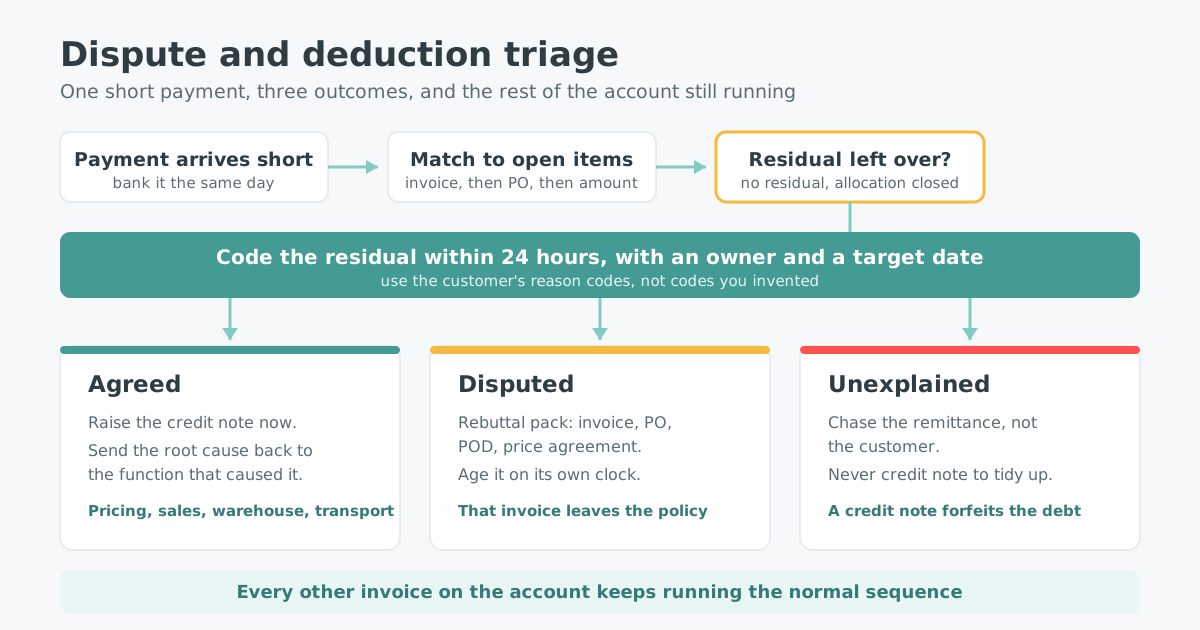
Code deductions in the customer's language, not your own. A wholesaler with invented reason codes cannot aggregate root causes across customers and cannot phrase a rebuttal in terms the buyer's system recognises.
Age deductions separately, on their own clock, and review them weekly by reason code and by the function that caused them: pricing, sales, warehouse, transport or master data. Mixed into ordinary debt, they make both numbers meaningless, which is the measurement problem the debtor days guide deals with in detail.
The most common thing we see on a wholesale ledger is a customer marked as a chronic late payer who is nothing of the sort. They pay on time and short pay one line every month, and the residual has been rolling forward for a year with nobody's name on it.
In Paidnice, the Include Invoices with Reference filter takes one disputed invoice out of a reminder, interest or statement policy while every other invoice on the account keeps running under the normal sequence. Switching the customer off entirely is the mistake that follows the mis-chase.
Paidnice sits on top of Xero or QuickBooks Online and runs the policies from the ledger, so a single invoice can leave a policy without moving the customer or switching the policy off.
Pricing is by invoice volume, from £49 / US$69 a month for 150 invoices, Pro from £74 / US$99, with no per-seat fees. Customers cut their average wait for payment in half, within 30 days.
The limits. Paidnice does not register a PPSR financing statement or a UCC-1, does not decide whether a deduction is valid, and does not block an order at entry, because it sits on the ledger rather than the order book.
It runs the sequence, and it stops running it on the invoice you tell it to leave alone. Where the dispute is not genuine, escalation workflows hand the account to a named person, and the wording for the next step is in our letter of demand template.
Which tools can actually do invoice-level exclusion, and which apply one global rule to the whole ledger, is compared in the wholesale credit control software guide. Where a dispute is closed and the invoice is simply late, charging interest on overdue invoices covers what a goods supplier can charge in each of these four markets.
What is a Romalpa clause?
A Romalpa clause is a retention of title clause in a contract for the sale of goods. It keeps legal ownership with the seller after delivery until a payment condition is met, using the right reserved by section 19(1) of the Sale of Goods Act 1979.
The name comes from the 1976 case Aluminium Industrie Vaassen BV v Romalpa Aluminium Ltd. In UK wholesale terms it usually appears as an all-monies clause.
Do I need to register a retention of title clause in the UK?
No, not for a simple or an all-monies clause. There is nothing to register, because you never parted with title and the clause creates no security over the buyer's property.
An extended clause over proceeds or mixed goods is different. It is a charge granted by the buyer, and under Companies Act 2006 s.859H it is void against a liquidator, an administrator and a creditor unless delivered to Companies House within 21 days.
Does the clause still work if the customer has already sold the goods?
Generally not. A sub-buyer who takes the goods in good faith and without notice will usually acquire good title under the Sale of Goods Act 1979, so the goods are gone.
Claiming the money instead is the extended proceeds limb, which needs a fiduciary relationship or a registered charge over book debts. Where the customer factors its receivables, the financier's registered charge takes priority.
What do I do on the day a customer goes into administration?
Serve written notice on the office-holder terminating any right to use or resell your goods, the same day. Sandhu v Jet Star Retail Ltd [2011] EWCA Civ 459 confirms the buyer's right to deal continues until you do.
Then submit the claim pack: signed terms, evidence of incorporation, unpaid invoices, delivery documentation. You may not demand payment of pre-appointment arrears as a condition of continued supply, under Insolvency Act 1986 s.233B.
Does a Romalpa clause stop a customer disputing an invoice?
No. A Romalpa clause is an insolvency-recovery mechanism, not a dispute-resolution one: it decides who owns the goods if the buyer fails, and says nothing about whether a shortage or rebate claim on a live invoice is valid.
A deduction dispute needs its own process: code the residual, hold the disputed invoice out of the reminder sequence, and keep the rest of the account collecting.
Should I credit note a disputed deduction to clear the ledger?
No. A credit note reverses the supply, forfeits the debt, and under an all-monies clause it can take the account to nil and pass title in stock still sitting on the customer's floor.
Where the deduction is agreed, a credit note is correct. Where it is disputed and simply unpaid, leave the debt on the ledger and claim VAT bad debt relief at six months, which recovers the tax and preserves the claim.
Paidnice is accounts receivable automation that enforces your payment terms, trusted by thousands of businesses on Xero and QuickBooks. Credit control and debtor management, run for you.
Try it Now - It's FreeNo card required.





Optimize your cash flow with our suite of financial tools designed for AR professionals. Calculate DSO, aging analysis, late fees, and more.