
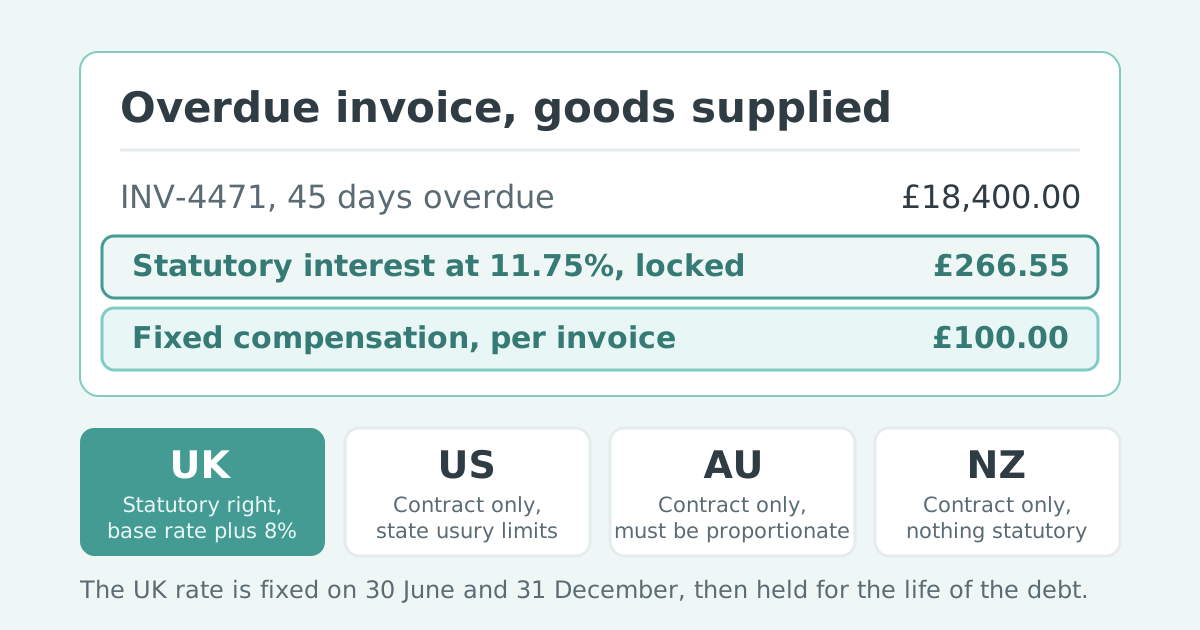

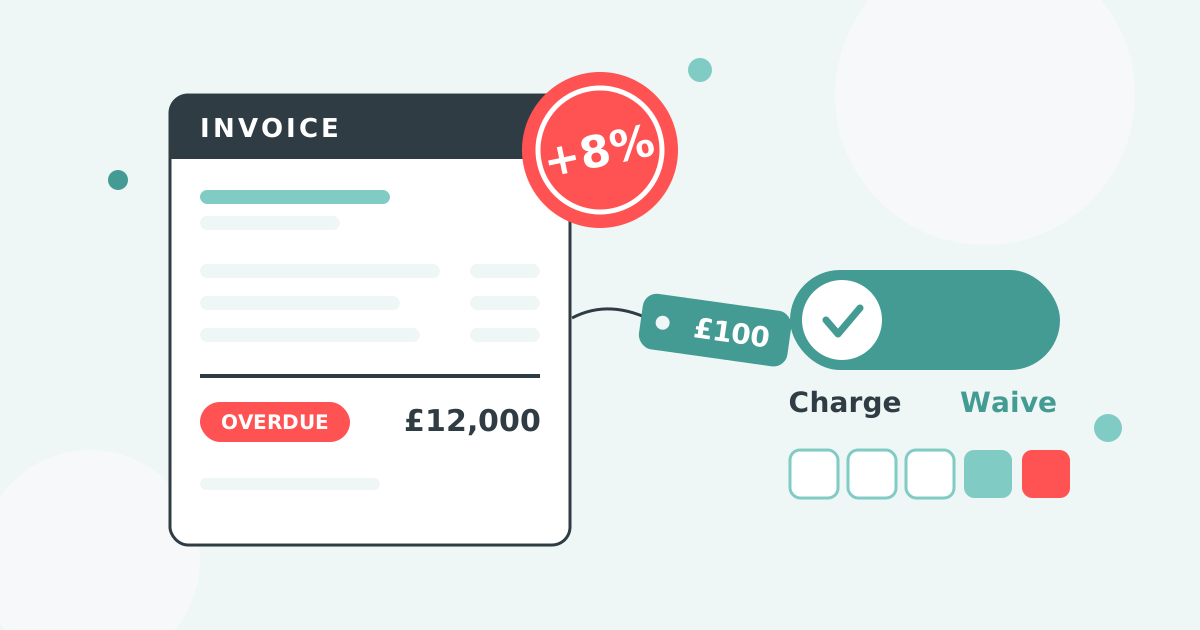
UK businesses can charge statutory interest of 8% over the Bank of England base rate on overdue B2B invoices under the Late Payment of Commercial Debts (Interest) Act 1998, plus a fixed £40, £70 or £100 sum by debt size, with no contract clause needed. In the US, Australia and New Zealand the right is contractual only.
A UK supplier of goods on B2B credit terms can charge statutory interest at 8 percentage points over the Bank of England base rate, plus a fixed sum of £40, £70 or £100 on each overdue invoice by its size, whether or not the contract says so. The rate does not move once it has been set for a debt, which is why one ledger can carry two of them.
The basics, the fixed-sum bands and a calculator are in late payment fees in the UK, and the ceiling is answered in how much can I charge for late fees. The Small Business Commissioner publishes a free interest calculator for a single invoice.
Four boundaries first.
Three points then matter more when you sell goods than when you sell time.
Yes. A single aged debtors report can carry two statutory interest rates at the same time, because each invoice keeps the rate set at the reference date before its interest started to run, and that rate is then held for the life of the debt.
Almost nothing on page one says so. The government's own guidance states only that statutory interest is "8% plus the Bank of England base rate", with no reference date and no fixing rule.
The rule sits in article 4 of the Late Payment of Commercial Debts (Rate of Interest) (No.3) Order 2002. It sets the rate from the official dealing rate on "the 30th June (in respect of interest which starts to run between 1st July and 31st December) or the 31st December (in respect of interest which starts to run between 1st January and 30th June)".
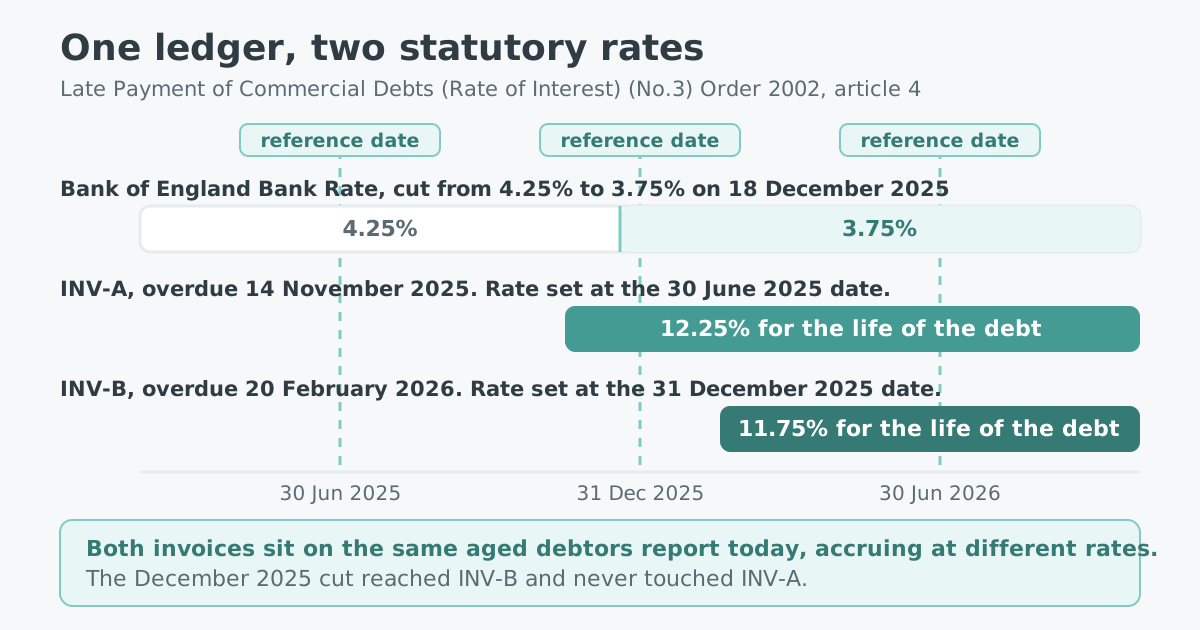
Here is what that does to a ledger. Two invoices to one builders merchant, both £12,000, both 100 days past due today.
The arithmetic:
Recalculate the whole report at today's 11.75% and you get £772.60, understating the claim by £16.44 on one pair. Across several hundred the error is systematic, always in whichever direction the Bank last moved.
Both rates come from HMRC's statutorily linked rates, where late payment interest is Bank Rate plus 4. Bank Rate has stood at 3.75% since 18 December 2025, and HMRC's linked rate followed on 9 January 2026 at 7.75%. Before that it was 8.25% from 28 May 2025, putting Bank Rate at 4.25% on the 30 June 2025 reference date.
Check the current figure on the Bank of England page for the reference date you need, not for today.
The two invoices carry £989.04 between them. UK wholesale ran a 13.60% gross margin proxy in 2024 on the ONS Annual Business Survey, though fuels wholesaling drags that down and a typical non-fuel wholesaler runs nearer 17.74%. Even at the higher figure, £989.04 ÷ 17.74% is the gross profit on £5,575 of replacement sales.
What those days cost across the whole ledger is the subject of debtor days for wholesalers.
The version we see most on demo calls is a spreadsheet that recalculates every open invoice at today's base rate. It looks tidy, and it is wrong on every debt that started running in an earlier half-year.
The fixed compensation sum under section 5A stacks per overdue invoice rather than per customer, sits outside the scope of VAT, and can be claimed for six years, including on invoices that were paid late and are now settled.
It stacks per invoice, not per debtor. Entitlement arises each time statutory interest starts to run, and it runs on each qualifying debt, so weekly delivery means one fixed sum per unpaid invoice.
Take twelve unpaid deliveries of £4,200, a £50,400 balance. Each sits in the £1,000 to £9,999.99 band, so each carries £70. That is 12 × £70 = £840, against the £100 you would claim if the balance arrived as one debt.
On a statement-traded account the per-invoice point moves the conversation further than the interest does. A credit controller who thought the argument was worth £100 finds it is worth £840 plus interest, which is a number the customer's own finance director will act on.
It carries no VAT. HMRC's guidance is that "no tax is due, however, on any interest awarded or agreed because of the late payment", at VATSC06810. Both are outside the scope of VAT, so raise the line with no VAT rather than at a zero rate.
It can be claimed after the fact. The right accrued when the invoice went overdue, and a claim on a simple contract runs for six years from that point. Paying the principal late does not extinguish what accrued along the way.
So a customer who has paid three weeks late for four years is a real claim. Raising it is a commercial decision, not a legal one.
The 60-day ceiling on UK B2B payment terms commences no earlier than 2027. On 24 July 2026 the government confirmed a 60-day statutory maximum on B2B payment terms, mandatory statutory interest, and commencement no earlier than 2027.
The confirmations are in the government response, and the legislation carrying them is in the Commercial Payments Bill explained. Four points change how to draft terms now.
So 60-day terms are legal today under section 4(2E), and longer only where the date is not grossly unfair. What changes is that 60 becomes a hard edge, so the accounts to look at now are the ones at 75 or 90. Setting terms account by account is covered in credit control for wholesalers.
Yes, but only by contract. Of the United Kingdom, United States, Australia and New Zealand, only the UK gives a supplier an automatic right to interest on an overdue trade debt. In the other three the late fee exists only because signed terms say so.
| United Kingdom | United States | Australia | New Zealand | |
|---|---|---|---|---|
| Statutory B2B interest | Yes, automatic from the due date | None for private trade | None | None before judgment |
| Basis of a late fee | Statute, plus contract | Contract only | Contract only | Contract only |
| Rate in practice | 11.75% where interest starts in 2026, plus £40, £70 or £100 per invoice | 1% to 1.5% a month, the cited norm | Whatever the terms set, if proportionate | Whatever the terms set |
| The limit | The statutory rate itself | State usury law, with the time-price doctrine in play | Penalties doctrine, Paciocco | Penalties doctrine, unfair terms |
| Must pre-exist the shipment | No, automatic | Yes, in signed terms | Yes, unfair-terms compliant | Yes, unfair-terms compliant |
| Payment-times register | Yes, for large buyers | None | Yes, Payment Times Reporting | None, the 2023 Act was repealed |
There is no federal right to interest on a private trade debt. The Prompt Payment Act binds federal agencies only, and state prompt-pay statutes are almost all construction-specific. A distributor on open account gets nothing from either.
The service charge must be agreed in writing before shipment, and be reasonable. The norm cited across US practitioner sources is 1% to 1.5% a month. At 1.5% that is 18.0% a year simple, or 19.56% compounded monthly, so terms saying "18% APR" while compounding describe something the invoice does not do.
State usury caps are the ceiling and they are not uniform. New York is the one position fully sourced here: a corporation cannot plead usury under GOL section 5-521, leaving criminal usury at 25% a year under Penal Law section 190.40. Figures for other states did not survive checking, so take local advice.
Australia gives a supplier no statutory right to interest on an overdue commercial debt, and the Supplier Pay On-Time or Pay Interest Policy reaches Commonwealth contracts only.
A contractual fee has to survive the penalties doctrine as restated in Paciocco v ANZ in 2016. A clause is a penalty where the sum is out of all proportion to your legitimate interests, judged on the facts known when you contracted. A fee sized to the real cost of carrying overdue debt is defensible. One retrofitted after a default is not.
The bigger exposure sits elsewhere in the same document. Since 9 November 2023 unfair terms in standard-form small business contracts are illegal and civilly penalizable rather than merely voidable, and a credit application is standard-form. Suppliers to the majors also sit under the Food and Grocery Code, mandatory since 1 April 2025, which governs conduct but grants no interest.
New Zealand is the only one of the four markets with neither statutory interest nor a payment-times register. The Business Payment Practices Act 2023 was repealed on 8 March 2024, before its disclosure duties took effect.
Interest arrives only once you sue, under the Interest on Money Claims Act 2016, at a term-deposit-linked rate calculated daily. The pre-litigation pressure a New Zealand wholesaler can apply is entirely what its own terms create.
Standard-form B2B contracts under NZ$250,000 a year fall under the unfair contract terms regime, covering most trade accounts. Suppliers to Foodstuffs and Woolworths NZ also sit under the Grocery Supply Code, in force in its 2025 form from 1 May 2026. It requires a reasonable payment time and written consent before deductions, but again no interest.
Once a UK customer enters a relevant insolvency procedure you cannot make payment of pre-appointment arrears a condition of continued supply, and you cannot terminate because of the insolvency itself.
The provision is section 233B of the Insolvency Act 1986, inserted by section 14 of the Corporate Insolvency and Governance Act 2020. Subsection (3) kills the insolvency-triggered termination clause. Subsection (7) is the one that catches wholesalers.
It says the supplier "shall not make it a condition of any supply of goods and services" after the insolvency starts "that any outstanding charges in respect of a supply made to the company before that time are paid". Stopping the lorries until the old account is cleared is now unlawful.
Termination remains possible with the office-holder's consent or the court's permission on hardship grounds, and neither arrives inside the hours a delivery decision takes.
Interest and compensation on the pre-appointment invoices still accrue, but they join the same unsecured claim as the principal. That is the argument for the controls that run earlier: the order gate, and retention of title and deductions.
No. Xero has no late fee or interest setting, so statutory interest is either calculated and added by hand, as an interest line on the overdue invoice or a separate interest invoice to the same contact, or raised by an app connected to the ledger. The Xero Product Ideas request for interest on late invoices dates from 29 March 2012, holds 1,114 votes, and Xero's last response on 7 July 2025 gave no committed plans.
Xero flags the invoice as overdue and does nothing further. By hand, for a wholesaler with dozens of deliveries a month, the separate interest invoice is the only workable route.
The two manual methods are in add late payment fees in Xero. QuickBooks Online has no statutory interest feature either.
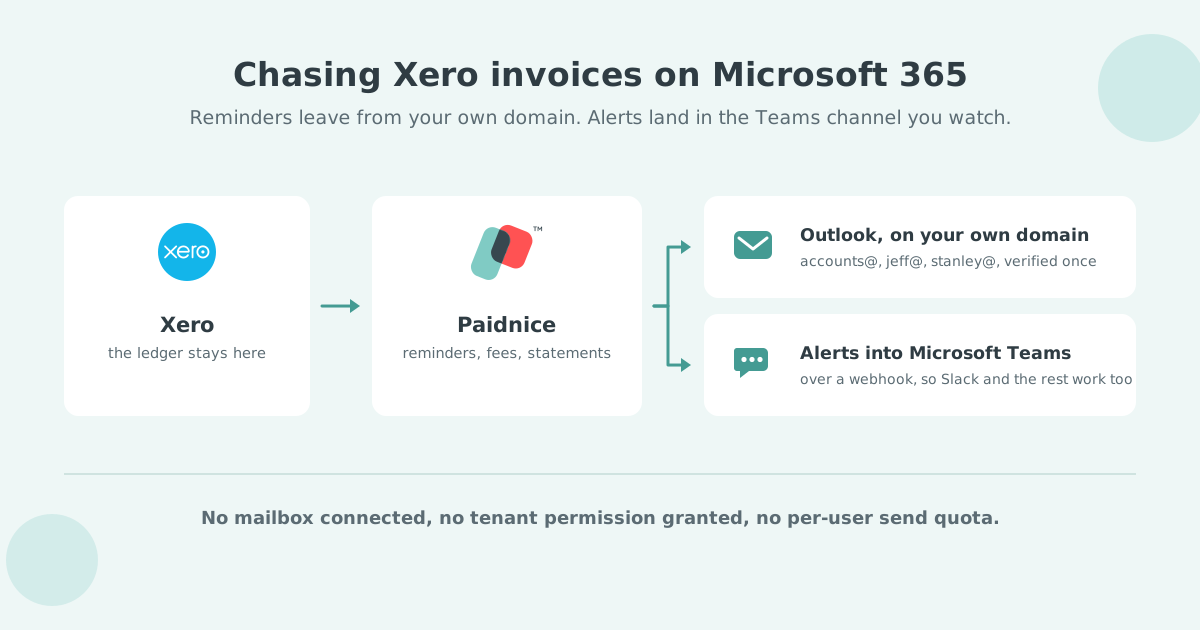
Paidnice connects to the Xero or QuickBooks Online organisation, runs one late fee policy per customer group, and raises the interest and the fixed sum on the ledger as a Draft or Approved invoice, so the charge enters the customer's payables system rather than an email. Doing this by hand across hundreds of invoices, each on its own locked rate, is why most wholesalers never charge interest at all.
Two charge types matter to a goods supplier, and both run on the same customer group: a per-invoice late fee, the natural home for the £40, £70 and £100 fixed sums at one per unpaid delivery, and statement interest, charged on the customer's whole overdue balance and prorated by the day. To set the UK statutory rate:
Statement interest recalculates at send, so the figure a customer opens is accurate that morning, not left over from the last policy run. Customers cut their average wait for payment in half, within 30 days. Pricing is by invoice volume, from £49 / US$69 a month for 150 invoices, Pro from £74 / US$99, no per-seat fees.
For a one-off figure, use the UK statutory interest calculator. For the category, see the best credit control software for wholesalers.
Can two invoices to the same customer carry different statutory interest rates?
Yes, and on an active trade ledger they usually do. The rate is fixed from the Bank Rate in force at the 30 June or 31 December reference date before interest started to run, so invoices overdue either side of that date accrue differently for as long as they stay unpaid.
Does my rate change when the Bank of England moves the base rate?
No. The reference rate is the one in force on 30 June for debts where interest starts between 1 July and 31 December, and on 31 December for debts starting between 1 January and 30 June, then fixed for the life of that debt. A change in between feeds the next reference date only.
Can I claim the fixed sum on every invoice, or only once per customer?
On every qualifying overdue invoice. Entitlement arises each time statutory interest starts to run, so twelve unpaid weekly deliveries of £4,200 carry twelve sums of £70, which is £840 rather than £100.
Are 60 day payment terms legal?
Yes. A private business purchaser can agree a payment date up to 60 days under section 4(2E), and longer only where the agreed day is not grossly unfair. The government confirmed on 24 July 2026 that a 60-day statutory maximum will apply, with limited exemptions and commencement no earlier than 2027.
Can you legally charge interest on overdue invoices without a clause in the contract?
In the UK, yes, on any B2B or public sector invoice, because the Late Payment of Commercial Debts (Interest) Act 1998 implies the term. In the US, Australia and New Zealand, no: the right exists only where signed terms set the rate before the goods ship.
Can I charge interest on an invoice that has already been paid?
Yes, if it was paid late. The right accrued when the invoice went overdue, and a claim on a simple contract runs for six years, so paying in full later does not wipe out what accrued. Raise it as a separate charge showing the rate, the days and the fixed sum, with no VAT.
Paidnice is accounts receivable automation that enforces your payment terms, trusted by thousands of businesses on Xero and QuickBooks. Credit control and debtor management, run for you.
Try it Now - It's FreeNo card required.


Optimize your cash flow with our suite of financial tools designed for AR professionals. Calculate DSO, aging analysis, late fees, and more.