


A customer payment plan splits an invoice into scheduled installments the customer commits to in writing. Done well, it wins work you would otherwise lose and rescues invoices that would otherwise go bad. Done casually, it turns you into an interest-free lender with none of the paperwork. This guide covers when plans make sense, when to say no, the deposit and schedule maths, the industries where they demonstrably work, and how to run them on Xero or QuickBooks without chasing anyone.
A payment plan is an agreement to pay one invoice in scheduled parts: a deposit, then installments on fixed dates, usually collected automatically. The invoice stays whole in your ledger; the payment is what gets split.
Three neighbors get confused with it. Progress billing invoices work in stages as it is delivered, which is a billing structure, not a plan. Buy now, pay later (Affirm, Klarna, Afterpay) is third-party financing at checkout: the provider pays you up front, charges you a fee, runs a credit check on your customer, and carries the risk. And a subscription is simply recurring billing for recurring service. The distinction matters because most advice on this topic quietly assumes you sell sneakers at an online checkout. If you invoice clients for services on Xero or QuickBooks, the checkout playbook does not fit, and this guide is written for you.
Because waiting for full payment is already costing you. In the US, small businesses wait 28.8 days on average to be paid and invoices arrive 9 days late (Xero Small Business Insights, March quarter 2026); Intuit's July 2026 research puts 59% of US small businesses holding invoices more than 30 days overdue, with an average of $17,700 USD tied up. Atradius' 2025 barometer found 43% of US B2B credit sales are paid late. Country by country payment speeds are on our accounts receivable statistics page; none of them make comfortable reading.
A structured plan converts that ambient lateness into scheduled cash. The direct evidence:
There is a psychology under those numbers. Prelec and Loewenstein's mental accounting research (Marketing Science, 1998) showed people feel the pain of paying, and structuring payments changes willingness to buy. A 2021 study found simply framing installments as interest-free tripled uptake of financing for a large purchase, from 12.4% to 38.6%. Installments are not a discount, but to the customer they can feel like one. That is leverage you can use without giving a single dollar away.
The case against is just as real, and almost nobody publishing on this topic writes it down. Practitioners do: the small business forums are full of owners who "got burned twice having to chase after clients". Four situations where the right answer is no:
No deposit means no plan. A customer who cannot fund 20% today is not a payment plan candidate, they are an unsecured credit risk asking for terms. Offer a smaller scope instead of a longer schedule.
Thin margins cannot fund float. A plan is you financing the customer. On 15% margins, one default eats the profit of six completed plans. Price the plan (a small establishment fee, or interest) or keep plans for high-margin work.
Work already delivered, leverage already gone. Plans agreed before delivery carry a natural enforcement lever: the work can pause. Retro-fitted plans on delivered work rely entirely on the paperwork, which is why the deposit, autopay, and acceleration rules below stop being nice-to-haves and become the whole game. That scenario has its own playbook: payment plans for overdue invoices.
Consumers at scale is a regulated lane. In the US, regularly offering consumers credit in more than four installments can make you a "creditor" under Regulation Z, with formal disclosure duties; B2B credit is exempt. Similar splits exist elsewhere (Australia's National Credit Code covers personal-purpose credit, not business credit). Details and primary sources are in the agreement template guide.
Seven questions separate a good plan from a future bad debt. Score honestly.
The defaults, and the reasoning. Adjust the numbers, keep the shape.
Deposit first: 20 to 50%. Toward 20 to 30% when rescuing an overdue balance, toward 50% when agreeing a plan on new work. The deposit is paid on signing, counts as installment one, and its arrival is the signal the plan is real.
Short beats long. Two to six installments, term inside six months, three for overdue balances. Every extra month is another month for your customer's circumstances to change. If the balance cannot clear in six months at a payable installment, you are pricing a loan, not a plan.
Exact dates, uneven amounts allowed. "The 1st of each month, September to December" is enforceable; "monthly" is a debate. Amounts do not need to be equal: a fixed weekly amount with a final settlement payment for the remainder is a perfectly good schedule, provided it is written down.
Autopay is a condition, not a preference. Card or direct debit authority signed with the agreement. Plans that rely on the customer pushing a button each month fail at the exact moment the customer gets busy or broke, which is the moment you built the plan for.
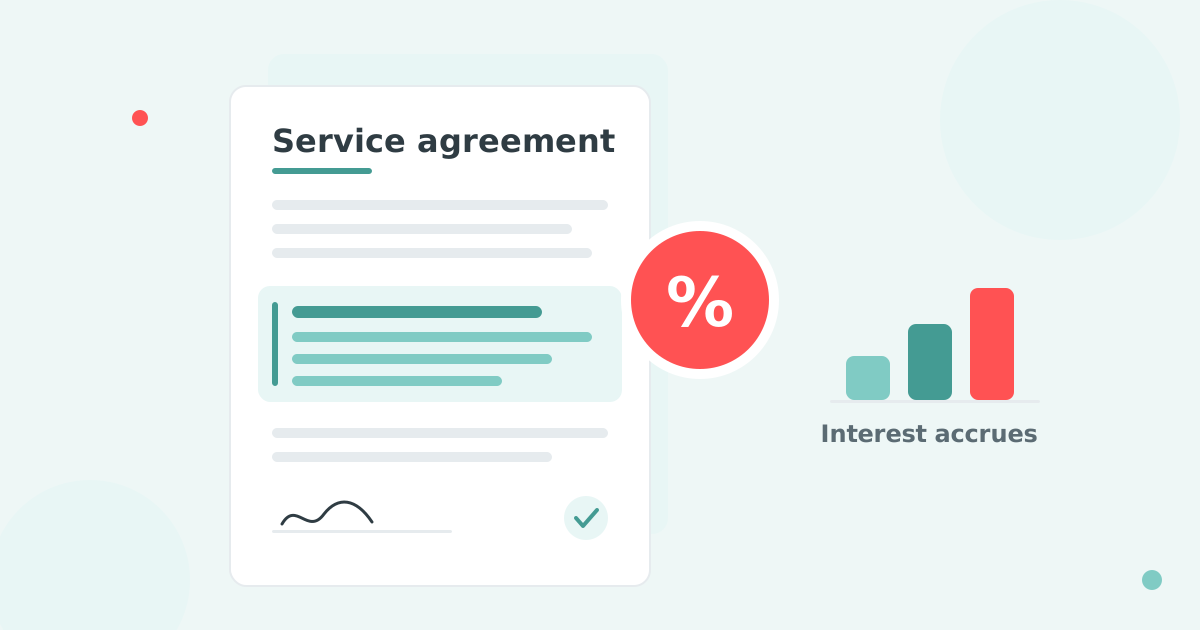
Keep fees and interest alive. The plan reschedules the debt; it does not put your late fee policy to sleep. A missed installment should cost something, and in the UK statutory interest (8% plus the Bank of England base rate, 11.75% as of July 2026) applies to late commercial payments whether or not you wrote a clause.
A worked example. A $12,000 USD invoice: $3,000 deposit on signing, then $1,500 on the 1st of each month for six months. Deposit lands day one, autopay runs the rest, the final installment settles the balance. Your exposure never exceeds $9,000 and falls every month.
Eight clauses do the work: parties and invoice references, acknowledgment of the balance, the deposit, the schedule table, autopay authority, late installment fees and interest, acceleration on default with a short cure window, and costs of recovery. The acknowledgment matters most: signed once, it removes the "we were never happy with the work" defense forever. The agreement template has all eight drafted, explained, and free to download with a schedule builder.
Plans work where invoices are large relative to the customer's monthly cash, delivery is ongoing or relationship-based, and the seller holds some leverage. The evidence by industry:
| Industry | Fit | Typical structure | The evidence |
|---|---|---|---|
| Legal | Strong | Deposit plus monthly installments; average installment around $300 | Firms offering plans earn 49% more revenue per lawyer; about 30% of firms still offer none (Clio) |
| Accounting & bookkeeping | Strong | Annual fees spread monthly, agreed in the proposal | 94% of US firms chase late payments and 80% find it awkward (Ignition); spreading fees removes the conversation |
| Agencies & consulting | Strong | Deposit, then monthly across the engagement; pause-work clause | Retainer-shaped cash flow suits schedules; the pause lever keeps plans honest |
| Education & training | Strong | 3 to 6 installments per term, enrollment fee up front | Up to 98% of US colleges run tuition plans, used by around 3 million students a term (CFPB) |
| Healthcare, dental & vet | Strong, consumer rules apply | Fee-free short plans; third-party financing for long terms | 46% of US consumers have used a payment plan for a medical bill (InstaMed); 74% of pet owners hit unexpected costs over $250 (Synchrony, 2025) |
| Trades & construction | Partial | Progress billing first; plans for the final balance or overruns | Slow payment costs US construction an estimated $299B a year (Rabbet); staged billing is the norm, plans mop up the tail |
| Wholesale & distribution | Partial | Trade terms and credit limits first; plans for arrears only | Terms are the industry standard; a plan is the arrears tool, not the sales tool |
| One-off low-ticket sales | Poor | Not worth the admin below a few hundred dollars | The overhead of agreement plus collection exceeds the margin; use card payment or BNPL at checkout instead |
The other fork in the road: run the plan yourself, or hand it to a financing provider.
| Approach | Cash timing | Cost to you | Who carries risk | Best for |
|---|---|---|---|---|
| In-house plan on the invoice | Deposit now, installments over the term | Processing fees, or a flat software subscription | You, controlled by deposit, autopay, and acceleration | B2B services on Xero or QuickBooks, repeat clients, balances over a few thousand |
| BNPL at checkout (Affirm, Klarna, Afterpay) | Full amount up front, next day | Roughly 2 to 8% per transaction | The provider | Consumer-sized one-off sales, typically under $30,000 USD, US-centric |
| Financing partner (QuickFee, Resolve and similar) | Full amount up front | Transaction and program fees | The lender | High-ticket professional services financing over 12+ months |
| Progress billing | Per stage delivered | None | Shared, stage by stage | Project work where scope is staged anyway |
Every failure mode in this guide is an execution failure. The schedule nobody reminded anyone about. The installment that needed a manual card charge. The missed payment nobody noticed for three weeks. Advice on this topic always ends with "automate it", then stops before saying how.
Here is how it works in Paidnice. You pick the invoice in Xero or QuickBooks Online, set the deposit and the schedule (any frequency, uneven amounts and a final settlement payment included), and the plan is written onto the invoice and the customer's PDF. Installments auto-charge through Stripe or Pinch Payments under the customer's signed authority, reminders run before and after every installment from your own domain, late fees apply to misses if that is your policy, and every payment reconciles back to the ledger. Customers can also self-serve a plan from the payment portal inside rules you set. It is the difference between offering payment plans and administering them: businesses on Paidnice cut their average wait for payment in half within 30 days, and the pattern across our customer stories is the same one this guide teaches, structure plus automation, from the bookkeeping firm that halved a six-figure overdue book to the events company that took late payments from one in five to zero. Payment plans are included on Pro plans, from US$99 a month.
Yes. Any business can agree to accept an invoice in installments; no license is needed for ordinary B2B arrangements. Put the schedule in a signed agreement, take a deposit, and collect by autopay. If you regularly finance consumers over more than four installments, check the credit rules for your market first.
A signed payment plan agreement is an enforceable contract. The clause that does the heavy lifting is the customer's written acknowledgment of the balance, which prevents later disputes about the underlying debt. A verbal "pay when you can" is binding on nobody, which is rather the point of writing it down.
20 to 30% on an overdue balance, up to 50% on new work. The deposit is your commitment test: research and practitioner experience agree that plans without one fail at several times the rate of plans with one.
Optional on B2B plans, and many businesses waive it inside short terms as a goodwill gesture while keeping late fees live on missed installments. In the UK, statutory interest of 8% plus the Bank of England base rate applies to late commercial payments regardless. Consumer plans with interest can trigger credit regulation, so take advice there.
The agreement should answer this before it happens: a failed payment is retried, a late fee applies, and if the miss is not fixed within a short cure window (seven days is typical), the whole remaining balance falls due. The step-by-step protocol is in our overdue invoices guide.
Each piece below stands alone; together they cover the whole system.
Paidnice is accounts receivable automation that enforces your payment terms, trusted by thousands of businesses on Xero and QuickBooks. Credit control and debtor management, run for you.
Try it Now - It's FreeNo card required.
Optimize your cash flow with our suite of financial tools designed for AR professionals. Calculate DSO, aging analysis, late fees, and more.