
Summary
The best credit control software for a UK small business depends on your ledger. Paidnice suits Xero and QuickBooks Online businesses that want statutory interest on the ledger, from £49 a month. Chaser suits firms past £4m turnover that want credit checks, from £199 a month. Satago suits Sage 50 or Xero businesses that want credit scores, from £25.
- Paidnice: Best for UK statutory interest and late fees applied automatically per customer group on Xero or QuickBooks Online, from £49 a month for 150 invoices and 2 users, priced by invoice volume, not turnover.
- Chaser: Best for firms past £4m turnover that want credit checks, letters and calls alongside chasing, from £199 a month, priced by turnover band.
- Satago: Best for Sage 50 or Xero businesses that want credit scores and invoice finance alongside chasing, from £25 a month inside Sage 50 or £45 standalone.
- Credit Hound: Best for Sage sites where disputes hold up cash, from £20 per user a month on Sage 50 or £51 for the first user on Xero.
Written for the person who does the chasing in a UK business: usually the owner, sometimes the one bookkeeper, on Xero, QuickBooks Online or Sage 50. If you have a finance team and a credit controller, credit control software compared is the better page. If your bookkeeper or accountant runs the chasing for you, see the best credit control software for accountants.
What is credit control software?
Credit control software connects to your accounting ledger, reads what is overdue, and chases it on a schedule you set. It is also sold as debtor management software.
Five capabilities define the category: automated reminders, escalation when they are ignored, a customer portal, dispute tracking, and risk data on how a customer pays. In the UK a sixth matters: whether the tool can charge the statutory interest the Late Payment of Commercial Debts (Interest) Act 1998 already entitles you to, at 8% above the Bank of England base rate.
The UK is the slower end of the scale. Xero Small Business Insights tracks how long UK small businesses wait for payment.
Source: Xero Small Business Insights, June 2026. See the full data on the Paidnice accounts receivable statistics dashboard.
Credit control software is bought to close the gap between the terms on the invoice and the line above. See current UK payment times by industry for your own sector.
What is credit control in the UK?
Credit control in the UK is the process of getting customers to pay on the terms they agreed, from the credit check to the final demand. It covers checking credit before you extend terms, invoicing with a clear due date, chasing on a schedule, charging the statutory interest and fixed sum the 1998 Act allows, and escalating to a formal demand or a collections partner. The Fair Payment Code, which replaced the Prompt Payment Code in January 2025, asks signatories to pay small suppliers within 30 days, with its Gold tier set at 95% of all invoices paid within 30 days (Office of the Small Business Commissioner), while construction and recruitment still run 60 and 90 day accounts. Credit control software automates the middle of that process, the chasing and the charging, on top of the ledger you already keep. The general definition, outside the UK rules, is in what is credit control.
What does credit control software do?
Credit control software does five jobs: reminders, escalation, a customer portal, dispute tracking, and risk data. What separates the tools is how many they automate.
- Automated reminders. Email, and sometimes SMS or letters, on a schedule that runs before and after the due date with the tone rising as the invoice ages.
- Escalation workflows. The overdue account moves from an accounts inbox to a named person, then to a director, then to a formal demand or a collections partner.
- A customer portal. One place your customer can see every open invoice and pay it, which removes the "please resend the invoice" round trip.
- Dispute tracking. A disputed invoice comes out of the chase sequence and into a queue with an owner, a reason and a follow-up date, instead of quietly stopping the whole customer.
- Risk data. Credit scores, credit limit suggestions and payment habit data on the customer, so you can price the risk before you extend the terms.
The number this category scores itself on is DSO, days sales outstanding, the average number of days it takes you to get paid. Hold every tool on your shortlist to it. Our guide to the dunning process covers how the reminder ladder is usually built.
Which credit control software is best for a UK small business?
Paidnice is the best fit for automating UK statutory interest and late fees on Xero or QuickBooks Online, Chaser for credit data past £4m turnover, Satago for credit scores and invoice finance, and Credit Hound for Sage sites where disputes hold up cash. Xero's built-in reminders cover a short overdue list. Entry prices run from included with your Xero subscription to £199 a month, counted in four different units.
Columns run left to right by entry price. That is not a ranking, and the cheapest column is rarely the right answer. Every figure traces to the vendor's own published material.
 Xero built-in Xero built-in |  Credit Hound Credit Hound |  Satago Satago |  Paidnice Paidnice |  Chaser Chaser | |
|---|---|---|---|---|---|
| Choose it when | |||||
| Best for | You chase under an hour a month | Your ledger is Sage and disputes are the bottleneck | You want credit scores, or invoice finance alongside | You use Xero as your ledger and you want accounts receivable automation | You are past £4m and need credit data at scale |
| The money | |||||
| Price from | Included | £20 per user | £25 Sage 50, £45 Xero | £49 | £199 |
| Priced on | Your Xero plan | Per user | Per company | Invoices a month | Company revenue |
| Invoices a month at entry | No cap | ⚠️ Not published | Unlimited on Sage 50, 100 emails on £45 Xero tier | 150 | No cap |
| Users at entry | Your Xero users | One per licence | Unlimited | 2 | 4 |
| Turnover gate | ✅ None | ✅ None | None published | Priced by invoice volume | Yes, £4m at £199 |
| The fit | |||||
| Size fit | Short overdue lists | Sage sites, any size | UK, any size | Any size up to $50m a year | £4m and above |
| Region | Global | UK led, six currencies | UK only | UK, AU, NZ, US, CA, ZA | UK led, global |
| Your ledger | |||||
| Xero | ✅ Yes | ✅ Yes | ✅ Yes | ✅ Yes | ✅ Yes |
| QuickBooks Online | ❌ No | ❌ None found | ✅ Yes | ✅ Yes | ✅ Yes |
| Sage 50 | ❌ No | ✅ Yes | ✅ Yes | ❌ No | ✅ Yes |
| What it automates | |||||
| Reminder sequences | ⚠️ Partial | ✅ Yes | ✅ Yes | ✅ Yes | ✅ Yes |
| Scheduled statements | ❌ No | ❌ None found | ✅ Yes | ✅ Yes | ⚠️ Partial |
| Payment plans | ❌ No | ❌ None found | ⚠️ Not documented | ✅ Yes | ✅ Yes |
| Customer payment portal | ❌ No | Pay links, £38 | ⚠️ Not documented | ✅ Yes | ✅ Yes |
| Credit checks on customers | ❌ No | ❌ None found | ✅ Yes | ⚠️ Creditsafe on Custom | ✅ Yes |
| UK statutory charges | |||||
| Interest at 8% above base | ❌ No | ❌ None found | ⚠️ Not documented | ✅ Yes | ✅ Yes |
| The £40, £70, £100 fixed sum | ❌ No | ❌ None found | ⚠️ Not documented | ✅ Yes | One rule only |
| Charge posts to the ledger | ❌ No | ❌ None found | ⚠️ Not documented | Xero and QBO | Xero only |
| Proof, and how to try it | |||||
| Rated | Not applicable | 5.0 from 11 Sage UK Marketplace reviews | ⚠️ Not documented | 5.0 from 83 Xero App Store reviews | 4.98 from 374 Xero App Store reviews |
| How you try it | Turn it on in Xero | Free trial, no card | No trial stated | 20 free actions, no card | 10-day trial after a demo |
Paidnice: best for UK statutory interest and late fees applied automatically per customer group, from £49 a month.
Yes The vendor documents the capability and we have read the documentation.
Partial It works, with a limit worth knowing before you buy. The limit is named in the cell or the tool notes below.
None found We read the vendor's product pages, feature lists and FAQs and the function does not appear in any of them.
Not documented Not documented by the vendor.
Paidnice
Paidnice: accounts receivable automation for Xero and QuickBooks Online, best for UK statutory interest and late fees posted to the ledger, from £49 a month.
Built in 2022 specifically to generate late fees, then grown into reminders, statements, payment plans, escalation and a customer portal. Pricing is on invoice volume: £49 a month for 150 invoices and 2 users, then unlimited users on every tier above.
Winner of Global Small Business App of the Year at the 2025 Xero Global App Awards, winner of New Zealand Small Business App of the Year at the 2026 awards, and a 2026 finalist in the UK. Rated 5.0 from 83 Xero App Store reviews. The platform has passed $1 billion collected on time across more than 1 million invoices since 2022.
Choose it when the charges have to land on the ledger, and you want statements, fees, payment plans and a portal inside one plan rather than as paid add-ons.
The limitation. Paidnice runs on Xero and QuickBooks Online only. If your ledger is Sage 50, Sage 200 or FreeAgent, we cannot help you. Three of the other four tools here run on Sage 50.
There is no credit checking either. If credit data on a new trade account is the primary job, Satago or Chaser is the buy. Below about an hour a month spent chasing, Xero's own reminders are the better answer and we will tell you so.
Chaser
Chaser: a UK credit control suite, best for firms past £4m turnover that want credit checks, letters and calls alongside chasing, from £199 a month.
The most established suite in this set, founded in 2014, and the deepest review base in the category at 4.98 from 374 Xero App Store reviews. It chases by email, SMS, letter and automated call, runs credit checking and monitoring as metered credits, and includes an integrated collections route.
Pricing is tiered on your company revenue: £199 a month up to £4m turnover, £599 up to £10m, and £899 for the top published tier, with a 10-day trial and a demo required before you can buy. Our Chaser alternatives guide covers the fit in more detail.
Choose it when you are past £4m turnover, credit checking matters as much as chasing, and you want letters and phone calls as well as email. At that size, credit control software for finance teams compares the tools built for a department.
The limitation. Pricing on company revenue rather than invoice volume means a low volume, high value business can land on the £599 tier for a handful of invoices a month.
The late fee is one global rule that cannot vary by customer group, it does not apply to payment-plan or partially-paid invoices, and the line-item sync is Xero only. Statements go monthly on a fixed day, with recipients and senders you cannot change.
Satago
Satago: UK credit control with credit risk data and invoice finance, best for Sage 50 or Xero businesses that want credit scores, from £25 a month inside Sage 50 or £45 standalone.
A UK hybrid: automated chasing and credit risk data on one side, invoice finance on the other.
Inside Sage 50 the embedded Credit Control and Risk Insights package starts at £25 a month for unlimited users, unlimited chasing and three full credit reports a year, with a Plus tier at £45 carrying 25 reports. The vendor states Plus is included with selected Sage 50 subscriptions, so ask your Sage account manager before you pay for anything.
On Xero or QuickBooks Online you are on the standalone ladder instead: Basic £45, Premium £80, Platinum £200 a month.
Choose it when you want credit scores and credit limit suggestions on your customers, or you want to finance an invoice as well as chase it.
The limitation. The £45 Basic tier caps you at 100 email reminders a month, which is the binding constraint on a chasing tool at that price. Satago is UK only, so a business with an Australian or US entity needs a second tool.
Satago does not document statutory interest, payment plans or posting a charge back to the ledger. Treat all three as open questions for the demo.
Credit Hound
Credit Hound: a Sage channel collections tool from Draycir, best for Sage sites where disputes hold up cash, from £20 per user a month on Sage 50.
A Sage channel collections tool from Draycir, in the market since 2002, built around structured dispute management and promise-to-pay tracking rather than around charging.
Pricing is published, which is rare in this channel: £20 per user a month on Sage 50 and Sage Accounting, £51 for the first user plus £35 for each user after on Sage 200 and Xero. The Sage UK Marketplace listing separately shows Credit Hound Professional from £39 a month, so confirm which price applies to you.
Choose it when your ledger is Sage, and disputes rather than reminders are what holds up your cash.
The limitation. It chases, it does not charge. No interest, no late fee, no fixed sum and no writeback of a charge to the ledger appears anywhere in the vendor's published material.
Payment is a separate £38 a month module and it is pay links rather than a portal, and there is no QuickBooks Online connector. Per-user pricing also scales badly: three people chasing on Xero is £51 plus £35 plus £35, so £121 a month, not £51.
Which credit control software works with Xero, QuickBooks Online and Sage?
Of the five UK credit control tools compared here, four run on Xero (Credit Hound, Satago, Paidnice and Chaser), three run on QuickBooks Online, three run on Sage 50, and only Satago and Chaser run on all three. Your accounting system removes most of the shortlist before price does.
- Xero. Credit Hound, Satago, Paidnice and Chaser all publish a Xero connector. Credit Hound's Xero tier is £51 for the first user, which makes it the most expensive entry point on Xero, not the cheapest.
- QuickBooks Online. Satago, Paidnice and Chaser. No QuickBooks Online connector appears in Credit Hound's published integration list.
- Sage 50. Credit Hound, Satago and Chaser. Paidnice does not connect to any desktop Sage product.
- FreeAgent. Satago publishes a FreeAgent connector. No FreeAgent connector appears in the published integration lists of the others.
Check the connector on the vendor's own integration page before you shortlist. A category page can name QuickBooks in its audience section and still recommend tools that have no QuickBooks connector.
If you are on Xero, our longer comparison of credit control software for Xero covers six tools against the same tests. If you run more than one Xero organisation, start with credit control across multiple Xero companies, because multi-entity pricing changes the answer.
Can credit control software charge statutory interest automatically?
Two of the five tools here apply the UK statutory rate of 8% above the Bank of England base rate automatically. One has no such function, one shows no evidence of it in any published material, and one leaves it undocumented.
The Late Payment of Commercial Debts (Interest) Act 1998 gives you an automatic right to interest at 8% above the Bank of England base rate on an overdue commercial invoice, whether or not your contract mentions it. You can also add a fixed sum for debt recovery costs: £40 on an invoice under £1,000, £70 from £1,000 to £9,999.99, and £100 at £10,000 and above.
The mechanic that catches people out is the fixing. The rate is set in six-month blocks by the base rate in force on 30 June and 31 December, and it holds for the whole block even if the Bank moves in between.
The Bank Rate on 30 June 2026 was 3.75%, so the statutory rate on debts becoming late between 1 July and 31 December 2026 is 11.75%.
Three questions to put to any vendor, in this order.
- Can it apply 8% above the Bank of England base rate without you retyping the rate every six months?
- Can it add the £40, £70 or £100 fixed sum on the same invoice, at the right band for the invoice value?
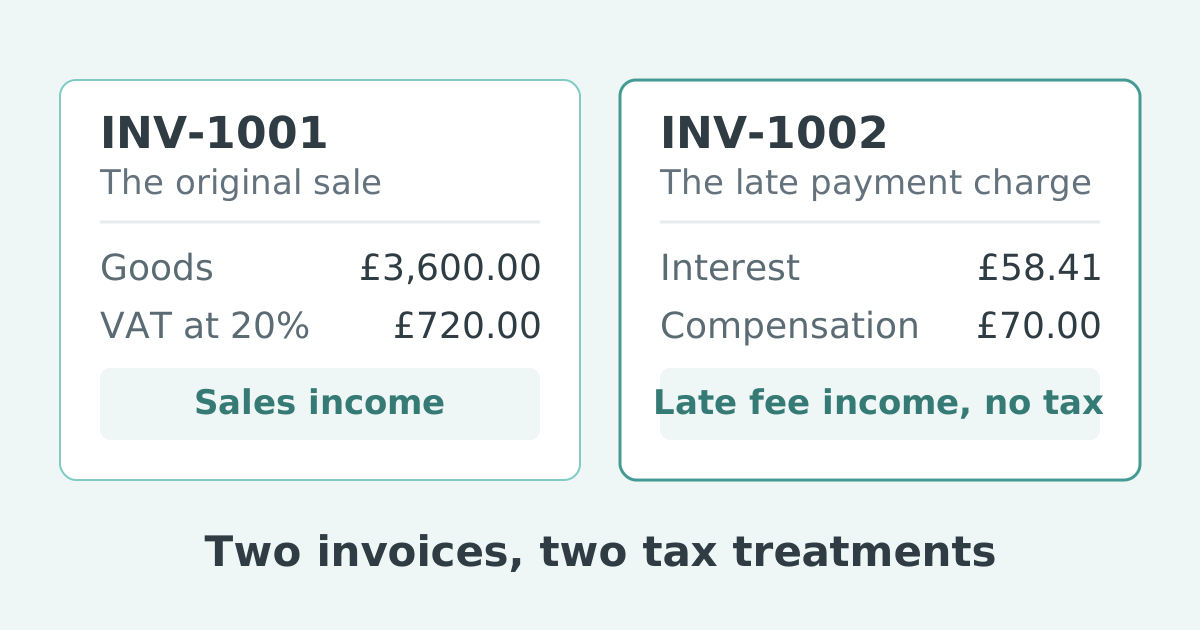
- Where does the charge land? A charge on a dashboard is a note. A charge posted to your ledger becomes a receivable, has a tax treatment, and enters your customer's accounts payable and their payment run.
The full arithmetic, with examples, is in our guide to late payment fees in the UK and in how much you can charge for late fees.
How many invoices a month justify credit control software?
About twenty overdue invoices a month is the point where credit control software costs less than chasing by hand: at eight minutes an invoice that is two hours forty of somebody's time, or £59 at £22 an hour fully loaded, against £49 for an entry tier. The longer comparison is in credit control software vs manual process.
Both figures are assumptions, so put your own minutes and your own hourly cost through the same arithmetic. Volume is the second thing to sort on, and only one of these five counts invoices at all, so the bands below use that ladder as the shape of the market rather than as the only route.
| Overdue invoices you chase a month | What to do about it |
|---|---|
| Under 20 | Stay on Xero's reminders and send a statement on the first of the month. A subscription costs more than the time it saves. |
| 20 to 150 | An entry tier does the job. Roughly £20 to £49 a month, depending on your ledger and your user count. |
| 150 to 300 | You have outgrown entry tiers. Expect £74 to £99 a month, and check the email allowance as well as the invoice cap. |
| 300 to 1,000 | £129 to £199 a month. Users included starts to matter more than the headline price. |
| Over 1,000 | Price on invoice volume rather than turnover, or a strong sales year moves you up a tier for no extra work. |
Volume is also why the delay costs more than it looks. On accrual accounting the VAT on an unpaid invoice is owed to HMRC whether or not your customer has paid, so every extra week of DSO is financed out of your own bank account.
What do Xero's built-in reminders do, and where do they stop?
Xero includes invoice reminders with your subscription: up to five emails on one organisation-wide schedule, fired at every invoice marked as sent. There is no interest, no statement schedule and no escalation to a named person.
The only balance control is a single checkbox that stops reminders below an amount you set, and it applies to all five reminders at once. Xero's own setup article points readers at the Xero App Store once they need more than that.
Interest is the clearest gap, and Xero's position on it is public. The request "Sales Invoices - Add interest to late invoices" was posted to the Xero product ideas board on 29 March 2012 and carries 1,114 votes, with the status Accepted.
Xero's Community Manager replied on 7 July 2025 that a team is considering how to solve it, that there are no committed plans, and pointed users at invoice template wording, manual line items or a third-party app.
Statements have the same shape: accurate in Xero, and sent by hand. Our guides to automatic customer statements in Xero and adding 30, 60 and 90 day ageing to Xero statements cover the workarounds and where they run out.
The limitation. Xero gives every customer the same schedule, with no interest, no statement schedule and no escalation to a named person. It is included with your subscription and it is enough while chasing is under an hour a month. Above that you are working around one schedule by hand.
How does Paidnice apply statutory interest and the fixed sum?
Paidnice charges UK statutory interest through its Bank of England base rate toggle, which adds your percentage to the base rate. It applies the correct rate for each period an invoice spans, so nobody retypes 11.75% in January.
The Paidnice base rate toggle has two modes. Lock fixes the base rate for each six-month period, as the Late Payment Order sets it: the rate in force on 30 June or 31 December applies for the next six months. Follow moves with the Bank of England base rate each time it changes. You can change your percentage at any time.
Two charge types run on the same customer group, which is unusual in this category.
- An invoice late fee, charged per overdue invoice. This is where the £40, £70 or £100 fixed sum goes, as a fixed amount line item with its own description and income account.
- A statement interest charge, charged per customer against the whole overdue balance, with the rate set as an annual percentage prorated per day or as a percentage of the balance at issue.
Three mechanics are worth knowing before you compare. Statement interest recalculates at the moment the statement is sent rather than at the last policy run, so the figure your customer opens is accurate that morning. Compounding is on by default, so simple interest is a deliberate choice you make. Where a customer holds a credit note, the charge is calculated on the net balance rather than the gross.
The charge posts into Xero or QuickBooks Online as a Draft or an Approved invoice, your choice, and a single disputed invoice can be excluded by reference without moving the customer out of the policy.
Ask every vendor on your shortlist to raise a late fee during the demo, then show you that fee sitting in your ledger as an approved invoice against the customer. Some tools show the fee only inside their own dashboard. A charge posted to the ledger enters your customer's accounts payable and their next payment run, which is where it does the work.
How do you try each tool before you pay?
Only one of the five UK credit control tools here, Credit Hound, offers a conventional free trial with no card and no obligation. Paidnice runs a free sign-up with 20 free actions, Chaser gates its 10-day trial behind a demo, and Satago and Xero offer nothing separate.
- Xero's built-in reminders. Already in your subscription. Turn them on under invoice settings and send a statement by hand for a month before you shop.
- Credit Hound. A free trial with no card details and no obligation to purchase. The vendor does not publish the trial length.
- Satago. No free trial is stated. Sign-up runs through the vendor's app, and on Sage 50 the first call should be to your Sage account manager to check whether Plus is already inside your subscription.
- Paidnice. There is no free trial. Signing up is free, the first 20 actions are free, there is no time limit and no credit card. Connect your ledger and watch what the first policy would have sent.
- Chaser. A 10-day trial, and a demo is required before you can buy.
Whichever you pick, run it against last month's real overdue list rather than a sandbox. The thing you are testing is whether the rules survive your actual customer mix. Trial terms across the wider market, and the settings to get right before anything sends, are in credit control software free trials, and the pricing models behind these plans in credit control software pricing.
What Paidnice costs, every tier
Paidnice runs from £49 a month for 150 invoices and 2 users up to £599 for 4,000 invoices, with unlimited users on every Pro tier and Custom from £749. Prices are hard-coded in each currency rather than converted.
| Plan | Invoices a month | Users | GBP | USD |
|---|---|---|---|---|
| Essentials | 150, with 600 emails | 2 | £49 | $69 |
| Pro 300 | 300 | Unlimited | £74 | $99 |
| Pro 600 | 600 | Unlimited | £129 | $179 |
| Pro 1,000 | 1,000 | Unlimited | £199 | $279 |
| Pro 2,000 | 2,000 | Unlimited | £349 | $489 |
| Pro 3,000 | 3,000 | Unlimited | £479 | $649 |
| Pro 4,000 | 4,000 | Unlimited | £599 | $799 |
| Custom | Above 4,000 | Unlimited | from £749 | from $999 |
| Multi-entity add-on | Per extra entity | Unlimited | £19 | $29 |
| SMS | Per message | Unlimited | £0.05 | $0.10 |
Email allowances scale with the tier, from 1,200 a month on Pro 300 to 24,000 on Pro 4,000. There are no per-seat fees on any Pro tier, and it is priced fairly, with no contracts or lock-ins. Verify current pricing on the Paidnice pricing page before you buy.
- Book a call and we will go through your overdue list with you and say which of these fits, including when it is not us.
- Start a free Paidnice account to test it on your own ledger. No card, and the first 20 actions are free.
- See what Paidnice does across reminders, statements, fees and payment plans.
Common questions
Ten questions UK buyers ask before they shortlist, answered against the same five tools.
What are the tools of credit control?
Credit terms and a signed agreement, credit checks before you extend those terms, invoices with clear due dates, automated reminders, customer statements, statutory interest and the fixed recovery sum, payment plans, and escalation to a demand or a collections partner.
How to keep track of customer payments?
Your accounting system is the record. Xero's Aged Receivables report tells you who is late and by how long. Credit control software sits on top of it, chases automatically and writes the payment back, so the ledger stays the single source of truth.
What is debtor management software?
The same thing as credit control software. Debtor management is the older UK term, credit control is the more common one, and vendors use both to describe a tool that connects to your ledger and automates chasing overdue invoices.
What is the best debt collection software?
Debt collection and credit control solve different problems. Credit control software works your ledger before an invoice goes bad. Debt collection software, or an agency, works accounts that have already failed. Most UK small businesses need the first and use the second rarely. The trade-off is set out in credit control software vs debt collection agency.
Which software is mostly used in finance?
For UK small businesses the ledger is almost always Xero, QuickBooks Online, Sage or FreeAgent. Credit control software is a layer on top of one of those, not a replacement, which is why the connector list decides your shortlist.
Is there free credit control software?
Not as a standalone product. Xero's reminders, statements and credit limits come with your subscription and cover a short overdue list. Satago states that its Plus tier is included with selected Sage 50 subscriptions, so a Sage 50 business should check before paying.
Does the late fee appear on the customer's account or as a separate invoice?
It depends on the tool. Paidnice raises it in Xero or QuickBooks Online as a Draft or Approved invoice against the customer, so it appears on their statement and enters their accounts payable. Some tools show the charge only inside their own dashboard.
Can credit control software handle payment plans?
Some can. Paidnice and Chaser both run instalment plans with payments taken automatically. Check how chasing behaves once a plan is live, because at least one tool chases against the original invoice due date rather than the instalment dates.
Does credit control software send SMS as well as email?
Paidnice charges £0.05 per SMS on top of the plan, Chaser meters SMS as credits, and Satago includes 100 SMS a month on its £80 Premium tier. SMS is worth turning on for the final reminder before escalation rather than for the whole ladder.
How much does credit control software cost in the UK?
UK credit control software costs between £20 and £199 a month at entry level. Paidnice starts at £49 a month, Credit Hound at £20 per user on Sage (£51 for the first user on Xero), Satago at £45 a month on Xero and Chaser at £199 a month. Xero's own reminders come with your Xero plan. Paidnice prices by invoices sent each month, Chaser by company revenue and Credit Hound per user.
How long does credit control software take to set up?
The connection is an OAuth login to your ledger and takes minutes. The real work is deciding your reminder ladder, which customers sit outside it and what your fee policy is, which is an afternoon with your aged receivables report open.

Stop chasing invoices.
Start getting paid.
Paidnice is accounts receivable automation that enforces your payment terms, trusted by thousands of businesses on Xero and QuickBooks. Credit control and debtor management, run for you.
Try it Now - It's FreeNo card required.