What is cash positioning?
Cash positioning is the practice of working out exactly how much cash a business has available right now, across every bank account, on a given day. It pulls together balances, cleared transactions and pending movements into one current view, so you know what you can actually spend or move today. Treasury teams often run it first thing each morning.
It matters because the cash on your bank dashboard is rarely the cash you truly have. Payments are in transit, direct debits are about to hit, and funds sit trapped in accounts you cannot draw on instantly. A clear cash position tells you what is genuinely usable, which is the difference between confidently paying suppliers and accidentally going overdrawn.
Cash you have today.It answers one question: how much usable cash do we hold right now, across all accounts.
Not the same as forecasting.Positioning is today's actual cash; forecasting predicts future cash. You need both.
Receivables drive it.The faster invoices are collected, the stronger and more predictable your daily position.
Cash positioning vs cash forecasting
Cash positioning shows the cash you have available today; cash forecasting predicts the cash you will have over the coming days, weeks and months. Positioning is a present-tense snapshot built from confirmed balances and known movements. Forecasting is forward-looking and built from assumptions about what will come in and go out. They answer different questions and work best together: the position tells you whether you can cover today, the cash flow forecast tells you whether you can cover the months ahead.
| Aspect | Cash positioning | Cash forecasting |
|---|---|---|
| Time frame | Today, right now. | The coming days, weeks and months. |
| Built from | Confirmed balances and known movements. | Assumptions about future inflows and outflows. |
| Question it answers | Can we cover what is due today? | Can we cover the months ahead? |
| The analogy | The speedometer: where cash stands this minute. | The route map: where cash is heading. |
A business that only forecasts can still be caught short by a payment it forgot was clearing; a business that only positions has no warning of a squeeze three weeks out. That is why most finance teams run both side by side.
How cash positioning works
Building a cash position is a short, repeatable routine: gather every balance, reconcile what is real, account for what is about to move, then read the net figure. Most teams run it daily, often before the morning starts.
Pull the opening balance from each bank account, currency and entity you hold cash in. Multi-account businesses do this through bank feeds or a treasury system.
Match cleared transactions and strip out anything still pending or in transit, so the figure reflects funds that have actually settled.
Add receipts confirmed for today and subtract payments due to clear, such as payroll, supplier runs and direct debits.
The result is your available cash today, often split into usable cash and amounts locked in restricted or non-operating accounts.
The hard part is rarely the arithmetic. It is getting timely, accurate data from every source. Manual spreadsheets pulled together from separate bank logins are slow and quickly go stale, which is why treasury management and accounting platforms that sync balances automatically have become the practical way to keep a position current.
Cash positioning example
A worked example shows why the headline bank balance can mislead. Say a business starts the day with 120,000 across two accounts. A 40,000 customer payment shows as received but has not cleared, so it is excluded. Payroll of 30,000 and a supplier run of 18,000 are both due to clear today, and 15,000 sits in a tax account that cannot be touched.
The available position is not 120,000. It is the 120,000 of settled cash, minus 30,000 payroll, minus 18,000 supplier payments, minus 15,000 of restricted tax money, which leaves 57,000 of genuinely usable cash for the day. The uncleared 40,000 only counts once it settles. A team reading the raw balance would think it had more than twice the cash it can actually spend, and that gap is exactly the risk cash positioning removes.
Why cash positioning matters for accounts receivable
Your cash position is only as reliable as your receivables, because money owed by customers is the largest variable feeding it. Every invoice still outstanding is cash you have earned but cannot yet position. When collections slow, your position weakens even though sales look healthy on paper, which is the classic profit-rich, cash-poor trap.
Faster collections, a stronger position
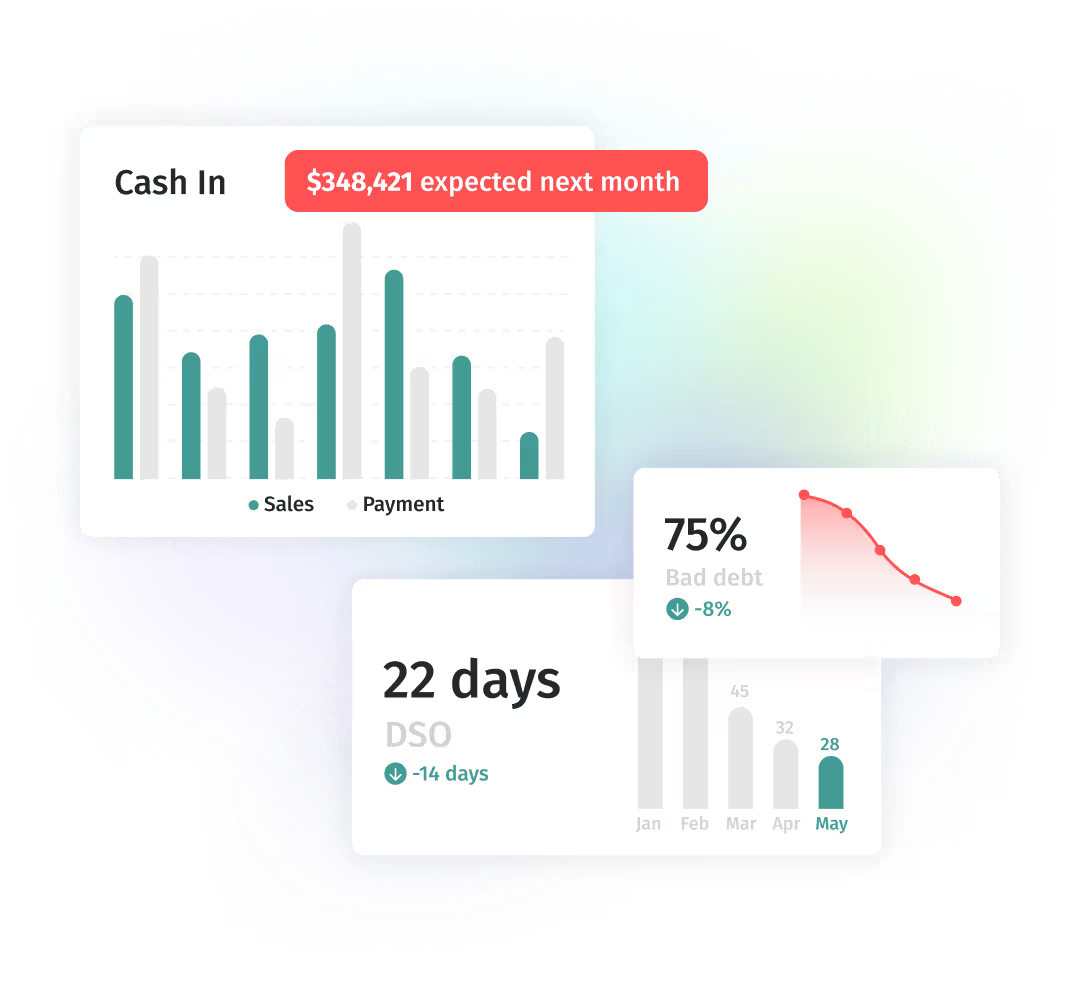
This is where AR discipline pays off directly. Shortening the time between issuing an invoice and banking the payment makes your daily position both larger and more predictable. Tracking days sales outstanding shows how long that gap runs, and live accounts receivable reporting lets you see expected receipts feeding into the position rather than guessing at them. Tightening collection is the most controllable lever a business has over its cash position.
Better receivables data, sharper timing
It also sharpens the position itself. When you know which invoices are due and how reliably each customer pays, you can place expected receipts on the right day with far more confidence than a flat assumption that everything arrives on its due date. A customer who always pays a week late should be modeled a week late. The closer your receivables data sits to your cash position, the less you are guessing and the earlier you can act on a looming shortfall, whether that means chasing a large overdue invoice or holding a discretionary payment for a few days.
How to improve your cash positioning
Good positioning is a habit, not a one-off. Run it on a fixed cadence, ideally daily, so the figure is always current rather than reconstructed in a panic. Centralize your bank feeds so balances arrive automatically instead of being keyed in by hand. Separate restricted cash, such as tax set aside or funds held in trust, from genuinely available cash so you never count money you cannot spend.
Then connect it to the front of your cash cycle. Speeding up collections feeds the position at source: automated reminders, easy payment options and clear terms all pull cash in sooner. The cash conversion cycle frames how positioning, collections and payables fit together, and pairing a daily position with a rolling cash flow projection gives you both today's reality and tomorrow's outlook in one view.
Common cash positioning mistakes
The most common mistake is treating the bank balance as the cash position, because the raw balance ignores payments about to clear and money that is restricted. A handful of recurring errors quietly overstate what you can spend.
Treating money that has not actually arrived as available leads to spending cash you do not yet hold.
Tax provisions or trust funds counted as spendable make the position look healthier than it is.
Decisions get made on a stale number that no longer reflects what cleared overnight.
Cash in a foreign account is not freely available until converted, and the rate moves while you wait.
The fix for all of these is the same. A consistent, automated routine that separates cleared from pending, usable from restricted, and refreshes on a fixed schedule. For multi-currency businesses, that means valuing each balance honestly rather than assuming instant access at a flattering rate.