

A free late fee calculator works out interest and any fixed compensation on an overdue invoice: the amount, times the annual rate, times days overdue, divided by 365. It will not apply the fee, raise the invoice, send it, or keep it accurate as interest accrues daily. That part is what gets you paid.
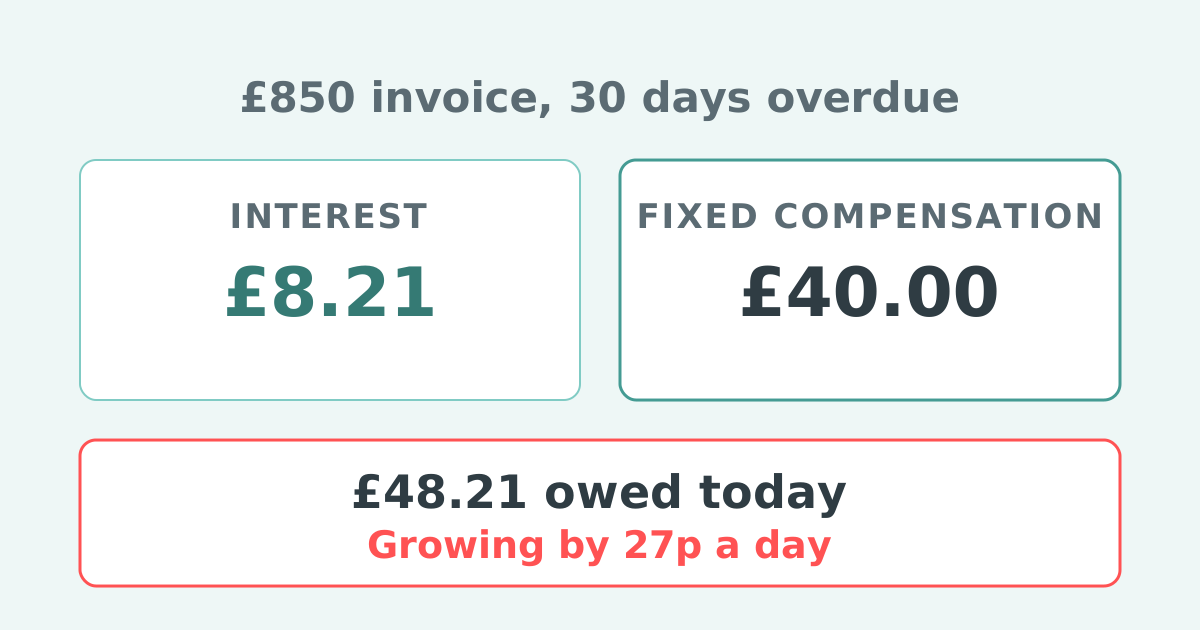
On an £850 invoice 30 days overdue under the UK statutory rate of 11.75%, you are owed £8.21 in interest plus £40 in fixed compensation, a total of £48.21 growing by 27p a day.
Pick your market, enter your own invoice, and the calculator shows what is owed today and what each further day adds.
UK statutory: Bank of England base rate plus 8%, fixed in six-month blocks, plus £40, £70 or £100 by invoice size. Verify the current base rate at bankofengland.co.uk.
Written out, so you can check the numbers.
An invoice of £850, 30 days overdue, under the UK statutory rate of 11.75% (Bank of England base rate plus 8%), with the £40 fixed compensation that applies to invoices under £1,000.
Look at the split. On this invoice the fixed charge is 83% of the late payment charge, and the interest is 17%. On small invoices the fixed compensation does almost all the work, which is why businesses that only charge a percentage rate find late fees are not worth the admin. If most of your invoices are under a few thousand, the fixed sum is the part that matters, and it is the part most people forget to claim.
The one above handles a single invoice in eight markets. For anything more, use the right specialist tool.
All three are free, with no sign-up. The full set of receivables tools is at paidnice.com/calculators.
Every calculator on the internet, including ours, stops at the same place. It gives you a number and does nothing with it.
That is not a criticism of calculators. It is what they are. The problem is that the calculation was never the hard part.
What separates businesses that collect on late fees is not the rate or the wording. It is whether the charge appears on every overdue invoice or only on the ones somebody got around to. A fee that shows up sometimes is read, correctly, as negotiable.
Your customer's accounts payable team processes thousands of invoices, and they learn quickly which suppliers have a system and which have a person who occasionally gets annoyed. Only the first group gets paid earlier. Consistent charging is also what shows up in your average wait for payment.
A good late fee policy applied when someone remembers collects less than a mediocre one applied every single time. Consistency is the mechanism, not the rate.
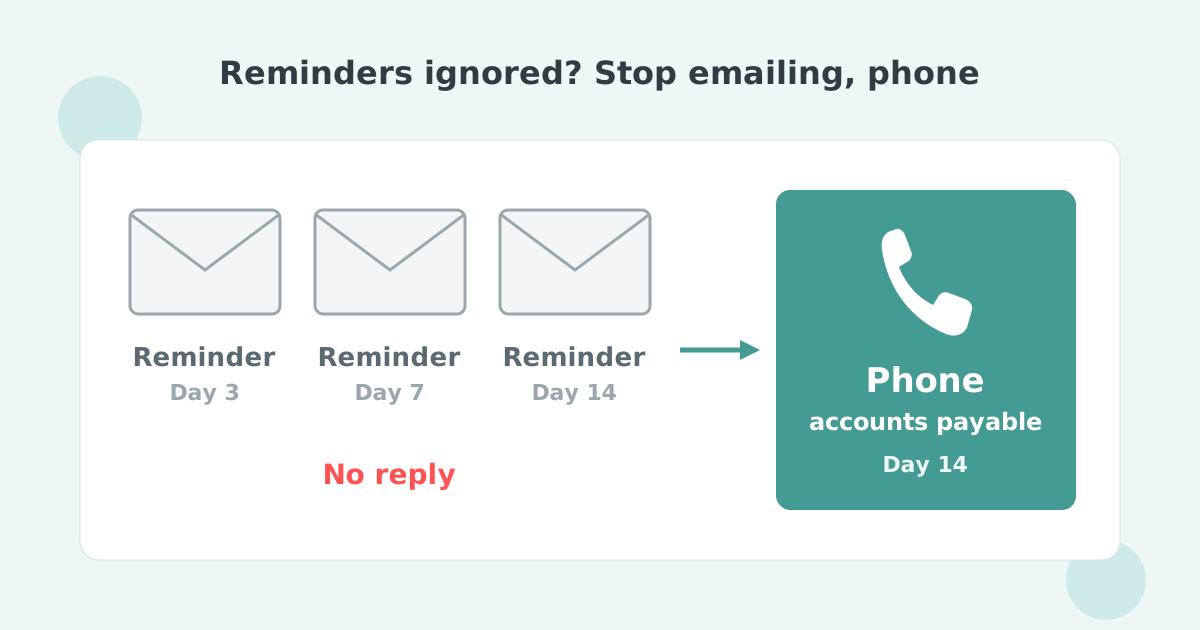
Which is the reason a calculator is not enough. Doing this by hand means someone sits down every month, works out the interest on each overdue invoice, raises each fee, sends each email, and then reverses the ones that get paid. In my experience that job survives a couple of months before something more urgent takes the morning.
Take the £850 above and follow it to the end, because the calculation is step one of five.
Five steps, on every overdue invoice, every month. That is the actual job.
The rate you can charge depends on whether your market gives you a statutory right or leaves it to your contract, and that split runs through all eight markets below.
| Market | Basis | Typical rate |
|---|---|---|
| UK | Statutory, automatic on B2B | Base rate plus 8%, plus £40, £70 or £100 per invoice |
| EU | Statutory, Directive 2011/7/EU | ECB reference rate plus at least 8 points, which is 10.40% for the second half of 2026, plus €40 minimum |
| US | Contractual, state usury caps | 1% to 1.5% a month |
| Australia | Contractual | No statutory rate. Around 10% a year is common practice |
| New Zealand | Contractual | No default in law. Set it in your terms |
| Canada | Contractual, provincial variation | State the annual equivalent rate |
| South Africa | Prescribed Rate of Interest Act | Prescribed rate, 10.25% from March 2026, set as repo plus 3.5% when gazetted |
| Singapore | Common law, older test retained | Genuine pre-estimate of loss |
In the UK and the EU the right is statutory and automatic. You can charge whether or not your contract mentions it. Almost everywhere else the right is contractual, so the clause has to exist before the invoice does, and a court would decide any dispute under contract law.
Country detail is in how much can I charge for late fees, and the US caps are in late fee laws by US state. In a contractual market the clause has to exist first, so start with payment terms and conditions templates and late fee policy wording examples.
Paidnice does all five steps above, on every overdue invoice, without anyone deciding to.
Setting it up is one policy on one customer group, and you can leave it in draft for the first month to see what it would have raised before anything goes out. Plans start at £49 a month, with no per-seat fees.
Is there a free late fee calculator?
Yes, several on this page, with no sign-up. Use the one above for a single invoice in eight markets, the UK statutory calculator for the current Bank of England rate, or the advanced calculator for several invoices at once.
How do I calculate a late payment fee?
Interest is the overdue amount times the annual rate times days overdue divided by 365. Add any fixed compensation or admin fee your terms or your market allow. On £850 at 11.75% for 30 days that is £8.21, plus £40 in the UK, so £48.21.
Is free late fee software available?
Free tools calculate. They do not apply the charge to your ledger, notify the customer, keep the figure current, or handle the waive. That gap is the reason most businesses with a calculator still do not collect late fees.
Why is the fixed fee bigger than the interest?
On small invoices it usually is, and that is intentional. The UK compensation sum exists to cover the cost of recovering the debt, which does not scale with the invoice.
Do I need to sign up to use these?
No. All the calculators linked here are free and open.
Paidnice is accounts receivable automation that enforces your payment terms, trusted by thousands of businesses on Xero and QuickBooks. Credit control and debtor management, run for you.
Try it Now - It's FreeNo card required.





Optimize your cash flow with our suite of financial tools designed for AR professionals. Calculate DSO, aging analysis, late fees, and more.