
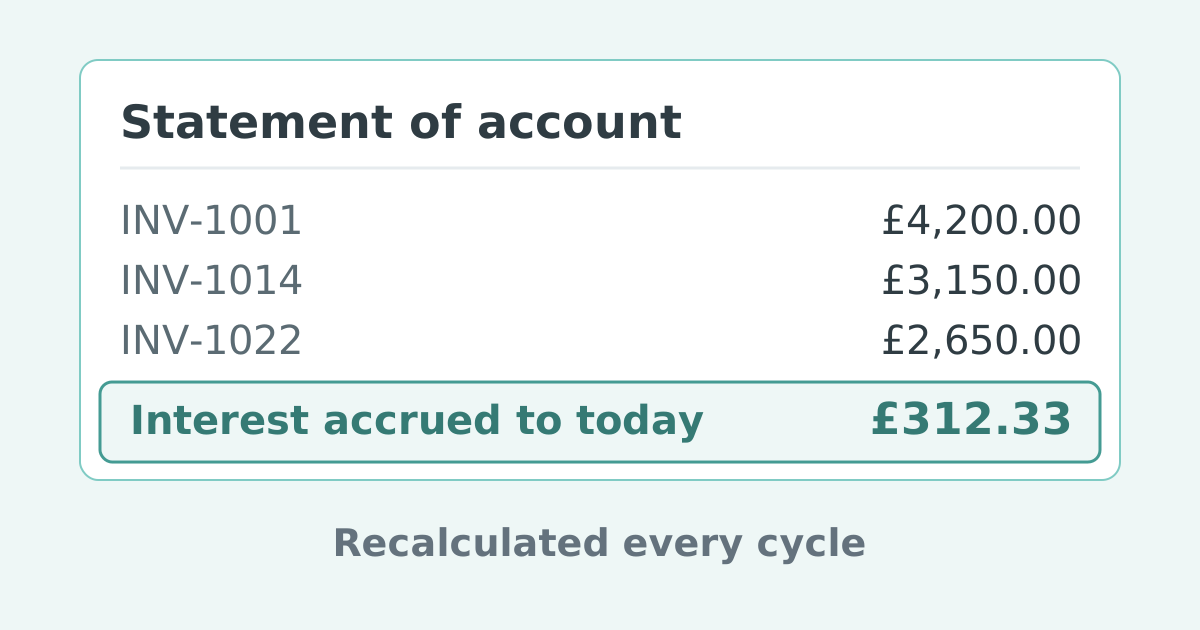

Xero and QuickBooks statements list invoices, credits and a balance. Neither has a calculation layer, so neither can show accrued interest on its own. The workaround is to bill the interest separately so it shows up as a line, but interest builds every day, so that figure is out of date within a week.
A statement of account has no calculation layer. It prints the documents attached to a contact, invoices, credit notes and payments, with a running balance, so every figure on it already exists as a transaction somewhere else. Interest is not a transaction until you raise one.
That is why the request has never been solved by a setting. It would need the statement to compute a number that does not exist in your ledger yet.
The same is true in QuickBooks Online. Its statements are also document lists, and its finance charge feature, where available, works by creating a charge rather than by calculating one on the statement itself.
The only way round it is to turn the interest into a transaction, because a transaction is the one thing a statement can display.
That works, for exactly one day. Interest accrues daily, so an invoice raised on the 1st is understated by the 2nd and materially wrong by the time most customers look at it.
Take a customer sitting on £10,000 of overdue invoices at 12% a year. That is £3.29 of interest a day.
So a statement sent at the end of the month, carrying an interest invoice raised at the start of it, understates what you are owed by nearly a hundred pounds on a single mid-sized account. Multiply that across a ledger.
Keeping it accurate by hand means editing that invoice every time you send a statement, on every account, which is why most people raise it once and quietly stop.
Work the interest out at the moment the statement is sent, not when the charge was first billed. The customer then reads a figure that is true that morning, which is the only morning that counts.
An interest figure is only true on the day it was worked out. If the charge was raised on the 1st and the statement goes out on the 30th, you have shown the customer a number you already know is wrong, and invited the argument.
This also fixes the credibility problem. A customer who checks your maths and finds the figure too low learns that your interest charges are approximate. That is not a reputation you want on a number you may eventually need to enforce.
Interest statements belong on rolling accounts and chronic late payers, and nowhere near disputed invoices or accounts already on a payment plan. Deciding this is a policy question, not a technical one.
| Account type | Show interest? | Why |
|---|---|---|
| Rolling accounts, many small invoices | Yes | One growing figure is far easier to act on than a list of aging invoices. |
| Chronic late payers | Yes | The monthly statement becomes the reminder that delay has a running cost. |
| Long-standing accounts that pay on time | Usually no | Nothing to charge, and the line reads as a threat where there is no problem. |
| Accounts in dispute | No | Exclude the disputed invoice entirely until it is resolved. |
| Accounts on a payment plan | No | They are already doing what you asked. Interest on top undermines the arrangement. |
Running different rules for different groups is covered in different late fee policies for different customers.
If your customer is a group with several trading entities, statements sent per entity give everyone a partial picture, and the person who actually authorizes payment sees none of it.
Send one consolidated statement to the parent, covering the child entities' invoices, with interest calculated across the whole group balance. That is the number the finance director is answerable for. The setup is in how to set up automatic customer statements in Xero and consolidated statements for parent and child customers.
QuickBooks Online has the same limitation. Its statements list transactions, so interest has to become a transaction before it can appear, and its finance charge feature creates a charge rather than calculating one on the statement.
QuickBooks does have a finance charge concept, and our guide to applying finance charges in QuickBooks Online covers it in full, along with whether you can add a late fee in QuickBooks Online. The same staleness applies: a charge created on the 1st does not update itself.
In the UK and the EU the right to charge interest is statutory and automatic on business-to-business invoices, so the interest line on a statement needs no contractual basis. Almost everywhere else the right is contractual, established by your payment terms and tested under contract law if disputed.
| Market | Basis | Rate |
|---|---|---|
| UK | Statutory, automatic | Bank of England base rate plus 8%, fixed in six-month blocks, plus £40, £70 or £100 per invoice |
| EU | Statutory (Directive 2011/7/EU) | ECB reference rate plus at least 8 points, which is 10.40% for the second half of 2026, plus €40 minimum |
| US | State by state, usury caps | Typically 1% to 1.5% a month |
| Australia, New Zealand | Contractual | No statutory B2B rate. Set it in your terms |
| Canada | Contractual, provincial variation | State the annual equivalent rate in your terms |
| South Africa | Prescribed Rate of Interest Act | Prescribed rate, 10.25% from March 2026, as a statutory fallback |
| Singapore | Common law, still applying the older genuine pre-estimate test | Must be a genuine pre-estimate of loss |
In a contractual market, put the rate on the statement itself as a footer line, referencing the clause in your terms. It costs nothing and it answers the first question a customer will ask. Wording is in our late fee policy wording examples.
Paidnice generates the statement and the interest together, which is the only way the number stays right.
Setting it up is one statement schedule and one interest policy on the same customer group.
Deciding between a per-invoice fee and a balance charge is covered in invoice late fee or statement interest. Whether that interest should compound is in compound or simple interest on overdue invoices, and to work a figure out now there is a free late fee calculator or the advanced calculator.
Can Xero show interest on a statement natively?
No. A Xero statement lists documents attached to a contact and has no calculation layer, so there is no field for accrued interest. The request has been open on the Xero ideas board since 29 March 2012, with 1,101 votes, and Xero's Community Manager Kelly Munro replied on 7 July 2025 that there are no committed plans to build it.
Should the interest be a separate invoice or a line on the original?
Separate. It keeps the original invoice as the record of the sale, it is far easier to waive, and it avoids mixing a no-tax charge into a tax invoice. How to account for late fees covers why.
Does the interest have to go into my ledger?
For it to be collectable, yes. A figure that appears only on a PDF never enters the customer's payables system, cannot be reconciled when paid, and is not evidence if you escalate.
How often should I send an interest statement?
Monthly, on a fixed day. Predictability is what makes it a process rather than a threat. It also has to actually land, which is a deliverability and wording question as much as a scheduling one.
What if the customer has a credit note sitting on their account?
Interest should be calculated on the net balance. Charging on the gross when the customer holds unallocated credit is the error that turns a routine statement into a complaint.
Paidnice is accounts receivable automation that enforces your payment terms, trusted by thousands of businesses on Xero and QuickBooks. Credit control and debtor management, run for you.
Try it Now - It's FreeNo card required.


Optimize your cash flow with our suite of financial tools designed for AR professionals. Calculate DSO, aging analysis, late fees, and more.