
Module 8Building the firm7 min read
The bookkeeping firm tool stack, by category
What an outsourced bookkeeping firm actually runs on, category by category, with published prices where they exist and an honest note where they do not.

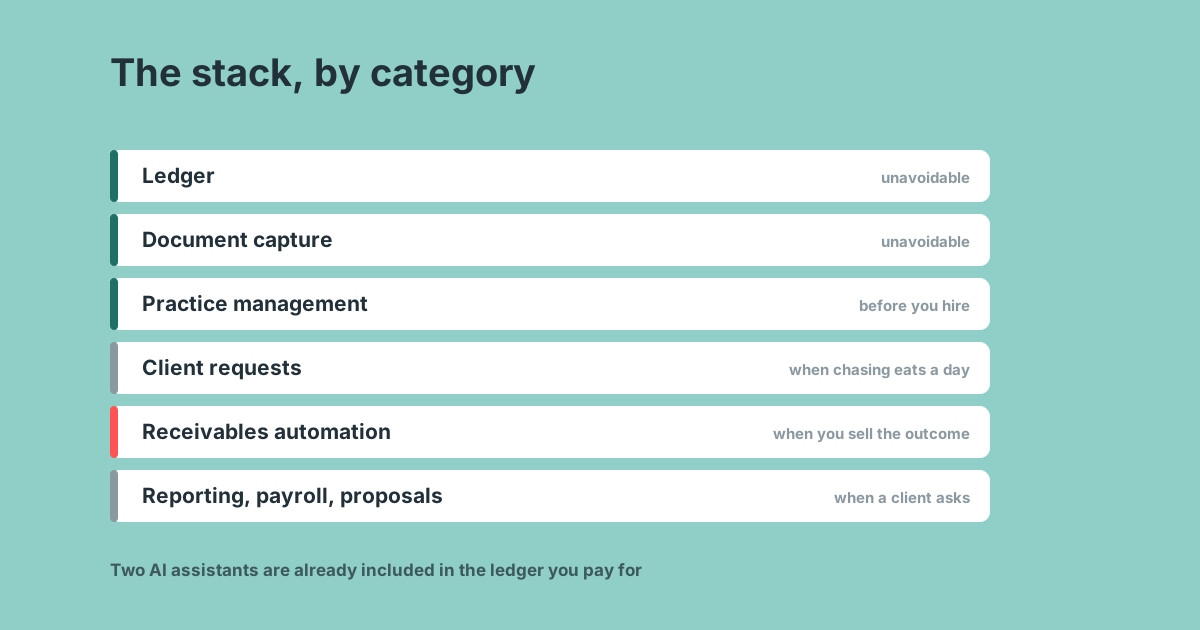
A bookkeeping firm runs on nine categories of tool, and most firms buy them in the wrong order. The ledger and document capture are unavoidable. Practice management is what breaks first as you grow. Everything else can wait until a specific problem justifies it, which is rarely on day one.
Key takeaways
Three categories are genuinely unavoidable: the ledger, document capture, and something that tracks who is doing what.
Practice management is the one people buy too late, usually after a deadline is missed.
Published pricing is patchy. Some vendors publish a full rate card, others quote only. Both are noted below.
Per-user pricing changes the maths once you hire. A $89 per user tool is a different decision at one person and at six.
The nine categories
| Category | The job | Buy it when |
|---|---|---|
| Ledger | Where the client's books live | Day one. It is not your choice, it is the client's |
| Document capture | Receipts and bills into coded entries | Day one. This is the volume work |
| Practice management | Who is doing what, for whom, by when | Before the second employee, not after |
| Client requests | Getting records out of clients without twelve emails | When chasing records eats a day a week |
| Receivables automation | Chasing your clients' invoices, and your own | When you add AR as a service, or stop getting paid on time yourself |
| Payroll | Running pay for clients | Only if you offer it. It is a service line, not a tool decision |
| Reporting | Management packs beyond the ledger's own reports | When clients start reading the pack |
| Proposals | Engagement letters, pricing and billing in one flow | When writing proposals by hand is the bottleneck |
| AI assistants | Drafting, sorting, explaining | Any time. Two are already free inside the ledger |
What things cost
Pricing transparency in this market is uneven, so this splits into what is published and what is not.
Published by the vendor. Xero's US pricing moves to Early $27, Growing $59 and Established $97 a month from 1 October 2026. Financial Cents publishes Solo, Team and Scale tiers per user. Canopy publishes three per-user tiers plus add-on modules. Content Snare publishes three flat monthly tiers. Stripe and GoCardless publish per-transaction rates.
Quote only. ADP does not publish a list price for RUN. Spotlight Reporting does not publish a price. Truewind is sales-led.
Treat with care. A lot of the numbers circulating for Dext, Karbon, Jetpack, Fathom and Ignition come from comparison sites rather than the vendor, and several conflict with each other. Check the vendor's own pricing page before you build a budget on them, because they change and aggregators lag.
The two that are already paid for
Before buying an AI tool, turn on the ones included in the ledger you are already paying for.
Just Ask Xero is included for Xero subscribers at no separate charge, covering natural-language queries and, since a mid-2026 update, real-time bank reconciliation and pre-payment bill screening. Intuit Assist is bundled into QuickBooks Online, United States only.
Neither replaces a general assistant connected to your own procedures, but both are free and most practices have not tried them. How to use AI for bookkeeping covers what to do with one.
Where receivables sits
The category is called accounts receivable automation. It handles the job neither the ledger nor the practice management tool does: reminders, statements, late fees and escalation running on a schedule against a client's ledger.
It is worth being straight about one thing here. This hub is published by Paidnice, which is a tool in that category. The category definition is not controversial, but if you want an independent taxonomy, there is not one: no analyst firm has defined this space, so every description of it including this one comes from somebody who sells into it.
What the category does is covered in outsourced accounts receivable.
How to sequence the buying
- Ledger and capture. Unavoidable, and the client usually decides the first one.
- Whatever the free AI in your ledger already does. Costs nothing, tried by almost nobody.
- Practice management, before you hire. The firm that adds a second person without it discovers why quickly.
- The one tool that fixes your loudest problem. Chasing records, chasing invoices, or writing proposals. One, not three.
- Everything else, when a client asks for it. Reporting tools in particular are easy to buy and hard to justify before anyone reads the pack.
💡 Paidnice insight
The most expensive tool in most firms is the one bought to solve a problem that a written procedure would have fixed for nothing. Before adding to the stack, write down how the job is done now. Half the time the answer is that nobody knows, which is the actual problem.
Common questions
What software do bookkeeping firms use?
A ledger, document capture, and practice management, at minimum. Beyond that it depends on the services offered: receivables automation, payroll, reporting, proposals and client request tools all solve specific problems rather than general ones.
Do I need practice management software?
Not as a sole operator. The moment there are two of you, the cost of not having it is a missed deadline, and firms almost always buy it one incident too late.
Is there free AI built into Xero and QuickBooks?
Yes. Just Ask Xero is included for Xero subscribers, and Intuit Assist is bundled into QuickBooks Online for United States organisations. Try both before buying anything.
How much should I budget for the stack?
Enough vendors quote rather than publish that an honest total is impossible to give. Build it from the published prices of the specific tools you want, watch for per-user pricing as you hire, and treat any range quoted elsewhere as an estimate.
More in Building the firm
How to build an outsourced bookkeeping firm
Registration, pricing, capacity and client acquisition, with the regulatory requirement for each market.
Outsourced accounts receivable: how to add it as a service line
The scope, the four pricing models, and the regulatory line on collecting in your name versus the client's.
Client accounting services: what CAS is, and what the benchmark data says
What the category actually is, and the three findings from the 206-firm benchmark worth building around.
Virtual bookkeeping services: what the remote model changes
What changes when delivery is remote, and the two client objections you need an answer for.