
Module 9Building the firm5 min read
Virtual bookkeeping services: what the remote model changes
What is actually different about delivering bookkeeping remotely, the two things clients ask that you need an answer to, and where the model breaks if you have not designed for it.

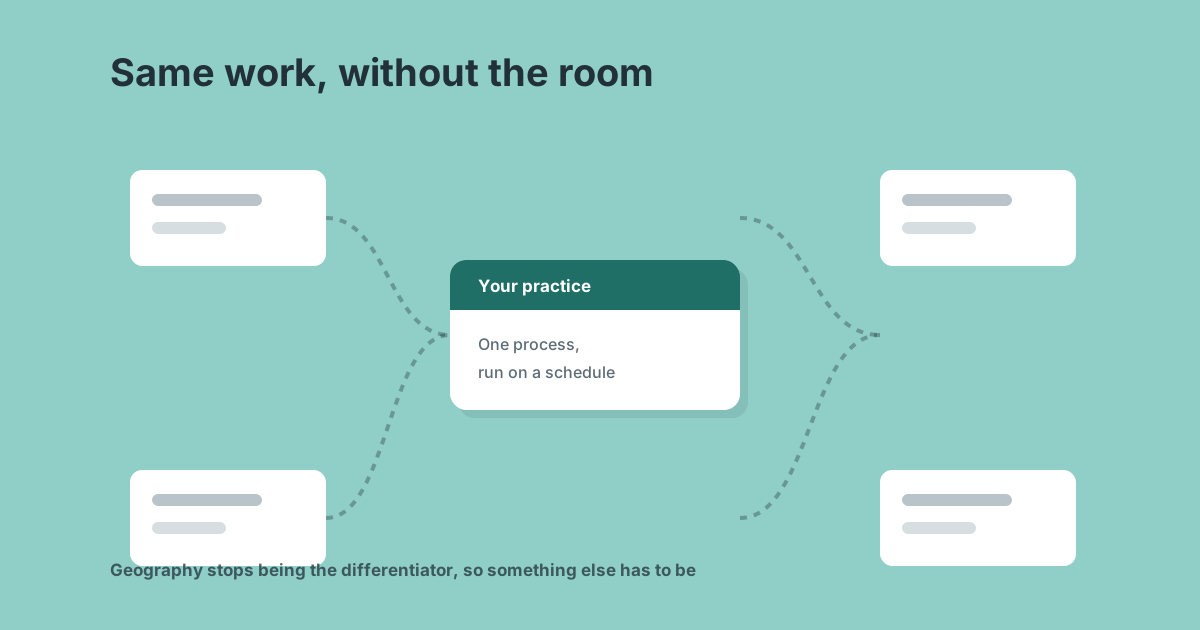
Virtual bookkeeping is the same work delivered without being in the room. The accounting does not change. What changes is how records reach you, how the client knows you are working, and how you prove the value of something they never see happening. Firms that treat it as ordinary bookkeeping done over email struggle with all three.
Key takeaways
Getting records is the job, not the bookkeeping. Remote delivery removes the option of walking over to a desk.
Invisible work needs evidence. A client who cannot see you working assumes nothing is happening.
Niching works harder remotely. Geography stops being your differentiator, so something else has to be.
The regulatory requirement follows the client, not you. Serving a market means meeting its rules.
What actually changes
| In person | Remote | |
|---|---|---|
| Getting records | Ask, or go and look | A request process, with reminders, or it does not happen |
| Queries | A conversation | An email that waits, then a second email |
| Client confidence | They see you there | They see output, or they assume nothing is happening |
| Your market | Local | Anywhere you are qualified to serve |
| Your competition | Local | Also anywhere |
The last row is the one people forget when they celebrate the fourth. Going remote widens your market and your competitive set by exactly the same amount.
The two questions clients ask
"How do I know you are doing anything?" They rarely say it that directly. It arrives as a request for an update, or as surprise at an invoice. The answer is a rhythm they can see: a monthly pack that arrives on the same day, a query email that comes when expected, a close date they know. Predictability substitutes for presence.
"What happens to my data?" A reasonable question when the person handling your books is somewhere you have never been. Have an actual answer: where the data sits, who has access, what happens when a staff member leaves, and whether anyone outside your jurisdiction touches it. Firms using offshore delivery teams should say so rather than be asked.
Where the model breaks
Record collection, first. Every virtual practice that is drowning is drowning here, not in the bookkeeping. A request process with reminders and a deadline is not administrative overhead, it is the operational core of the model.
Scope, second. Remote work invites small favours because they are quick to ask for. A question that would take a minute in person takes a minute over email too, and nobody bills for either, until there are forty of them a month.
Proof of value, third. This is where receivables earns its place in a virtual practice specifically. It produces a number that moves and that the client feels: days to get paid, before and after. It is the easiest thing to point at when someone who cannot see you working asks what they are paying for.
Compliance follows the client
Serving a client in another market means meeting that market's rules, regardless of where you sit.
- Australia: preparing or lodging a BAS for a fee requires TPB registration as a BAS Agent, wherever you are based.
- United Kingdom: offering bookkeeping services requires AML supervision.
- New Zealand: AML/CFT obligations depend on the transactions you handle, not on your location.
- United States: no bookkeeping licence, but attest work remains CPA-only and state rules apply.
The full detail per market is in how to build an outsourced bookkeeping firm.
Niching, because geography no longer differentiates
A local firm can sell proximity. A virtual one cannot, which is why the benchmark finding on niching matters more here: firms where one industry produced over half of advisory revenue reported 38% higher median revenue and 51% higher median net revenue per client.
Remotely, "the bookkeeper for veterinary practices" travels. "A bookkeeper" does not.
💡 Paidnice insight
The virtual firms that retain clients longest tend to own one number the client cares about and report it monthly without being asked. Getting paid faster is the easiest one to take ownership of, because the work runs on rules rather than attention and the before and after is impossible to argue with.
Common questions
What are virtual bookkeeping services?
Bookkeeping delivered remotely: the same reconciliation, coding, close and reporting, with records exchanged digitally and the relationship run over scheduled contact rather than presence.
Is virtual bookkeeping safe?
The accounting risk is identical. The difference is data handling, so expect to answer where records are stored, who can access them, and whether anyone outside your jurisdiction is involved.
Can I serve clients in another country?
Sometimes, and the rules follow the client. Australian BAS work needs TPB registration regardless of where you sit. UK bookkeeping needs AML supervision. Check the client's market, not yours.
How do virtual firms charge?
Overwhelmingly a fixed monthly fee rather than hourly. Among surveyed advisory practices, hourly billing fell from 53% to 10% in five years, and remote delivery pushes the same way because the client is buying an outcome they cannot watch being produced.
More in Building the firm
How to build an outsourced bookkeeping firm
Registration, pricing, capacity and client acquisition, with the regulatory requirement for each market.
Outsourced accounts receivable: how to add it as a service line
The scope, the four pricing models, and the regulatory line on collecting in your name versus the client's.
Client accounting services: what CAS is, and what the benchmark data says
What the category actually is, and the three findings from the 206-firm benchmark worth building around.
The bookkeeping firm tool stack, by category
Nine categories, what each one is for, and which ones you can genuinely skip at the start.