
Module 2The receivables process6 min read
The collections process: a ladder you set once and stop improvising
How to design a collections process that runs on a schedule: when the first contact goes, how the tone escalates, who owns a disputed invoice, and the point where chasing stops and a decision starts.

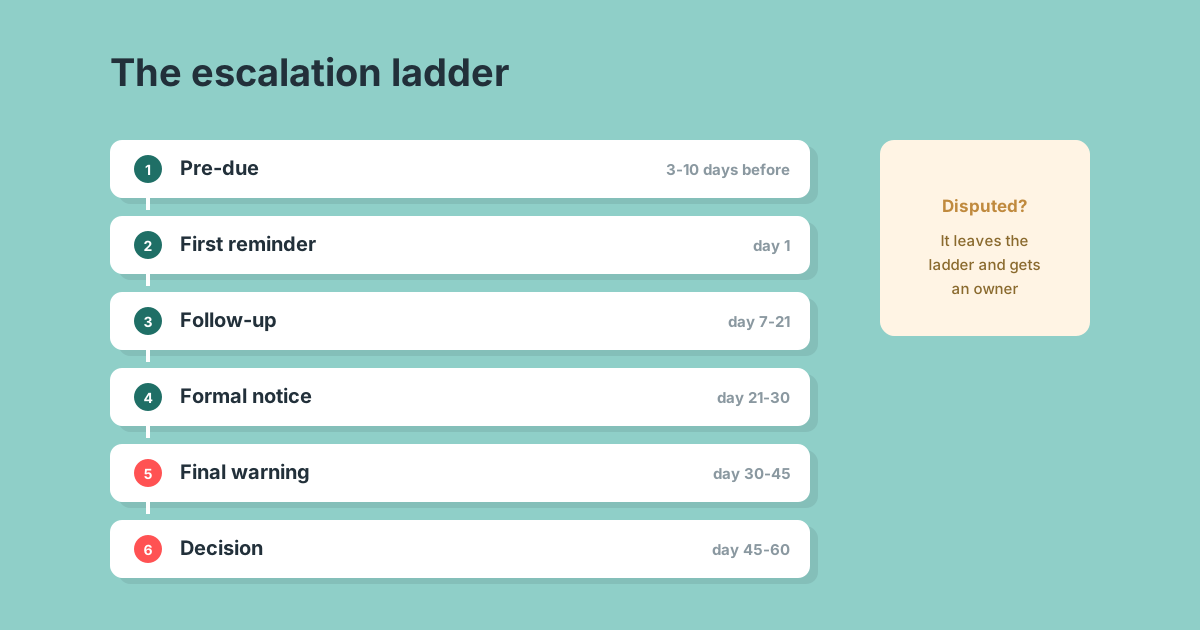
A collections process is the set of rules that decide who gets contacted, when, and in what tone, before anyone has to think about it. The point is not the wording of the emails. It is that the timing is agreed in advance, so chasing starts on day one rather than whenever someone notices, and stops at a decision rather than trailing off.
Key takeaways
Most businesses do not have a collections problem, they have a timing problem. Chasing starts a fortnight late and every rung slides with it.
Late and disputed are different states. A late invoice needs a reminder. A disputed one needs an answer, and reminders make it worse.
The ladder has to end. A process with no final rung is a process that chases forever at declining cost-effectiveness.
Tone escalates, volume does not. Six emails in a week is noise. Five contacts over six weeks, each firmer, is a process.
The six rungs
No professional body mandates a cadence. This is the pattern that recurs across credit management guidance, and the days matter far less than having decided them.
| Rung | When | What it says |
|---|---|---|
| 1. Pre-due | 3 to 10 days before | Your invoice falls due on the 30th. Here it is again |
| 2. First reminder | Day 1 past due | Neutral. Assume an oversight, because usually it is |
| 3. Follow-up | Day 7 to 21 | Names the amount, the days overdue and the agreed terms |
| 4. Formal notice | Day 21 to 30 | References the agreement. Goes to a named person, not an inbox |
| 5. Final warning | Day 30 to 45 | States exactly what happens next, and means it |
| 6. Decision | Day 45 to 60 | Credit hold, referral, payment plan or write-off. Not another email |
Rung 1 is the one most businesses skip and the cheapest to add. It is not chasing. It removes the most common excuse, which is that the invoice never arrived.
Rung 6 is the one most processes lack. Without a defined end point, an invoice at 90 days gets the same email it got at 30, indefinitely, and nobody ever decides whether it is worth pursuing.
Late is not the same as disputed
This is the distinction that separates a real process from a reminder schedule.
| Late | Disputed | |
|---|---|---|
| What it means | They agree they owe it and have not paid | They do not agree they owe it, or not all of it |
| What it needs | A reminder on schedule | An answer from someone who knows the job |
| What happens if you treat it as the other | Nothing bad | Reminders escalate a disagreement into a relationship problem |
| Who owns it | The process | A named person, with a deadline |
A disputed invoice that sits in the reminder sequence is the single most common way a collections process damages a customer relationship. The moment a query comes back, the invoice leaves the ladder and joins a queue with an owner and a date.
Tone, rung by rung
The escalation is in the wording, not the frequency. Each rung assumes less goodwill than the last.
- Helpful. "Just so it does not catch you out, this falls due Friday."
- Neutral. "This was due yesterday. If it is already scheduled, ignore this."
- Direct. "This is now 14 days past our agreed 30-day terms. Can you confirm a payment date?"
- Formal. "Invoice 1042 remains unpaid 28 days past terms, contrary to the agreement dated 3 March."
- Final. "If we do not receive payment or a payment plan by the 14th, the account goes on hold."
Two rules hold across all of them. Always name the amount and the number of days. Always make the next step a single, easy action.
Who the reminder goes to
A large share of unpaid invoices are unpaid because the reminder is landing somewhere nobody acts on. Before redesigning the wording, check three things: whether you hold a named contact rather than a generic inbox, whether that person can actually authorise payment, and whether your emails are arriving at all.
Deliverability is the unglamorous half of collections. An escalation ladder that lands in a spam folder is a ladder nobody climbed.
What you can add to the invoice
Whether you can charge for lateness is a legal question with a different answer in each market, covered fully in the accounts receivable process. The short version:
- United Kingdom: statutory interest at base plus 8%, currently 11.75%, plus fixed compensation of £40 to £100. Automatic, even if the contract is silent. The detail is in credit control procedures.
- United States: whatever the contract says, within state law. No federal right for private B2B.
- Australia and New Zealand: only what the terms of trade provide. If it is not written down, it does not exist.
Running it without a person
The ladder above only works if it runs on the day it is supposed to. Neither Xero nor QuickBooks fires anything when an invoice passes its due date, so every rung is either diarised by a human or automated.
💡 Paidnice insight
When we look at why a client's ladder is not working, it is almost never the copy. It is that rung 1 never goes, rung 3 goes on day 25 instead of day 14, and rung 6 does not exist. Customers using Paidnice cut their average wait for payment in half within 30 days, and the change is mostly that the schedule is kept. Use accounts receivable automation for the rungs and keep a person for rung 6, which is a judgment call about a customer worth keeping.
Common questions
What is the collections process in accounts receivable?
It is the part of the receivables cycle that runs after an invoice is issued and before it is paid: the scheduled contacts, the escalating tone, the handling of disputes, and the decision point where chasing stops. It is step 5 of the eight-step cycle.
How often should you chase an overdue invoice?
Five or six times across six weeks, with the tone escalating each time, is the pattern that recurs in credit management guidance. Chasing more often than weekly does not increase recovery and does damage the relationship.
When should you stop chasing and refer a debt?
Most credit policies set the referral point somewhere between 60 and 90 days past due, after multiple unanswered contacts. The exact day matters less than having decided it before you are emotionally invested in the invoice.
What is the difference between collections and credit control?
Credit control is the whole discipline, including deciding who gets credit in the first place. Collections is the chasing part. In the UK the terms are used almost interchangeably; in the US "credit control" is rarely used at all.
More in The receivables process
The accounts receivable process: the eight steps, and the five that actually decide whether you get paid
The full cycle, the formulas that measure it, the escalation ladder, and what you can legally charge in each market.
Credit control procedures: the UK process, and what the law gives you
The UK version: statutory interest at base plus 8%, fixed compensation, and the Fair Payment Code.
The month-end close checklist, and where the two platforms leave you
The full close task list, close timing that is actually realistic, and the close-tracking feature Xero does not have.