
Module 5Building the firm8 min read
How to build an outsourced bookkeeping firm
What you legally need to start in each market, how firms actually price the work, what breaks as you grow, and where the clients come from. Written for the person building the practice.

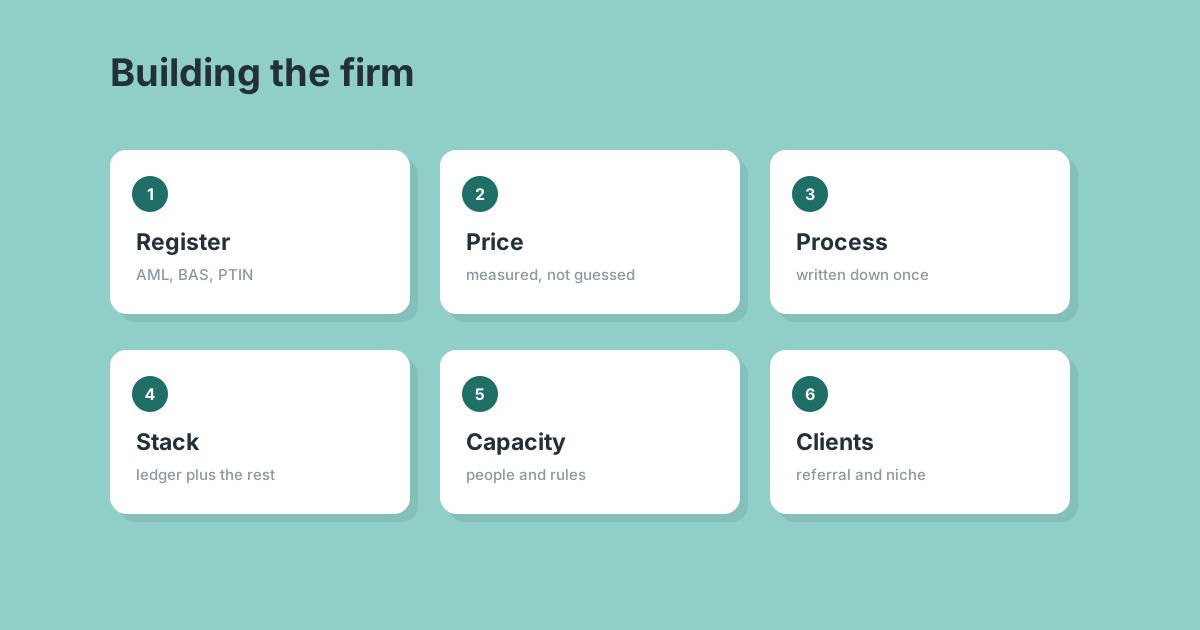
An outsourced bookkeeping firm sells a repeatable monthly process to businesses that do not want one in-house. What you need to start it is far less than most people assume in some markets and non-negotiable in others, the pricing is barely published anywhere, and the thing that breaks first is almost never demand.
Key takeaways
Australia has the hardest entry requirement. BAS Agent registration is legally required to touch GST or BAS work for a fee, with 1,400 hours of experience behind it.
The UK requirement is AML supervision, before you take a single client. Not a professional body membership, a supervisor.
Almost nobody publishes their prices. Two firms we could verify publish a rate card. Everything else quoted as a market rate is an estimate.
Scope creep is the failure mode, not price. The work expands into adjacent tasks nobody re-priced.
What you actually need to start
| Market | Legally required | Common but optional |
|---|---|---|
| United States | No bookkeeping licence exists. A PTIN if you prepare federal returns for pay | AICPA or NACPB certification. Only a CPA can issue audited, reviewed or compiled statements |
| United Kingdom | AML supervision under the Money Laundering Regulations 2017, via ICB, AAT, ACCA or HMRC directly | Professional body membership, professional indemnity insurance (often required by the body rather than by law) |
| Australia | BAS Agent registration with the TPB for any BAS service for a fee. Cert IV plus a Board-approved GST course, 1,400 hours in four years, and PI insurance | ICB Australia membership. General bookkeeping that is not a BAS service does not trigger registration |
| New Zealand | No general licence. You may be an AML/CFT reporting entity depending on the transactions you handle for clients | CA ANZ membership, which is a different credential entirely |
Two of these catch people out. In the UK, AML supervision is a legal precondition rather than a badge, and the regime is taken seriously enough that the FCA publicly censured the ICB for failings in its role as a supervisor. In Australia, the line is not what you call yourself: the moment you prepare or lodge a BAS for a fee, registration applies.
New Zealand's AML position is fact-specific rather than blanket. If you are handling client funds or transactions, get advice rather than assuming you are outside it.
Pricing, and why nobody will tell you the number
Four models exist, and in practice the profession has moved decisively away from hourly. In the 2024 CPA.com and AICPA benchmark survey of 206 US firms with client advisory practices, only 10% used hourly billing as their primary method, down from 53% in 2018.
| Model | Best for | Where it goes wrong |
|---|---|---|
| Fixed monthly | Predictable volume you have measured | The client's volume or messiness grows and you absorb it |
| Tiered packages | Selling without a quote every time | Clients sit in the wrong tier and nobody moves them |
| Per transaction | Genuinely variable volume | Under-prices the clean-up on a messy ledger |
| Hourly | One-off remediation work | Punishes you for getting faster, which is the whole point of building a process |
On actual numbers, be sceptical of every range you read. We could verify exactly two firms publishing a rate card: one at USD 750 and USD 2,250 a month, another from USD 150. Everything else circulating as a market rate traces to aggregator content rather than a published price.
The defensible way to price is from measured data rather than a feel for the client, which is what fee scoping covers.
What the benchmark survey does tell you
The CPA.com and AICPA survey is the one properly sampled dataset in this space. Three findings are worth building a firm around.
- Niching pays measurably. Firms where one industry produced more than half of advisory revenue had 38% higher median revenue and 51% higher median net revenue per client.
- Dedicated staff is the norm, not a luxury. 78% of these practices had staff working only on that service line.
- Technology changes capacity, not just cost. Firms that had invested in technology served a median of 100 clients against 67 for those that had not.
What breaks as you grow
Scope creep, first and worst. Bookkeeping sits next to a dozen adjacent tasks that all feel like the same job: chasing a query, fixing a prior period, answering the client's accountant. Each is reasonable, none were priced, and together they are why a profitable client stops being one.
Capacity, second. The constraint is rarely finding clients, it is finding someone who can do the work to your standard. The most commonly reported response is upskilling existing staff rather than hiring, which is slower than it sounds.
Undocumented process, underneath both. A firm where the method lives in one person's head cannot delegate, cannot price accurately, and cannot survive that person going on leave. The software that supports it is covered in the tool stack. Writing the procedure down is the unglamorous work that makes the other two solvable, and it is what the AI workflows in this hub are built on.
Where clients come from
Referral dominates. TaxDome's niche accounting report found 58% of businesses found their current firm through a peer referral, and nothing else in this research came close.
The platform directories, Xero's advisor directory and the QuickBooks ProAdvisor listing, are the other channel firms name consistently. There is no published comparison of their relative effectiveness, so treat anyone claiming one beats the other as guessing.
If you are delivering remotely, which most new firms now are, the virtual model changes how records reach you and how you prove value. What the survey data does support is niching: it measurably raises revenue per client, and it makes referral work harder for you, because "the bookkeeper for dental practices" is a referable sentence in a way that "a bookkeeper" is not.
💡 Paidnice insight
The firms that scale without drowning tend to sell an outcome rather than an hour, and the easiest outcome to evidence is getting the client paid faster. It is measurable before and after, it recurs monthly, and the work can run on rules rather than on your team's attention. That is why outsourced accounts receivable is usually the first service line worth adding.
Common questions
Do I need a qualification to start a bookkeeping business?
It depends entirely on the market. In the United States, no licence exists. In the United Kingdom you need AML supervision before trading. In Australia you need TPB registration as a BAS Agent for any BAS work. In New Zealand there is no general licence but AML obligations may apply.
How much should I charge for bookkeeping?
There is no credible market rate to quote, because almost no firm publishes one. Price from measured transaction volume and measured messiness rather than an impression, and build in a repricing trigger before you send the quote.
What is the difference between outsourced bookkeeping and client accounting services?
Scope. Outsourced bookkeeping is the monthly transaction and reconciliation work. Client accounting services, or client advisory services, extends into reporting, forecasting and advice. The second is where the survey data shows the growth.
I am a business owner looking to outsource. What should I ask?
Ask what is explicitly out of scope, what happens when volume grows, and who does the work. The third question matters more than most people realise, because the answer is frequently not the person selling to you.
More in Building the firm
Outsourced accounts receivable: how to add it as a service line
The scope, the four pricing models, and the regulatory line on collecting in your name versus the client's.
Client accounting services: what CAS is, and what the benchmark data says
What the category actually is, and the three findings from the 206-firm benchmark worth building around.
The bookkeeping firm tool stack, by category
Nine categories, what each one is for, and which ones you can genuinely skip at the start.
Virtual bookkeeping services: what the remote model changes
What changes when delivery is remote, and the two client objections you need an answer for.