
Module 4The receivables process6 min read
The month-end close checklist, and where the two platforms leave you
A complete month-end close for a small business on Xero or QuickBooks, grouped the way you actually work through it, plus the close features each platform has and the one Xero is still missing.

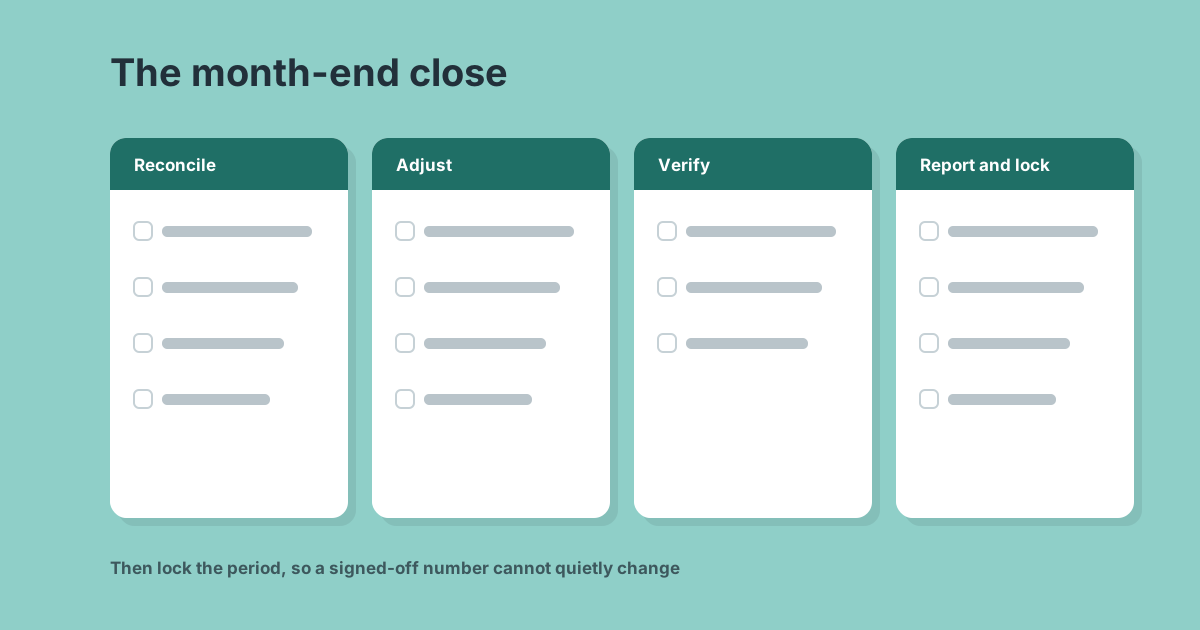
A month-end close is the routine that makes the numbers trustworthy: reconcile everything, put income and expense in the right period, produce the three statements, then lock the period so nobody changes history. Xero and Intuit both publish their own version. They agree on the substance and differ on how they group it, and one of them has a genuine feature the other does not.
Key takeaways
QuickBooks has a Books Close dashboard. Xero has lock dates and no native close checklist at all, which is still an open request on their product ideas board.
Xero's own guidance is three to five days for a small business, and five to ten for a complex one.
Lock the period. An unlocked prior month is how a signed-off number quietly changes.
The AR reconciliation is where collections and close meet. If the ageing does not tie to the control account, your chasing list is wrong too.
The checklist
Reconcile
- Bank and credit card accounts reconciledEvery account, not just the main one. Ask how many exist rather than assuming
- AR and AP reconciled to the general ledgerThe subledger agreeing to the control account. This is the one that makes your ageing trustworthy
- Key balance sheet accounts reconciledTax payable, loans, payroll liabilities
- Aged receivables and payables reviewedNot just produced. Somebody reads it and acts
Adjust
- Recurring journals postedRent, subscriptions, depreciation
- Accruals and prepayments recordedRevenue and cost landing in the period they belong to
- Prior-month temporary accruals reversedThe step that quietly doubles an expense when it is missed
- Deferred revenue recordedMoney received for work not yet done
Verify
- Payroll and benefits entries verifiedIncluding that withholdings match the obligation
- Fixed asset register updated and depreciation posted
- Inventory and cost of goods reconciledWhere the client carries stock
Report and lock
- Profit and loss, balance sheet and cash flow produced
- Variance reviewed against last month and budgetThe step that turns a close into something worth reading
- Supporting documents attached and approvals obtained
- Period locked and reports archived
What each platform actually gives you
| Xero | QuickBooks Online | |
|---|---|---|
| Locking the period | Lock dates, under Accounting, Advanced, Financial settings. Admin role required | Closing date with an optional password |
| Seeing what changed after close | Not natively | Exceptions to Closing Date report |
| Tracking close progress | No native close checklist. Still an open feature request | Books Close dashboard |
| Branded management reports | Not natively | Management Reports, but only on Advanced and Enterprise tiers |
If your practice runs on Xero, the close checklist lives outside the ledger by necessity: in your practice management tool, a shared document, or a written procedure an assistant follows. That is not a workaround, it is the current state of the product.
How long a close should take
Xero's own guidance is three to five days for a small business and five to ten where there is more complexity. That is the most relevant published figure for this audience, and it comes from the platform rather than a survey.
Be careful with the other numbers that circulate. The widely quoted "6.4 day median close" comes from an APQC metric whose own title describes an annual close, not a monthly one, and the claim that small businesses take 12 to 20 days appears only in vendor blogs with no methodology attached. We have left both out rather than repeat them.
Where close meets collections
The AR reconciliation is the step that connects this module to the rest of the hub. If the receivables subledger does not agree to the control account, two things follow: the balance sheet is wrong, and the ageing you are chasing from is wrong. People chase invoices that were paid, and miss ones that were not.
Getting that tie right every month is what makes the collections process trustworthy rather than a source of awkward emails.
💡 Paidnice insight
The close task most often done badly is reviewing the ageing, because producing the report feels like the job. Producing it takes a click. Acting on it is the work, and it is the one close step that directly changes when money arrives.
Common questions
What should be included in a month-end close?
Reconciliations of bank, card, AR and AP, adjusting journals for accruals, prepayments and deferred revenue, payroll and fixed asset verification, the three financial statements, a variance review, and then locking the period.
Does Xero have a month-end close checklist?
No. Xero has lock dates to prevent changes to a closed period, but no native checklist or close task tracking. It remains an open request on Xero's product ideas board. QuickBooks Online does have a Books Close dashboard.
How long should a month-end close take?
Xero's own guidance is three to five days for a small business, five to ten where there is more complexity. Most published benchmarks beyond that are drawn from mid-sized and large finance teams and do not describe a sole bookkeeper's workload.
Why lock the period?
Because an unlocked prior period lets somebody post into a month you already reported on, which means the numbers you gave the client no longer match the ledger. QuickBooks will also show you what changed after the close date; Xero will not.
More in The receivables process
The accounts receivable process: the eight steps, and the five that actually decide whether you get paid
The full cycle, the formulas that measure it, the escalation ladder, and what you can legally charge in each market.
The collections process: a ladder you set once and stop improvising
The escalation ladder, the tone at each rung, and how to separate a late invoice from a disputed one.
Credit control procedures: the UK process, and what the law gives you
The UK version: statutory interest at base plus 8%, fixed compensation, and the Fair Payment Code.