
Module 7Building the firm6 min read
Client accounting services: what CAS is, and what the benchmark data says
The one properly sampled dataset on CAS practices, what it shows about growth, niching and staffing, and the naming confusion that trips people up when they research the category.

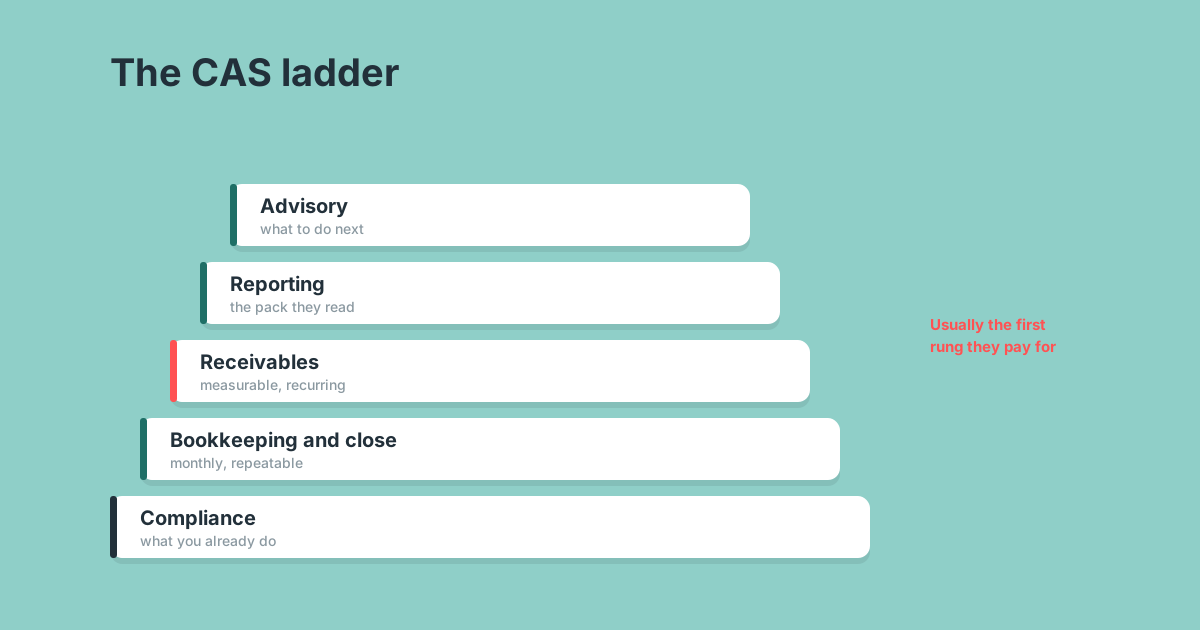
Client accounting services is the packaged monthly service a firm sells beyond compliance: the bookkeeping, the close, the reporting, and the advice that comes off the back of it. The category has a naming problem worth knowing about, and one genuinely good dataset behind it that almost nobody quotes properly.
Key takeaways
The official name is Client Advisory Services. Most people search for "client accounting services". Both abbreviate to CAS, which is why the two get used interchangeably.
Median revenue growth was 17% across 206 US firms, with median net client fees per professional of $156,250.
Niching is the clearest lever in the data: 38% higher median revenue, 51% higher net revenue per client.
78% have dedicated staff. CAS run in the gaps between compliance work is the version that does not grow.
The naming problem
AICPA and CPA.com define CAS as Client Advisory Services: advising clients across a range of financial decisions to deepen the relationship. The phrase most people actually type into a search box is client accounting services.
The two are used interchangeably across the profession, and the slide from "accounting" to "advisory" is the whole point of the category. It describes a firm moving from recording what happened to helping decide what happens next. If you are reading research on this, check which definition the author is using, because a survey of advisory practices is measuring something different from a survey of outsourced bookkeeping.
What the benchmark actually found
The 2024 CPA.com and AICPA PCPS benchmark survey covered 206 US CPA firms with CAS practices, reporting on 2023 data. It is the only properly sampled dataset in this space, and the figures below all come from it.
| Measure | Finding |
|---|---|
| Median revenue growth | 17% |
| Projected median three-year growth | 99% |
| Median net client fees per professional | $156,250, up 29% on the prior survey |
| Practices with dedicated CAS-only staff | 78% |
| Median clients served, technology-invested firms | 100, against 67 for others |
| Hourly billing as the primary method | 10%, down from 53% in 2018 |
That last line is the one with the most practical weight. In five years the profession moved decisively off hourly for this work, because a service built on a repeatable process gets faster over time, and hourly billing penalises exactly that.
The niching finding, and why it is the one to act on
Firms where a single industry generated more than half of CAS revenue reported 38% higher median CAS revenue and 51% higher median net revenue per client.
The mechanism is not mysterious. A firm that serves one industry knows the chart of accounts, the seasonality, the software, the common disputes and the benchmarks without asking. The work takes less time and is worth more, which is the only combination that improves a margin.
It also makes the firm referable, which matters because peer referral is where most bookkeeping and accounting clients come from.
Where receivables fits
CAS is usually described as a ladder: compliance, then bookkeeping and close, then reporting, then advisory. Receivables tends to be the first rung above bookkeeping that clients will actually pay for, for three reasons.
- The outcome is measurable. Days to get paid, before and after.
- It recurs. Chasing is not a project that finishes.
- It can run on rules rather than on your team's attention, which means it scales without adding headcount, and it travels well in a remote practice.
The build for that specific service line is in outsourced accounts receivable.
What the data does not tell you
Two things people quote confidently that the research does not support.
There is no published CAS margin figure. The survey reports revenue per professional, not margin. Anyone quoting a CAS gross margin is extrapolating.
The Rosenberg Survey is not the source for the growth numbers. It is a respected annual benchmarking survey, but the CAS growth figures circulating in commentary trace back to the CPA.com survey above. Cite the one you actually read.
💡 Paidnice insight
The firms that struggle to launch CAS usually try to sell advice first, because it sounds like the valuable part. The ones that succeed tend to sell an operational outcome first, prove it with a number, and earn the advisory conversation afterwards. Getting a client paid faster is the cheapest version of that proof to deliver.
Common questions
What are client accounting services?
A packaged monthly service covering bookkeeping, month-end close, management reporting and the advice that follows, sold as an ongoing relationship rather than as compliance work. AICPA and CPA.com formally call it Client Advisory Services.
Is CAS profitable?
The benchmark reports median net client fees per professional of $156,250 and median growth of 17%, but it does not publish a margin figure. Profitability in the data tracks with niching, dedicated staff and technology investment rather than with the service itself.
How do firms price CAS?
Overwhelmingly not hourly. Only 10% of surveyed firms used hourly as their primary method, against 53% five years earlier. Fixed fee and tiered packages dominate.
Do I need dedicated staff to run CAS?
78% of surveyed practices have them. It is not a legal requirement, but a service line run in whatever time is left after compliance season is the version that does not grow.
More in Building the firm
How to build an outsourced bookkeeping firm
Registration, pricing, capacity and client acquisition, with the regulatory requirement for each market.
Outsourced accounts receivable: how to add it as a service line
The scope, the four pricing models, and the regulatory line on collecting in your name versus the client's.
The bookkeeping firm tool stack, by category
Nine categories, what each one is for, and which ones you can genuinely skip at the start.
Virtual bookkeeping services: what the remote model changes
What changes when delivery is remote, and the two client objections you need an answer for.