
Module 6Building the firm7 min read
Outsourced accounts receivable: how to add it as a service line
What an outsourced AR service actually includes, the four ways firms price it, and the regulatory line that decides how you can chase on a client's behalf. Written for the firm building the service, not the business buying it.

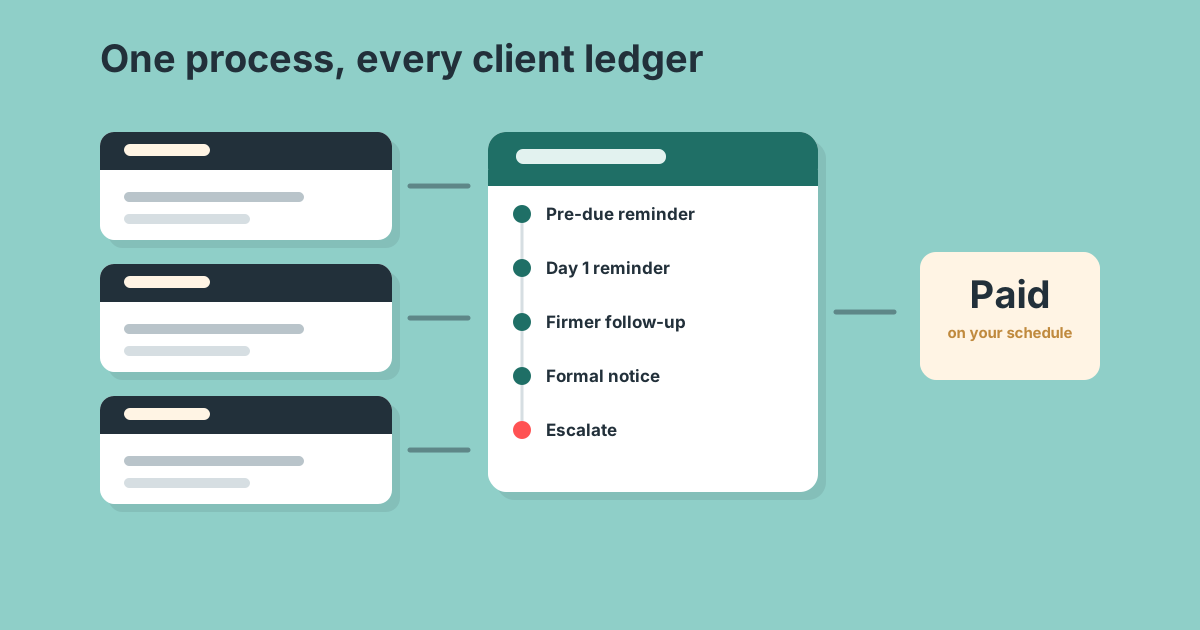
An outsourced accounts receivable service means running a client's collections for them: their invoices, their ledger, their customers, your process. The scope is well established, the pricing is not published by anyone, and the single decision that matters most is whether you chase in your own name or purely as the client's back office. That choice changes your regulatory position in every market.
Key takeaways
Two questions decide your regulatory exposure: is the debt consumer or commercial, and do you collect in your own name or the client's.
For most bookkeepers the answer is reassuring. The FDCPA covers consumer debt only, and UK FCA authorisation applies to consumer debt collection only. B2B collection sits outside both.
Nobody publishes a rate card. Not one established provider publishes a price. Any range you read is an aggregator's estimate.
Scope creep is the failure mode, not pricing. AR work expands quietly through disputes and reconciliation that were never in the engagement.
What the service actually includes
Across established providers the scope is consistent. These six things are the service; anything else is an add-on you price separately.
| Component | What you are actually doing |
|---|---|
| Invoicing and billing administration | Raising or reviewing invoices so they are correct before they go out |
| Credit management | Terms, limits, and whether a new customer gets credit at all |
| Collections and dunning | The reminder ladder, run on schedule rather than when someone remembers |
| Dispute resolution | Fielding queries and getting them answered before the invoice ages |
| Cash application | Matching receipts to invoices, including part payments |
| Reporting | Ageing, DSO, what moved, what is at risk |
Legal escalation is not part of it. Every provider that offers it sells it as a separate tier, and you should too, because it is a different activity with a different risk profile.
The regulatory line
This is the part firms get wrong, usually by assuming the rules are stricter than they are.
| Market | Consumer debt | Commercial B2B debt |
|---|---|---|
| United States | FDCPA applies. Third-party collectors are regulated | FDCPA does not apply. State collection-agency licensing may still, and some states carve out commercial-only work |
| United Kingdom | FCA authorisation required. Debt collecting is a regulated activity under CONC 7 | Not FCA-regulated. Collecting one business's debt from another does not need authorisation |
| Australia | State licensing plus the ACCC and ASIC conduct guideline | Same state-by-state position. WA licenses, Queensland licenses field agents, Victoria uses negative licensing |
| New Zealand | Conduct rules under the Fair Trading Act, CCCFA and Privacy Act | No general licensing regime published. Take advice before assuming none applies |
The second question is the one that moves you across the line. The FDCPA excludes someone collecting in the creditor's own name, which is the traditional distinction between acting as a client's back office and acting as a third party. Providers structure around this deliberately: Atradius offers collection "in the name and style of" the client.
This is a summary, not advice. Whether you need a licence turns on facts specific to your firm, your market and often your state. The two questions above tell you which conversation to have with a lawyer. They do not answer it.
New Zealand does not publish a licensing position for commercial collection. Treat it as open rather than settled.
How firms price it
Four models exist. No established provider publishes a rate card, so anyone quoting you a market rate is quoting an estimate.
| Model | Works when | Breaks when |
|---|---|---|
| Fixed monthly retainer | Volume is predictable and you have measured it | The client grows or their ledger gets messier and you absorb it |
| Per invoice or transaction | Volume swings month to month | The client sends fewer, larger invoices than you modelled |
| Percentage of collections | The debt is aged and recovery is genuinely uncertain | Applied to current debt, where you get paid for invoices that would have been paid anyway |
| Dedicated FTE | The client is large enough to occupy a person | Below that size, where it is just an expensive retainer |
Whichever you pick, price it from measured volume rather than an impression of the client. The counts that predict cost are transaction volume, the proportion of the ledger that is uncategorised, and the spread between the lightest and heaviest month. That is the same measurement described in fee scoping.
Standing it up
- Pick one existing clientIdeally one who already complains about getting paid late. You need a real ledger to build the process against, not a hypothetical one.
- Measure before you touch anythingCurrent DSO, current days late, current ageing profile. Without a baseline you cannot show the client what changed, and showing them is how this becomes referable.
- Write the ladder downWhen the pre-due reminder goes, what day the tone changes, when it escalates to a person, when it stops. This is the product. The full pattern is in the accounts receivable process.
- Decide whose name goes on itThe regulatory question above, settled before the first email rather than after.
- Automate the schedule, keep the judgmentReminders, fees and escalation run on rules. The difficult conversation and the payment plan stay with a person.
- Price the second client from the firstYou now have measured effort against measured volume, which is a far better basis than a guess.
What breaks it
Scope creep. AR is unusually prone to it because the adjacent work looks like the same job. Chasing becomes fielding disputes, which becomes reconciling the account, which becomes fixing the ledger. Each step is reasonable and none of them were priced.
No baseline. A firm that cannot show a before and after is selling effort rather than outcome, and effort is what gets cut when the client reviews costs.
Doing it by hand. The economics only work if the schedule runs itself. A service where a person triggers every reminder is a service priced as software and delivered as labour.
💡 Paidnice insight
The firms that make this work treat the chasing as infrastructure and sell the judgment. Reminders, late fees, statements and escalation run under rules on the client's ledger. What the firm bills for is the decision about which accounts need a human, the payment plan conversation, and the monthly read of what changed. Customers using Paidnice cut their average wait for payment in half within 30 days, which is the before-and-after a service line needs to be renewable.
Common questions
Do I need a licence to chase my clients' invoices?
For commercial B2B debt, usually not. The FDCPA covers consumer debt only, and UK FCA authorisation applies to consumer debt collection. Where it gets complicated is US state licensing, which varies and sometimes applies regardless, and Australia, which is state by state. Consumer debt is a different answer everywhere. Get advice on your specific position.
What is receivables outsourcing?
Handing the running of accounts receivable to an external provider: invoicing administration, credit management, collections, disputes, cash application and reporting. The client keeps the ledger and the customer relationship. The provider runs the process.
How much does outsourced AR cost?
No established provider publishes a price, so there is no market rate to quote. The four pricing models above are real. The dollar ranges that circulate are aggregator estimates rather than published rates.
Should I offer this to every client?
No. It suits clients with recurring B2B invoicing, a real ageing problem, and enough volume that a process beats memory. A client with six invoices a month does not need it, and offering it anyway is how a service line gets a reputation for being overhead.
I am a business looking to outsource this, not a firm. Where do I start?
Ask any provider three questions: what exactly is in scope, what is explicitly out, and what happens when an invoice is disputed rather than simply late. The third one separates a collections service from an administrative one.
More in Building the firm
How to build an outsourced bookkeeping firm
Registration, pricing, capacity and client acquisition, with the regulatory requirement for each market.
Client accounting services: what CAS is, and what the benchmark data says
What the category actually is, and the three findings from the 206-firm benchmark worth building around.
The bookkeeping firm tool stack, by category
Nine categories, what each one is for, and which ones you can genuinely skip at the start.
Virtual bookkeeping services: what the remote model changes
What changes when delivery is remote, and the two client objections you need an answer for.