
Module 1The receivables process9 min read
The accounts receivable process: the eight steps, and the five that actually decide whether you get paid
The full AR cycle end to end, why authoritative sources disagree on whether it is five steps or eight, the formulas behind DSO, CEI and ADD, a day-by-day escalation ladder, and what the law in your market lets you charge on an overdue invoice.

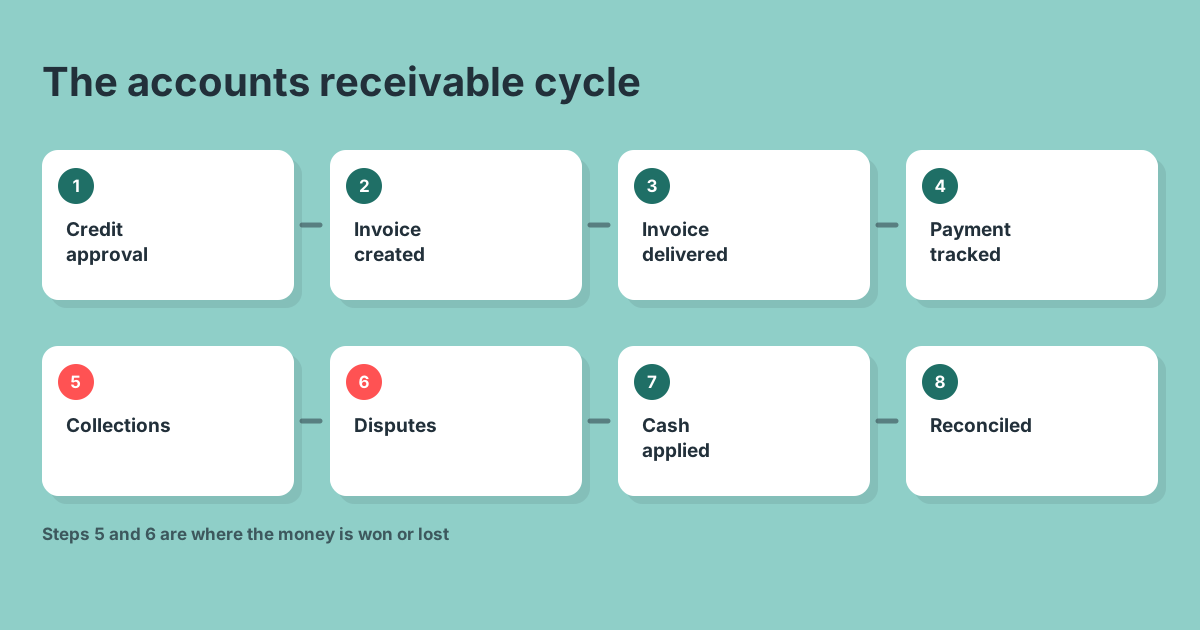
The accounts receivable process is the cycle that turns a delivered job into money in the bank: approve the credit, raise the invoice, deliver it, track the payment, chase what is late, resolve disputes, apply the cash, and reconcile. Eight steps. You will also see it written as five, and the disagreement is not sloppiness, it is a choice about how finely to split the chasing part. That choice matters, because the steps the short version folds together are the ones where the money is actually won or lost.
Key takeaways
No standards body defines the step count. Sage publishes five, HighRadius publishes eight. Both are defensible. Neither is official.
The average small business waits 29 days to be paid in the US and the UK. That is Xero Small Business Insights data, not an estimate, and it is roughly your payment terms plus eight days.
Three formulas measure the process: DSO for speed, CEI for collection effectiveness, ADD for the gap between the two.
What you can charge on a late invoice is not a policy choice, it is a legal one, and it differs completely between the UK, the US, Australia and New Zealand.
What the benchmark actually is
Almost every page on this subject quotes a DSO benchmark with no source behind it. There is a real one. Xero Small Business Insights publishes payment timing from anonymised small business invoice data, with a stated methodology and a monthly update.
Source: Xero Small Business Insights, June 2026. Time to be paid is measured from invoice issue to payment. We publish the full series, by country and industry, in our accounts receivable statistics.
Two numbers matter here. The first is how long payment takes in total. The second is how much of that is lateness rather than terms. A business on 30-day terms in the United States waiting 29.1 days is close to fine. The same business being paid 8.3 days late means its terms are not being respected, and that is the part a process can fix.
The eight steps
| # | Step | What decides whether it works |
|---|---|---|
| 1 | Credit approval | Whether you check at all before extending terms. Most small businesses do not |
| 2 | Invoice creation | Correct detail, correct contact, terms stated on the document |
| 3 | Invoice delivery | That it reaches a person who can pay it, not a generic inbox |
| 4 | Payment tracking | Knowing today, not at month end, what has gone past terms |
| 5 | Collections and follow-up | Whether chasing happens on a schedule or when somebody remembers |
| 6 | Dispute resolution | How fast a query is answered, because a disputed invoice ages while nobody owns it |
| 7 | Cash application | Matching receipts to invoices, including part payments |
| 8 | Reconciliation and reporting | The ledger agreeing to the bank, and someone reading the ageing. Part of the month-end close |
Why some sources say five steps
Sage publishes a five-step version: generate the invoice, deliver it, record the transaction, collect payment, reconcile. HighRadius publishes eight, adding credit approval, dispute resolution and cash application as separate steps.
Neither is wrong. The five-step version folds collections and dispute resolution into "collect payment" and treats credit approval as something that happened earlier. The eight-step version splits them out.
The reason to prefer the longer version is practical rather than academic. Steps 5 and 6 are where a process either exists or does not. If collections and disputes are one undifferentiated box labelled "chase it", nobody owns the difference between an invoice that is late and an invoice that is contested, and those need completely different handling.
The three formulas that measure it
Three numbers tell you whether the process works. Each has an exact formula, and each answers a different question.
| Metric | Formula | What it answers |
|---|---|---|
| DSO Days sales outstanding | (Accounts receivable / total credit sales) x number of days | How long, on average, money sits unpaid |
| CEI Collection effectiveness index | ((Beginning AR + credit sales - ending total AR) / (Beginning AR + credit sales - ending current AR)) x 100 | Of what you could have collected, how much you did |
| ADD Average days delinquent | DSO - best possible DSO, where best possible DSO = (current AR / billed revenue) x days in period | How much of your DSO is lateness rather than terms |
ADD is the one most people skip and the one that answers the question a client actually asks. A DSO of 45 days on 45-day terms is a business with slow terms. A DSO of 45 days on 30-day terms is a business with a collections problem. ADD separates the two, and it is the difference between advising a client to renegotiate terms and advising them to chase properly.
A word on benchmarks, because this subject is full of numbers with nothing behind them.
We went looking for a named, sampled, dated study behind the DSO and CEI benchmarks that circulate in this space. There is not one. The figures repeated across vendor content trace back to other vendor content. The same is true of the widely quoted claim that an invoice chased in the first week is 2.5 times more likely to be paid.
We have left those out. The Xero Small Business Insights figures above are published, dated and methodologically transparent, which is why they are the only benchmark on this page.
The escalation ladder
No professional body publishes a mandated chasing cadence. What follows is the pattern that recurs across credit management guidance, and the point is less the exact days than that the days are decided in advance rather than improvised.
| When | What goes out | Tone |
|---|---|---|
| 3 to 10 days before due | Pre-due reminder | Helpful. It is not late yet |
| Day 1 past due | First reminder | Neutral, assume an oversight |
| Day 7 to 21 | Firmer follow-up | Direct, name the amount and the terms |
| Day 21 to 30 | Formal notice | Formal, reference the agreement |
| Day 30 to 45 | Final warning | States what happens next, and means it |
| Day 45 to 60 | Referral or credit hold | Decision point, not another email |
The pre-due reminder is the step small businesses most often skip and the cheapest one to add. It is not chasing. It removes the most common excuse, which is that the invoice was never seen.
What you can legally charge, by market
This is the part that is genuinely different everywhere, and getting it wrong in either direction costs a client money. Charging what you are not entitled to damages a relationship. Not charging what you are entitled to is free money left behind.
| Market | Statutory right to charge interest | The detail that matters |
|---|---|---|
| United Kingdom | Yes, automatic | Bank of England base rate plus 8% under the Late Payment of Commercial Debts (Interest) Act 1998, currently 11.75%. Plus fixed compensation of £40, £70 or £100 by invoice size. It applies even if the contract says nothing |
| United States | No federal right for private B2B | Governed state by state through contract and usury law. The federal Prompt Payment Act covers agencies paying contractors, not private business |
| Australia | No | No statutory interest right and no mandated maximum term. The Payment Times Reporting Scheme makes large businesses disclose how fast they pay, which is transparency rather than a cap |
| New Zealand | No | Any right to charge interest has to come from your own terms of trade. If it is not in the agreement, it does not exist |
| European Union | Yes, under the Directive | Directive 2011/7/EU sets a 30-day default, extendable to 60 by agreement. The 2023 proposal for a hard 30-day cap stalled and is not law, despite being widely written about as though it were |
For a bookkeeper this has a practical consequence. In the UK, a client with unpaid commercial invoices is sitting on a statutory entitlement they probably have not claimed, set out in full in credit control procedures. In New Zealand, the same client has nothing unless their terms of trade say so, which makes fixing the terms the higher-value piece of advice.
Where Xero and QuickBooks leave off
Both ledgers hold the receivable and show you an ageing report. Neither runs the process.
Nothing in either platform fires when an invoice passes its due date. The Xero connection has no email tool at all, so anything sent has to be triggered by a person. That is the gap that either gets filled by somebody diarising a chase, or by accounts receivable automation that runs the ladder above on a schedule.
💡 Paidnice insight
The step most clients get wrong is 4, not 5. They do not have a collections problem so much as a visibility problem: nobody knows on the day an invoice goes past terms, so chasing starts a fortnight late and every subsequent step slides with it. Customers using Paidnice cut their average wait for payment in half within 30 days, and most of that comes from the ladder starting on time rather than from anything said in the emails.
Common questions
What is the accounts receivable process in simple terms?
It is everything between finishing the work and having the money: agreeing terms, invoicing, tracking what is owed, chasing what is late, settling disputes, and matching the payment when it arrives. Most small businesses do the first two well and the rest by memory.
What are the 5 C's of accounts receivable?
Character, capacity, capital, collateral and conditions. It is a banking framework for assessing credit, and it applies at step 1 of the process, before you extend terms rather than after an invoice goes unpaid.
What is the 10 rule for accounts receivable?
It is an informal credit practice, sometimes called cross-aging: if 10% or more of a customer's outstanding balance is overdue, commonly by 90 days or more, the whole account gets reclassified as high risk rather than just that invoice. Some credit teams use 25% instead. No accounting standard defines it, which is worth knowing before quoting it as a rule.
What is the best KPI for accounts receivable?
ADD, average days delinquent, for most small businesses. DSO is the better-known number but it moves when payment terms change, which makes it easy to misread. ADD isolates lateness, which is the part you can actually influence.
How long should it take to get paid?
Your terms, plus as little as possible. Xero Small Business Insights puts the average at 29.1 days in the United States and 29.3 in the United Kingdom, with businesses paid roughly 8 days late in both. Australia and New Zealand are faster, at 20.3 and 23.2 days.
More in The receivables process
The collections process: a ladder you set once and stop improvising
The escalation ladder, the tone at each rung, and how to separate a late invoice from a disputed one.
Credit control procedures: the UK process, and what the law gives you
The UK version: statutory interest at base plus 8%, fixed compensation, and the Fair Payment Code.
The month-end close checklist, and where the two platforms leave you
The full close task list, close timing that is actually realistic, and the close-tracking feature Xero does not have.