


Dunning is the process of methodically contacting customers to collect overdue payments, moving through escalating reminders, statements, and penalties until the invoice is paid or handed to collections.
The word is older than software. It goes back to the 17th century and the idea of persistently demanding what you are owed. In modern finance it just means the collection routine that sits between "invoice sent" and "invoice paid." You send a reminder. You send another. You add a late fee. You send a statement. Eventually, if nothing lands, the account is escalated.
Most small businesses already do a version of this by hand, badly, because it is nobody's favorite job. The value of naming it as a process is that a process can be written down, made consistent, and handed to software. Our own dictionary entry on dunning keeps the one-line definition. This page is the working manual behind it.
Search "dunning" and the results blur two worlds together. One is a finance team following up on a $9,000 invoice that is 20 days past its net-30 terms. The other is a subscription app whose customer's card just declined at renewal. Both are called dunning. Almost nothing else about them matches: the trigger, the actor, the channel, and the way it fails are all different.
If you run a B2B business on Xero or QuickBooks, you are almost always in the left column below. The card-retry playbook that dominates the SaaS blogs does not map to your situation, and following it will leave real money on the table.
| B2B invoice dunning | SaaS subscription dunning | |
|---|---|---|
| What you chase | A person to approve and pay an issued invoice | A failed card charge to retry successfully |
| Trigger | An invoice passes its due date | The payment processor declines a charge |
| Who takes the action | The customer (approves, queries, or pays) | The bank or card network (the retry clears) |
| Main channels | Email, SMS, statements, and phone calls | Automated card retries plus "update your card" emails |
| Tone that works | Firm, personal, aware of the relationship | System notifications, low-touch and transactional |
| How it fails | The account escalates to collections | The subscription cancels (involuntary churn) |
| Typical timeframe | Days to weeks, tracking net 14 or net 30 terms | Minutes to days, across a short retry schedule |
| Software that fits | AR automation on Xero or QuickBooks (Paidnice) | Billing and retry logic (Stripe Billing and similar) |
The rest of this guide is about the left column: getting a real customer to pay a real invoice, without wrecking the relationship in the process.
Stages are only useful if they map to timing and tone. Here is the ladder we see work most often for SMBs. The last rung is the one everyone dreads, which is exactly why the earlier rungs matter: run them consistently and most invoices never reach it.
A friendly heads-up that the invoice is coming up. Polite, no pressure, and it lifts on-time payment on its own.
Professional and understanding. Confirm they received the invoice and ask when payment will be sent.
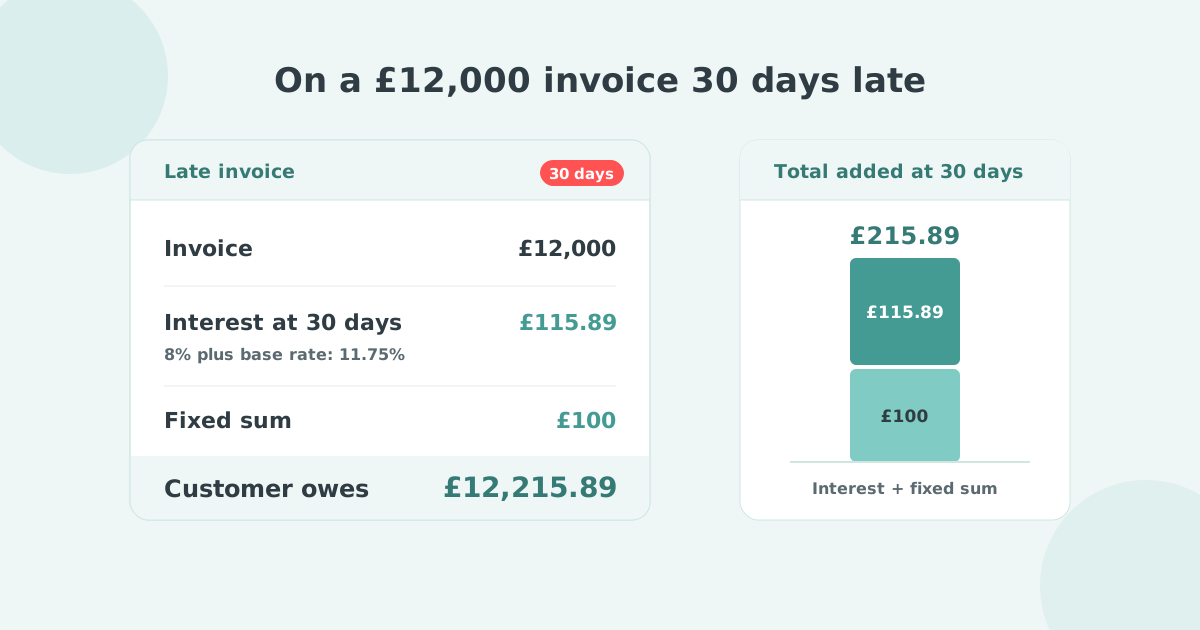
Direct but still polite. The late fee or interest lands here, and the email states it plainly.
Firm and next-step-focused. A clear deadline to pay before the account is escalated.
Final and factual, no threats. The account moves to a phone call, a payment plan offer, or a collections handoff.
If you want the timing and fee logic in more depth, we broke the full sequence down in the invoice escalation ladder. The principle is simple: the customer should always know what the next step is, and it should never come as a surprise.
The mistake most people make is writing every reminder in the same anxious tone, or worse, going straight to hostile. Match the tone to the stage. Here is a copy-paste library for the three rungs that do most of the work. Swap the bracketed fields for your own.
Subject: Invoice [#1234] from [Your Company]

Hi [First name],

A quick note that invoice [#1234] for [$ amount] was due on [date] and is now showing as unpaid on our side.

If it is already on its way, thank you and please ignore this. If not, could you let me know when we can expect payment?

You can pay online here: [payment link]

Thanks,
[Your name]
Subject: Invoice [#1234] is now overdue, late fee applied

Hi [First name],

Invoice [#1234] for [$ amount] is now [10] days overdue. In line with our payment terms, a late fee of [$ amount] has been applied, bringing the balance to [$ new total].

Please arrange payment at your earliest convenience: [payment link]

If something is holding this up, reply to this email and we will sort it out.

Thanks,
[Your name]
Subject: Final notice: invoice [#1234]

Hi [First name],

Invoice [#1234] for [$ total incl. fees] is now [21] days overdue. This is a final reminder before the account is escalated.

Please pay within 7 days to avoid escalation: [payment link]

If you would like to arrange a payment plan instead, let me know today and we can set one up.

Regards,
[Your name]
Need more variety so reminders never read like copies of each other? See our collection letter templates.
There is no magic count. What moves the needle is that a reminder goes out on schedule, every time, without someone having to remember to do it. When reminders are consistent, eight in ten invoices get paid on time, and the ones that slip rarely need the full ladder.
Sending more than five emails to a customer who is simply not paying is not persistence, it is noise. Past the final notice, a phone call or a payment plan offer usually does more than a sixth email. That is where a channel like SMS earns its place: at roughly $0.10 per message, a single text at the final-notice stage often gets a faster reply than another email in a crowded inbox.
Xero and QuickBooks can send a basic reminder, but they stop at the polite end of the ladder. They do not apply late fees or interest, they do not route VIPs differently from repeat late payers, and they do not escalate. That gap is what Paidnice fills. It sits on top of the ledger you already use, watches every invoice, and runs the full sequence: pre-due nudge, overdue notices, fees, statements, and escalation.
The routing is the part that keeps it fair. A long-standing customer who is two days late gets a gentle nudge. A serial late payer gets the full ladder and the late fee. You set the rules once, and the software follows them. Customers who switch this on cut their average wait for payment in half within 30 days, reduce overdue invoices by 70% in the first 30 days, and take up to 90% of the manual follow-up work off their team.
Here is the limit. Automated dunning will not save a relationship that is already broken over a genuine dispute. If a customer is withholding payment because a line item is wrong or the work is contested, more reminders make it worse, not better. Pause dunning on that account and route the dispute to a human. That is exactly why blunt "email everyone" dunning backfires, and why good escalation rules include a way to hold the sequence the moment a reply needs a person. The process stops the moment you hit send, so build in the off switch before you turn it on.
See how Paidnice automates dunning →
Dunning is the accounts receivable term for the routine you follow to collect an unpaid invoice: a sequence of reminders, statements, and penalties that gets firmer the longer the money is outstanding. The word predates software and simply means persistently asking for what you are owed.
A standard dunning process runs five stages: a pre-due reminder, a first overdue notice, a second notice with a late fee applied, a final notice, and escalation. Each stage gets firmer, and each one states the next concrete step so nothing comes as a surprise to the customer.
B2B invoice dunning chases a person to pay an issued invoice through reminders, fees, and statements. SaaS subscription dunning retries a failed card charge automatically to prevent involuntary churn. They share a name but differ in the trigger, who acts, the channels, and how they fail.
For most overdue invoices, three to five touches across three to four weeks is enough, because the majority are paid after the second or third reminder. The number matters less than sending each reminder on schedule and staying consistent.
Yes. You connect an AR tool to Xero or QuickBooks so it watches due dates, sends the reminder ladder, applies late fees, and escalates from your own email domain without manual work. Customers who automate it cut their average wait for payment in half within 30 days.
Paidnice is accounts receivable automation that enforces your payment terms, trusted by thousands of businesses on Xero and QuickBooks. Credit control and debtor management, run for you.
Try it Now - It's FreeNo card required.

Optimize your cash flow with our suite of financial tools designed for AR professionals. Calculate DSO, aging analysis, late fees, and more.