
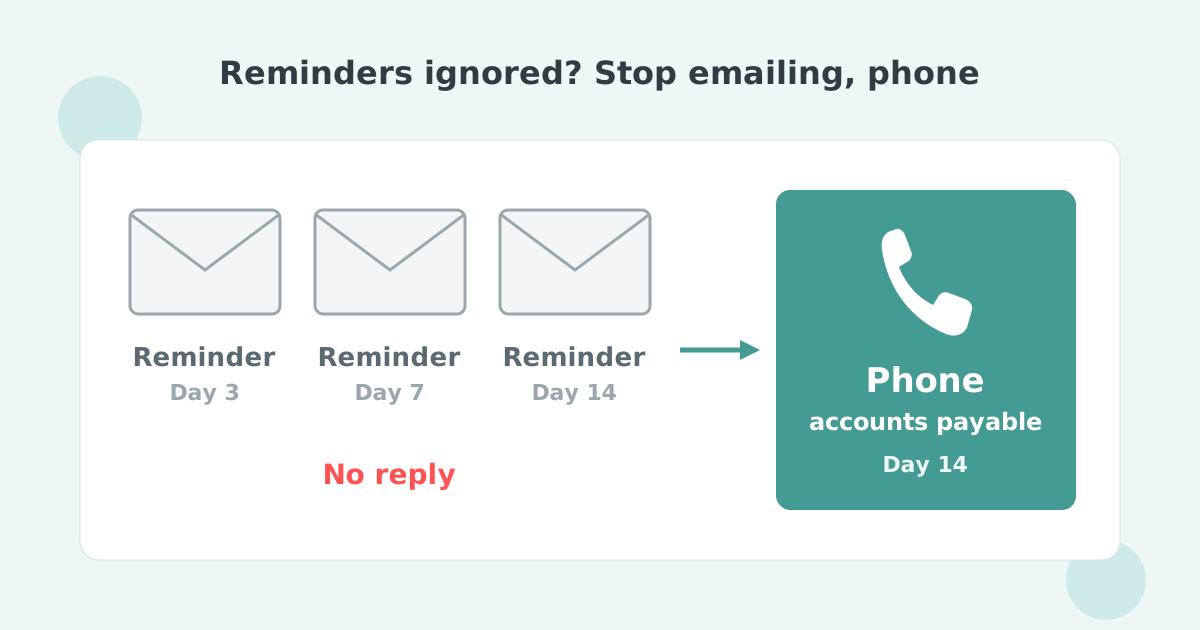

When a customer ignores your invoice reminders, stop sending more of the same. Check the invoice, phone accounts payable, then climb one rung at a time: final notice with the fee applied, letter of demand, then agency or court.
This page is the ladder, written for an Australian business owner first. The UK, New Zealand and US equivalents sit in the same table, because the rungs are the same everywhere and only the day-counts and the courts change. Every rung is dated and sourced. The letter templates live on their own pages and are linked from here.
Key takeaways
How do you politely remind someone of an outstanding invoice? Name the invoice number, amount and due date, ask if there is a problem with the invoice, and give a payment link. Keep it to three sentences. See email templates for invoice payment reminders.
Customers ignore reminders for three reasons: the reminder never reached the person who pays bills, there is a dispute nobody has raised, or your invoice has been ranked behind everyone else's. The first job is to find out which.
The Xero Small Business Insights data for the June 2026 quarter puts the average Australian small business at 22.9 days to be paid and 6.0 days late (Xero SBI, published 30 Jul 2026). A customer who is 30 days past due and silent is well outside that band. Before you escalate, rule out your own side.
If all four are clean, the customer has chosen not to pay yet. More reminder emails stop working at that point, and the ladder starts.
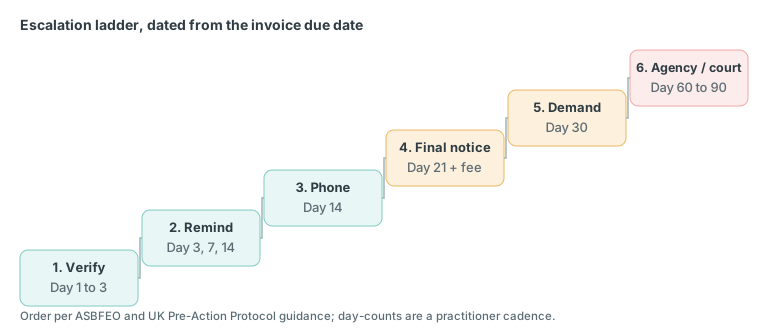
Six rungs, each with a day-count from the due date. The order is fixed across every official source. The day-counts are yours to set, and they belong in your payment terms.
| Rung | Day (from due) | Action | What it must contain |
|---|---|---|---|
| 1. Verify | Day 1 to 3 | Check the invoice, the contact and the send log | Nothing goes to the customer yet |
| 2. Remind | Day 3, 7, 14 | Reminder emails, escalating in tone, plus a statement | Invoice number, amount, due date, a payment link |
| 3. Phone | Day 14 | Call the accounts payable contact | One question: is there a reason this has not been paid? |
| 4. Final notice with fee | Day 21 | Written final notice; apply the late fee or interest your terms allow | The fee amount, the new balance, the date the next step happens |
| 5. Letter of demand | Day 30 | Formal demand on letterhead, posted and emailed | The debt, the deadline, the consequence (agency or court) |
| 6. Agency or court | Day 60 to 90 | Collection agency, or file in the small claims court for your market | The full follow-up history as evidence |
The cadence of four to six touches, at roughly 3, 7, 14 and 30 days overdue, is the most common one published by practitioners (BILL). The 60 to 90 day hand-off to an agency, after an ignored demand letter, is the consensus in collections guidance (Summit).
The official Australian guidance is ASBFEO's: friendly reminders, negotiation, letter of demand, then a collection service bound by the ACCC and ASIC guideline. NSW small claims go to the Local Court up to $20,000.
The Australian Small Business and Family Enterprise Ombudsman sets the order. If a debt is not recovered after friendly reminders, informal negotiation and a letter of demand, the business may engage a debt collection service, and must follow the consumer-law obligations published by the ACCC when it does (ASBFEO, Handling debts). ASBFEO's Dispute Support tool can also point you to low-cost mediation before any of that.
The conduct rules for the collection rung are the joint ACCC and ASIC Debt Collection Guideline, ASIC Regulatory Guide 96, republished 13 April 2021. It sets reasonable contact hours, methods and frequency, and bans harassment, coercion and misleading conduct (ASIC RG 96). It binds you as well as the agency.
If the customer still does not pay, the NSW Local Court Small Claims Division hears debt disputes up to $20,000. The standard filing fee is $179 for an individual or $358 for a corporation (NSW Local Court fees). In Victoria, general commercial debt recovery goes to the Magistrates' Court, not VCAT.
The limitation period for a simple contract debt is six years in NSW, Victoria and Queensland. In NSW and the ACT the clock does not restart once it has expired; in Victoria, Queensland, WA, SA and Tasmania a part-payment or written acknowledgement resets it (Sprintlaw).
Australian late fees are contractual
The UK has a statutory rate of 8% plus base rate. Australia's official guidance names none for a business debt, so a late fee or interest charge holds only where it is in the terms the customer agreed to. Put it in your terms before you need it. The detail is on late fees in Australia.
Debt recovery in Australia starts with the payment terms. The terms fix the due date, the late fee, the interest rate and the escalation steps, and every rung of the ladder above is only as strong as the clause that authorises it.
ASBFEO's own sequence (reminders, negotiation, letter of demand, agency) assumes those terms exist. Without a fee clause, rung 4 is an empty threat; without a recovery-costs clause, the agency's fee comes out of your margin. Four clauses do the work for a small business that sells on credit in Australia.
The letter of demand template covers rung 5 for Australia and New Zealand. Once the demand has been ignored, when to send an overdue invoice to a collection agency gives the day-count decision and the agency fee.
The rungs do not change. What changes is the statutory interest you can add, the letter the court expects before a claim, and the small-claims limit and fee.
| Market | Interest and fees you can add | Letter before court | Small claims limit and fee | Limitation period |
|---|---|---|---|---|
| Australia | Contractual only; must be in your terms | Letter of demand (ASBFEO) | NSW Local Court to $20,000; $179 individual, $358 corporation | 6 years (NSW, Vic, Qld) |
| United Kingdom | 8% + Bank of England base rate, plus £40 / £70 / £100 fixed sum, Late Payment of Commercial Debts (Interest) Act 1998 | Letter of Claim under the Pre-Action Protocol for Debt Claims; debtor gets 30 days | Small claims track to £10,000; fees £35 to £455 | 6 years, Limitation Act 1980 s5 |
| New Zealand | Contractual; Fair Trading Act 1986 bars misleading collection conduct | Letter of demand (standard practice) | Disputes Tribunal to $60,000 from 24 Jan 2026; $468 fee on the $30,001 to $60,000 tier, recoverable if you win | 6 years, Limitation Act 2010; restarts on part-payment or written acknowledgement |
| United States | Contractual; FDCPA covers consumer debt only | Demand letter (standard practice) | Varies by state: California $6,250 for businesses, Texas $20,000, New York $10,000 in NYC | 3 to 10 years by state for written contracts |
United Kingdom. Statutory interest at 8% plus the Bank of England base rate accrues automatically from the day after the due date, with no notice to the debtor required (Insolvency Service technical manual). Before court, the Pre-Action Protocol for Debt Claims requires a Letter of Claim by post with 30 days to respond (Ministry of Justice). The letter before action template covers it.
The Small Business Commissioner runs a free complaints service for small suppliers unpaid by larger customers, and stops once legal action starts (Small Business Commissioner).
New Zealand. The Disputes Tribunal's limit rose from $30,000 to $60,000 on 24 January 2026 (Ministry of Justice). The Commerce Commission's guidance says collectors should contact a debtor only when needed and for a reasonable purpose (Commerce Commission, June 2019). Fees are covered on late fees in New Zealand.
United States. The FDCPA and the CFPB's Regulation F (in force 30 Nov 2021) govern consumer debt collection only; a business debt is outside them (CFPB). Commercial agencies commonly charge 15% to 45% of what they recover (industry guide), and the limitation period runs 3 to 10 years by state for a written contract (Upsolve).
The final notice states the fee and the next date. The letter of demand states the debt, the deadline and the consequence. Neither threatens anything you will not do, and both are kept as evidence for the court.
The final notice (rung 4) is the last email in the reminder sequence and the first one that costs the customer money. It contains four things.
Enter the invoice, the days it is overdue and the fee your terms allow. The result is the balance the final notice should state.
The letter of demand (rung 5) goes on letterhead, by post and by email, with a fixed deadline: 30 days in the UK where the protocol requires it, commonly 7 to 14 days in Australia, and a similarly short window in New Zealand. The wording is on the letter of demand template and collection letter templates pages.
The earlier, softer emails are on email templates for invoice payment reminders. Keep copies of every message and the send log; they are the evidence for rung 6.
Insight from the Paidnice team
The letters that get paid are the ones with a fee already on the account. A demand for $4,800 gets filed; a statement showing $4,800 plus $96 in interest, and a note that interest is still running, gets a phone call. In our experience the fee is the leverage, and the letter is the notice of it.
Xero's native reminders cover rung 2 and stop. An accounts receivable app runs rungs 2 to 5 on a schedule: escalating reminders, SMS, statements, the fee on the ledger, and the hand-off task for the demand letter.
| Tool | Reminders | SMS | Scheduled statements | Late fee or interest | Escalation hand-off |
|---|---|---|---|---|---|
| Xero (native) | Up to 5 per organisation, one schedule for all contacts | No | No | No | No |
| QuickBooks Online (native) | Up to 3, email only, invoices already emailed | No | Advanced plan only | Automatic late fee with grace period, amount or percent; not retroactive | No |
| Paidnice | Escalating schedule per customer group | Yes | Yes, automatic | Late fee or statement interest on the ledger, draft or approved | Task at a set number of days overdue, assigned to a person |
Xero sends up to five reminder emails per organisation on one schedule, with no SMS, no scheduled statements and no fee (Xero Central). That is the reminder rung, done well, and nothing above it. QuickBooks Online is similar: up to three reminders, email only, though it can add an automatic late fee with a grace period (QuickBooks help).
Apps that sit on Xero and QuickBooks add the rest. Chaser adds email and SMS reminders and credit checks, from £199 a month (as at September 2026, verify current pricing).
Paidnice, from AUD 99 a month, runs rungs 2 to 5 from the ledger. The setup that matches the ladder above:
Customers using it cut their average wait for payment in half, within 30 days.
If you are weighing up the apps, credit control software is the comparison. The point for this page is simpler: an ignored reminder is a scheduling problem until rung 3, and a leverage problem from rung 4. Fix the schedule so the fee and the letter arrive on the dates your terms promised.
Paidnice is accounts receivable automation that enforces your payment terms, trusted by thousands of businesses on Xero and QuickBooks. Credit control and debtor management, run for you.
Try it Now - It's FreeNo card required.




Optimize your cash flow with our suite of financial tools designed for AR professionals. Calculate DSO, aging analysis, late fees, and more.