
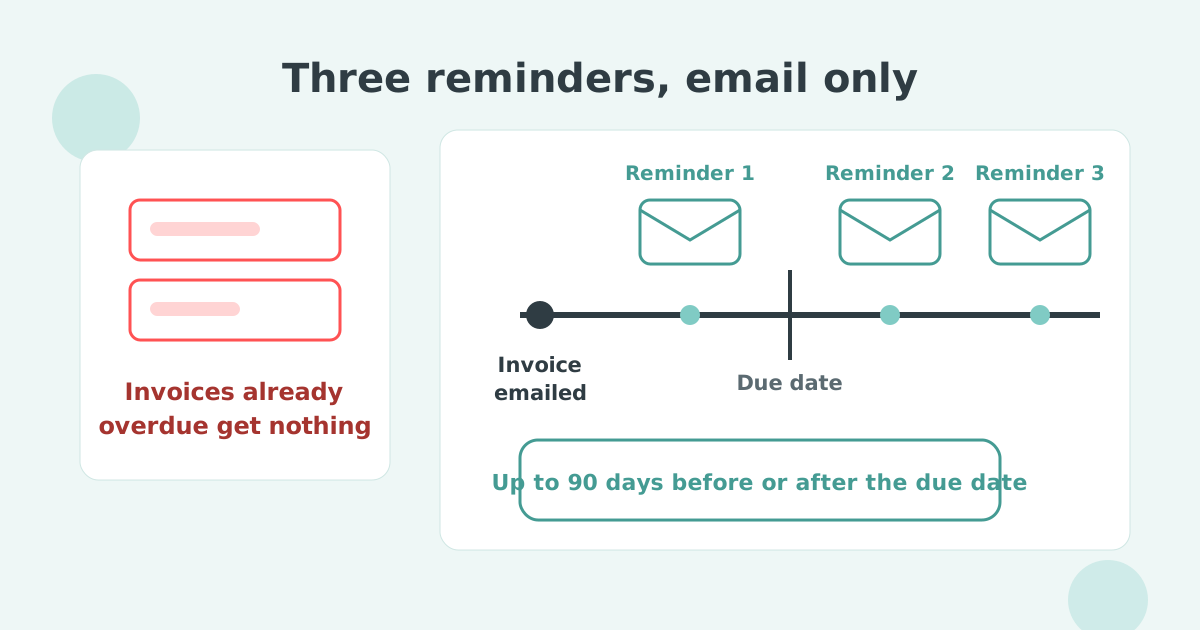

Yes, with limits. QuickBooks Online sends up to three automatic email reminders per invoice, up to 90 days before or after the due date. It only chases invoices emailed after the setting went on, cannot text, and sends no statements or payment plans.
This guide covers the native setup step by step, the limits on the settings page, the four gaps an office manager hits in the first month, and the connected apps that close each one. Every claim about QuickBooks Online below comes from Intuit's own help articles, linked where they are used.
QuickBooks Online chases overdue invoices with up to three automatic emails once you turn the feature on, but not invoices emailed before that moment. Paidnice picks up invoices already open when you connect.
The setup takes about five minutes. Every step below is from Intuit's help article Send invoice reminders automatically or manually (page dated August 5, 2026).
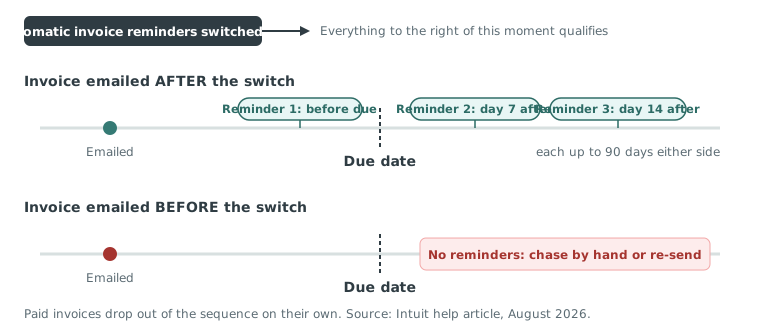
From that point, any invoice you email from QuickBooks Online that is still unpaid when a reminder's trigger day arrives gets the reminder. Paid invoices drop out of the sequence on their own. For a one-off nudge outside the schedule, open the invoice, use the Receive payment dropdown and choose Send reminder. That manual send is independent of the automatic sequence.
The automated reminders are a single, organization-wide email sequence: up to three messages, each with its own day count, subject and body, applied to every invoice you email from QuickBooks Online.
The table sets out what the settings page controls and what it does not. Two rows matter more than the rest: the single schedule and the retroactivity gap. Both are covered below the table.
| Setting | QuickBooks Online | Notes |
|---|---|---|
| Number of reminders | 3 | Xero allows 5 per Xero organisation, for comparison. |
| Timing window | Up to 90 days | Before or after the due date, per reminder. |
| Custom subject and message | Yes | Per reminder, with an optional PDF attachment. |
| Channel | Email only | No SMS option on the help article. |
| Applies to existing overdue invoices | No | Only invoices emailed after the toggle is on. |
| Different schedule per customer | No | One sequence for the whole organization. |
| Turn off for one customer | Unclear | Not documented on Intuit's core article. |
| Escalate to a named person | No | All three emails come from the same sender. |
QuickBooks Online Advanced adds workflows, which can create extra invoice reminders beyond the three-reminder setting (Intuit help).
The one-schedule problem. A customer who pays on day 28 every month and a customer who is 60 days late on three invoices get identical emails on identical days. There is no way to give the reliable payer a softer sequence, or the slow payer a harder one. The tone you write for the worst case lands on the best case too.
The retroactivity gap. This is the caveat that surfaces in several QuickBooks Community threads on the subject, and most guides skip it. Turn reminders on today and the invoices already overdue from last month are not enrolled. You still have to chase those by hand, or re-send them from QuickBooks so they qualify.
Re-sending an old invoice to enroll it in the reminder sequence may also change the "sent" date the customer sees; Intuit's article does not say. If you take that route, keep a note of the original send date in case the account ever goes to a collector.
The automatic payment reminders feature is the same three-reminder setting described above. QuickBooks Online has one reminder setting. The "Schedule Payment Reminders" tool in Intuit's help is a QuickBooks Desktop feature. Beside it sits a separate automatic late fee setting, which is also not retroactive.
People search for "payment reminders," "invoice reminders" and "overdue reminders" as though they were three features. In QuickBooks Online they are one. The three settings that actually exist on the Sales tab are:
For the late fee setting in detail, including what shows up on the customer's invoice, see Can I add a late fee in QuickBooks Online? and How to apply finance charges in QuickBooks Online. This page stays on reminders.
Three emails from the same address on a fixed schedule stop working when the customer has already decided to pay late. At that point the reminder needs a consequence attached, or a different person sending it.
The problem is large. Intuit's own 2026 Small Business Late Payments Report found that 59% of US small businesses have invoices overdue by 30 or more days, and the average business is owed $17,700 (Intuit QuickBooks, July 2026).
A polite email on day 7 and day 14 handles the customer who forgot. It does nothing for the customer who is managing their own cash flow by stretching yours. For that customer, four things move the invoice up their payment run:
QuickBooks Online does the first only on Advanced, the second without retroactivity or escalation, and the third and fourth not at all. That is the gap the app store fills.
Accounts receivable apps in the QuickBooks App Store replace the three-email sequence with per-customer schedules, SMS, scheduled statements, late fees with leverage and payment plans. Paidnice also picks up invoices already open at connection.
The table compares four apps QuickBooks Online users in the US commonly weigh against each other, with what each adds on top of the native setting. Prices are as at September 2026; verify current pricing. Where a row says "Not published," the vendor does not state the capability publicly and no evidence was found either way.
| Capability | QuickBooks Online native | Chaser | Upflow | Kolleno | Paidnice |
|---|---|---|---|---|---|
| Reminder sequence | 3 emails (Advanced: workflows) | Multi-step schedule | Multi-step workflow | Multi-step workflow | Multi-step schedule |
| Different schedule per customer group | No | Yes | Yes | Yes | Yes |
| SMS reminders | No | Yes | Yes | Yes | Yes ($0.10 each) |
| Statements on a schedule | Advanced only | Not covered in this comparison | Not published | Portal only | Yes |
| Late fees and interest | Not retroactive | Not covered in this comparison | Via ERP only | No evidence found | Yes (per group, on the ledger) |
| Payment plans | No | Not covered in this comparison | No | Yes | Yes (Stripe) |
| Credit checks | No | Yes | Scoring only | Yes | No |
| Pricing model | Included | Turnover-based, from £199/mo, entry tier to £4m turnover | Quote by gross invoice value, unlimited seats; Payments add-on $390/mo | €650 per user/mo (€545 annual) | Invoice-based, from $69/mo, no per-seat fees |
| Built for | Any QBO user | Larger businesses with a credit team | AR teams wanting analytics | AR teams wanting cash application | Companies without an AR team |
A short read of each, in the order they appear above:
We built the first version of Paidnice in 2022 to apply late fees, because the native reminder toggles in Xero and QuickBooks Online were where most small businesses stopped. The pattern we see is consistent: three polite emails, then someone in the office starts phoning. Customers cut their average wait for payment in half, within 30 days.
Stay on the native three reminders while your overdue list fits on one screen and every invoice was sent after you turned reminders on. Add an app when the same customers keep reappearing, or when someone is chasing by hand after the third email.
| Your situation | Stay native | Add an app |
|---|---|---|
| Fewer than about five overdue invoices at a time | Yes | |
| Same customers late every month | Yes, per-group schedules | |
| Older invoices already overdue when you switched reminders on | Re-send them manually | Paidnice picks up open invoices at connection |
| Customers ask for one statement, not ten emails | Advanced plan | Yes |
| You want the late fee to actually get paid | Yes, fee on the ledger | |
| A large balance needs splitting into installments | Yes | |
| You need credit checks before you sell | Chaser or Kolleno |
Whatever you choose, get the emails delivered first. Reminders that land in spam never happened as far as the customer is concerned; see Why are my QuickBooks emails going to spam? before adding volume.
If you decide to go beyond email, SMS payment reminders for QuickBooks covers the second channel, and How to set up a payment plan in QuickBooks Online covers the split-balance case. For the wider tool comparison, credit control software compared by turnover, seats and cost sets the options side by side.
The questions that come up most on the QuickBooks Community and in support threads, answered from Intuit's own documentation.
How do I turn off invoice reminders in QuickBooks Online?
Settings > Account and settings > Sales > Reminders > edit, then switch off Automatic invoice reminders and save. The whole sequence stops. Turning it off for a single customer is not documented on Intuit's core article.
How do I send a reminder for an invoice manually?
Open the invoice, select the Receive payment dropdown, choose Send reminder. This works whether or not automatic reminders are on.
How do I see which reminders have gone out?
Sent reminders appear in the invoice's activity; Intuit's article does not describe the log in more detail.
Do reminders go out on weekends?
The schedule is by day count, with no weekday setting documented on the help article, so assume a reminder can send on any day.
Will reminders apply to invoices I created before turning them on?
No. Only invoices emailed from QuickBooks after the setting is on qualify. Re-send the older invoices, chase them manually, or connect Paidnice, which picks up invoices already open at connection.
Paidnice is accounts receivable automation that enforces your payment terms, trusted by thousands of businesses on Xero and QuickBooks. Credit control and debtor management, run for you.
Try it Now - It's FreeNo card required.


Optimize your cash flow with our suite of financial tools designed for AR professionals. Calculate DSO, aging analysis, late fees, and more.