Summary
Kolleno vs Upflow comes down to breadth against analytics. Kolleno is a per-user order-to-cash platform from $650 a user a month, covering reconciliation, disputes and credit risk above $1m turnover. Upflow is quote-only by gross invoice value band, with Starter at $333 in its own page data, and leads on AR analytics. Neither computes late fees or statutory interest natively.
- Paidnice: Best for businesses up to $50m a year on Xero or QuickBooks Online that want late fees and UK statutory interest applied automatically, from $69 (£49) a month, priced by invoice volume.
- Kolleno: Best for finance teams above $10m turnover that want receivables, payments, reconciliation and dispute handling in one platform, from $650 per user a month, or two Business Plus seats at $1,245 each.
- Upflow: Best for scaling B2B SaaS teams that manage by AR analytics such as countback DSO and cohort forecasting; price on request by gross invoice value band, with Starter at $333 in its page data.
Kolleno is an AI order-to-cash platform from London, founded in 2020. It puts collections, payments, cash application and credit risk in one system, and its reconciliation covers BAI2, NACHA and ISO 20022 bank files plus NetSuite foreign-exchange journals. Published plans start at USD 650 per user a month, above $1m turnover.
Upflow is an accounts receivable platform founded in Paris in 2018, headquartered in New York. It syncs invoices from Xero, QuickBooks Online, NetSuite, Sage Intacct, Stripe Billing and Chargebee, then runs reminder workflows and the stronger analytics of the pair: countback DSO, collection effectiveness, at-risk rate and cohort forecasting. Upflow's pricing page is quote only, though its structured data lists Starter at $333 and Grow at $833 a month.
How much do Kolleno and Upflow cost?
Kolleno suits finance teams above $10m turnover that want reconciliation in the same platform; Upflow suits analytics-led teams that accept a quote. Kolleno costs USD 650 per user a month on BusinessPay, a price it publishes. Upflow's pricing page is quote only, though its structured data lists Starter at $333 and Grow at $833 a month; the last published list prices were $440 and $880.
Kolleno: BusinessPay USD 650 per user a month, or USD 545 per user a month billed annually. Business Plus USD 1,245 per user a month, or USD 995 billed annually, two seats minimum. Enterprise tiers are quoted, and integrations, customisations and add-ons can carry extra charges.
Two things get reported wrongly. The vendor publishes dollar figures on a page that renders local currency, so a pound amount quoted at parity is likely a conversion. And per-user pricing compounds: two Business Plus seats cost USD 2,490 a month at the monthly rate, or USD 23,880 a year on the annual rate.
The $440 and $880 figures were the last published list prices for Grow and Scale, recorded in third-party pricing captures, TrustRadius among them. Upflow removed dollar figures from its visible pricing page between mid-2024 and 2026, so confirm any amount with sales before you budget.
Upflow's pricing FAQ mentions a free Discover plan, but it is not among the plan cards; it covers analytics only and carries no collection automation, so you cannot chase an invoice on it.
 $650Kolleno BusinessPay, per user per month, above $1m turnover
 Quote onlyUpflow, by gross invoice value band; its page data lists Starter $333 and Grow $833, last published $440 and $880
 $69Paidnice Essentials per month (£49), no per-seat fee
What is the difference between Kolleno and Upflow?
Kolleno is a broad, reconciliation-led order-to-cash platform and Upflow is a narrow, analytics-led receivables tool. Every feature difference below follows from that split.
Kolleno bundles receivables, payments, reconciliation, credit risk and e-invoicing, with three AI layers in every subscription: insights, a copilot that drafts messages for review, and an agent that runs policy-based collections. Its reconciliation library runs to 36 help articles.
Kolleno also classifies disputes and deductions by reason code and ranks them for the collector, which is the part of collections a reminder tool leaves alone. Its published case studies name Deel, Miro, 1Password and Rakuten, which is the size of finance function it is built around.
Kolleno also runs workflows at the invoice level as well as the customer level, so a single disputed invoice can be paused without touching the rest of that customer's chase sequence.
Upflow does not create invoices. It syncs them, hosts them on a branded portal, and runs workflows of emails, SMS, letters, calls and tasks. What it does better is measurement: countback DSO against best possible DSO, collection effectiveness, at-risk rate over 90 days, cohort forecasting.
They part company on instalments. Kolleno splits balances weekly, monthly or bi-monthly; Upflow offers partial payments and promises to pay, with no instalment plan.
One average hides a wide range. Xero Small Business Insights breaks Australian payment times down by industry.
| Industry | Time to be paid |
|---|---|
| Mining | 31.3 days |
| Public Administration and Safety | 29.3 days |
| Manufacturing | 29.2 days |
| All industries | 20.3 days |
| Health Care and Social Assistance | 12.0 days |
| Accommodation and Food Services | 8.3 days |
Source: Xero Small Business Insights, June 2026. See the full data on the Paidnice accounts receivable statistics dashboard.
A ledger spanning that range needs more than one schedule.
Which business size fits Kolleno vs Upflow?
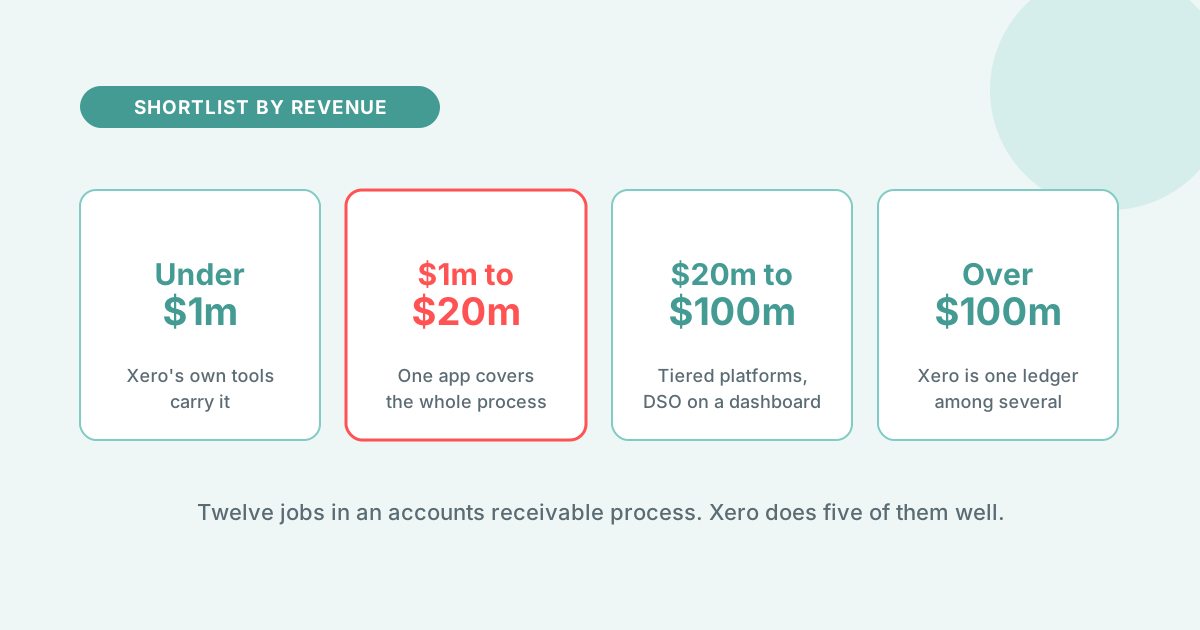
Kolleno needs above $1m turnover and gates automation at $10m with two seats. Upflow publishes no floor and quotes every plan by gross invoice value band, starting with Starter at up to $10m.
| Kolleno tier | What it adds | Seats | Turnover floor |
|---|---|---|---|
| BusinessPay | Portal, payment links, collections inbox | 1 | $1m |
| Business Plus | Auto-reconciliation, workflows, reporting, AI Agent support | 2 | $10m |
| Enterprise | NetSuite, SAP, Oracle, Business Central, multi-entity, 400 SMS or calls | 2 | $100m |
| Enterprise Plus | Custom ERP work, 24/7 support, dedicated CSM, 600 SMS or calls | 4 | $1bn |
The second row is the one that matters. Workflows, auto-reconciliation and reporting sit on Business Plus, so the realistic entry point for a business that wants automation is two Business Plus seats above $10m turnover, not one BusinessPay seat above $1m.
Upflow bands its plans by annual gross invoice value instead: Starter up to $10m, Grow up to $25m, Scale up to $50m, Accelerate up to $100m and Entreprise above that. No minimum is published, so a smaller company can open a conversation, but every tier is quoted by sales.
How do Kolleno, Upflow and Paidnice compare?
Kolleno, Upflow and Paidnice differ most on revenue fit, pricing model, seat minimums and late fees. The table also covers send frequency, ledger depth and ratings.
| Capability | Kolleno | Upflow | Paidnice |
|---|---|---|---|
| Best for | Reconciliation and disputes at scale, above $10m | AR analytics for scaling B2B SaaS teams | Late fees, interest and reminders on Xero or QuickBooks Online |
| Size fit | Above $1m turnover; above $10m for workflows | Gross invoice value bands: up to $10m, $25m, $50m, $100m, then above | Any size up to $50m a year, or 50,000 invoices a year |
| Price from | USD 650 per user (USD 545 billed annually) | Quote only; page data lists Starter USD 333, Grow USD 833 (last published USD 440, USD 880) | USD 69 / GBP 49 (Essentials, 150 invoices; Pro from USD 99) |
| Pricing model | Per user | By revenue band, quoted | Flat, by invoice volume |
| Seat minimum | ❌ 1 on BusinessPay, 2 on Business Plus | Not published | ✅ None; 2 users on Essentials, unlimited on Pro |
| Ledgers and ERPs | NetSuite, SAP, Sage Intacct, Dynamics 365, Workday, Oracle, Xero, QuickBooks Online | NetSuite, Sage Intacct, Xero, QuickBooks Online, Stripe Billing, Chargebee, Zuora | Xero, QuickBooks Online (NetSuite, Sage Intacct, MYOB, Dynamics 365 on Custom) |
| Late fees and interest | ❌ No evidence found | ❌ Via ERP only; no native computation | ✅ Invoice late fees and statement interest, Bank of England base rate auto-indexed |
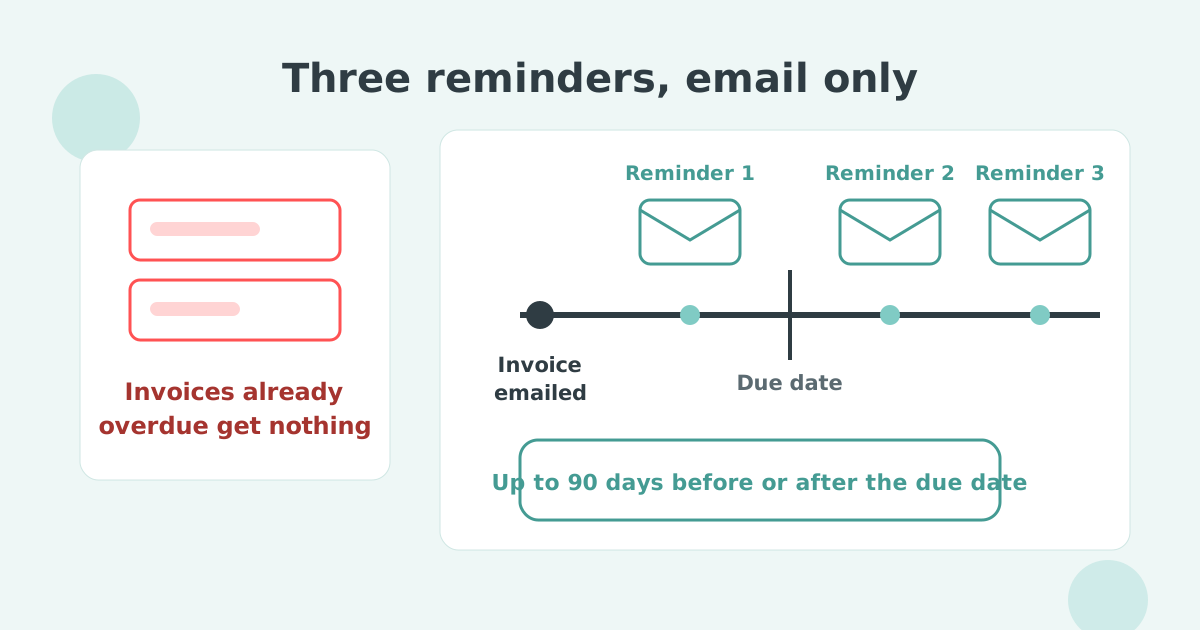
| Automation sending | Trigger-based workflows with run-hour limits; letters and calls are not workflow actions | Once daily at a fixed org-level time, business days only | Per policy and customer group, with an action time on each policy |
| Free tier or trial | ❌ None published | ⚠️ FAQ mentions a free Discover plan, not a listed plan card; analytics only, no collection automation | ✅ No time-limited trial; sign-up is free and the first 20 actions are free, no card |
| Rating |  4.9 from 99 (G2, 17 Jun 2026) 4.9 from 99 (G2, 17 Jun 2026) | 4.8 from 233 (G2, 3 Jun 2026) |  5.0 from 82 (Xero App Store, 20 Aug 2026) 5.0 from 82 (Xero App Store, 20 Aug 2026) |
Do Kolleno or Upflow compute late fees and statutory interest?
Neither Kolleno nor Upflow computes late fees or statutory interest natively. Upflow documents applying late payment fees through NetSuite, and we found no late fee or interest feature in Kolleno's product or help materials.
This matters most in the UK. Under the Late Payment of Commercial Debts (Interest) Act 1998 a business can charge the Bank of England base rate plus 8% a year, plus fixed compensation of £40, £70 or £100 by debt size.
The statutory rate is fixed in six-month blocks, taking the base rate in force at the end of December and the end of June, so a tool that does not track it cannot apply the correct rate across a long-overdue invoice. On this evidence, interest in either tool is ledger work. Our guide to the dunning process places fees in the escalation ladder.
How deep do Kolleno and Upflow go on Xero, QuickBooks Online and NetSuite?
Kolleno and Upflow both list Xero and QuickBooks Online, but Kolleno's depth sits on NetSuite and bank files and Upflow's QuickBooks Online sync is one-way. The gap shows up as reconciliation you do by hand.
Upflow polls QuickBooks Online every five minutes with no webhooks, payments land in Undeposited Funds, and custom fields cap at three, text only. Kolleno invests in BAI2, NACHA and ISO 20022 bank files, SFTP, match scoring and NetSuite multi-currency journals. If Xero is your ledger, our comparison of credit control software for Xero covers that end.
Kolleno vs Upflow review: who rates higher?
Kolleno rates 4.9 from 99 G2 reviews (latest 17 June 2026) and Upflow rates 4.8 from 233 (latest 3 June 2026), so Upflow's sample is more than twice the size.
Kolleno reviewers praise collections speed and support; the recurring criticisms are navigation, reporting they want more customisable, and a basic mobile app. Upflow reviewers praise setup speed, integrations and named account managers; the recurring criticisms are rigid reporting when slicing data, email cosmetics, and not being able to select several invoices at once.
Where does each of the three run out?
Kolleno, Upflow and Paidnice each have one limit that rules them out for some buyers. This section names it for all three, ours included.
Kolleno

The limitation. Per-user pricing with a turnover floor, and the tier carrying workflows and reporting needs two seats above $10m. We found no late fee or interest feature. Reconciliation depth points at NetSuite rather than Xero or QuickBooks Online.
Upflow

The limitation. Every tier is quote only on the visible pricing page, with Starter at $333 only in its structured data, so budgeting means a sales call. No native late fee computation and no instalment plans. Statement generation is not documented. Automatic actions fire once a day at a fixed time, business days only, and your own SMTP disables open and click tracking.
Paidnice

The limitation. No bank-file cash application, so no BAI2, NACHA or ISO 20022 matching and no remittance parsing. Credit bureau checks run through Creditsafe on Custom only. Upflow reports on more metrics, countback DSO against best possible DSO among them. Standard plans run on Xero and QuickBooks Online only. The AI Credit Controller is in beta, and every message needs human approval before it sends.
Which should you choose: Kolleno, Upflow or Paidnice?
Choose Kolleno for reconciliation at scale, Upflow for AR analytics, and Paidnice for late fees, interest and reminders on Xero or QuickBooks Online up to $50m a year.
Choose Kolleno if you match thousands of payments from bank files, handle disputes and deductions, and sit above $10m turnover with budget for two Business Plus seats.
Choose Upflow if you run B2B SaaS billing on NetSuite, Chargebee or Zuora, your board reads countback DSO, and you accept quote-only pricing by gross invoice value band.
Choose Paidnice if you run Xero or QuickBooks Online up to $50m a year and customers pay late, from $69 (£49) a month.
How Paidnice applies fees and interest
Paidnice runs late fees, statement interest, reminders, statements and payment plans on your Xero or QuickBooks Online ledger, from USD 69 (GBP 49) a month with no per-seat fee.
Essentials covers 150 invoices a month. A business sending 300 to 600 invoices a month sits on Pro, from USD 99 to USD 179 a month, still with no per-seat fee.
Paidnice is accounts receivable automation that enforces your payment terms, covering credit control and debtor management on your ledger. It is built for Xero and QuickBooks Online, priced fairly, with no contracts or lock-ins, and it is perfect for finance teams doing up to $50m a year needing a robust accounts receivable system.
Two charge types run on the same customer group. An invoice late fee is charged per overdue invoice. A statement interest charge is charged per customer against the whole overdue balance, with a Bank of England base rate toggle that applies the correct base rate for each period an invoice spans. UK compensation of £40, £70 or £100 is applied as a fixed line item with its own income account.
Interest compounds by default, and simple interest is the setting you turn on deliberately. Accrued interest recalculates when a statement is sent, so the figure the customer opens is accurate that morning. The fee posts to the ledger as a Draft or Approved invoice, which is what puts it into your customer's payables system.
$1 billion collected on time across more than 1 million invoices since 2022.
Customers cut their average wait for payment in half, within 30 days. Paidnice won New Zealand Small Business App of the Year at the Xero Global App Awards 2026, and holds 5.0 from 83 Xero App Store reviews.

💡 Paidnice insight
Ask which half of the problem you have before you shortlist. Hard-to-match payments need a cash application engine. Customers who pay late need fees and interest posted on the ledger. An order-to-cash platform solves the matching half; the chasing half still runs on your reminder schedule.
For a wider field, our Kolleno alternatives guide and Upflow alternatives guide rank five tools each, and the accounts receivable software page covers the category.
What else do people ask about Kolleno vs Upflow?
Searchers add reviews, cost and free trials to the Kolleno vs Upflow comparison most often, in both directions.
Kolleno vs Upflow review: which one do reviewers rate higher?
Kolleno rates marginally higher at 4.9 from 99 G2 reviews against Upflow's 4.8 from 233. A 0.1 difference between scores is noise. The review counts are the more useful signal, and Upflow has been reviewed at more than twice Kolleno's volume.
Kolleno vs Upflow cost: what does each one charge?
Kolleno publishes USD 650 per user a month on BusinessPay, or USD 545 per user a month billed annually, and USD 1,245 per user on Business Plus with two seats. Upflow's pricing page is quote only, though its structured data lists Starter at $333 and Grow at $833 a month; the last published list prices were $440 on Grow and $880 on Scale.
Upflow vs Kolleno reviews: how many are there on each platform?
G2 carries 233 Upflow reviews at 4.8 and 99 Kolleno reviews at 4.9. Capterra carries 15 Upflow reviews at 4.5 and 8 Kolleno reviews at 5.0. The Xero App Store UK carries 18 Kolleno reviews at 5.0.
Upflow vs Kolleno cost: which is cheaper for a business under $10m?
Kolleno's automation tier needs above $10m turnover and two seats. Upflow's Starter band is quoted privately, with $333 a month as the floor in its own page data. Under $10m on Xero or QuickBooks Online, Paidnice publishes $69 a month (£49).
Is there a free trial for Kolleno or Upflow?
Neither Kolleno nor Upflow publishes a free trial. Upflow's pricing FAQ mentions a free Discover plan, but it is not among the plan cards; it is analytics only, with no automated chasing. Paidnice has no time-limited trial; sign-up is free and self-serve on Xero or QuickBooks Online, and the first 20 actions are free with no card.

Stop chasing invoices.
Start getting paid.
Paidnice is accounts receivable automation that enforces your payment terms, trusted by thousands of businesses on Xero and QuickBooks. Credit control and debtor management, run for you.
Try it Now - It's FreeNo card required.