
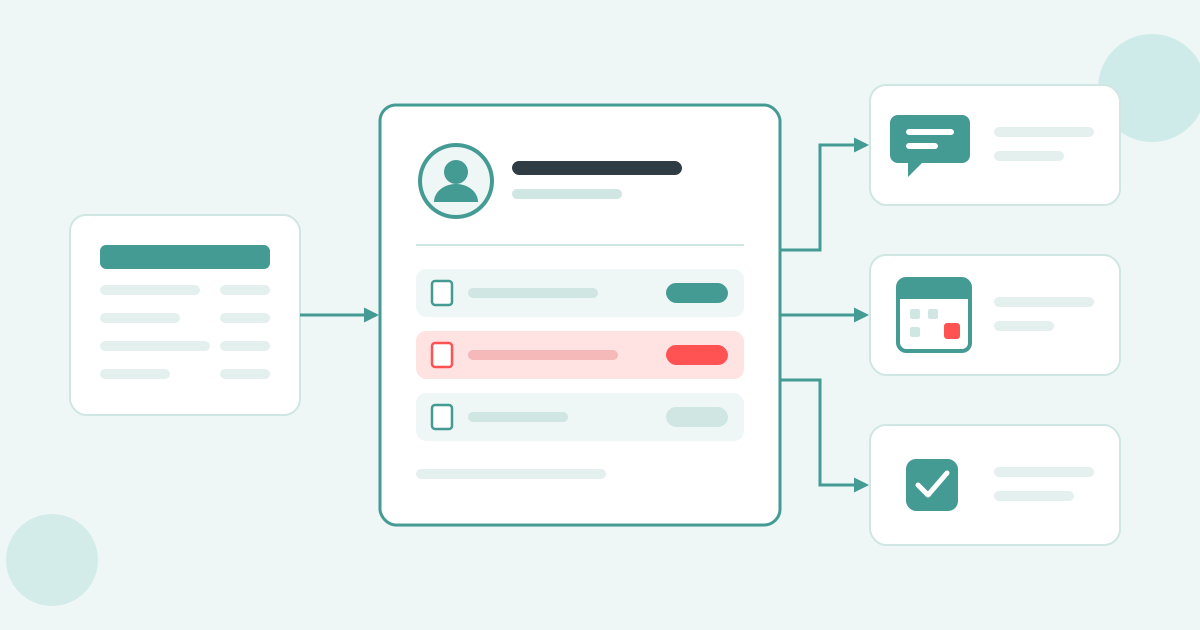

An accounts receivable CRM is software that holds each customer's open invoices, payment history, notes and follow-up tasks in one record, so a finance team can collect on time and apply its terms the same way to everyone.
You may see the same idea called a CRM for accounts receivable or a collections CRM. In a B2B finance team, all three names mean a customer record built around what the customer owes.
It is a customer record for the finance team. It reads invoices from the accounting system and adds payment behavior, contacts, conversations, promises to pay and the next action for each account.
The accounting system records that an invoice exists and if it is paid. It does not record that the customer's payables contact changed last month, that they promised payment on the 14th, or that one invoice is in dispute. That knowledge usually sits in one person's inbox.
An accounts receivable CRM puts that knowledge against the customer and the invoice. It also does the routine work: reminders, statements, late fees and tasks for the people who must make a call. Read how financial relationship management compares with accounts receivable automation if the category names are unclear.
A sales CRM tracks deals before the invoice. An accounts receivable CRM tracks the customer after the invoice. The users, the data and the goal are all different.
| Sales CRM | Accounts receivable CRM | |
|---|---|---|
| Core user | Sales and account managers | Finance and credit control |
| Data it holds | Leads, deals, pipeline | Invoices, balances, payment history |
| Source of truth | The CRM itself | The accounting ledger |
| Goal | Win the sale | Get the invoice paid on time |
| Payment terms | Not applied | Applied by rule |
Agency debt-collection software is a different product. It is built for collection agencies that work debts owed to other companies. A B2B accounts receivable CRM is for a business that collects its own invoices from its own customers and keeps the relationship.
It should cover six jobs: sync with the ledger, score payment behavior, record every conversation, automate routine follow-up, assign tasks to people, and report the results.
Test seven things: the ledger connection, how terms are enforced, customer segmentation, approval controls, the team workflow, the link to your sales CRM, and how the price grows.
The tool should read invoices and payments automatically and write back what it creates, such as a late fee invoice or a note. Ask what happens at connection. A tool that ignores invoices that were already open on day one leaves your oldest debt outside the system.
Some tools only send reminders. Your payment terms have leverage only when the consequence is applied each time. Look for late fees and interest that apply automatically and can be waived deliberately, plus statements and escalation that run by rule. Paidnice treats the enforcement of terms as a fifth part of financial relationship management. The general definition does not include it.
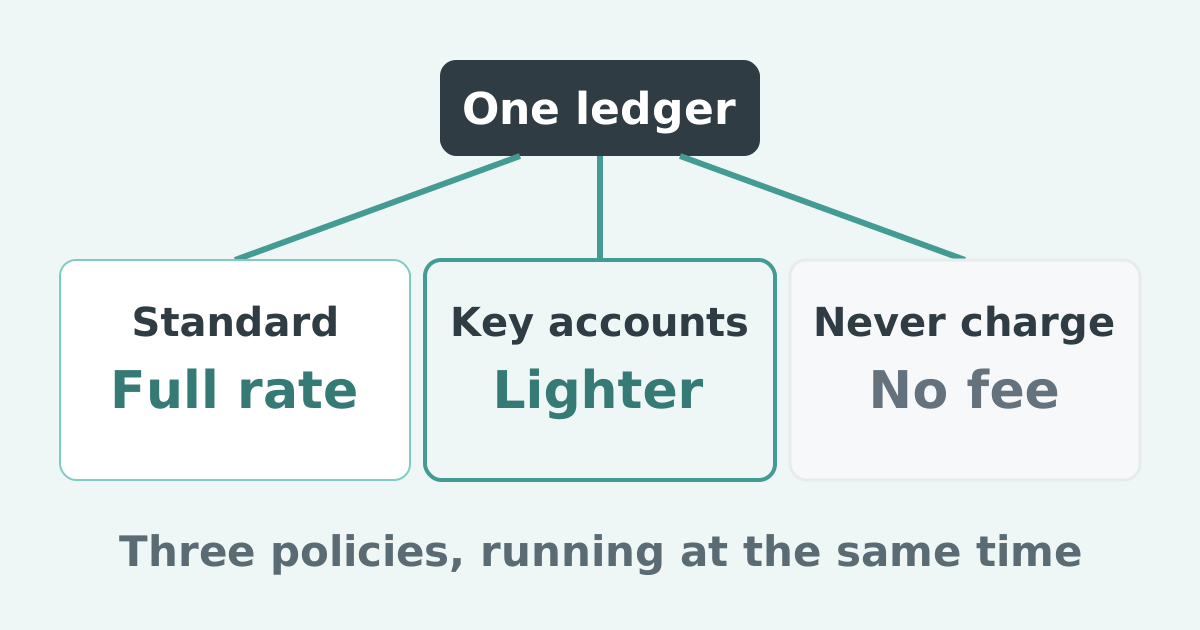
A key account and a slow-paying one-off buyer should not receive the same sequence. Check that you can put customers in groups, run a different policy for each group, and take one disputed invoice out of a policy without switching the policy off for the whole customer.
Ask if a person can approve actions before they send, and if the tool shows every message sent and who sent it. Customer replies should be visible in the same place as the invoice.
Look for assigned owners, escalation tasks assigned to a person, mention notifications, and alerts to Slack or Microsoft Teams. Check the user pricing too. A per-seat fee discourages you from giving sales and operations the access they need.
The simplest reliable method is BCC logging. Each reminder is copied to the logging address of HubSpot, Pipedrive or Salesforce, and the message appears on the customer's timeline. The customer does not see the BCC address.
Some vendors price by your annual revenue, some by user, some by invoice volume. Pricing by invoice volume matches the work the software does. Ask about contract length and the cost of the next tier before you start.
For a longer checklist with questions to ask each vendor, read how to pick a financial relationship management system.
Track days sales outstanding (DSO) and the collection effectiveness index (CEI). DSO shows how long you wait for payment. CEI shows how much of the collectable money you collected.
DSO = (accounts receivable ÷ credit sales in the period) × days in the period.
Example: $120,000 of receivables and $300,000 of credit sales in a 90-day quarter gives (120,000 ÷ 300,000) × 90 = 36 days. A lower number is better. Compare DSO with your payment terms. If your terms are 30 days and DSO is 52, customers take 22 days of free credit.
CEI = (opening receivables + credit sales − closing total receivables) ÷ (opening receivables + credit sales − closing current receivables) × 100.
Example: opening receivables $100,000, credit sales $300,000, closing total receivables $120,000, of which $90,000 is not yet due. CEI = (400,000 − 120,000) ÷ (400,000 − 90,000) × 100 = 90.3%. A result near 100% means you collected almost all the money that was due in the period.
DSO moves when sales move, so a strong sales month can hide slow collections. CEI is not affected in that way. Read the two together, and add aging buckets and on-time payment rate for detail. A tool with accounts receivable reporting built in shows these numbers without manual work.
Credit management has two jobs: deciding who gets credit, and managing the credit you have given. An accounts receivable CRM does the second job and supplies evidence for the first.
The payment history in the CRM shows how a customer behaves with you. A bureau report shows how they behave with others. You can use the two together. For the software that covers limits, holds and follow-up, see credit management software. If you charge for late payment, a late fee manager runs the policy: who is charged, who is exempt and what was collected.
A collections CRM in a B2B business is an accounts receivable CRM. It works beside your sales CRM and your accounting software, and replaces neither.
In a B2B business it is another name for an accounts receivable CRM: software for collecting your own invoices from your own customers. It is different from the debt-collection software that agencies use to work debts for other companies.
Only in part. A sales CRM can show an invoice status through an integration. It does not apply payment terms, send statements, add late fees or calculate DSO. Most teams keep the sales CRM and connect an accounts receivable tool to it.
They are the five tests a lender or supplier uses before giving credit.
An accounts receivable CRM gives you first-hand data on character, because it records how each customer pays you.
No. The ledger stays the source of truth for invoices, payments and tax. The accounts receivable CRM connects to it, for example to a Xero organisation or a QuickBooks Online company, and does the collection work. Accounts receivable automation explains that work in full.
Paidnice is accounts receivable automation that enforces your payment terms, trusted by thousands of businesses on Xero and QuickBooks. Credit control and debtor management, run for you.
Try it Now - It's FreeNo card required.
Optimize your cash flow with our suite of financial tools designed for AR professionals. Calculate DSO, aging analysis, late fees, and more.