


Summary
A credit policy is the written set of rules for who gets credit, how much, on what terms, and what happens when an invoice goes unpaid. A small business version is ten sections on two pages.
- Ten sections: Purpose, who approves, application and checks, limits and review, terms, collection steps, late fees, holds, disputes, and write-offs.
- The gap most skip: Name the person who can pull a customer out of the collection process, and the person who approves a write-off.
- In Paidnice: Terms, reminders, late fees, credit limits and escalations run as rules in Paidnice on your Xero or QuickBooks invoices.
A new customer asks for Net 30 on a $12,000 first order. The person who said yes last time is on leave, and nobody can find what was agreed. Dun & Bradstreet notes that not every company writes its credit policy down. Here is what a written one looks like, section by section, with a template you can fill in today.
What is a credit policy?
A credit policy is a written set of rules for deciding which customers get credit, the payment terms, the limit on what they can owe, and what happens when they pay late.
A credit policy webinar hosted by the National Association of Credit Management defines it as guidelines that spell out which customers get credit, the exact payment terms, the limits on outstanding balances, and how to deal with delinquent accounts. The same deck draws a useful line: a policy says what you do, procedures say how.
Free: Payment reminder email templatesCopy the reminder emails for before, on and after the due date.Four parts recur in almost every version:
- Credit evaluation: credit scores, financial statements, background checks.
- Terms of sale: Net 30 or Net 60, late interest, early-payment discounts.
- Credit limits: how much each customer can owe at once.
- Collection process: what happens to overdue invoices and disputes, and when an outside collector steps in.
Policies are described as loose, tight, flexible, or no-credit, shorthand for how much risk you take on to win sales. The sales credit policy entry in our dictionary covers the definition in more depth. A credit policy here means a company's written rules for extending credit to customers. It is not a trade credit insurance policy, which is a separate product.
A credit policy is not the same as a credit limit or a credit application. The limit is one number inside the policy, and the application is the form that feeds it. Both get their own sections below.
What should a credit policy include?
A small business credit policy needs ten sections: purpose, who approves credit, application and checks, limits and review, payment terms, collection steps, late fees and interest, credit holds, disputes, and write-offs.
The CICM, the UK's credit management body, lists what each part should answer: who does the risk assessment and when, how a limit is set and how often it is reviewed, how stopping supply works, and the trigger points for escalation. It also names two decisions that are easy to leave out: who may remove a customer from the standard collection process, and who approves a bad debt write-off.
Those two lines are the override rights. Without them, the salesperson and the owner both have a say and nobody has the final one. Put a name against each decision.
On the collection side, NACM's collections policy outline covers when to contact a customer and how, when to place an account on hold, how disputes are resolved, when to hand over to an outside collector, and when to write off to bad debt. That is the order your collection section should follow.
Three components get their own guides: the credit application form a new customer completes before you extend terms, the five Cs of credit for reading what comes back, and setting a credit limit, the arithmetic that turns the application into a number.
Shorter terms are the cheapest line in the policy to change. In Paidnice data, the same customer pays a 14-day invoice 9 days sooner than a 30-day invoice, with no rise in unpaid invoices (22,761 customers). If your terms section says Net 30 by habit, test Net 14 on new accounts.
What does a small business credit policy template look like?
The template below is the whole policy on one page: ten sections with fill-in fields, ready to copy into a document or download as a Word file, free to download, no sign-up.
Type into the shaded fields first. The download and print copies use what you typed, or the bracketed example if a field is blank.
Credit policy
Ten sections. Who gets credit, how much, on what terms, and what happens when an invoice is late.
1Purpose and scope
This policy applies to all sales on credit by . Its purpose is to extend credit to customers who pay on time and collect every invoice on the terms agreed. Reviewed on .
2Who approves credit
approves credit up to . approves anything above that. Approval is recorded before the first invoice on terms.
3Application and checks
Every new credit customer completes a credit application. We check first.
4Credit limits and review
Each customer has a credit limit set by . Limits are reviewed every months, sooner if payment behavior changes.
5Payment terms and methods
Standard terms are from invoice date. Accepted methods: . Early payment discount: .
6Collection steps
Reminder days before due, then at days overdue. Call at days. Formal letter at . Outside collector at .
7Late fees and interest
Overdue invoices carry after a grace period of days, as stated in our terms.
8Credit hold
Supply stops when an account is days overdue or over its limit. is the only person who can lift a hold or pull a customer out of the collection steps above.
9Disputes and queries
A disputed invoice is logged the day it is raised and answered within working days. Collection pauses on that invoice only.
10Write-offs
An invoice is written off after days and every step above. approves every write-off in writing.
Bracketed values are examples. Put a name or role against every approval, hold and write-off line before you adopt the policy.
Bracketed numbers are examples. Section 8 is covered in full in when to put a customer on credit hold. Dun & Bradstreet suggests reviewing the policy ideally once a year, so section 1 carries a date.
How do late fees and interest work in a credit policy?
A late fee or interest charge only holds up if it is written into your terms before the sale, and the rate you can charge depends on the country you trade in.
In the US, state law and your contract set what you can charge, so write the fee into your terms of trade and check your state's rules before you set a figure.
In the UK, the Late Payment of Commercial Debts (Interest) Act 1998 makes it an implied term that a qualifying business debt carries simple interest. GOV.UK puts the statutory rate at 8% plus the Bank of England base rate, unless your contract sets a different rate. The Act adds a fixed sum per debt: £40 under £1,000, £70 from £1,000 to under £10,000, £100 at £10,000 or more.
If your UK policy sets its own rate, section 8 of the Act voids any term that excludes statutory interest unless the contract gives a substantial remedy for late payment. A Commercial Payments Bill is also before Parliament; the government's outline proposes maximum payment terms of 60 days. It is not law, so write your policy to the 1998 Act.
In Australia, write the rate and the grace period into your terms and conditions, and agree them before the first invoice.
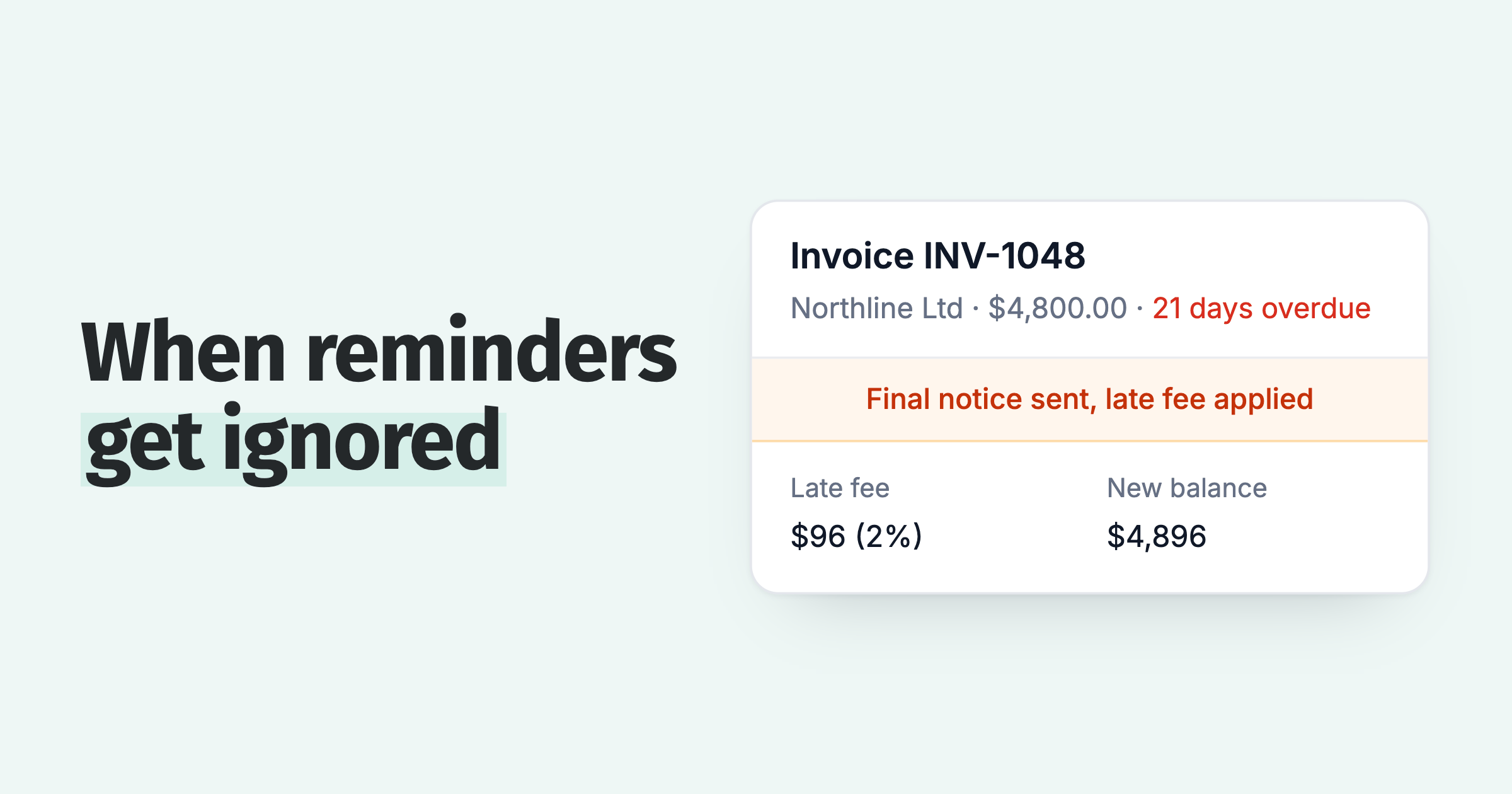
Charging the fee changes behavior. In Paidnice data, businesses that apply their first late fee see on-time payment rise 3.3 points more than similar businesses that do not charge (229 businesses against a matched 143). Section 7 is worth filling in.
How does Paidnice run a credit policy for you?
Paidnice turns the policy into rules that run in Paidnice on your Xero or QuickBooks invoices: terms, reminders, late fees, credit limits and escalations.
Each numbered section of the template above maps to a setting:
- Sections 5 and 6: customers sit in groups, and each group runs its own reminder and late fee policies, so new accounts, good payers and slow payers each get the steps you wrote down. Tags handle the exceptions inside a group.
- Section 7: an invoice late fee per overdue invoice, or interest on the whole overdue balance, with a grace period. In the UK the Bank of England base rate toggle applies base plus your percent, and a fixed line item carries the £40, £70 or £100 sum.
- Sections 4 and 8: every customer has a 0 to 100 credit score built from how they pay you, a credit limit you set, and an escalation that fires when the limit is breached. Paidnice raises a Stop Credit escalation for the named person in section 8, and that person decides and lifts any hold. Paidnice places no hold in the ledger.
- Section 3: the credit score runs on every plan, and credit checks through Creditsafe are available on the Custom plan.
The fee itself posts to Xero or QuickBooks as a draft or approved invoice, so it sits in the customer's payables rather than in a note. The credit score, limits and Stop Credit escalation are set out on the credit scoring page. Reminders and fees live under email and SMS reminders and late fees and interest.
Questions about credit policies
Write the policy once, name the person behind each decision, and put the rules where invoices are issued so they apply every time.
What are the types of credit policy?
Loose, tight, flexible and no-credit. A loose policy extends terms to most customers to win sales, a tight one limits terms to proven payers, a flexible one sits between the two and adjusts by customer, and a no-credit policy takes payment up front.
Who approves credit and who can override the policy?
Name a role for each level: one person approves up to a set amount, a second person approves above it. Then name the one person who can lift a hold or pull a customer out of the collection steps. If that line is blank, the loudest voice in the room decides.
How does a credit policy change collections?
The collection steps stop being a judgment call. A reminder goes at 7 days because the policy says so, and a call happens at 21 days because the policy assigns it. The customer learns the pattern.
How is a credit policy different from a credit limit or a credit application?
The policy is the rule book. The credit limit is one number the rule book produces for each customer. The credit application is the form that collects the information the limit is based on.
What is a trade credit policy?
The same document, written by a supplier that sells on terms. Trade credit is the goods-now, pay-later arrangement the policy governs.
What makes a good credit policy?
A good credit policy is written down, names the person behind each decision, sets one limit and one set of terms per customer, and is reviewed once a year. It runs where invoices are issued, so the rules apply every time.
About the editorial team
Denym started Paidnice in 2022 after customers paying late left his own business short on payroll. He has led it to $1 billion collected on time across more than 1 million invoices, and writes about credit control, late fees and getting paid on Xero and QuickBooks.


 App of the Year